
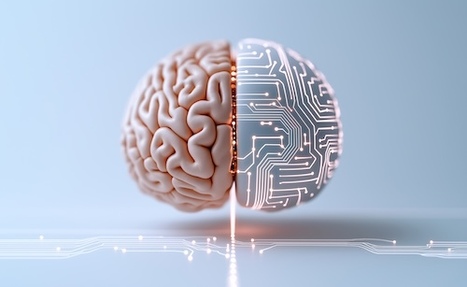
AI computers come equipped with Neural Processing Units (NPUs) that make capable of operating AI models locally, which is key for privacy in the school setting.
Get Started for FREE
Sign up with Facebook Sign up with X
I don't have a Facebook or a X account


|
Scooped by
EDTECH@UTRGV
onto Educational Technology News Today, 1:38 PM
|
 Scoop.it!
AI computers come equipped with Neural Processing Units (NPUs) that make capable of operating AI models locally, which is key for privacy in the school setting.

 Your new post is loading...
 Your new post is loading...
Your new post is loading...
Scoop.it!
Watch this video to learn more about the fully online, accelerated, project-based Master of Education in Educational Technology at the University of Texas Rio Grande Valley. For more information, visit: https://www.utrgv.edu/edtech/index.htm
EDTECH@UTRGV's insight:
This 30-hour accelerated program designed to prepare persons in K-12, higher education, corporate, and military settings to develop the skills and knowledge necessary for the classrooms and boardrooms of tomorrow. Students in this program have the opportunity to earn one or more graduate certificates in E-Learning, Technology Leadership, and Online Instructional Design.

harrietwatkins's curator insight,
August 24, 2024 10:34 PM
This is a fantastic program! Its practical, real-world based and applicable to many areas of industry where teaching and learning, training and development are used.

Katlego Mofokeng's curator insight,
May 19, 3:46 PM
Using technology in education proves affective in helping students/ learners accelerate their learning progress.
Scoop.it!
AI computers come equipped with Neural Processing Units (NPUs) that make capable of operating AI models locally, which is key for privacy in the school setting.
EDTECH@UTRGV's insight:
"The presence of an NPU gives AI PCs the ability to run AI models locally without connecting to the internet or cloud and ups the overall performance of a computer"
Scoop.it!

"Greg sits in the library, hunched over his computer. He racks his brain while pondering his thesis statement for his final paper of the semester. This is a subject he’s been researching for months for this class. Greg knows this subject like the back of his hand, but he just can’t get the wording right, and it’s driving him crazy. So he asks ChatGPT. ChatGPT proceeds to spit out a perfectly worded paragraph for his thesis, not a single error in sight. He copies and pastes it without a second thought."
EDTECH@UTRGV's insight:
"Although AI seems to have largely negative implications for College, there is still hope for higher education in the hands of the current and growing generations."
Scoop.it!
From
uxdesign

"Digital wellness is a strange concept when you think about it. Our phones track how much we use them, present this data as evidence of failure, and then leave us alone with our guilt never really addressing why we reached for them in the first place or offering constructive suggestions for improvement."
EDTECH@UTRGV's insight:
"Digital wellness, to truly live up to its name, should feel more like an environment that supports the user, rather than just a dashboard that informs."
Scoop.it!

A cohort of young, environmentally conscious people labelled ‘AI vegans’ is leading the charge against ChatGPT and other forms of generative AI.
EDTECH@UTRGV's insight:
"Bella is one of a growing number of ‘AI vegans’, a new name for those choosing to abstain from all generative AI, systems that are trained on vast data sets to create text, images, music and more."
Scoop.it!

Explore how AI is transforming academic publishing—from writing and peer review to ethics and editorial judgment—and how scholars can adapt responsibly.
EDTECH@UTRGV's insight:
"[I]s AI disrupting traditional publishing models, or is it fostering a natural evolution within the academic enterprise?"
Scoop.it!

A teacher-turned-architect talks about the value of renovating old schools for today’s learners.
Scoop.it!

"There is a new “cliff” in American higher education, and it is not the demographic cliff. Rather, it is the dramatic cliff in math knowledge, skills and abilities. Let me be clear that other discipline deficiencies are found in this new generation of college students, however they are dwarfed by those in math."
EDTECH@UTRGV's insight:
AI can personalize learning by identifying each learner’s specific skill gaps and delivering adaptive, targeted instruction and ongoing assessments to support mastery.
Scoop.it!

In "Metaphors We Live By," Lakoff and Johnson emphasise that metaphors are fundamental to human thought and language, not just decorative language. In this post, I've examined my own use of metaphors to describe AI and analysed their implications, highlighting the power and limitations of these metaphors in shaping our understanding of AI and its impact.
EDTECH@UTRGV's insight:
"Many of our metaphors for AI treat it as a tangible, physical thing. This helps us grasp something inherently abstract and complex."
Scoop.it!

Last weekend, a university student reached out and asked me, “How can I learn more about AI?”
EDTECH@UTRGV's insight:
"If your institution treats AI like a novelty, a side elective, a fun toy, or something to rebel against instead of the operating system that is reshaping the global economy, then they are training you for a world that already disappeared."
Scoop.it!

By studying AI-generated characters such as Tilly Norwood, educators can empower students to navigate and shape a world in which technology and storytelling intersect.
EDTECH@UTRGV's insight:
"Is authenticity defined by humanity or by emotional connection? What makes a performance believable or moving?"
Scoop.it!

Learn how the NEST framework helps educators create nurturing, trusting online classrooms that support student success, confidence, and engagement.
EDTECH@UTRGV's insight:
"In online nursing education, a “nest” is more than a metaphor—it is a learning environment where students feel safe, supported, and guided as they prepare to enter professional practice."
Scoop.it!

AI is transforming software engineering through automated coding, smarter debugging, and faster release cycles, so teams can boost productivity while maintaining responsible, human-in-the-loop oversight.
EDTECH@UTRGV's insight:
"Understanding the potential impact of future trends, including AI’s role in software architecture design and decision-making, will lend insights into how the engineer’s role will shift from manual coding to strategic oversight and innovation facilitation."
|
Scoop.it!
Durable skills are critical for success in college and beyond--and laying a strong foundation for these skills in K-12 learning is essential.
EDTECH@UTRGV's insight:
"As AI increasingly automates technical tasks across industries, students’ long-term career success will rely less on technical skills alone and more on durable skills or professional skills, often referred to as soft skills."
Scoop.it!

"The integration of Artificial Intelligence (AI) into higher education has ignited a fervent debate across campuses worldwide. Far from being a fleeting trend, AI presents a fundamental paradigm shift, challenging traditional pedagogical approaches, redefining academic integrity, and promising to reshape the very essence of a college degree."
EDTECH@UTRGV's insight:
"AI is poised to either revolutionize higher education for the better or fundamentally undermine its foundational principles, making the decisions made today crucial for generations to come."
Scoop.it!

From
vocal
Explore the top 10 education trends that will change education forever. Read about how AI classrooms, lifelong learning, and other trends are changing education.
EDTECH@UTRGV's insight:
"The future of education is no longer just classrooms and textbooks—it is innovation, personal learning, and learning that prepares learners for an ever-increasingly rapid pace of change."
Scoop.it!
"This year’s senior class is the first to have spent nearly its entire college career in the age of generative AI, a type of artificial intelligence that can create new content, like text and images. As the technology improves, it's harder to distinguish from human work, and it’s shaking academia to its core."
Scoop.it!

Discover practical strategies to design a meaningful course ending that reinforces learning, fosters reflection, and builds student confidence and closure.
EDTECH@UTRGV's insight:
"Far too often, the end of a course is treated as an administrative period, marked by the collection of assignments, preparation for tests, and course evaluations. However, research and teaching practice suggest that this stretch can—and should—be much more."
Scoop.it!

While most higher education leaders focus on AI's operational benefits — and rightfully so — the deeper transformation lies in how artificial intelligence is fundamentally reshaping what it means to learn, teach, and lead in the 21st century.
EDTECH@UTRGV's insight:
"The question isn't just whether institutions can keep pace operationally; the real challenge is whether we can maintain academic rigor and cultivate critical thinking in an AI-enhanced world while fostering the leadership culture necessary for sustainable transformation."
Scoop.it!

AI literacy goes beyond coding or data science--it means understanding how artificial intelligence functions and how it can be guided.
EDTECH@UTRGV's insight:
"The future of employability depends not only on what students know, but on how well they collaborate with intelligent systems."
Scoop.it!
From
uxdesign
"Through stories about silicon prosthetics, immigrant workers, visually impaired children, and many others, we see the full spectrum of user needs. Design becomes stronger when we widen participation and reduce the assumptions that limit our work."
EDTECH@UTRGV's insight:
Patricia Moore’s empathy-driven approach to universal design—shaped by many different user experiences—demonstrates that design improves when we include more voices and question our assumptions.
Scoop.it!

Starting with where/how to put “AI in Education” seems to start backwards.
EDTECH@UTRGV's insight:
"77% of recent grads say they learned more in six months on the job than in their entire 4-year degree."
Scoop.it!

Pedagogy that prioritizes persistence for adult learners is not just good teaching--it’s a commitment to equity, access, and education.
EDTECH@UTRGV's insight:
"Colleges often talk about retention rates, but for adult learners, persistence is deeply personal. Every week, my students face the question: Do I have the energy, time, and confidence to keep going?"
Scoop.it!

Conversations With Kevin Hogan: Julia Fallon, Executive Director, and Ji Soo Song, Director of Projects and Initiatives at SETDA, explain how districts can tap Title II-A funds to provide professional learning for educators.
EDTECH@UTRGV's insight:
"[T]eachers increasingly have access to technology but lack the time, resources, and training to integrate it effectively into their instruction."
Scoop.it!

Educators worldwide are reexamining how creativity can be taught in an age when artificial intelligence (AI) tools are able to generate essays, images and designs in seconds.
EDTECH@UTRGV's insight:
"True creativity is more than the final output. It involves trial and error, critical thinking, reflection, and even failure."
Scoop.it!

"Students are not just undermining their ability to learn, but to someday lead."
EDTECH@UTRGV's insight:
"I set out this semester to look more carefully for AI work. Some of it is quite easy to notice... But there is a difference between recognizing AI use and proving its use. So I tried an experiment."
|








"The presence of an NPU gives AI PCs the ability to run AI models locally without connecting to the internet or cloud and ups the overall performance of a computer"