

It's not just students, more professors are using AI in the classroom. But they say more guidance is needed on how to use the technology.


|
Scooped by
EDTECH@UTRGV
onto Educational Technology News October 16, 2025 10:38 AM
|
 Scoop.it!
It's not just students, more professors are using AI in the classroom. But they say more guidance is needed on how to use the technology.


 Your new post is loading...
 Your new post is loading...
Your new post is loading...
Scoop.it!
|
|
|
Scooped by
EDTECH@UTRGV
Today, 12:59 PM
|
Scoop.it!
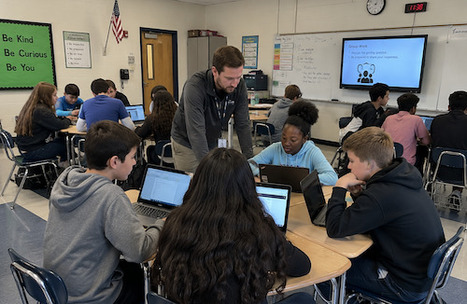
AI should never replace teachers in collaboration or expertise, but should shine a light on the insights that spark deeper conversations.
"AI is becoming more adept at eliminating the cumbersome, lower-level administrative tasks associated with compiling data and summarizing assessments, giving educators more time to focus on meaningful collaboration and develop richer conversations to better inform instruction."
|
|
Scooped by
EDTECH@UTRGV
Today, 12:55 PM
|
Scoop.it!

"When students and educators think of asynchronous courses, they envision something akin to a correspondence course, lacking an available professor with disengaged students struggling to understand assignments in isolation, all within a disconnected learning environment. This type of course structure has the potential to leave students with high levels of stress and anxiety, feelings of apathy, and an overabundance of reading materials, without the requisite expertise to guide them through the learning process."
"One particular challenge of asynchronous learning is managing the isolation felt by students due to the lack of real-time interactions with classmates and the instructor."
|
|
Scooped by
EDTECH@UTRGV
Today, 12:48 PM
|
Scoop.it!
This is the percentage drop in brain activity measured among participants in an MIT Media Lab study who used ChatGPT, compared to those who wrote without AI assistance. This is not a philosophical finding. It is a neurological one, recorded via EEG, from the actual brainwaves of real people while they worked.
"There is a paradox at the heart of everyday AI use, and it is worth naming clearly: the better you get at using AI, the easier it becomes to stop thinking."
|
|
Scooped by
EDTECH@UTRGV
Today, 12:43 PM
|
Scoop.it!
"Some K-12 teachers say they are using AI on the job, but around eight in ten say they've received no formal guidance on applying the tools their work"
"AI tools are reshaping the classroom and students' critical thinking — but school leaders are lagging on giving teachers formal guidance for using the tech, a new report shows."
|
|
Scooped by
EDTECH@UTRGV
May 26, 10:59 AM
|
Scoop.it!

Cybersecurity ranks as the No. 1 priority for education technology leaders in the United States, according to the latest State of Ed Tech report from CoSN, yet insufficient cybersecurity staffing and the lack of a dedicated budget are key barriers.
"Budget constraints remain the top implementation challenge: Districts reported risks to classroom technology modernization, devices, cybersecurity, software licenses, and IT staffing after the end of emergency funding programs such as ESSER."
|
|
Scooped by
EDTECH@UTRGV
May 26, 10:55 AM
|
Scoop.it!

An analog classroom is not the way forward—but we should be rethinking higher ed’s approach to ed tech. I, like many of you, was caught off guard by the massive Canvas outage, caused by a group of hackers who demanded that Instructure pay a ransom to avert the disclosure of millions of users’ personal data. The outage could not have happened at a worse time, as instructors were evaluating final exams and assignments, calculating final grades, and gearing up for summer online courses.
"What troubled me through much of the dialogue, however, was a hard and fast turn against all technology and a commitment to return to a more or less fully analog classroom when we’re back in the fall."
|
|
Scooped by
EDTECH@UTRGV
May 26, 10:51 AM
|
Scoop.it!

Higher costs and longer lead times mean K–12 districts must pivot their device strategy. The most successful districts are acting now.
"The rise in costs and manufacturing times for computers, tablets and other devices can be attributed to the explosive growth of AI and the massive need for data infrastructure growth it has ignited."
|
|
Scooped by
EDTECH@UTRGV
May 26, 10:47 AM
|
Scoop.it!
"Thoughtful, age-appropriate approaches can equip students with skills needed to effectively use the technology, says ISTE+ASCD’s Jessica Garner."
"To boost students’ artificial intelligence literacy, experts suggest using a curricular rather than technological lens, integrating the tech into the classroom offline with younger children, ensuring everyone knows how it works, and making sure students in particular know that chatbots are not people."
|
|
Scooped by
EDTECH@UTRGV
May 25, 11:05 AM
|
Scoop.it!

AI is associated with rising productivity expectations and changes to early career tasks, and is exposing gaps in workforce training.
"As organizations trade long-term talent development for short-term efficiency, they may risk weakening the talent pipeline that generates the on-the-job learning and experience needed for early career professionals to become future subject-matter experts and leaders."
|
|
Scooped by
EDTECH@UTRGV
May 25, 11:01 AM
|
Scoop.it!

Personalization is a well-established driver of student engagement, yet delivering individualized instruction at scale remains a challenge in online education.
"Across analyses, students preferred personalized over non-personalized content, and human-recorded over AI-generated content. The magnitude of the personalization effect substantially exceeded the effect of human presence."
|
|
Scooped by
EDTECH@UTRGV
May 25, 10:57 AM
|
Scoop.it!
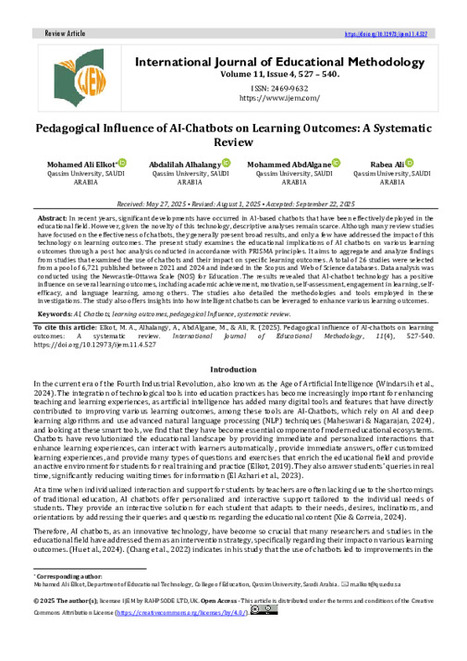
"In recent years, significant developments have occurred in AI-based chatbots that have been effectively deployed in the educational field. However, given the novelty of this technology, descriptive analyses remain scarce. Although many review studies have focused on the effectiveness of chatbots, they generally present broad results, and only a few have addressed the impact of this technology on learning outcomes."
"AI-chatbot technology has a positive influence on several learning outcomes, including academic achievement, motivation, self-assessment, engagement in learning, self-efficacy, and language learning, among others."
|
|
Scooped by
EDTECH@UTRGV
May 22, 11:10 AM
|
Scoop.it!

Discover practical ways educators can foster future-ready skills such as collaboration, emotional awareness, creativity, and time management.
"Future-ready skills are essential for shaping confident, capable, and compassionate individuals. While academic knowledge forms the foundation of education, these skills enable students to communicate effectively, solve problems, work collaboratively, and adapt to changing environments."
|
|
Scooped by
EDTECH@UTRGV
Today, 1:01 PM
|
Scoop.it!

Without guardrails on the use of AI tools, students are left to find their own way and make their own decisions for using the technology.
"Even as students are incorporating AI tools into coursework, institutional practices for teaching AI literacy remain limited and uneven, at best."
|
|
Scooped by
EDTECH@UTRGV
Today, 12:57 PM
|
Scoop.it!

"Much is being said about the impact of artificial intelligence in the hands of students resulting in too many A’s being granted. We are seeing colleges and universities across the country cracking down on grade inflation."
"It strikes me that the more A’s earned in a well-designed class using quality grading rubrics, the better. If viable, relevant, up-to-date learning outcomes are well assessed, then higher grades on average are commendable."
|
|
Scooped by
EDTECH@UTRGV
Today, 12:51 PM
|
Scoop.it!
"The concept of early engagement is a necessity for online instructors in higher education to establish social connectedness with learners. The practice is based on Garrison et al.’s (1999) model for the Community of Inquiry (CoI). The CoI model suggests that the optimum online learning experience occurs when social, cognitive, and teaching presences converge [1]. However, social presence is more than simply one of three components; social presence is a foundational element. Social presence exists to establish an emotional connection."
"Implementing early engagement practices builds social presence, a critical component for developing cognitive and teaching presences"
|
|
Scooped by
EDTECH@UTRGV
Today, 12:46 PM
|
Scoop.it!

"The 2026 State of EdTech report provides insights into the state of K-12 education through the lens of education technology leaders—professionals who play a critical role ensuring technology is safe, reliable, and effective in supporting student learning, teaching, and district operations."
"Cybersecurity continues to rank as the No. 1 priority for education technology leaders, reflecting the essential role secure digital systems play in modern education."
|
|
Scooped by
EDTECH@UTRGV
May 26, 11:00 AM
|
Scoop.it!

Purpose-built AI systems can analyze patterns in student performance, identify specific skill gaps, and connect those gaps directly to instructional recommendations. Done well, this doesn't remove the teacher from the equation. It sharpens the teacher's ability to act.
"AI-supported tools can turn data into instructional guidance: Purpose-built systems can identify patterns, surface skill gaps, and recommend next steps while keeping teachers in control."
|
|
Scooped by
EDTECH@UTRGV
May 26, 10:57 AM
|
Scoop.it!

Learning how to question and analyze are skills that must be honed and practiced. Educators must help train minds to look for flawed arguments, misuse of data, or outright lies so we can ensure that as students form their own thoughts on issues, they are grounding them in reality.
"Digital literacy is critical for K–12 students: Educators must help students question and analyze information, including flawed arguments, misused data, and false claims."
|
|
Scooped by
EDTECH@UTRGV
May 26, 10:54 AM
|
Scoop.it!

Some low-tech strategies can help us build more resilient systems. In case you missed it, Canvas went down last week. A cybersecurity incident affecting the Canvas learning management system caused disruption to around 9,000 universities, colleges and K–12 schools. Instructors and students were temporarily unable to access course materials, assignments, announcements and student communications during one of the busiest periods of the academic term.
"What many institutions have not developed with equal rigor are plans for moving in the other direction: from digital dependence back to resilient, low-tech or distributed alternatives during disruption."
|
|
Scooped by
EDTECH@UTRGV
May 26, 10:49 AM
|
Scoop.it!
"“User” has traditionally meant one thing: a person. The user is someone who navigates an interface, scans text/visuals, and makes decisions. UX/UI has always been about “reducing friction” between humans and the products they use. But UX and the design process are heavily evolving."
"[I]f UX has always been about designing for people and human understanding, what does it mean to also design for machines and their interpretation?"
|
|
Scooped by
EDTECH@UTRGV
May 25, 11:06 AM
|
Scoop.it!

When AI is built to amplify human potential instead of replace it, classroom pedagogy doesn't shrink--it expands.
"The question isn’t adoption anymore. It’s alignment: making AI serve pedagogy, privacy, and outcomes–or it isn’t worth using at all."
|
|
Scooped by
EDTECH@UTRGV
May 25, 11:03 AM
|
Scoop.it!

MacBook Neo conversations are only the beginning--what matters more is if surrounding IT teams are ready to support the change.
"At $599 retail and $499 through Apple’s education pricing,...Are Macs finally close enough to Chromebook territory to be considered for broader 1:1 deployments?"
|
|
Scooped by
EDTECH@UTRGV
May 25, 10:59 AM
|
Scoop.it!
"Ask ten people in the industry what responsible AI design means and you will get ten different answers. Ethics frameworks, trustworthy AI principles, responsible innovation checklists: the vocabulary keeps growing. But underneath all of that sits a more practical question. When someone is actually sitting in front of an AI-powered product, what makes the experience good? And who, if anyone, has written that down in a way that’s actually useful?"
"Three of the world’s largest tech companies have published guidelines for responsible Human-AI Interaction. Here’s what they got right, and where the gaps are."
|
|
Scooped by
EDTECH@UTRGV
May 25, 10:55 AM
|
Scoop.it!

Educators are not always aware of the implications of using the latest shiny AI tool. Laura Milne offers guidance on balancing educational value with institutional priorities
"Cost is a key factor to take into account when choosing an AI tool. When one is offered for free it is likely that your data you enter is the 'cost'. All major chat-based tools have settings that allow users to opt out of their data being used to train the model."
|
|
Scooped by
EDTECH@UTRGV
May 22, 11:07 AM
|
Scoop.it!

The AI models and chatbots that we interact with tend to affirm our feelings and viewpoints — more so than people do, with potentially worrisome consequences.
"AI models offer affirmations more often than people do, even for morally dubious or troubling scenarios."









"40% of administrators and 30% of instructions use generative AI daily or weekly"