



From
hbr

 Your new post is loading...
 Scoop.it! 
Scoop.it!

Australia's leading cultural education and entertainment provider. School incursions, workshops, tours and events. Promoting indigenous and world cultures.
Scoop.it!

Finland’s education system, often held up as an exemplary model for the rest of the world, is on the verge of making some major changes.
Scoop.it!

In 1980, China introduced the one-child policy. In the process, it created a lost generation – second and third children who went unregistered, couldn’t go to school, and who continue to live in the shadows.
Scoop.it!

Yes, one of the questions is "Why are Israelis and Palestinians fighting?"

Brian Wilk's curator insight,
March 22, 2015 1:02 PM
This story of the Palestinians, Israel, Arabs, and Jews has its roots in Germany at the hands of one of the worst dictators the world has ever seen, Adolf Hitler. His ethnic cleansing of Jews via torture, the gas chamber, and starvation, is one of the bleakest times in recorded humanity. The remaining Jews were a people without a land and so it was agreed that Israel would be formed to provide a safe haven. However the land has been disputed, fought over, and the borders changed so many times that it no longer resembles the initial attempt to provide a refuge for the Jews. Ironically, 700,000 Palestinians had been displaced initially and now number 7,000,000 according to the article; all of them designated as refugees. There is no solve for the problems between the Arabs, Jews, Palestinians and Israel as too much blood has been spilled, and forgiveness is a forgotten word. How do you apologize or forgive for generations of bloodshed, displaced families, borders that constantly change, and religions that contradict one another? I'm glad that I wake every day in the USA. We have our own issues to resolve, but nothing approaches the contradictions and paradoxes this area of the world must live with every day. 
Claire Law's curator insight,
April 26, 2015 2:07 AM
A good refresher for teachers and a start for students 
Michael Amberg's curator insight,
May 26, 2015 11:25 PM
Its interesting to see another side to the story and what barriers are now in place from the two opposing cultures.
Scoop.it!

More than 6,000 child soldiers may now be involved in the conflict in the Central African Republic (CAR), with their numbers growing as fighting pits community against community in clashes that have taken on increasingly sectarian overtones, the... Via Amos Odero, Jocelyn Stoller

Natthaya Eiamampai's curator insight,
February 15, 2015 9:11 AM
Current Events # 3
This article is about the growing number of child soldiers involved in conflicts in CAR (Central African Republic). Many groups of people, such as UNICEF are trying to help rescue these children. Not only boys, but girls are also taken in as sex slaves. WFP( World Food programme) is also trying to send in food trucks, but there are many obstacles. It will no longer be able to send food after March due to the rainy season and the higher food prices. The agency will soon have to cut rations and suspend distribution outside Bangui Airport. the UN Integrated Peace building Office in the Central African Republic reported that the head of State Transition election will soon take place and that the Office will support the process.
I think that this article is very interesting. I fully appreciate the people who are planning to help the children that were involved in wars. This article made me understand that the children here are desperate. Recruitment is happening because of poverty, despair, the thirst of revenge, and the little options those children have. This also makes me understand the novel I am currently reading, 'A Long way Gone'. This is a story of a soldier boy and all the terrible acts he could manage to do. This also makes me wonder if there was anyone who was willing to help the boy in the story. After all, this is an extremely interesting article and I find it worth reading.
Pai
Scoop.it!

Every year, the group Reporters Without Borders puts out a global ranking of nations that is based on the how well countries protect or infringe upon the freedom of the press. This year, the ranking for the United States was a dismal 49th. Via Jocelyn Stoller
Scoop.it!

Legendary photojournalist Steve McCurry is opening a retrospective exhibit in Italy called “Steve McCurry: Oltre Lo Sguardo” that will feature 150 photos taken throughout the 30 years of his illustrious career. The photos, taken among people of various cultures around the world, emphasize his unparalleled ability to capture the human soul through a lens. Via Ana Cristina Pratas
Scoop.it!

Neuroscience is changing the meaning of criminal guilt. That might make us more, not less, responsible for our actions Via Greg Downey

Greg Downey's curator insight,
January 5, 2013 6:11 PM
Great long piece on the ways that understandings of automatic action, semi-consciousness and even extremely small brain insults (like tiny tumours or other inconsistencies) might be considered in legal cases as mitigating criminal liability. Well worth a read.
Scoop.it!

One urban planning professor has defined this as a process that occurs in discrete stages.
Much has been made of the wave of millennials moving to cities. In intriguing new work, geographer and urban planner Markus Moos of the University of Waterloo gives the phenomenon a name: “youthification.” Moos defines youthfication as the “influx of young adults into higher density” cities and neighborhoods. And in some ways these neighborhoods are “forever young,” where new cohorts of young people continue to move in as families and children cycle out in search of more space.
Tags: neighborhood, gentrification, urban, place, culture, economic.

ZiyCharMatt's curator insight,
February 20, 2015 12:09 PM
This city talks about which cities in the United States have the largest amounts of young and old residents. This is important because those cities with large amounts of young people (like Austin) are likely to be on the cutting edge of innovation and it is those cities that we can look to to show the rest of the nation the future of urban design. I believe that this article is very interesting and provides a good insight into which parts of the country are advancing quickly and which parts are sating rooted in the past.
-Charles Bradbury
Scoop.it!

Google Earth Engine works with scientists by using satellite imagery to provide data visualizations for environmental and health issues.

Todd Hallsten's comment,
February 13, 2015 10:39 PM
I like the idea of this map because it allows for the comparison of logged forest to preserved forest. Allowing for facts not rumored amount of trees producing air, i would really like to see a map of alaska..
Scoop.it!

In a December report, UNICEF labeled 2014 as one of the worst years for children on the record. Between war, violence and the spread of disease, Executive Director of UNICEF, Anthony Lake, said, “Never in recent memory have so many children been subjected to such unspeakable brutality.”
Watching the video, it’s hard to bear. It is hard to fathom that this is what is in our world. The leap from where we are to where we want to be may seem insurmountable. I say the enormity of the situation is indicative of the great work of our time-
Can we allow this suffering to activate new levels of empathy, compassion and creativity?
By carrieleeferguson Via Edwin Rutsch, Jocelyn Stoller
Scoop.it!

In response to demographic challenges, China eased restrictions on its one-child policy last year, but fewer couples than expected have asked the government’s permission to bear a second child.
|
Scoop.it!

Travel with the world’s greatest explorer and his nervous sailor assistant to discover India, Africa and Europe. They will be sharing insights into many of the world’s famous cultural destinations as they go! This show is mixing in themes of friendship and self-esteem along the way, and relies on the students’ involvement to get the story going. Via Cultural Infusion
Scoop.it!

A person’s culture deeply impacts his or her way of thinking and learning; that presents a special challenge to educators because modern classrooms often have a beautiful mishmash of students from different backgrounds. Via Becky Roehrs, Cultural Infusion

Becky Roehrs's curator insight,
February 14, 2015 6:57 PM
Excellent list of articles, lessons and video materials about diversity and Key recent and historical events. I especially like tolerance.org's materials.
Scoop.it!

Don't believe everything you hear about how to bring diversity to your team.
Scoop.it!

Scoop.it!

Sudanese soldiers raped more than 200 women and girls in Darfur last October, says Human Rights Watch. A systematic attack on the town of Tabit saw members of the armed forces commit a series of atrocities, including the rape of at least 221 women and girls in a 36-hour period. Via Jocelyn Stoller
Scoop.it!

"A new survey has found that one fifth of secondary students have taken part in online bullying, with teenage boys being more likely to have done so than girls." Via EDTECH@UTRGV
Scoop.it!

Folkstreams is an incredible online archive of documentary films about American folk and roots music and culture including "Born From Hard Luck," excerpted above. Via Greg Downey
Scoop.it!

Ethnographic works on American or European culture of shoe-throwing is absolutely necessary, argues Dabashi. Via Greg Downey
Greg Downey's curator insight,
February 27, 2013 3:18 AM
One of the most difficult tasks we people of Oriental descent face when we live here in North America is precisely this urgent need to explain to our friends and colleagues why is it that our folks "back home" so loathe their shoes that they throw them at their enemies while here in North America the anthropological fact we immediately notice is exactly the opposite and how people so utterly adore their shoes that throwing it at a person is nothing short of a stirring sign of adoration and even flirtations, depending on the season of the year, region of the US, where the ritual takes place, and/or the age and sex of the shoe-thrower.
Scoop.it!

Here’s a head-scratcher — what is beauty? Can you describe beauty to someone else? What about to a machine? Yahoo Labs has developed a machine learning algorithm that can recognize beautiful portraits and separate them from the less than lovely ones. Via Ashish Umre
Scoop.it!
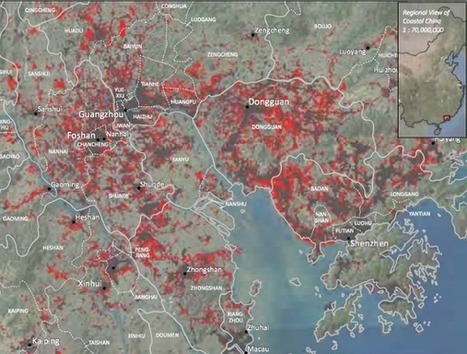
Several hundred million more people are expected to move to cities in East Asia over the next 20 years as economies shift from agriculture to manufacturing and services, according to a World Bank report

BrianCaldwell7's curator insight,
April 5, 2016 8:13 AM
Cities in this region have experienced spectacular growth; they are at the heart of China's manufacturing and exporting boom. For example, Shenzen was a small city with about 10,000 residents in 1980 but is now a megacity with over 10 million people. China's SEZs (Special Economic Zones). Cities that were once separate entities have coalesced into a large conurbation and if they are counted as one, it's now the largest metropolitan area. Cities like London and New York become global cities over hundreds of years--this happened in one generation. Click here for 5 infographics showing East Asia's massive urban growth. Tags: APHG, urban, industry, manufacturing, economic, unit 7 cities, megacities, China, East Asia.
Scoop.it!
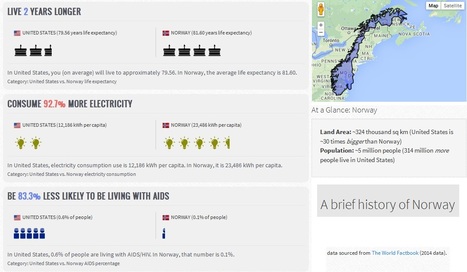
"MyLifeElsewhere allows you to compare your home country with different countries around the world. Ever wonder what your life would be like if you were born somewhere else?"

's curator insight, January 31, 2015 1:56 AM
Un site d'une grande simplicité d'utilisation bien qu'en anglais. Le principe est de choisir deux pays dans un menu déroulant pour en comparer les principaux indicateurs de développement sous la forme de petites infographies très pédagogiques. Dernière information sur ce site, les statistiques utilisées proviennent des bases de données open source de la CIA américaine.
Brian Wilk's curator insight,
February 7, 2015 7:51 PM
After studying this comparison tool and using it to find the best of the best and worst of the worst, I picked out some highlights I'd like to share. Monaco is clearly the place to be born, earn, and live. When compared to the USA, the infant mortality rate is 71% less, the life expectancy is 10 years longer @ 84, and you'll earn 62% more money, no doubt because you have ten more years in which to do so. I believe the stats may be skewed a bit in this country comparison as the very rich live there and they have access to the best medical care, and probably don't have very many infants with them when they make the move from elsewhere, hence the low infant mortality rate. Austria is not a bad second choice as you are 33% less likely to be unemployed. On a sobering note, the life expectancy if you live in Namibia is only 52! Yikes, I'm already 53... It's far worse however in Swaziland. The life expectancy is sadly only 50.5 years and you are 44 times more likely to have AIDS than if you lived here. 26.5% of the population has AIDS! Be thankful for where you live and stop complaining, it's far worse on average in nearly all other countries. 
Monika Fleischmann's curator insight,
February 15, 2015 4:59 AM
Seth Dixon's insight:
Did you know that with 1/30th the territory of the United States, Norway still has over 25% more coastline? I didn't either until I compared Norway to the United States using My Life Elsewhere. This site is designed allow United States students to imagine how their lives might be different if they were born in a different part of the world. Students would probably die 21 years earlier if they were born in Liberia and 11 times more likely to have died in infancy. Students would be 43.8% less likely to grow up and be unemployed and have 36.3% less babies if they were born in Taiwan. This side-by-side format is a great way to help students help make these statistics real and meaningful. One major drawback: this site only allows users to compare a country to the United States. If you prefer to have students compare, say Cuba to the United Arab Emirates, I would recommend that you try If It Where My Home. |








Thanks to @ICTPHMS for this resource!