


Why do Chinese parents often prefer a western education for their children, even though in many ways Shanghai schools excel?

 Your new post is loading...
 Scoop.it! Why do Chinese parents often prefer a western education for their children, even though in many ways Shanghai schools excel? 
No comment yet.
Sign up to comment
Scoop.it!
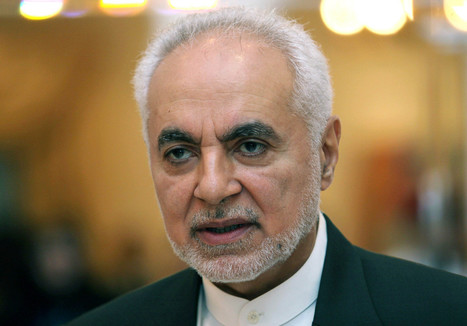
On Monday the international community was rocked by news that a "deeply disturbed individual” had taken 17 people hostage in a cafe in Sydney, Australia. The attacker and two hostages were killed as the crisis ended Tuesday morning local t... Via Jocelyn Stoller
Scoop.it!

A new study links climatic instability and a lack of natural resources to belief in moralizing gods in cultures around the world.

Scott Langston's curator insight,
November 16, 2014 6:25 PM
Inspiring faith? Is God an environmental construct? 
Kelli Jones's curator insight,
December 2, 2014 1:06 AM
This article talks about how where we live can influence our religion. I couldn't agree more. Although I have been an active member of a church for a long time now I can't help but think that if I didn't live in the US I wouldn't be a Christian. If I were born in China for example I may not even know the name Jesus Christ. That's a scary thought. 
Molly McComb's curator insight,
March 21, 2015 3:59 PM
This shows how different cultures have adapted to harsh environments
Scoop.it!

The Asian Muslim Action Network (AMAN) is a unifying force for peace and social action in Asia. Via CoPeSeNetwork, Jocelyn Stoller
Scoop.it!

It used to be "political correctness". You only had to say the words to set a coalition of right-wing columnists, Tory backbenchers and patriotic Englishmen (sic) seething with rage. Respecting the rights of gay people, women, the disabled or foreigners was loudly condemned as "political correctness gone mad", which was one step worse than PC on its own. What is the country coming to when you can't make jokes about loony left-wing councils banning Christmas? (Not that they ever did.) Via Darcy Delaproser, Nevermore Sithole, Jocelyn Stoller
Scoop.it!

In many countries, eggs aren't refrigerated and they're still considered safe to eat. But in the U.S., we have to chill them, because we've washed away the cuticle that protects them from bacteria.

Gareth Jukes's curator insight,
March 24, 2015 10:38 PM
Variations of major zones and effects of markets-
This article describes why the U.S is one of the few countries that actually refrigerates their eggs. This is beacuse we had washed away the cuticle that protects eggs from bacteria. In other countries, they just leave eggs like how they were laid.
This article contributes to the idea of variations of markets by explaining how our country is one different from most of others by eggs. It also explains why we are one of the few that must chill the eggs, unlike other markets and/or venders. 
BrianCaldwell7's curator insight,
March 16, 2016 3:44 PM
For many Americans that are traveling abroad for the first time, realizing that eggs aren't in the refrigerator is a bit of a culture shock (not to mention the moment they find milk in a box that also isn't being refrigerated). Agricultural practices dictate storage requirements and some things we might have imagined were universal are actually place-specific or peculiar to our cultural setting. What we are taught to think of as gross, appropriate, attractive or even sanitary is often steeped in a cultural context. So is it strange the we refrigerate our eggs in the United States, or that they don't in other places?
Tags: food production, technology, industry, food, agriculture, perspective.
Scoop.it!
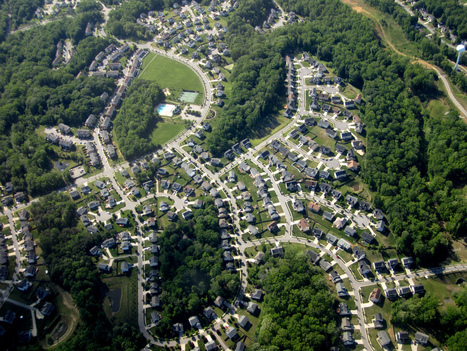
"Although we seldom think about them this way, most American communities as they exist today were built for the spry and mobile. We've constructed millions of multi-story, single-family homes where the master bedroom is on the second floor, where the lawn outside requires weekly upkeep, where the mailbox is a stroll away. We've designed neighborhoods where everyday errands require a driver's license. We've planned whole cities where, if you don't have a car, it's not particularly easy to walk anywhere — especially not if you move gingerly. This reality has been a fine one for a younger country. Those multi-story, single-family homes with broad lawns were great for Baby Boomers when they had young families. And car-dependent suburbs have been fine for residents with the means and mobility to drive everywhere. But as the Baby Boomers whose preferences drove a lot of these trends continue to age, it's becoming increasingly clear that the housing and communities we've built won't work very well for the old."

Alexandra Piggott's curator insight,
October 18, 2014 6:48 PM
This is also an issue in Australia where the overwhelming majority of people live in single story dwellings and are very car reliant. 
Joshua Mason's curator insight,
January 28, 2015 8:59 PM
I can definitely see this as a real problem. Both my Uncle and my Great Uncle moved their condos from ones that had numerous steps to climb to the second floor to more elder-friendly options. My Great Uncle even went a step further to move him and his wife to a senior living community, where there food, entertainment, etc. is all provided within an enclosed neighbourhood with other people of their age group. More of these communities that act like oversized retirement homes could be the answer. They give the illusion of suburban living, something the baby boomers liked, while providing the accessibility they need.
Scoop.it!

The key to creating a culture of acceptance begins with helping students articulate how they see themselves and the labels they give each other.
Scoop.it!

Scoop.it!

From
www

This journal publishes articles on basic research and theory in the broad field of abnormal behavior, its determinants, and its correlates.
Scoop.it!

Here’s a region-by-region look at where religious harassment takes place, and to which groups. (@pewresearch How religious #harassment varies by region across the globe. Via Annabel Kaye
Scoop.it!

If you read this blog regularly, you know that I keep stressing the major role an audience plays in the success of any business. Of particular importance is the way you address complaints. Unfortunately, we are all very busy and spotting these complaints can be a chore. For customers, it means a lot of work for nothing. Enters GripeO. I came across this tool a couple of months ago on Twitter and the slogan ("A Better Way to Complain") intrigued me. So , I sent a few questions to Co-Founder and CEO, Mike Klanac. The interview is below.
Scoop.it!

Today, India's Supreme Court granted legal recognition of transgender citizens and prohibited discrimination on the basis of sexual orientation or gender identity. Via Annabel Kaye

Annabel Kaye's curator insight,
April 16, 2014 3:34 AM
Did you know the EU have long recognised three genders?
|
Scoop.it!
Scoop.it!

When looking at large-scale international studies and comparisons of education systems worldwide, everyone’s always talking about Finland. Finland seems to set the benchmark for education worldwide. Foreign educational experts, delegations of teachers and educational politicians flock to the departments of teacher education in Finnish universities, as well as schools. So what is it about education […] Via Timo Ilomäki
Scoop.it!
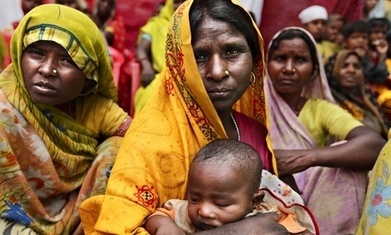
Sai Ram, burned alive because of a stray goat, was just one of 17,000 Dalits to fall victim to caste violence in the state of Bihar
Scoop.it!

I believe the 21st century education is idiosyncratic in nature. It has acquired some distinctive features that sets it apart from the kind of traditional education that was prevalent in the 20th century. Of course it does not take you long to guess the reason behind this change , digital revolution has and is still radically transforming the way learning and instruction is delivered.
Scoop.it!

"Seldom has it been more important for Americans to form a realistic assessment of the world scene. But our current governing, college-educated class suffers one glaring blind spot. Modern American culture produces highly individualistic career and identity paths for upper- and middle-class males and females. Power couples abound, often sporting different last names. But deeply held religious identities and military loyalties are less common. Few educated Americans have any direct experience with large groups of men gathered in intense prayer or battle. Like other citizens of the globalized corporate/consumer culture, educated Americans are often widely traveled but not deeply rooted in obligation to a particular physical place, a faith or a kinship."

Brett Laskowitz's curator insight,
January 28, 2015 12:17 PM
My APHUG students will read this article before even beginning our study of religion. My hope is that this may at the very least help them empathize with the religious fervor that still has such a profound impact on the culture of much of the world. 
Evan Margiotta's curator insight,
March 18, 2015 12:26 PM
With the rise and fall of human civilizations have come the rise and fall of religions as well. Americans have grown unaware of the beliefs and teachings of other religions. They do not know the difference between ethnic and universalizing religions. They do not know that Islam is the fastest expanding religion in the world even though Christianity still has the most followers. Unit 3 Culture
Molly McComb's curator insight,
March 21, 2015 3:57 PM
This article shows how religion affects the world around us and its importance in governments. Especially in the middle east (Saudi Arabia), countries often import factors of their major religion into their government.
Scoop.it!

"There are 1.2 billion people between the ages of 15 and 24 in the world today — and that means that many countries have populations younger than ever before. Some believe that this 'youth bulge' helps fuel social unrest — particularly when combined with high levels of youth unemployment. Youth unemployment is a 'global time bomb,' as long as today’s millennials remain 'hampered by weak economies, discrimination, and inequality of opportunity.' The world’s 15 youngest countries are all in Africa. Of the continent’s 200 million young people, about 75 million are unemployed. On the flip side, an aging population presents a different set of problems: Japan and Germany are tied for the world’s oldest countries, with median ages of 46.1. Germany’s declining birth rate might mean that its population will decrease by 19 percent, shrinking to 66 million by 2060. An aging population has a huge economic impact: in Germany, it has meant a labor shortage, leaving jobs unfilled." Via Jim Lerman

Brian Wilk's curator insight,
March 23, 2015 7:08 PM
Demographics seemingly started with age as a metric many years ago and have evolved into marketing tools, political footballs, and ways to combat everything from obesity to social security. Africa is clearly the youngest and probably for a very morbid reason; AIDS and Ebola among other diseases have taken their toll on the sexually active and thus have reduced the average age of their population. Germany seems to be the place to go for a job as the labor shortage will mean higher wages for the folks who are left. Japan has another issue; a healthy aging population that will strain the government's ability to financially take care of them. I wonder if the unevenness of Europe is an indication of the two World wars that were fought mostly on the turf. Did some countries lose more than others? If more soldiers, presumably of baby making age, perished did this affect the countries ability to keep pace with the Germany's and Spain's of Europe? Diet seems to play a large part as well as the Mediterranean is well represented in terms of age. Does their healthy diet of fish, nuts, legumes and olive oil make a difference? I could spend all day postulating, but I'll leave some of the findings for you to discover... 
Deanna Metz's curator insight,
March 1, 2016 8:05 PM
The median age of a population call be a quite telling statistic--almost a surrogate for a population pyramid. I post this with a special attention to Sub-Saharan Africa; the youngest 15 countries in the world are all in Africa, one of the major demographic realities confronting African economies and politics. Here is a map with the median age of U.S. counties. Tag: population, demographic transition model, population pyramids. 
Olivia Campanella's curator insight,
October 31, 2018 11:55 AM
In the article there are 1.2 billion people between the ages of 15 and 24 in the world today. Meaning that, countries around the world have populations younger than ever! 15 of the youngest countries are in Africa. And of the 200 million young people of Africa, about 75 million are unemployed. The worlds youngest country is Niger with a population and median age of 15.1 and coming in a close second is Uganda with 15.5, but Japan and Germany are some of the Worlds oldest countries ranging in a median age of 46.1!
Scoop.it!

Teachers aiming to differentiate learning in their classroom can focus on content, process, and product in giving students opportunities to grow and shine as individuals.
Scoop.it!

Fox News host Elisabeth Hasselbeck asserted on Wednesday that Christianity should be kept in schools because Christians were being persecuted by Islamic militants in Iraq. Via Jocelyn Stoller
Scoop.it!
How Much Data Is Generated On Twitter, Instagram, Vine, Tinder & WhatsApp Every Minute? | AllTwitter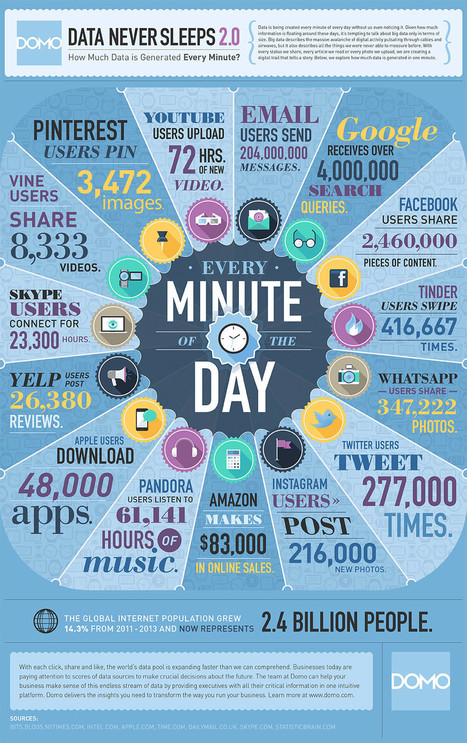
Here’s the thing: the internet never sleeps.Which means data never sleeps, and the internet sure likes to use up a lot of it. How much? In any given minute, 277,000 tweets are published on Twitter, 216,000 photos are sent to Instagram and 8,333 videos are shared on Vine.And we’re just getting started. Over that same 60 second period, 347,222 photos are sent on WhatsApp, 416,667 swipes are made on Tinder and 3,472 images are pinned on Pinterest.And if you think that’s impressive, Google receives 4 millions search queries, Facebook users share 2.46 million pieces of content and 204 million email messages are sent each and every minute of the day.This visual from DOMO looks at how much data is generated every minute across the net.... Via Jeff Domansky, Mark E. Deschaine, PhD, John Evans

Ignacio Garrido's curator insight,
July 1, 2014 1:14 AM
Exercise 33. Remember you have to send the answer by Moodle. Good Luck¡¡
1. Write an opinion about avantatges and disavantatges of the nes technologies and in relation with the text. 2. What is the most used network in graphic? Why do you think? 3. How many graph's apps do you know? How many do you use daily?
Scoop.it!

Homeless Hospital Patients Now Have A Care Facility Where They Can Recover Via Hunter Homeless Connect
Scoop.it!

Explore educational and professional development resources for teachers and classrooms on Annenberg Media's learner.org. Companion to the Annenberg Media series Power of Place. This site covers the 26 episodes of the world geography course, produced by Cambridge Studios.
Scoop.it!

Brought to Europe from the New World by Spanish explorers, the lowly potato gave rise to modern industrial agriculture

Kaitlin Young's curator insight,
December 13, 2014 12:57 PM
Potatoes are one of the most widespread foods in the world, due to its resiliency to harsh weather conditions and its ability to grow to large sizes. Potatoes can also be traced to show the beginning forces of globalization. Before modern communication and transportation technology, globalization occurred at a much slower rate. Globalization spread through trade routes in the forms of foods, resources, and therefore cultures and people.
BrianCaldwell7's curator insight,
March 16, 2016 3:52 PM
The Colombian Exchange is a term that describes the most dramatic biologic transfer in history. European explorers brought animals and agricultural items from the Old World to the New and subsequently brought back items from the New World back to the Old. This exchange profoundly reshaped many societies as agricultural diffusion of the potato lead to the changes across northern Europe.
Tags: agriculture, food production, diffusion, historical, colonialism, Europe. |






