Further to the relevance of the IGF as a space to foster awareness and enhance discussions on human rights issues, the significant number of IGF sessions related to human rights at this year’s IGF and the diversity of stakeholders involved in those discussions also reflected an important trend towards considering online rights issues from a multi-stakeholder perspective.
What a thrill to be here. Let me start by saying thank you to Leslie Harris and the Center for Democracy and Technology for including me tonight. Leslie and
Western countries throw out nearly half of their food, not because it's inedible -- but because it doesn't look appealing. Tristram Stuart delves into the shocking data of wasted food, calling for a more responsible use of global resources.
My scoop it opinion piece was on global food waste. How globally food is thrown by the tons daily. Its audience is everyone and its purpose is to try to get people to open their eyes and waste less. America makes over four times the amount needed to feed its people. We are hurting the environment by making so much food that just go to waste. The purpose of this is to illustrate the huge issue we have with countries of people who don’t have food to begin with and here we are throwing away perfectly good food that could be use for these people or to feed pigs to make more meat. His exigence is all the food that could be use for other people or animals and its going to land fills daily. Its like a ticking time bomb hurting earth. His constraints are the laws set on food given to live stock in Europe and companies and the corporations that control the food. He urges people to use the amount of food they truly believe they will eat.
President Mugabe's economic mismanagement of Zimbabwe has brought the country poverty and malnutrition. After 36 years in charge, he's looking to extend his rule by 5 more years.
Robert Mugabe's blatant and stunning incompetence and corruption destroyed the value of the Zimbabwean dollar and the resulting hyperinflation decimated the national economy. This is one of the premier examples of how a total lack of competent and powerful institutions can undermine a once promising economy and devolve a nation into one of the poorest on earth.
Setting the record for world history's worst case of hyperinflation should send a signal to any sane person that a change of course is drastically needed. But, it seems Zimbabwe's chief dictator (parading as a "president"), Robert Mugabe, made one-too-many errors leading to the collapse of his country's economy. The unemployment rate hit 95% in 2008. One could argue this disaster started with British racism and exploitation. To deal with the complex legacy of European colonialism, Mugabe confiscated all the commercial farmland from white owners and redistributed the business to friends, loyalists, and family who did not have any expertise in running agricultural businesses. To make a few short-term gains, the valuable lands were sold off and neglected. Consequently, the agricultural sector crumpled severely reducing the flow of revenue and trade. To combat this, Mugabe decided to cheat and print more money - causing a process of vicious hyperinflation. The excessive regulations and taxes also make it difficult for new businesses in Zimbabwe to get off the ground.
In relation to geography, it is interesting to analyze how the aftermath of British colonialism and good natural resources are present in the world's poorest country. Mugabe's decision to push out white farmers was clearly a big man method of dealing with the shame, grief, and anger of colonial exploitation, theft, and degradation. This aggressive backfired as even though the land is quite arable, it requires special knowledge, management, and dedication on part of the land's stewards to reap success. This seems to be a trend in some African countries. They are endowed with good natural resources to build a strong economy. The problems created by colonialism, however, and the lack of human capital in these African nations have led to cases of severe mismanagement and struggle.
ItIt is horrible that after Zimbabwe gained it independence from a apartheid like government that oppressed some of its people, its leaders including Mugabe turned around and continued to oppress certain people. They kicked out all the white farmers (a majority of farms at the time in Zimbabwe were owned by whites) and replaced them with government friends. This obviously leads to famine with not many crops being grown. The market was decimated because Zimbabwe went from being a bread basket of African agriculture to a malnutrition state begging for economic aide to prevent mass starvation. History may repeat itself today where South Africa is attempting to make the same mistake.
Joe Henrich and his colleagues are shaking the foundations of psychology and economics—and hoping to change the way human behavior and culture is understood.
Jonathan Marks brings a really strong critique of the political naivite of a lot of genetics research:
'This is political and has always been. The people who are the most political tend to be the ones claiming self-consciously to be the most scientific, and tend to be the ones whose science stands up the worst. That's another reason to study history. It’s time to stop allowing people to pretend that this science isn’t political, and claiming the higher scientific ground for for their thinly cloaked politicized science; they are entitled only to the lower scholarly ground and the lower moral ground. That’s is not where science belongs.'
The Lewa Conservancy is home to lion, leopard & elephant, but every year, over 1,000 people decide they’d like to run through it in the Safaricom Marathon.
You run through 13 miles of unfenced wild, 5500 feet elevation and 80 degree heat in this marathon. It is probably the most challenging marathon ever!!
Much has been written recently about the differences between education systems around the world, but much less has been said about what excellent schools around the world have in common. Over the past year, I’ve visited top-ranked schools across four continents and met an extremely diverse array of school leaders. Amid this diversity, I was surprised when each leader described the same three priorities as fundamental to their schools’ success. From Singapore to Switzerland, South Africa to India, these three practices recurred with remarkable consistency.
This is video is a great tool to drum up interest in an AP Human Geography course produced by David Burton. See more promotional videos/start-of-the-year clips at http://wp.me/P2dv5Z-1ec
This is just one of my favorite "start of the year" videos. I've compiled them for when you need to show the importance of geography, spatial thinking and geo-literacy. Collectively, they show why taking geography courses is so important, useful and interesting.
Western countries throw out nearly half of their food, not because it's inedible -- but because it doesn't look appealing. Tristram Stuart delves into the shocking data of wasted food, calling for a more responsible use of global resources.
My scoop it opinion piece was on global food waste. How globally food is thrown by the tons daily. Its audience is everyone and its purpose is to try to get people to open their eyes and waste less. America makes over four times the amount needed to feed its people. We are hurting the environment by making so much food that just go to waste. The purpose of this is to illustrate the huge issue we have with countries of people who don’t have food to begin with and here we are throwing away perfectly good food that could be use for these people or to feed pigs to make more meat. His exigence is all the food that could be use for other people or animals and its going to land fills daily. Its like a ticking time bomb hurting earth. His constraints are the laws set on food given to live stock in Europe and companies and the corporations that control the food. He urges people to use the amount of food they truly believe they will eat.
In which John Green teaches you about population. So, how many people can reasonably live on the Earth? Thomas Malthus got it totally wrong in the 19th century, but for some reason, he keeps coming up when we talk about population. In 1800, the human population of the Earth passed 1 billion, and Thomas Malthus posited that growth had hit its ceiling, and the population would level off and stop growing. He was totally right. Just kidding, he was totally wrong! There are like 7 billion people on the planet now! John will teach a little about how Malthus made his calculations, and explain how Malthus came up with the wrong answer. As is often the case, it has to do with making projections based on faulty assumptions. Man, people do that a lot.
WIRE is Amnesty International's global magazine for people who are passionate about human rights. Read about our campaigns and fresh research, meet the people we work for and with, and - most importantly - take action.
Latest issue of Amnesty International's Wire magazine is out -- available for download here. Stories on arms treaties, human cost of Syria, Romani activism, and more. Free to download.
American scientist and author Jared Diamond was recently in Australia promoting his 5th book The World Until Yesterday: What can we learn from traditional societies?
If you're not over Jared Diamond's account of the differences between Us and Them, and his shtick about fearing the shower, there's more from an interview he did with sociologist Peter Christoff. For example, he has no time for criticisms that he's homogenizing indigenous groups:
'The traditional societies that we see today are not frozen models of the past, on the one hand. On the other hand, they’re not irrelevant to the past because they are still small-scale societies. And when you’ve got 200 people, and whether the 200 people are from today or whether the 200 people are from 30,000 years ago, there are some things that you have to have with 200 people. So in short, I think my book is faithful to the complexities of the problem.'
In other words, I acknowledge what my critics say, but then dismiss it and suggest it's irrelevant because I thought of it.
Transforming bricks-and-mortar shopping is a high-stakes endeavor for retailers given Americans still do over 90% of our shopping in physical stores. In fact, one of the latest trends in retail is the launch of physical stores by online e-commerce companies, including Amazon, Warby Parker, and Birchbox.
Dozens of startups have taken on the challenge of helping retailers bridge the gap between digital and physical commerce through features ranging from shelf-stocking robots, to augmented reality displays, to Wi-Fi based beacons that collect data on shopper behavior.
Using CB Insights data, we identified startups enhancing the in-store experience with digital tools. The startups in our list have racked up partnerships with many big name brands — including Maybelline, Lancome, Kiehl’s, Cabela’s, Foot Locker, Home Depot, Express — and department stores, from Lord & Taylor to Target.
I think this is a brilliant idea. I thought I was being clever by turning song lyric progressions into examples of code (loops, if-else statements, etc.), but the Finns teach loops through knitting in 5th grade! That is the kind of cross curricular, synthetic thinking that is the currency of 21st Century employability.
Clueless. This is exactly how I felt as I entered the world of employment and I know I’m not alone.
Having spent time developing my knowledge and skills since leaving school, I’ve realised how ill prepared I was for leaving full-time education. Whilst I worked hard at school to get the best grades I could, the skills I learnt seem like they may never be used, whilst the skills I’ve actually needed in the real world I’ve had to learn.
Industry has changed, students no longer enter into careers that will last their entire working lives, freelance roles and flexible working have become more common, along with working from home. Students need to be taught life skills within the secondary curriculum to better prepare them for life after school, along with skills-based teaching that can be transferred to any career.
There has been much research into the skills shortage in the UK, reflecting that both digital skills and soft skills are needed to succeed, and whilst there is already a large amount of pressure on teachers to deliver curriculum content, I believe it’s essential for students to learn the skills to succeed in everyday life if we are to have a workforce equipped for the future.
A cohort of nearly 100 architecture and design students and academics from Curtin recently visited the Perth university’s Malaysian campus, at Sarawak in Borneo, as part of a wider plan to internationalise courses through international study tours, internships, collaborations and partnerships.
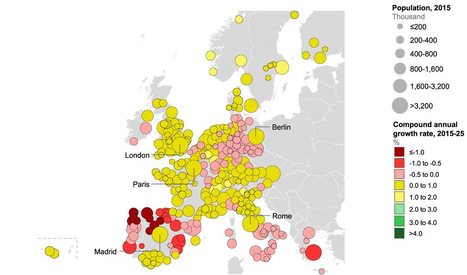
"The world is experiencing rapid urbanisation, but not every city is growing. Population is likely to decline in 17% of large cities in developed regions and 8% of cities across the world from 2015 to 2025, according to a McKinsey report."
In this article the maps below are a good tool for Regional Geography classes. These maps show how the world is experiencing rapid urbanization, but not all cities are growing. Population is likely to decline in 17% in developed regions
Generation Global helps students build empathy for those in different cultures by engaging in dialogue about their experiences. The goal is to make the exotic
Via Susan Grigsby @sksgrigsby
To get content containing either thought or leadership enter:
To get content containing both thought and leadership enter:
To get content containing the expression thought leadership enter:
You can enter several keywords and you can refine them whenever you want. Our suggestion engine uses more signals but entering a few keywords here will rapidly give you great content to curate.


 Your new post is loading...