Your new post is loading...
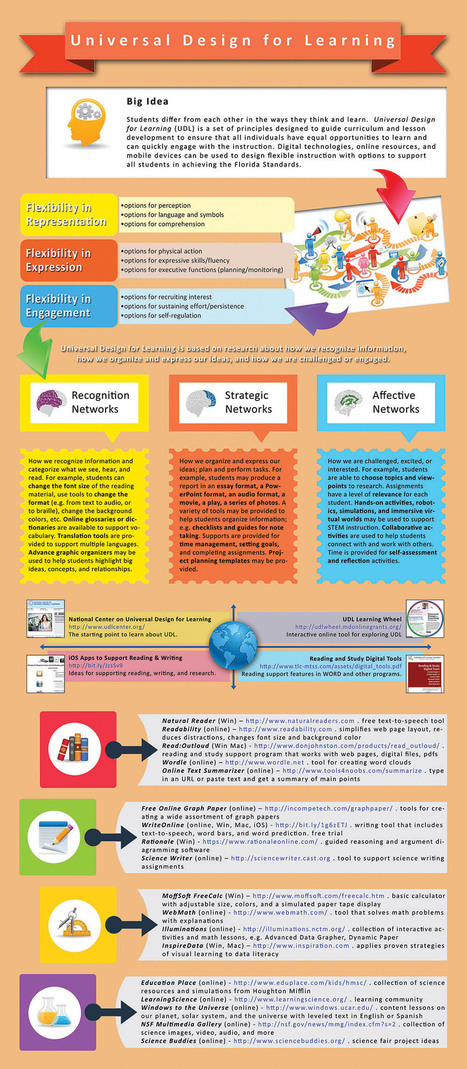
The infographic we have for you today provides an excellent explanation of what Universal Design for Learning is all about. We invite you to check it out and share with us your thoughts.
“Universal Design for Learning is a set of principles designed to guide curriculum and lesson development to ensure that all individuals have equal opportunities to learn and can quickly engage with the instruction.Digital technologies, online resources, and mobile devices can be used to design flexible instruction with options to support all students in achieving the Florida Standards”
Via John Evans

|
Rescooped by
Dennis Swender
from All things communication
May 21, 2015 1:57 AM
|
A few things are certain in life: death, taxes, and the fact that designers love to hate Comic Sans. Lately though, there's been a lot of discussion around the idea that this widely loa…
Via aufaitLibrarian
UDL theory (universal design for learning) can help embed a personalized approach to the instructional design process.
Via EDTECH@UTRGV
|
|
Scooped by
Dennis Swender
May 1, 2015 7:30 PM
|
Most people would agree that the best strategy for PDF accessibility is to integrate accessibility best practices prior to the conversion process, when the document is first being created.
|
|
Scooped by
Dennis Swender
May 1, 2015 7:29 PM
|
This quick guide is designed to provide a high-level understanding of how to use different types of campus technologies accessibly. For more detailed information follow the links for each technology.
|
|
Scooped by
Dennis Swender
May 1, 2015 7:28 PM
|
As social media continues to grow as a powerful medium for sharing information and ideas, the need for accessible infographics has become more critical. An infographic is a visual representation of data that turns complex information into bite-sized pieces that can be read at a glance. Because it can make a large amount of information easier to digest, perhaps the most valuable function of an infographic is the ease with which it can be shared across different social media platforms.
|
|
Scooped by
Dennis Swender
May 1, 2015 7:27 PM
|
The primary aim of this site is to provide faculty assistance in creating or converting online instructional materials to be accessible to the widest audience possible. The same techniques to make course content accessible can be used by anyone who has responsibility for creating public documents, videos and websites. We encourage all faculty and staff to proactively use these tools so that all public materials are accessible for anyone.
|
|
Scooped by
Dennis Swender
May 1, 2015 7:23 PM
|
I’ve been working (more or less) full time in digital accessibility for quite some time now, so naturally I’ve watched with great interest the unfolding developments in recent years towards establishing the International Association of Accessibility Professionals (IAAP), and specifically IAAP’s focus on the subject of individual accreditation of accessibility professionals. I was involved in a few very early discussions, I work for a founder member organization of IAAP, and I’ve had some discussions with colleagues more closely involved. But aside from that I’ve had no direct involvement, so these opinions are my own, as a curious potential member looking in from the outside.
|
|
Scooped by
Dennis Swender
May 1, 2015 7:22 PM
|
NIMAS is a technical standard used by publishers to produce source files (in XML) that may be used to develop multiple specialized formats (such as Braille or audio books) for students with print disabilities.
|
|
Scooped by
Dennis Swender
May 1, 2015 7:20 PM
|
A blind mother whose three children attend Seattle Public Schools is suing the district, saying its website and math software aren’t compatible with technology that blind people use to access the Internet.
Noel Nightingale filed the discrimination lawsuit in federal court Wednesday (August 2014). She says that from 2005 until 2012, she was able to use the Seattle Public Schools website with a “screen reader,” a device that vocalizes the information on a computer screen or displays the content on a refreshable Braille display.
But in 2012, she says, changes to the website made it no longer compatible. The software that students use to complete math assignments wasn’t available either.
|
|
Scooped by
Dennis Swender
May 1, 2015 7:19 PM
|
Cognitive Accessibility User Research describes the challenges of using web technologies for people with learning disabilities or cognitive disabilities. The research describes challenges in the areas of attention, executive function, knowledge, language, literacy, memory, perception, and reasoning. It is organized by user groups of the following disabilities: Aging-Related Cognitive Decline, Aphasia, Attention Deficit Hyperactivity Disorder, Autism, Down Syndrome, Dyscalculia, Dyslexia, and Non-Verbal. Additional user groups may be added to future versions. This document provides a basis for subsequent work to identify gaps in current technologies, suggest strategies to improve accessibility for these user groups, and develop guidance and techniques for web authors.
|
|
Scooped by
Dennis Swender
May 1, 2015 7:18 PM
|
On April 2, the Department of Justice entered into a settlement agreement with edX, a major online college course provider, over alleged violations of the Americans with Disabilities Act (ADA) related to the accessibility of online courses. EdX operates a web-based service that allows members of the public to view hundreds of online courses, including courses at more than 60 universities. Following a compliance review, the Justice Department determined that edX violated the ADA by not ensuring that online courses were accessible to people with hearing, vision and manual dexterity disabilities. EdX denied any ADA violations and disputed the Justice Department's findings.
|
|
Scooped by
Dennis Swender
April 23, 2015 1:24 PM
|
Last year, Hanna Rosin, a well-known journalist for the Atlantic, wrote an article about her son’s Asperger's diagnosis. He lived with this label for only four months, at which point the disorder was expunged from the DSM V. Now, her son is sai...
|
|
|
Scooped by
Dennis Swender
May 21, 2015 4:39 PM
|
Oliver Sacks’ latest book “On the move” is a glorious memoir. | National Aphasia Association http://t.co/OAAxcQIDBB
|
|
Scooped by
Dennis Swender
May 20, 2015 1:13 PM
|
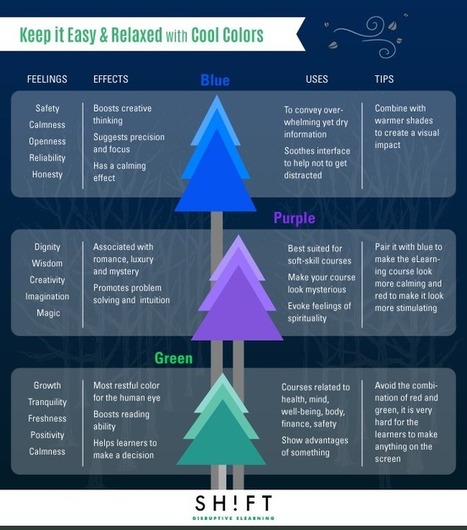
Learn how you can use cool colors to your advantage when designing your eLearning courses.
|
|
Scooped by
Dennis Swender
May 16, 2015 10:42 AM
|
The dolls are custom-designed for their owners, parents can request a doll with the same disability as their child
|
|
Scooped by
Dennis Swender
May 1, 2015 7:29 PM
|
Accessibility features include the ability to increase the size of text and images. For someone who needs large print to read, this can be a revelation, as so few books are published in this format. The colors can usually be changed to suit a person's requirements for their visual or cognitive condition. This can be of great benefit for someone with low vision, or with a cognitive reading impairment, as often a different color combination can be easier to read. E-books can also be read by a blind person using a feature where the text on screen is spoken to them with a synthetic voice, or sent to a connected device that uses a matrix of plastic pins to form braille letters, to be read by touch. These accessibility features are available on tablet computers such as the iPad and on Android tablets costing as little as £119 (about $192 or €140). And iPads and iPhones come with a built-in (free) text-to-speech capability called VoiceOver, which is very popular with people who are visually impaired.
|
|
Scooped by
Dennis Swender
May 1, 2015 7:28 PM
|
Designing for People with Partial Sight and Color Deficiencies
by Aries Arditi, PhD This page contains three basic guidelines for making effective color choices that work for nearly everyone. Following the guidelines are explanations of the three perceptual attributes of color -- hue, lightness and saturation -- as they are used by vision scientists.
|
|
Scooped by
Dennis Swender
May 1, 2015 7:27 PM
|
The International Association of Accessibility Professionals (IAAP) officially began accepting membership applications last week, an important step in elevating, defining, and improving accessibility as a profession around the world. The new group is dedicated to supporting people working in accessibility through professional development, networking and the creation of a global community. The goal is to encourage more companies, groups and individuals to adopt and implement accessible products, services and content for people with disabilities.
|
|
Scooped by
Dennis Swender
May 1, 2015 7:26 PM
|
As a deaf-blind person, I’ve had to fight for seemingly trivial things like the right to access cafeteria menus or participate in rock-climbing. Most of the barriers I have encountered stemmed from misunderstandings by people unfamiliar with accommodations for people with disabilities. Through guidance from teachers and parents, I learned to educate community members about accommodations for deaf-blind individuals. The process of advocating for myself allowed me to develop strong problem-solving and analytical skills. I later realized that I could use these skills to help others in the disability community.
|
|
Scooped by
Dennis Swender
May 1, 2015 7:22 PM
|
It is well documented that students with disabilities are facing barriers in their pursuit of higher education, and institutions are having a difficult time fulfilling their legal obligation to ensure equal access. So it was surprising last month when the American Council on Education, in a letter to Sen. Tom Harkin about the proposed reauthorization of the Higher Education Act, completely dismissed a provision that would make it easier for its member institutions to meet the needs of students with disabilities. The provision, Sec. 931 of the draft document, calls for guidelines to ensure that students with disabilities have access to "electronic instructional materials and related information technologies" that are "consistent with national and international standards." Colleges that do not use materials that conform to the guidelines may opt out by showing that they offer students with disabilities access to instructional and technological materials that are equivalent to those usedby non-disabled students, a standard the institutions should already be meeting.
|
|
Scooped by
Dennis Swender
May 1, 2015 7:21 PM
|
For the nearly 8 million people in the US with some degree of vision impairment, the advent of ebooks and e-readers has been both a blessing and a burden. A blessing, because a digital library—everything from academic textbooks, to venerated classics, to romance novels—is never further away than your fingertips. A burden, because the explosion of ebooks has served as a reminder of how inaccessible technology really can be.
For more than a decade, the visually-impaired have been locked in an excruciatingly slow and circuitous battle against US copyright laws. And it’s left the visually-impaired with few options but to hack their way around digital barriers—just for the simple pleasure of reading a book.
|
|
Scooped by
Dennis Swender
May 1, 2015 7:20 PM
|
Burlington, Vermont (July 29, 2014): The National Federation of the Blind, the nation’s leading advocate for equal access by the blind to technology and electronic information, and Heidi Viens, a blind parent from Colchester, Vermont, have filed suit (case number: 2:14-CV-162) against Scribd, Inc. Scribd offers an Internet-based “personal digital library” that allows sighted subscribers to access a collection of over 40 million titles. For a monthly fee of $8.99, sighted subscribers gain unlimited access to this large collection through its website and apps, as well as other services, such as publishing their own work by uploading it to the Scribd collection and participating in social media features. The case has been filed in the United States District Court for the District of Vermont and alleges violations of Title III of the Americans with Disabilities Act. The website and mobile applications that Scribd uses to provide its subscribers with access to electronic documents are not accessible to blind people.
|
|
Scooped by
Dennis Swender
May 1, 2015 7:18 PM
|
Amy Ruell has been blind since birth, but software programs called screen readers help her read web content-that is, if websites are created in a way that makes their information accessible and usable for her, which is not always the case. Sometimes, sites that constantly refresh aren't coded right, and every page refresh causes her screen reader to start going through the page all over again. Some sites don't have properly tagged headings or descriptive links to help her find what she needs quickly; others are too cluttered with ads. These kinds of problems make the web inefficient for reading news and content, says Ruell, a Boston area-based clinical social worker who is also a technical support specialist for an assistive technology company. She states she'd probably read more content if the access and usability were greater. Sometimes, Ruell reaches out to website developers to ask if they can make some changes for accessibility. "By far, the most common reaction I get is surprise, because they don't have a clue that the person on the other end of that computer screen or smartphone is a blind person," she says. "They don't know that these things even exist that would allow a person without vision to access the information on the web.
|
|
Scooped by
Dennis Swender
April 28, 2015 9:56 PM
|
ACCESS Project website at Colorado State University
|