



"If you haven’t taken a look in a while, you will be amazed by the goodies Google offers to support learning across grades and content areas. They are spread across a variety of platforms, among the major portals are..."

 Your new post is loading...
 Scoop.it! "If you haven’t taken a look in a while, you will be amazed by the goodies Google offers to support learning across grades and content areas. They are spread across a variety of platforms, among the major portals are..." No comment yet.
Sign up to comment
Scoop.it!

"The education system forces people to unlearn the empathy they were born with. It's a system based on always seeming strong, contributing to the economy
Beth Dichter's insight:
Did you know that humans are "hard-wired for empathy," that mirror neurons "allow us to learn complex social behaviors," that having "four or more adverse childhood experiences" can raise the odds of having learning or behavior problems in school by as much as 32 times? This post from InformEd provides at recent research on empathy and then focuses on two sections: * Does empathy really improve academic performance? * How to cultivate empathy for learning? The second section has four strategies that you can implement in your classroom: * Practice role playing * Focus on non-cognitive skills * Promote emotional literacy * Create a sense of community This is a lengthy post but it provides additional resources as you read through it, and notes that some schools in the US are using an empathy curriculum as early as first grade. 
Meg Swecker's curator insight,
November 3, 2014 9:41 AM
How empathy contributes to advanced learning. Very interesting! 
Lisa Norris's curator insight,
November 4, 2014 12:50 PM
Modeling empathy even on our worst days is so important for kids in this day and age!
Scoop.it!
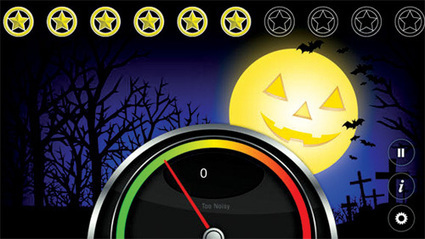
As every teacher knows, good classroom management can make the difference between a great class experience and a poor one. While technology doesn’t replace the need for a solid approach to classroom management, tech tools, including these, can certainly help.
Beth Dichter's insight:
Richard Byrne shares two timers, an iPad app that helps students understand noise levels (and hopefully learn to keep their voices down), and a random name selector. There is a detailed explanation of each tool and two videos, one that shares how to use classroom timers and one that looks at using a random name generator in a class. 
LucaVanin's curator insight,
November 1, 2014 4:51 AM
Strumenti per la gestione dell'Aula, anche virtuale.
Scoop.it!

Sometimes it feels crazy overwhelming to keep assessing students and know exactly what they do/don't understand. That's where these quick and easy formative assessment ideas comes in! My school dis...
Beth Dichter's insight:
This visual that shares a number of ways to do assessments would be a great tool to add to your toolkit. The post provides links to additional resources for assessments. Click here to download the version in the graphic above: (PDF): Formative Assessments. 
Denver Leigh Watson, M.Ed, LDTC's curator insight,
October 31, 2014 1:28 AM
We often think of assessment in a formal, summative sense; however, the art of formative evaluation is critical to master in order to assess how well students are grasping concepts. Jumping past basic recall and simple predictions, formative assessments are great tools for establishing where personal connections have been made in a child's learning process. While we are reaching for the application and synthesis of knowledge, we need to break free from multiple choice bubbles and encourage students to travel deeper into their learning.
Scoop.it!

"USC Rossier School of Education, in collaboration with the Mattel Children’s Foundation, has launched “Speedometry™,” a free-to-use curriculum that utilizes Hot Wheels® toys to teach elementary-age students science, technology, engineering and mathematics (STEM). “Speedometry” is tailored for children in fourth grade and emphasizes hands-on discovery and learning." (Quoted from press release from USC Rossier School of Education, http://rossier.usc.edu/usc-rossier-and-mattel-childrens-foundation-launch-innovative-stem-curriculum-for-fourth-graders/)
Beth Dichter's insight:
Here is a new free program offered through USC Rossier School of Education and the Mattel Children's Foundation that provides a curriculum geared to Grade 4 that will help students engage in STEM. The program is called Speedometry and will have students learning about scientific concepts like velocity, gravity, kinetic energy and more. Most exciting is that you can put in a request for a free kit that will provide:
This link will take you the page where you can apply, and you can also download the lesson plans. What a great opportunity! 
Aevalle Galicia's curator insight,
October 30, 2014 3:23 PM
Okay, so not really math but still an awesome way to get kids interested in math and physics!
Scoop.it!

In an 11th-grade English class at Pittsfield Middle High School in rural New Hampshire, Jenny Wellington’s students were gathered in a circle debating Henry David Thoreau’s positions on personal responsibility. “Do you think Thoreau really was about ‘every man for himself’?” asked one 16-year-old boy. “He lived alone in the woods and didn’t want to …
Beth Dichter's insight:
What happens when a school chooses to introduce student-centered education and the state requires that high schools look at competency-based model, rather than seat-time, to award credits? Based on this article pretty amazing things can happen. This is not a short article, but it is worth reading. You will hear from students, staff and administrators about the changes that have happened and what is planned for the future. If the idea of a competency-based model is new to you it may change your perspective on education. Take the time to read this report. You may also find yourself checking out some previous reports from Hechinger. Throughout the report there are links to previous reports that share additional information on some of the concepts discussed.
Scoop.it!

"The rise of the standing desk may appear to be a response to the modern, eat-at-your-desk, hunched-over worker chained to her computer, but history paints a different picture: Hemingway, Benjamin Franklin, and Thomas Jefferson all stood while they worked. Donald Rumsfeld had a standing desk, and so did Charles Dickens. Workplaces are moving toward more standing desks, but schools have been slower to catch on for a variety of reasons, including cost, convenience, and perhaps the assumption that “sit down and pay attention” is the best way to learn."
Beth Dichter's insight:
How would your classroom change if you were to switch to standing desks? Would it help your students who prefer to move? Would they learn more? This post looks at one small study and the results show that standing desks may make a difference. Students (and adults) need to move. Sitting in a chair is more confining than sitting on a stool or standing. Take the time to read this post and you may find yourself trying to create your own standing desk, or perhaps you might write a grant to bring one or two standing desks to your classroom.
Scoop.it!

"How you and the world have changed since you were born. Best viewed on Chrome, Firefox and Internet Explorer 10 and above."
Beth Dichter's insight:
Check out this new site from BBC that allows you to see how the world has changed since you were born. Learn how many times your heart has beaten. Learn how far you have traveled through space. Find out what species has been discovered in your lifetime and how much the sea level has raised. This would be a great site to have students explore and then write about the changes they think are most important, or have them create an infographic that shares changes. Or you might use it to explore how fast the world is changing for a classroom discussion.
Scoop.it!

Quoted from the post: I spent last weekend on a camping trip with extended family. Having just completed a report on the use of digital games in the classroom, I was more than a little eager to consult with the kids in the group about their use of digital games inside and outside of the classroom. Given the popularity of Minecraft, I started there. “Do any of you guys play Minecraft?” I asked. Instantly there were three kids with three devices surrounding me, each showing me their “worlds.”
Beth Dichter's insight:
Should students play digital games in the classroom? This post, from the Joan Ganz Cooney Center provides a link to a report, Level Up Learning: A National Survey on Teaching with Digital Games. In 2012 the Cooney Center did a similar survey. This one provides more up-to-date information. They sampled 684 K-8 teachers and divided the report into four sections: 1. The "players" (a look at the game-using teachers); 2. The "practices" (as in the practices teachers engage in with their students around game playing); 3. The "profiles" (of the teachers that looks at how teachers use games in terms of frequency and ways: 4. The "perceptions" of the teachers (barriers and opportunities) This post provides an overview of some of the key finding and much more is found in the 67 page report (which is linked to in the article and can be found at http://www.joanganzcooneycenter.org/wp-content/uploads/2014/10/jgcc_leveluplearning_final.pdf.
Scoop.it!

“Sticky Teaching”–interesting idea. Learning that lingers. Chris Lema gets at that idea in the following presentation, along with a basic explanation of why this idea works by focusing on the patterns that brains “can’t ignore.” Cool approach, so we’ve taken the six strategies, and given an example for each.
Beth Dichter's insight:
Sticky teaching looks at "understanding what the brain can't ignore." In this post there is an explanation of six strategies of sticky teaching. 1. Awaken the intrigue. 2. Begin and end often. 3. Create lots of contrast. 4. Draw them in with stories. 5. Emotion draws attention. 6. Focus on the big idea. Each of these ideas is discussed in the post. There is also an embedded slideshare in the post. It provides some interesting statistics and explains why each of these strategies work.
Scoop.it!

Can kids solve real life problems that affect our world? Sure! Why not? Many of you know the 7 sterile steps to PBL. How about adding a little more to the 7 steps? Here are a few ideas about how to...
Beth Dichter's insight:
Check out this great visual on Problem Based Learning (PBL)from Mia MacMeekin. It provides a look at the seven steps found in PBL. For each step she provides a number of ways for students to think about the specific process. What are the seven areas? 1. Start with a real life problem 2. Map it out 3. Prototype, prototype, prototype 4. Be creative 5. Think global 6. Join a challenge 7. Set goals 8. Create learning moments Along the way she also makes some suggestions on what you should be doing as a teacher. If PBL is new to you (or your students) this would be a great visual to have your students recreate, where they may change words and add images to make it their own. Then hang it in your classroom and support them as they become experienced at problem based learning.
Scoop.it!
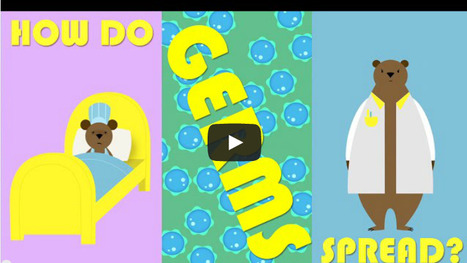
"Germs are found on almost every surface we come in contact with, which makes it incredibly common for our bodies to be exposed to them. But why are some of these germs relatively harmless, while others can be fatal? Yannay Khaikan and Nicole Mideo explore this question by examining germs’ varying modes of transmission."
Beth Dichter's insight:
As flu season approaches teaching students about germs is something we try to do in many classrooms. To make it a bit more understandable this TED-Ed video provides a look just how germs may spread. The language is appropriate for a range of grades (as terms are also explained). And as all TED-Ed videos you will find a list of additional resources as well as a quiz and a discussion questions.
Scoop.it!
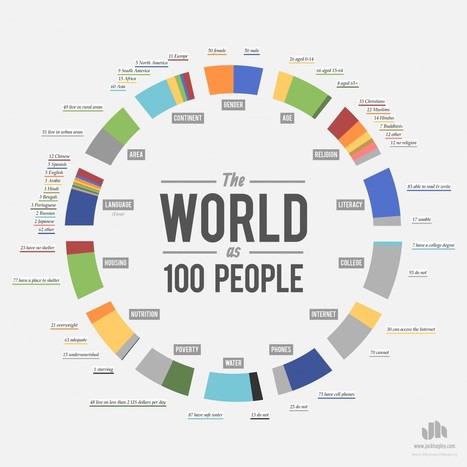
The World as 100 People. This idea has been around since 1990. This is my attempt at presenting the information.
Beth Dichter's insight:
This infographic shows the data in format that may make it easier for some students to understand. To see the original data visit 100 People: A World Project (and the page that opens has the statistics). 
Ryan Rejaei's curator insight,
October 20, 2014 8:41 PM
So interesting. And easy to understand the information 
Becky Roehrs's curator insight,
October 23, 2014 3:54 PM
If you want to see a detailed breakdown and find out where the data came from, here you go: http://www.100people.org/statistics_detailed_statistics.php |
Scoop.it!

Whether you use musical instruments, game pieces, call-and-response, or electronic devices, there are many successful ways of getting students to focus front and stop talking.
Beth Dichter's insight:
At times we need to quiet our students down. This post provides 30 suggestions that you might want to implement in your classroom. They have categorized the suggestions by grade levels, but it is often true that a tip for elementary school will also work with middle school students. Throughout the post there are links to additional resources, including a number of videos where you can see the suggestions in action. You might also consider reading the comments from other listeners. There are a number of ideas in some of them and one provides a link to a different article from Edutopia, A Sure Fire Strategy for Building Classroom Community (and I would suggest checking out the comment since you are hearing from a teacher who did this with their students).
Scoop.it!
Beth Dichter's insight:
Are you interested in having your students be more involved in the creation of projects? This visual is a "learning commons working model" that looks at "key stations in the learning commons." As a teacher what changes might you need to make in your classroom for this to work? What will you see and hear? How will you get your students engaged? Maker stations, innovation work, project-based learning - all are experiential and many of our students will gravitate towards projects if given the opportunity. This visual provides a road map that may help you make shifts in your classroom.
Scoop.it!
"Brain-based learning isn’t a new concept, but it’s enjoying renewed attention thanks to the teacher accountability movement begun by President George W. Bush and continued by President Barack Obama. In a nutshell, teachers who use brain-based techniques don their “neuroscientist” hats and focus on creating experiences that cater to the inner workings of their students’ brains. The result: better learning experiences and better retention."
Beth Dichter's insight:
This post shares three techniques you may want to incorporate into your classroom. Each has a short description as well as a section on why it is effective and how to implement the technique. * Incorporate frequent brain breaks * Make time for social and emotional learning * Teach smaller chunks As new research is published on the brain the impact it may have on the classroom is significant. If we know that providing short brain breaks (and movement breaks) may allow students to come back refreshed and ready to learn then we need to consider how we can provide these opportunities. 
Sally DeCost's curator insight,
November 1, 2014 12:17 PM
Excellent article on Brain Based Learning. It includes many of the concepts emphasized by Whole Brain Teaching.
Scoop.it!

Contrary to popular belief, high achievement isn’t merely a product of talent and ability.In fact, our internal beliefs about our own abilities, skills, and potential actually fuel behavioral patterns and predict success. Leading Stanford psychologist Carol Dweck argues that the pivotal quality sepa
Beth Dichter's insight:
As teachers we would like our students to have a growth mindset. What are ways we can help foster a growth mindset? This post provides four suggestions. Each is written below. To learn more about each of them click through to the post. 1. Think about setting achievable micro-goals to encourage students’ consistent, incremental progress. 2. When students succeed, praise their efforts and strategies as opposed to their intelligence. 3. Help students focus on and value the process of learning. 4. Design classroom activities that involve cooperative--rather than competitive or individualistic--work. There are additional links found in the article.
Scoop.it!

From
io9

Designer Eleanor Lutz is fast becoming one of our very favorite science-visualization artists. Her latest work provides a mesmerizing look at the weird and wonderful ways that animals breathe. (Did you know, for example, that grasshoppers have no lungs?)
Beth Dichter's insight:
This is an animated visual that shows how human lungs, bird lungs, and a grasshopper (who does not have lungs) breathe. I suspect that students will be very intrigued with this and that a great classroom discussion could take place, or students might want to learn how other animals breathe, and compare them to the images provided.
Scoop.it!
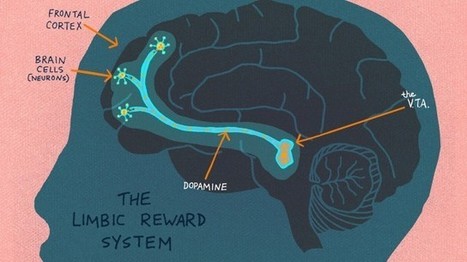
New research suggests that curiosity triggers chemical changes in the brain that help students better understand and retain information.
Beth Dichter's insight:
It seems that most days you can find an article that discusses new findings about how the brain works...and many of these finding my be important to educators. This post looks at how curiousity may trigger chemical changes in the brain, specifically "the parts of their brains that regulate pleasure and reward" as well increased activity in the hippocampus, which plays a role in the creation of memories. As a teacher I ask myself how can we get our students to ask questions? How can we ask our students to be curious (something that may be declining as standardized testing is pushed)? 
Aurore A.N Beaini's comment,
October 28, 2014 10:28 AM
I think your post is very interesting for children anyway, it's also useful for mothers
Scoop.it!
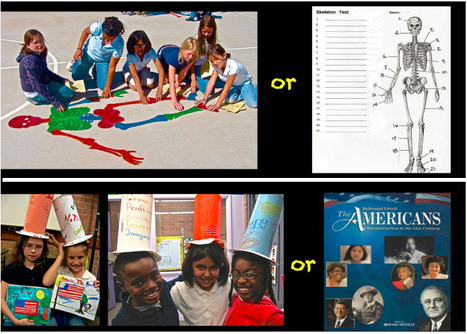
'The things we have to learn before we do them, we learn by doing them.' Aristotle "Give the pupils something to do, not something to learn; and the doing is of such a nature as to demand thinking; le..."
Beth Dichter's insight:
What is experiential learning? This post explores this concept, with a list of "principles as articulated by the Association for Experiential Education" and also eight images that compare experiential learning to a more traditional classroom. Finding projects that help students understand key concepts is one way for us to include experiential education in our classroom. The images provided in this post may spark your imagination. 
Drora Arussy's curator insight,
October 27, 2014 8:44 AM
Biology, history, religion, foreign language, math - irrespective of the topic, in order for it to be real, it must be experienced. Authentic texts and situations can be created through drama and other arts based projects. This is the base - now add all of the extra tools and methods, in context.
Scoop.it!
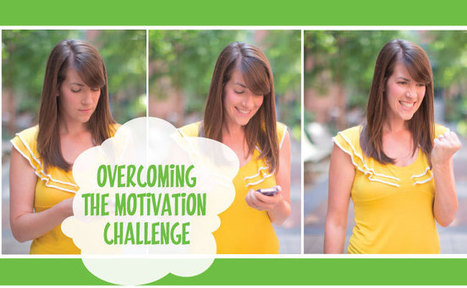
Keeping learner motivation levels high is one of the common challenges faced by the eLearning professionals. With these tips you can motivate them from that first splash to the finish line.
Beth Dichter's insight:
How do you motivate your students? This post explores this and shares five tips you might use if you teach online, but the same tips will also work in a face2face classroom. What are the tips? 1. Offer choice, control and freedom 2. Structure lessons around clear, real world goals 3. Create engaging, bite-sized materials 4. Engage students with each other 5. Give - and seek - feedback frequently. Each of these is discussed in more detail in the post.
Scoop.it!

"The Franklin Academy High School implemented a 1:1 iPad deployment a the beginning of the 2010-2011 school year. Over the course of the next two school years, the pilot was expanded to include all grades 9-12 in the high school. This deployment has reached 475 high school students and all teaching staff. Our K-8 program deployed iPads across the grade levels in the form of class sets and mobile carts. This study targeted our 1:1 deployment at the high school to investigate the impact the device has had on teaching and learning. The survey used to gather the student data was administered in April of 2014. Students included in the survey used the device anywhere from 1 to 4 years. The students use the iPad while at school and home."
Beth Dichter's insight:
The Franklin Academy (located in Wake Forest, NC) began a laptop initiative four years ago. Te@chThought has just published their four year study and review which focuses on Student Use and Behavior. You can access a pdf and download the report from the site. You can find more information about the initiative as well as information from previous years and a detailed visual that looks at the four years using the following categories on the Franklin Academy High School iPad Initiative Wiki * Learning Workflow * Device Management * Student Benefits * Teacher Benefits If your school is considering an iPad initiative (or a 1-to-1 initiative) you may find valuable information as you read through the the report and the Wiki.
Scoop.it!
Beth Dichter's insight:
This video presents SAMR, but there is a twist. It is from the student point of view. They clearly explain the four components of SAMR and also provide examples. Additional resources are provided at the end of the video. 
Chris Hua's curator insight,
February 9, 2018 10:10 PM
SAMR explanation in the perspective of the student
Chris Hua's curator insight,
February 9, 2018 10:20 PM
SAMR explanation in the perspective of the student
Scoop.it!

"Once upon a time there was a Google Spreadsheets script that would create word clouds for you. When the new (current) version of Google Spreadsheets was launched that script stopped working. This morning I found a replacement for that old script."
Beth Dichter's insight:
If you or your students use Google Docs they can quickly generate a word cloud when their document has 100 or more words. Richard Byrne provides clear instructions in this post as well as suggestions on how your students might use the word cloud to help them revise, to find words the may have over used and more!
Scoop.it!
"Researchers have long been searching for better ways to learn. In recent decades, experts working in cognitive science, psychology, and neuroscience have opened new windows into how the brain works, and how we can learn to learn better. In this program, we look at some of the big ideas coming out of brain science. We meet the researchers who are unlocking the secrets of how the brain acquires and holds on to knowledge. And we introduce listeners to the teachers and students who are trying to apply that knowledge in the real world."
Beth Dichter's insight:
This radio documentary focuses on current research on how we learn. You may listen to the documentary, or you may read the transcripts. There are three programs that discuss: * This is Your Brain on Language - This portion focuses on raising a bilingual child. It turns out that children whom are bilingual have higher executive functioning skills. * Learning to Love Tests - That's right, we can teach students to love tests, but only if we use them correctly! * Variation is Key to Deeper Learning - Trial and error is one way to learn, but it turns out that if you "build a level of desirable difficulty" into the learning process (and tests) students may retain more knowledge and skills. Choose to listen to the interviews with experts in these areas, or read through the transcripts to learn more about this new research and how it may impact your teaching and your students. |







Joyce Valenza provides a brief look at many of the amazing goodies provided by Google. A partial list is below, but when you click through to the post all of the sites are hot-linked, so you click and arrive quickly at the site. Have fun exploring!
* Build with Chrome (think LEGOs)
* Google Earth Tour Builder
* Zygote Body
* Google Cultural Institute, that now includes Google Art Project, Historic Moments and World Wonders
* Google Ideas Projects - Valenza states that these projects "seeds technology-driven initiatives by connecting users, experts and engineers around critical issues that people face in times of conflict, instability or repression."