


A 3 Tiered App-roach to the discovery of SAMR

 Your new post is loading...
 Scoop.it! A 3 Tiered App-roach to the discovery of SAMR No comment yet.
Sign up to comment
Scoop.it!
"It’s always revealing to watch learners research. When trying to understand complex questions often as part of multi-step projects, they often simply “Google it.” Why do people migrate? Google it. Where does inspiration come from? Google it. How do different cultures view humanity differently? Google it. Literally Google it. Type those questions word-for-word into the Google search box and hope for answers..."
Beth Dichter's insight:
Today many students when asked a question choose to Google the answer. A generation is turning to one (or perhaps two or three) search engines and reading the top two or three results. As educators we should think about how this type of search is impacting how our students think. This post explores this, looking at three areas: 1. Google creates the illusion of accessibility 2. Google naturally suggests “answers” as stopping points 3. Being linear, Google obscures the interdependence of information What do you think? Do you think Google is impacting student learning? Do you think that project based learning, inquiry learning, authentic learning projects would provide opportunities for students to not only search, but to use their critical thinking skills? This post may make you look at search engines in a different way.
Scoop.it!

This infographic outlines the learning theory pioneered by George Siemens and Stephen Downes.
Beth Dichter's insight:
Have you wondered what connectivism is? This infographic, using information from Stephen Downes and George Siemens provides this definition for connectivism: "...the thesis that knowledge is distributed across a network of connections, and therefore that learning consists of the ability to connect and traverse those networks." What are the 8 principles? They are listed below but you will find much more information in the infographic. 1. Learning and knowledge rest in a diversity of opinions 2. Learning is the process of connecting specialized nodes 3. Learning may reside in non-human appliances 4. Capacity to know is more important than what is currently known 5. Nurturing and maintaining connections is needed to facilitate continual learning 6. The ability to define connections between concepts is important 7. Currency (accurate, up-to-date knowledge) is the intent of all connectivist learning activities 8. Decision-making is a learning process as information can change and what is viewed as correct one day may be incorrect the next The second part of this infographic focuses on What Does an Online Connectist Course Look Like? There is much information to be found in this lengthy infographic. It also includes a list of works consulted.
Scoop.it!

"According to an article on Time.com about the best and worst learning techniques, active learning methods (e.g. writing) are far more useful for long-term retention than passive learning methods (e.g. highlighting or underline words). One of the best ways? Surprisingly enough: flashcards, according to research from the Association of Psychological Science."
Beth Dichter's insight:
Brain research has shown that recalling information is one of the best ways to learn. What better way to recall information than to use flashcards. This post, from Edudemic, shares three flashcards apps. It provides information on each, sharing features and providing a conclusion that may lead you to prefer one app over another. Share this information with your students. Consider challenging them to create a set of flashcards that others could use to review.
Scoop.it!

Find education news, teaching strategies, lesson plans, activity ideas and more on the WeAreTeachers blog. Featuring posts by guest bloggers and teachers.
Beth Dichter's insight:
If you have not checked out Wonderopolis it worth your time to head over and see the resources available. They post a Wonder of the Day (and as of this writing they have 1328 wonders). You will find a question and a movie, but that is just the beginning. There are additional questions, a Wonder Gallery, Wonder Words (as in vocabulary), Try It Out (ideas for follow-up work), Still Wondering (additional resources), Test Your Knowledge, and a Wonder What's Next (a teaser for the following wonder). Although this was written for a Kindergarten class the site allows you to search and provides Wonders appropriate through high school. The idea of using this as a tool for writing is one that could be used in any classroom, and you could focus it in specific areas or change it daily. And if you are looking for some Wonders that are appropriate for younger grades you may want to check out this post by the author: 50 Great Wonders from Wonderopolis for Primary Grades. 
Carola Brunnbauer's curator insight,
November 12, 2014 1:26 AM
tatsächlich eine wunderbare Website und ein sehr schöner Erfahrungsbericht, so etwas sollte es auch auf Deutsch geben
Scoop.it!

"Recently, the NY Times ran an excellent article entitled: A Natural Fix for ADHD. In this piece, Dr. Richard Friedman, Professor of Clinical Psychiatry and Director of the Psychopharmacology Clinic at Weill Cornell Physicians, explores the neuroscience behind ADHD (Attention Deficit Hyperactivity Disorder). In so doing, Friedman attempts to reframe our understanding of just what ADHD is, and how much more nuanced our approaches for treating it need to be."
Beth Dichter's insight:
This post from Edudemic explores ADHD in five areas: * ADHD has long been a controversial topic * The neuroscience behind ADHD * When ADHD was an evolutionary advantage * 5 Creative Approached - Get hands on - Vary the routine - Incorporate movement into your lesson plans - Teach mindfulness - Create a tutoring program Many of us have students with ADHD in our classrooms, and we know that day to day the behavior changes. This post provides some background information that was certainly new to me as well as some ideas you might incorporate into lessons that may help all your students, not only those with ADHD. I would also recommend reading the NY Times article referenced above. It will provide additional information.
Scoop.it!

"In the past year, education researchers have done much to turn commonly held beliefs about learning on their head. In her controversial new book, Seven Myths About Education...Daisy Christodoulou draws on her recent experience of teaching in challenging schools to show us just how much educational practice contradicts basic scientific principles..."
Beth Dichter's insight:
What myths do you know that undermine educational effectiveness? This post provides 21, and each is explained in the post. Fourteen of the myths provide links to additional information. Five of them are listed below. Click through to the post to find additional information on these five and the additional sixteen. * Facts prevent understanding. * You can always just look it up. * Homework boosts achievement. * Subject matter knowledge is a teacher's most powerful asset. * The brain is static, unchanging and set before you start school. You may not agree with all of these myths. Many could be used as a starter for discussions in a faculty meeting or with parents. 
Lon Woodbury's curator insight,
November 10, 2014 10:07 AM
Its amazing how many things there are that everybody knows - but just ain't so! -Lon
Scoop.it!
Beth Dichter's insight:
With the new revised Periodic Table there was the need for a new Periodic Table song...and here it is. Not only are the elements in order, the song also explains the new set-up of the table. You may want to partner this with the new TED-Ed Periodic Videos that have been published. There is a video for every element. If you find the New Period Table Song moving a bit too quickly you can find a version that is slowed down HERE. You will also find the words to the song in you click "Show More" under the video (for the song versions) and you will find links to download the song. As students have to learn this new chart many will find the song entertaining and a great way to learn the elements. The videos from TED-Ed provide an avenue for students to learn about the elements by watching a video, which many will also find entertaining.
Scoop.it!

"Carol Ann Tomlinson, author of “The Differentiated Classroom: Responding to the Needs of All Learners,” is the country’s preeminent scholar on differentiated instruction. Tomlinson defines differentiated learning as “ensuring that what a student learns, how he/she learns it, and how the student demonstrates what he/she has learned is a match for that student’s readiness level, interests, and preferred mode of learning.” She likens the reluctance to integrate modern knowledge of the learning process into the classroom to settling for a Model T instead of embracing 21st-century engineering."
Beth Dichter's insight:
This post explores some of Carol Ann Tomlinon's work on differentiation. Specifically it looks at: * Content * Process * Product * Affect After defining each of these concepts you will find the following sections: * The Empirical Basis of Differentiation * Implementing Differentiation in your Classroom * Anecdotal Support for this Method * Criticisms of Differentiation Many teachers find it difficult to find the time to differentiate for all students and some students find it frustration to discover that they have more work than other students. Today we are often told that we need to personalize the instruction for each student. Differentiation is one way we can walk down this road.
Scoop.it!

Digital citizenship is not so different from traditional citizenship. We still need to guide students to be kind, respectful and responsible. What’s new is teaching them how to apply these values to the realities of the digital age.
Beth Dichter's insight:
This new infographic from ISTE compares a good citizen to a good digital citizen. Many students many find this poster of value as they learn the need to be a good citizen both online and offline. As the post states, being a good citizen and a good digital citizen "are not so different from the basic tenets of traditional citizenship: Be kind, respectful and responsible, and just do the right thing."
Lon Woodbury's curator insight,
November 10, 2014 3:36 PM
We still have a long ways to go to figure out how to make this happen as effectively as we do face to face interactions. -Lon
Scoop.it!

Helping every student experience meaningful, deep learning is a constant challenge, in no small part because no two learners are alike. To reach students who are particularly challenged -- whether because of their ability to speak English or some other reason -- educators can find a way in by tapping into students' interests and passion.
Beth Dichter's insight:
How do we get our students to do deeper learning? One way it to find our what our students are passionate about, allowing them to connect their personal life to their academic life. The post discusses challenges that of English language learners, yet the ideas apply to all of our students. Three sections provide suggestions: * Creating Structures for Success * Teacher Grouping * School Structures to Promote Success There are many quotes I could choose to share. This is the one I have chosen: '“The first thing that comes to mind for me is changing students’ perceptions of themselves so they don’t see themselves as unable to learn...If they are thinking about themselves as students who are exercising that muscle, the brain, then it changes their perception of themselves.”
Scoop.it!

Hi everyone,Here are a few fun suggestions to increase your vocabulary prior to undertaking your exam.Cheers,Kaitlin RobbsVivid-Verb-Listtone_mood_words
Beth Dichter's insight:
Here is one great visuals and two word lists for vocabulary. The image above is a word wheel that looks at emotions, helping students hone in on other words that may more accurately describe a character. There is also a Vivid Verb List and one that looks at moods. 
Lisa Norris's curator insight,
November 4, 2014 9:54 AM
I would have my upper ES grade students add this to their writer's notebook! Excellent resource to help with continuous vocab growth! 
Drora Arussy's curator insight,
November 4, 2014 10:44 AM
Such a great simple visual tool. Should be in everyone's bookmark, on your physical wall hanging up, or whatever other means you use. It helps you start thinking a bit about what words you can use and how to use them. 
Janet McQueen's curator insight,
November 4, 2014 5:38 PM
Great tools for expanding ELLs vocabulary especially useful when writing.
Scoop.it!
I put together this video for my class of seventh graders. Song features contributions from the following artists: Ben Jackson, Matt Omalley, Nakia Simon, Ta...
Beth Dichter's insight:
Learning the difference between various words that describe things figuratively is often difficult. Here is a video that may help your students understand the following terms: * Personification * Alliteration * Assonance * Hyperbole * Onomatopoeia * Metaphor * Simile Through repetition, images, the use of the words in context, and a melody that one can sing along too this video may find a place in your classroom. Although designed by a Grade 7 teacher you may find it useful in grades above and below Grade 7. Kudos to the teacher who posted this, Revae Mendoza! 
Mel Riddile's curator insight,
November 3, 2014 8:59 AM
Here is a video that may help your students understand the following terms: * Personification * Alliteration * Assonance * Hyperbole * Onomatopoeia * Metaphor * Simile |
Scoop.it!

The right image may be just the added touch your blog post or social media update needs to get noticed, but finding free, high-quality photos that you can use is challenging. You'll want to bookmark all of these resources to use time and again.
Beth Dichter's insight:
Finding free images to use online is not always easy. This post provides 12 sources to help you find the image that may be just right for blogging or social media posts. Several of these sources may be new to you, and each is described with some detail so you may find one or two that would meet your needs. What are the sources? * Unsplash * Pixabay * FreeImages * PicJumbo * FreePixels * Gratisography * Death to the Stock Photo * SumALL * DreamsTime * Free Range Stock * ImageBase * Unprofound Do you have a favorite site that provides free photos? If so, share it in the comment section. 
Katherine Zhang's curator insight,
November 18, 2014 7:35 PM
Free images to use for blog, social media post. A great photo can hep you reach more audiences. Save the link as your reference.
Scoop.it!
Beth Dichter's insight:
Do you find that during classroom discussions students often disagree with others but have provide reasons that may not be accurate. This series of five videos from the PBS Idea Channel chips away five of the most common fallacies that you find in arguments that are seen online. The Guide to Common Fallacies includes: * The Straw Man Fallacy * The Ad Hominem Fallacy * The Black and White Fallacy * The Authority Fallacy * The "No True Scotsman" Fallacy The link above will take you to a page where each one may be seen individually. There is also a playlist that provides an introduction that is located here. The individual videos are about 2 to 2.5 minutes in length, totaling ~11 minutes. If you watch the playlist it will be about 13 minutes long. This series of videos would be great to use in classes where you discuss issues that are often controversial, such as propaganda, bias and many currents events. 
Donald Herrera's curator insight,
November 17, 2014 1:09 PM
Guía en Video de las Falacias más Comunes
Scoop.it!
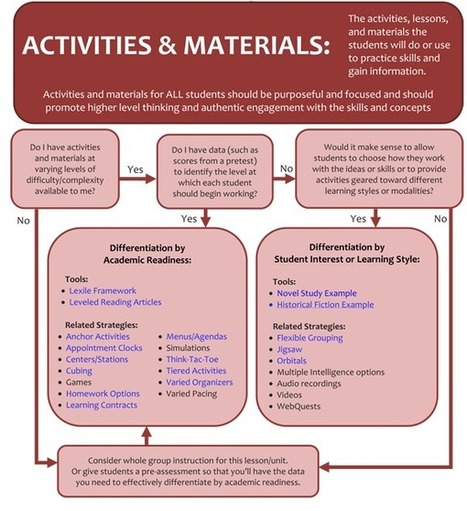
"Differentiation is adjusting and modifying what skills and concepts student learn, what materials the use, and/or how their learning is assessed based on the needs of the students. Our students are not all the same, so we cannot expect that teaching a lesson one way will reach every student."
Beth Dichter's insight:
This post from For the Teachers provides two great resources to help you look at differentiation in your classroom. The first is a detailed visual (Differentiation Planning Diagram) that looks at three areas of planning necessary for differentiation. * Concepts - The skills and concepts students will are expected to know or be able to do (at the end of a lesson or unit). * Assesments - How the students will demonstrate what they have learned. * Activities and Materials - The materials, activities and lessons that students will do or use to practice skills and gain information. There is also a great visual that provides 101 Ways to Show What You Know (which may be downloaded as a pdf). This visual has four areas that students may show their knowledge/understanding: * Visual * Written * Performance * Spoken You may find yourself printing out this visual and using it as a way to quickly consider a variety of ways students could demonstrate their knowledge. The Differentiation Planning Diagram may also be downloaded.
Drora Arussy's curator insight,
November 17, 2014 8:11 AM
We hopefully are all trying to differentiate, but sometimes we need that creative push and encouragement. This is a wonderful resource with printable infographics for coming work areas and links to concepts and other resources to really get you thinking in every direction outside of the box - each student will gain something out of you using this.
Janet McQueen's curator insight,
November 17, 2014 6:57 PM
These differentiation flowcharts will prompt teachers to make good decisions around scaffolding of student learning. 
Becky Roehrs's curator insight,
November 17, 2014 7:08 PM
Check out concepts, assessments, and activities for differentiation...
Scoop.it!

PBS LearningMedia wants to give you the tools you need to navigate and succeed in the digital age of learning. We’ve compiled a short list of favorite tec
Beth Dichter's insight:
PBS is a great resource and this post from Mind/Shift highlights a number of their best resources. The grade range spans Grades 2 - 12, with a focus on Grades 6 - 12. Several also include professional development opportunities available online to help with a specific resource. * How to Make an Interactive Timeline * Technology and You * How to Make a Prezi * The Art of Creative Coding * Engaging Students in Lecture and Labs * Teaching Civic Engagement Using Social Media * Educaching * Changing Students Lives Through Tech To access these materials you will need to join PBS (which is free). Remember, there are many additional resources available on the PBS website.
Scoop.it!

"One of the strategies that I use when creating lesson plans is to reflect on the previous lesson. Part of that reflection includes feedback from students. This can be done by simply asking students to raise their hands in response to a "did you get it?" type of question, but I like to have better record of responses than just a hand count. Here are some tools that can be used for collecting exit information from students."
Beth Dichter's insight:
Richard Byrne shares five tools that he uses with students. They are: * Google Forms * Padlet * Socrative * Poll Everywhere * Plickers - For the classroom that isn't 1:1 Each tool is discussed and if you search for the tool on his website you will find information about how to use it. You may find that your students will be more engaged with exit slips if they use technology to respond. In addition, some of these tools provide unique ways to see the response, such as Poll Everywhere which will display feedback as word clouds.
Scoop.it!

"Michelangelo defines great art. He carves the human form in marble as if it is caught between breaths. Muscles glisten with sweat. Agony shows on eyebrows as taut fingers curl. Oh to live as a master like Michelangelo! We know from his own words his desire to level up... If you’re great –good enough is never good enough. The arch enemy of greatness is our own complacency. An insatiable desire to innovate lives in the DNA of the awesome. Do you want to be awesome too? How?"
Beth Dichter's insight:
There are days when it is difficult to move forward, when frustration has taken over enthusiasm and we may question ourselves. This post is a lesson in inspiration (at least for me) and provides great quotes and images that lead one to think again about how to handle the difficult situations we find ourselves in, be in the classroom or out of the classroom. The post provides 8 suggestions, and each is followed by a quote and/or visual. Each is also followed by a question. What are the suggestions? Three are listed below. * Decide to Level Up. And the question is....What is one new thing I can learn today? * Take Time to Read. And the question is...What is the last book I read? * Seek inspiration. And the question is....Where do I struggle to be inspired? How can I inject vitamin B there? Allow yourself the time to read through this post and re-energize your spirit. May your day be awesome!
Scoop.it!

"Quite simply, digital storytelling is the act of using computer-based tools (desktops, laptops, tablets, cameras. and even smartphones) to tell a story. Used in the classroom, it is a lens that teachers and students can use to master the craft of storytelling and argumentative analysis. Digital storytelling might incorporate anything from storyboarding to script writing, revision, production and further editing."
Beth Dichter's insight:
Digital storytelling is a great way to introduce students to many skills. Students can learn how to create story boards, edit and revise their writing, select a digital tool and create a product. This post from Edudemic provides a guide that you may find useful if this is new to you. After introducing digital storytelling the post provides ten lesson ideas as well as additional resources. There are a few suggestions I would add to this list. One, the tool xtranormal, which is referenced in the second lesson idea, is currently not available. However, the good news is that another company has purchased the company and it will return. For younger children a good tool to help create a digital story is Little Bird Tales. The website Storybird is also a great tool to check out and they provide amazing images that students may use to create their story. This site may be used with younger students as well as students in high school.
Carola Brunnbauer's curator insight,
November 10, 2014 2:38 AM
Unterrichtsidee der «Historical Slide Show» als Anregung für die WB Mediendidaktik Geschichte
Scoop.it!

"Over a decade ago, cognitive scientists John D. Bransford and Daniel J. Schwartz asked fifth graders and college students to create a recovery plan to to protect bald eagles from extinction. Surprisingly, the two groups came up with plans of similar quality (although the college students had better spelling skills)."
Beth Dichter's insight:
How do students learn to ask questions? Today many schools are driven by test taking, but lacking in teaching students how to ask questions. We ask student to be critical thinkers, but do not necessarily provide the tools. This post will help you with some of the tools. Learn about different types of questions: * Display questions * Referential questions * Open-ended/divergent questions * Closed/convergent questions * Low risk questions Consider the purposes of questions Effective questions vs ineffective questions How to design effective questions And last (but not least) find 30 thought-provoking questions to ask your students. This resource is rich with material that may help you move your students in their skills in asking questions. 
Susan C. Freeman's curator insight,
November 8, 2014 11:50 AM
This article is terrific. However, James says the apple falling is a myth. What say you?
Scoop.it!
"Project-based learning is one aspect of the Common Core’s with extra buzz. PBL engages students in purposeful ways by providing opportunities to develop a laundry list of 21st century skills in areas including critical thinking, research strategies, collaboration, communication, and literacy. If your head is spinning and you are wondering how you are going to make time for and create appropriate PBL opportunities for your elementary students, don’t worry! The good news is there are many ways to incorporate practical project-based learning into your elementary classroom. "
Beth Dichter's insight:
If you are considering project-based learning, but have questions about just what to do, this post may assist you. There are many suggestions about practical PBL projects that are appropriate for students in grades K - 5. The post also includes a quick overview of the stops in PBL as well as a list of read-aloud books that may inspire students to ways they might create a project that will help their community. You will also find a list of ten ideas for projects and three other sections: * Inspire Projects with Hand to Heart/Paw/Earth * Teach Students to Ask Questions/Research Across Texts * Try Ready-Made Books and Projects with Heifer Project-based learning provides authentic learning opportunities for students to be highly engaged and to focus on the four C's that the Partnership for 21st Century and Common Core would like us to address: Communication, Collaboration, Critical Thinking and Creativity.
Scoop.it!
Beth Dichter's insight:
This infographic is from the Center for Teacher Quality in Kentucky. It shares three recommendations that a group of teachers came up with when asked to explore this challenge: "rethink professional learning and restructure the school day to improve learning for students and teachers." The three areas discussed are: 1. Redesign school schedules to prioritize learning for students and teachers. 2. Promote teacher-driven Professional Learning Communities. 3. Rethink classroom structures and needs. Along with information on these areas this post also includes a pdf of the infographic as well as a series of blog posts on professional learning and a Prezi presentation. Consider sharing this infographic (and the other information) at a faculty meeting. Do teachers in your building think these types of changes would impact their classroom? Would they want to explore this as an option in the future? 
Beth Dichter's comment,
November 7, 2014 11:23 PM
Chris, I think this is a dialogue that needs to take place in schools. I found the article/infographic and reviewed the materials and realized that the dialogue needs to move from the school to the community, so that the support is from a much broader base. Thanks for your comments.

Ines Bieler's curator insight,
November 8, 2014 4:01 AM
This is a a great reminder to put our focus on collaboration again. And both sides - teachers and students are beneficiaries. 
ManufacturingStories's curator insight,
November 8, 2014 3:18 PM
For more resources on STEM Education visit http://bit.ly/1640Tbl
Scoop.it!
Shows how something extraordinary can be achieved, provided we have some more time. :-)
Beth Dichter's insight:
How do you teach creativity? This video may not show how but it does let us know that to be creative takes time. In just over 2 minutes see the difference when assigning a task for a short period of time or for a more extended period of time. If we want our students to be creative we need to give them the time to BE creative. The question is, where do we find this time? 
o p's curator insight,
November 10, 2014 4:35 AM
Faire vivre aux clients le fameux effet WAHOUUU! nécessite de l'empathie et de la créativité... et du temps pour les personnes qui les accompagnent.
Scoop.it!
Beth Dichter's insight:
If you are looking from some short (as in 1 - 2 minute) videos that may help you begin a science lesson check out Ask Smithsonian, located on the Smithsonian website. You will find over 40 videos available. The topics vary, from What is the Origin of Applesauce to Is Quicksand Real to Why Do Bugs Die on Their Back. You will also find some videos that are applicable to social studies, such as How Did King Tut Die. |







About a year ago I scooped a post from Lisa Johnson on S.A.S.S.Y SAMR. Since that time she has spent additional time working with the SAMR model and her new thoughts on SAMR are found in this post.
Johnson now looks at SAMR as a 3-tiered model, and this link shares five resources filled with information.
Fancy SAMR provides an overview of SAMR. A video, Haiku Deck, a Visual Thinking Stem, and many images that describe SAMR are included.
Cheeky SAMR explores ways to connect SAMR to actual classroom tasks. You will find a Quizlet on SAMR (and it will take some thoughtful consideration). You can also print out the information on Quizlet and reflect on some questions
S.A.S.S.Y. SAMR has you explore what S.A.S.S.Y. means through an interactive infographic which provides a wealth of resources.
That's So Not SAMR looks at misconceptions about SAMR and provides an interview with Dr. Rueben Puentedura, who describes SAMR in his own words (and who first published on this concept).
And last but not least there is a page S.A.S.S.Y. SAMR Additional Resources where you can find the evolution of S.A.S.S.Y. SAMR (she is up to version 3) as well as additional resources.
If you have read this far, and not heard of SAMR, here is a brief description. It is a tool that allows teachers to reflect on how they are having students use technology. Is it used for:
S = Substitution
A = Augmentation
M = Modification
R = Redefinition