


Where is emerging technology heading? What may become mainstream in coming years? Here is one view of what the future may bring. You may look at this as a roadmap for students in STEM. This file is also available at http://envisioningtech.com/ as a screen-optimized PDF, a print-optimized PDF and a high resolution PNG.

Eclectic Technology
230.9K views |
+1 today
Filter by date
Tags
Tech tools that assist all students to be independent learners & teachers to become better teachers
Curated by
Beth Dichter
 Your new post is loading...
 Scoop.it! 
Do you wonder how to best teach about YouTube and Digital Citizenship? Google has just released a "new interactive curriculum to support teachers of secondary students (~ ages 13-17)." The curriculum has ten lessons: What Makes YouTube Unique, Detecting Lies, Safety Mode, Online Reputation and Cyberbullying, Policy, Reporting Content, Privacy Part 1, Privacy Part 2, Copyright, and Additional Resources/Appendix Including Parent Resources. There is a Teacher's Guide as well as Slides for each lessons.
Scoop.it!

Textbooks vs e-Books - What do students prefer? The marketing from Student Monitor surveyed 1,200 students enrolled full-time at 4 year colleges and universities. To learn more check out the infographic.
Scoop.it!

Web Lab. A series of interactive Chrome Experiments made by Google. See the magic of the web brought to life. Open to the world online. Live from the Science Museum, London. Enter the Lab. Quoting from Google's Official Blog "This idea that science and technology can inspire people is one that we hold close to our hearts. It’s also the thought behind a new exhibition we’re launching today online and at the Science Museum in London. We hope to inspire people around the world by showcasing the magic that the Internet makes possible...Each of the five experiments—Universal Orchestra, Data Tracer, Sketchbots, Teleporter and Lab Tag Explorer—showcases a modern web technology found in Chrome to explore a particular theme in computer science." Have some fun playing at the Web Lab!
Scoop.it!
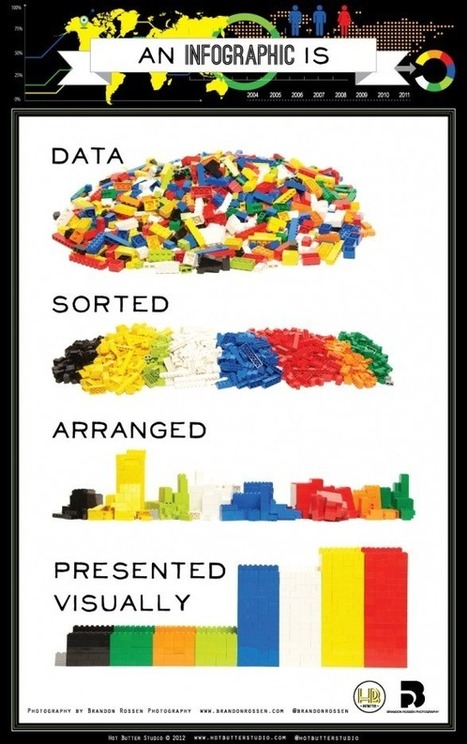
LEGO bricks illustrate the simple idea behind infographics.
Scoop.it!

Do you have questions about what Open Education is and why it matters? Would you like to be able to share information on why using Open Educational Resources (OER) has benefits and opportunities for teachers, students and schools? Check out the three videos that are the winners of the 'Why Open Education Matters' video contest sponsored by Creative Commons, the U.S. Department of Education and the Open Society Foundation. All are short (~ 3 minutes or less) and provide a great overview on Open Education. And all are open source! Share, remix, rebuild, educate yourself and others on the value of Open Education.
Scoop.it!

Are you looking for a resource with great tools to help you with the Common Core Standards? You may want to check out achievethecore.org. They provide "free, high-quality resources to educators now doing the hard work of implementing these higher standards." This link goes directly to a page called "Steal These Tools" with additional information also available on the website
Scoop.it!
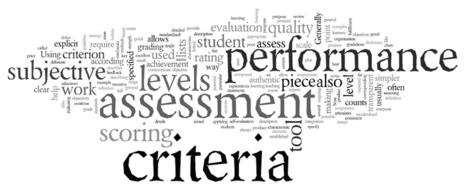
This wiki states that it was created to address to needs: "First, to explore what makes a rubric a "quality rubric" with definitions, examples, and non-examples. Second, to wrestle with some of the issues that come along with them. Definition: There are a variety of explanations as to the origins of the word, ranging from text in Medieval manuscripts inked in red in order to draw attention or highlight the words to annotations in the margin of a religious text. In education, the definition appears to change dramatically from author to author, website to website."
Scoop.it!

We've said it before: we love Pixar. Their stories are original, funny, and appeal to all audiences. They're masters. That's why Jess and I got excited when we saw Pixar's 22 rules to storytelling. An infographic plus the rules for storytelling in text form!
Scoop.it!

Quoting from the Google Official Blog: That’s the idea behind Maker Camp, a new online “summer camp” on Google+. Over the course of six weeks, 13- to 18-year-olds (as well as their parents and teachers) will have the opportunity to collaborate with popular maker personalities—including Mark Frauenfelder of Boing Boing, Stephen and Fritz of EepyBird (the Coke and Mentos guys), Jimmy DiResta (co-host of Dirty Money on the Discovery Channel) and Limor Fried (founder of Adafruit)—and other creative teens on fun projects themed around “the art of making.” Our goal is to encourage everyone this summer to make something and share it with their friends and family.
Scoop.it!

Qwikstory is a social network site that lets users create stories 1000 characters at a time. "The site provides great opportunity for use in educational environments in which classrooms can collaboratively and virtually work on concepts like writing. McFadden adds the site is also a good opportunity for non-English speakers to practice their reading and writing skills in a more connected manner. ...The story threads can also be made private and only accessible if invited by the creator."
Scoop.it!
Part 2 of a four part series on Transforming Lessons for the 21st Century Classroom. In this post Steps Four and Five are introduced and explained. Step 4 discusses how to "develop an engaging title...and pose a question out of content." Step 5 discusses how to "outline the technology to incorporate" As in the first part, each step includes links to resources to help you explore the concepts in more detail. Step 5 also discusses Bloom's Taxonomy and how it relates to 21st century learning.
Scoop.it!

Are you thinking of next year and your classroom? If so, this post may be just the thing to move you along. Vicki Davis has taken the alphabet and given us 26 tips that span the classroom. With links to many additional resources this resource will provide many ideas. |
Scoop.it!

There are many websites that offer looks at Bloom's Digital Taxonomy. Edorigami provides an in-depth look at Bloom's Revised Taxonomy, providing an introduction and background as well as information on the higher order thinking skills (HOTS). When we think of Bloom's it is important to remember that it is a learning process.
Scoop.it!
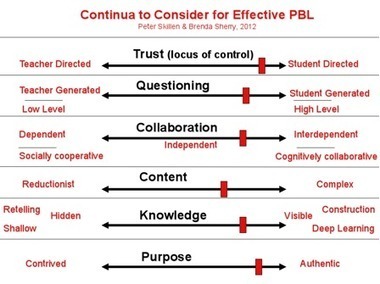
Project Based Learning - there are many views on this subject. This post provides a great diagram that helps to see the continua that one may consider when designing PBL. It looks at six issues: Trust (locus of control), Questioning, Collaboration, Content, Knowledge and Purpose. For example, with Trust the continua moves from teacher directed to student directed. Based on the project you may find that the location varies. A short description is provided for each of the six issues that you may want to consider as are additional resources.
Scoop.it!
Are you looking for some excellent resources to learn more about a Flipped Classroom? Perhaps you would like to try in in your classroom when school starts. This post provides a great introduction and provides an explanation about why the "simple definition" may not be the best definition. Following this section there are sections on: * Resources to Better Understand Flipping the Classroom * Higher Level Thinking Skills...Two Way Interaction...Formative Learning...21st Century Skills * Resources to Promote Higher Level Thinking Skills, 21st Centur Skills, and Formative Learning in the Flip * Research * Home Base for Flipping (as in learning management systems) * Global Communities (share across boundaries) * New and Latest Followed by a conclusion. A must read for folks interested in learning more about flipping a classroom.
Scoop.it!

We hear that students are visual learners, but studies show a wide discrepancy in the percentage of people who would be classified as visual learners, from 39% to 65%. This article looks at this fact, and the 'conundrum' that (quoting from the article): * Most information today is delivered visually. * Most studentsself-identify as visual learners. * Many students, in fact, are not visual learners. * Many students, therefore, are actively working (or studying) against their own educational self-interest. Two options are presented on "how to handle this dilemma" as well as a wide range of resources. Key is the concept of graphicacy, the literacy of decoding and encoding picture. For more information click through to an excellent article.
Scoop.it!

There are so many new buzzwords in education that it becomes hard to know what just what people are talking about...and to the rescue come an EdTech Cheat Sheet that will help you 'understand new trends in educational technology.'
Scoop.it!
A project by the Pew Research Center, Teens 2012: Truth, Trends, and Myths About Teen Online Behavior was presented at the ACT Enrollment Planners Annual Conference in July 2012. Some of this information may surprise you.
Scoop.it!

Is it possible to access student work from iPads use as a "class set"? According to the blog Digital Roadtrip the answer is yes. Learn about this "little known and cool method" that allows you so sync over wifi.
Scoop.it!

There are so many Learning Management Systems available, and Lore in one of them. Originally known as Coursekit, it has been redesigned and is getting great reviews. The website states: "With best-in-class teaching and discussion tools, Lore turns your class into an online community. By signing up, you’re joining the largest network of instructors and students in the world. Learn more." 
Alberto Rivera's curator insight,
June 5, 2022 4:14 AM
In times when content has become a commodity the thing that sets one platform or service apart from the other is the ability to build context around the content. In the case of Lore, this context is community. This community starts with the instructor and the students of a particular course but does not end there. Like on Facebook students have the ability to talk to and interact with each other outside of their course or school.
Scoop.it!

The concept of personalizing education has received more attention recently. In this post, Justin Reich explores the idea of personization and how it may impact education, with a focus on what he defines as "Moral #1 - that education for civic purposes cannot be personalized." He will have a second post for "Moral #2 - that (some forms of) personalization will optimize measureable outcomes at the expense of (potentially more important) non-measureable outcomes." What are your thoughts on the personalization of education?
Scoop.it!
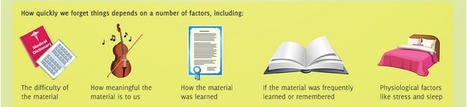
"Our brain houses many, many memories, but why do we remember some things so strongly and have a difficult time recalling others." Have you heard of the forgetting curve? This may help explain memory retention. Check out this infographic for more information.
Scoop.it!

There are many resources on how to evaluate web resources for classroom use and here is a new one to add to your list. This post provides techniques to consider when you are evaluating web resources: scanning the URL as well as specific items to look for on the website; evaluation criteria (five points to look for) as well as other evaluation tools you might want to check out. A number of other links are also provided as is a SlideShare version of the article that you may also download.
Scoop.it!
From
www

This pdf has a wide range of lessons which tend to be for secondary school. They include lessons in the disciplines of ELA, Math, Chemistry, Biology, Physics, History, Geography, Spanish, Art and Physical Education. Please note that all apps listed within the lesson are not free. |





