Your new post is loading...

|
Scooped by
Beth Dichter
July 14, 2012 8:27 PM
|
How can teaching metacognition impact the way a student learns? This post states that to teach students to become "expert learners" they must understand that metacognition involves three processes (quoting from the post):
* Teaching students that their ability to learn not only changes, but that they can affect how that ability develops,
* Teaching them how to plan for success and set goals, and
* Giving them lots of opportunities to monitor their learning and adapt their own learning strategies We may also help them by providing strategies. The article provides five recommendations on strategies, and an additional five may be found in a post on The Educators PLN at http://www.edupln.com/profiles/blogs/metacognitive-strategies-for.
|
|
Scooped by
Beth Dichter
July 14, 2012 11:03 AM
|
"As mobile learning programs become more ubiquitous, international attention is focusing on how different countries integrate mobile devices into formal learning." This post reviews a 'UNESCO Working Paper Series on Mobile Learning' specifically the section on 'Essential Conditions for Mobile Learning.' Five key conditions are detailed that are necessary for a mobile learning initiative to suceed: * Visionary Leadership and Commitment * Robust Technology Capacity * Professional Development * Scalability * Policies that Promote and Support the Initiative For additional information on these five areas and to access the Working Paper click through to the post.
|
|
Scooped by
Beth Dichter
July 13, 2012 7:55 PM
|
|
|
Scooped by
Beth Dichter
July 13, 2012 5:16 PM
|
Do you want your students to be more creative? Check out this video. "If we want students and graduates who are more creative, innovative thinkers, we must find better ways to free them from the constraint of time. At the end, the video states Creativity is not inspired by the pressure of time but by the freedom, the playfulness, and the fun. Does that describe most secondary classrooms you know? I know many that fit that description, but not anywhere near enough. Too many pressures regarding content coverage and/or accountability…"
|
|
Scooped by
Beth Dichter
July 13, 2012 1:56 PM
|
Blekko, the human-curated search engine, on Thursday unveiled a new content curation site, ROCKzi, which lets people consume and socialize around the news they care about in a PInterest-like environment. "Blekko, which lets people find filtered, in-context search results by using “slashtags,” appeals to power users (like librarians), Markson said. But, taking a cue from from other popular curation sites, ROCKzi was built to bring curation to a wider set of users through low-touch, passive curation tools. The site surfaces fresh content from news sources curated by power blekko users and displays articles in topic-specific, searchable “news boards,” from “Geekery” and “Glitterati” to “SportZ” and “Red State.” As of now, there are 33 boards but, over the next few weeks and months, it plans to expand to hundreds and then thousands more." If you have not tried Blekko for traditional searching it is well worth the effort, and based on the reviews of their new social search tool it too would be worth the effort.
|
|
Scooped by
Beth Dichter
July 13, 2012 9:30 AM
|
"Given all the press around the Flipped Classroom, Khan Academy, and Ted-Ed, long overdue discussions around the use of lectures in the classroom have evolved. Educators are questioning when, how, and what types of lectures best serve and address student learning. Along with this development, research is being conducted with students about how they want to be taught and what they learn via a lecture model of education. For example, according to “Learn Now, Lecture Later,” a new report released by CDW-G, only 23% of students are satisfied with the way the teachers spend their class time." A thought provoking look at how lectures are used and changes we might consider in the classroom.
|
|
Scooped by
Beth Dichter
July 11, 2012 9:28 PM
|
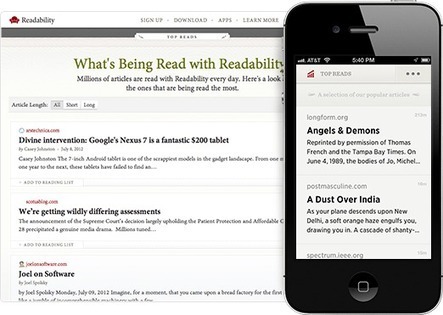
Do you use Readabilility? It is a great tool that allows you to remove the clutter from a webpage and save the article...and it is free! They have just upgraded the app for the iPhone, iPad and iPod. For more information check out their blog post.
|
|
Scooped by
Beth Dichter
July 11, 2012 7:39 PM
|
"It’s hard to find a field that hasn’t been radically changed by technology, and education is no exception. Few classrooms these days operate without digital tools, gadgets, or applications that have made it easier for teachers to track student progress and tailor lessons to student needs and interests. While the tools of today are great, there are even more great technological teaching tools and practices on the horizon, many of which are just starting to be adopted in the classroom or are just making it out of the developmental stages. These tools offer new and often very promising ways to connect with students and improve the quality of education offered in schools. Read on to learn about just a few of the websites, programs, and amazing technologies of the future teachers and students alike will soon be using."
|
|
Scooped by
Beth Dichter
July 11, 2012 4:57 PM
|
This is the first post of a four part series on ways to bring transform your lessons to meet the needs of the digital era, and explores steps 1 - 3. The first three stpes look at setting the foundation. Specifically, * Locate the one lesson you want to transform * Declare your standards (with links to help you meet this goal) * Incorporate the 21st century skills (also with links to help you meet this goal) If you are looking for ideas on how you might begin to infuse your lesson plans with 21st century skills and technology this series of posts will be a great tool!
|
|
Scooped by
Beth Dichter
July 11, 2012 1:15 AM
|
"A recent post by Fabio Sergio on the Fast CoDesign site explored "10 Ways That Mobile Learning Will Revolutionize Education" on a global level based on research that Frog is conducting on the ways that learning models are evolving and can be improved through mobile technologies. Here in two parts is a summary of Sergio’s 10 innovative possibilities for mobile learning (mLearning) and a consideration of the efficacy of each." To see Part 2 of this two-part post go to: http://www.onlineuniversities.com/blog/2012/07/the-mobile-learning-future-education-%E2%80%93-part-2/
|
|
Scooped by
Beth Dichter
July 9, 2012 9:23 PM
|
Do you use Google+, Facebook or Twitter? If so, you may be interested in the 12 Cheat Sheets that cover many shortcuts. For Google you will find: Google+ Cheat Sheet,Photostream Cheat Sheet and Complete Google+ Cheat Sheet. For Facebook you will find: Facebook Size and Dimensions Cheat Sheet, Facebook for Newbies Cheat Sheet and Facebook Shortcuts Cheat Sheet. For Twitter you will find: Complete Twitter Cheat Sheet, Twitter Newbies' Cheat Sheet and Manners Cheat Sheet. There are 3 for General Social Media Cheat Sheets: Blocking Cheat Sheet, What's Not Allowed Where (Google+, Facebook, Twitter, Linkin, Quora and Reddit) and Social Media Keyboard Shortcuts (Twitter, Google+, Facebook).
|
|
Scooped by
Beth Dichter
July 9, 2012 10:24 AM
|
A LiveBinder that will help you grow you PLN (as in Personal Learning Network). Quoting from the site: "This crowdsourced resource is meant to help those who are just beginning to start their journey as a "connected educator." It is not exhaustive. In fact, if all goes to plan, it will be a perpetual work in progress - just like the PLNs it will hopefully help build."
|
|
Scooped by
Beth Dichter
July 8, 2012 7:30 PM
|
This website provides links to "thebest K-5 online, interactive, educational games and simulations in one place!" If you have a SMARTboard or an interactive white board this site will provide access to a wide variety of resources. Many interactive games in math, ELA, science, social studies, art, music, typing, holidays, brain teasers and teacher tools.
|
|
|
Scooped by
Beth Dichter
July 14, 2012 11:22 AM
|
"Google Sites for Teachers was designed as a guide for new users of Google Sites. I have designs for expanding it to include more advanced features in the future. You can view the 47 page guide as embedded below."
|
|
Scooped by
Beth Dichter
July 14, 2012 10:39 AM
|
How can we best use educational media and technology to promote early reading? The Joan Ganz Cooney Center and the New American Foundation have reviewed the Campaign for Grade-Level Reading ("a collaborative effort by dozens of partners from philantropy, government, business, and the non-profit and voluntary sectors to mobilize measureable community action to help close the dismal gaps in reading by third grade"), specifically one area - "the possibility that well-deployed technology could be a 'game changer' in moving the literacy needle." This short post provides an overview of their initial findings as well as links to a variety of resources, including a SlideShare "Early literacy and technology - scanning the landscape." To go directly to the SlideShare: http://www.slideshare.net/cooneycenter/early-literacy-and-technology-a-scan-of-the-landscape.
|
|
Scooped by
Beth Dichter
July 13, 2012 7:30 PM
|
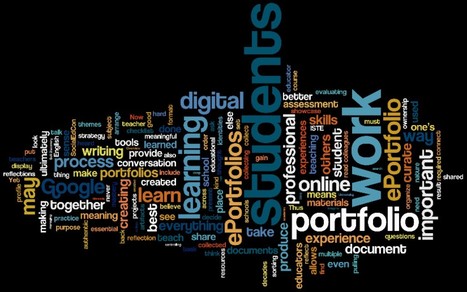
You have - no doubt - tuned in to the buzz about ePortfolios. Digital portfolios certainly were the talk of ISTE 2012 in June. This post provides links to resources for ePortfolios as well as asking five essential questions. * Whose ePortfolio is it? * Who will read the ePorfolio, and for what purpose? * Who will curate and organize the materials of an ePortfolio? * What shape will the ePortfolio take, and where should it be housed? * What is the teacher's role? When choosing to move in the direction of ePortfolios there are many questions that we need to answer. This post helps us begin to think deeply about issues that surround the use and management of ePortfolios.
|
|
Scooped by
Beth Dichter
July 13, 2012 4:16 PM
|
"Voice Recognition software has made impressive gains in recent years. With the advent of handheld touch screen devices, it is making its way into everyday life for a growing number of people. Moreover, voice recognition is rapidly becoming more accurate. This is great news for individuals who struggle with writing!" This post provides options for iOS, Androic, Mac/PC/Linux (all via a browser) and PC (online or off line). The focus is on the use of speech recognition for writing. This list of tools helps to provide options for many students who struggle with writing or keyboarding...think of Universal Design for Learning as you consider using them.
|
|
Scooped by
Beth Dichter
July 13, 2012 1:12 PM
|
"They say love is the universal language, but when you’re in a Chinese market trying to haggle over a fake Rolex, love probably won’t help you get the deal done. With all the resources freely available, there’s no reason to not at least brush up on the native language of a country you’ll be visiting or to simply expand your horizons..." This post is in sections that include: Courses for Beginners, Video Channels (watchand learn), Podcasts (great for auditory learners), Textbooks (all listed ones are free!), Translation (tools that may supplement your studies), Communities (connect with other learners), Tools (high tech resources to help you), and Apps.
|
|
Scooped by
Beth Dichter
July 12, 2012 1:53 PM
|
SimpleK12 has great resources and this link provides access to 10 of the most popular iPad resources for educators. You will find 50+ Quick Tips and Resources, 20 Free iPad Apps Educators Can't Live Without, Essential iPad Websites and App Guide, Apps for Students with Special Needs, and much more. SimpleK12 also provides live webinars for free so you may want to sign up to receive notification of when they take place. You may choose to join SimpleKi12's Teacher Learning Community (there is a cost) but these specific resources are available at no cost.
|
|
Scooped by
Beth Dichter
July 11, 2012 7:47 PM
|
An overview that covers: • Lead High-Level, Text-Based Discussions
• Focus on Process, Not Just Content
• Create Assignments for Real Audiences and with Real Purpose
• Teach Argument, Not Persuasion
• Increase Text Complexity
|
|
Scooped by
Beth Dichter
July 11, 2012 7:33 PM
|
What is the purpose of education? "In the United States, historically, the purpose of education has evolved according to the needs of society. Education's primary purpose has ranged from instructing youth in religious doctrine, to preparing them to live in a democracy, to assimilating immigrants into mainstream society, to preparing workers for the industrialized 20th century workplace.
And now, as educators prepare young people for their futures in a world that is rapidly changing, what is the goal? To create adults who can compete in a global economy? To create lifelong learners? To create emotionally healthy adults who can engage in meaningful relationships?" This article looks at this issue from a variety of viewpoints, and provides historical look from 1934 to 1991. An interesting read that may raise more questions than it anwer.
|
|
Scooped by
Beth Dichter
July 11, 2012 1:26 AM
|
Are you looking for a tool that you can put in the hands of your studnents tha twill provide them with tools to help them learn? If so, check out The Freedom Stick. A free downloadable package of software that comes to you from Michigan's Integrated Technology Support. For information and links to many other resources check out this post!
|
|
Scooped by
Beth Dichter
July 9, 2012 9:54 PM
|
Do you remember the Queen's Coronation? The Kennedy assassination? Beatniks and hippies? The Miners' Strike and Greenham Common? The Great Storm and the Ash Cloud? Brought to life using audio performance and archive footage, 60 Years in 60 Poems travels through time to unpack our shared history, celebrating individual moments alongside national events.
|
|
Scooped by
Beth Dichter
July 9, 2012 12:55 PM
|
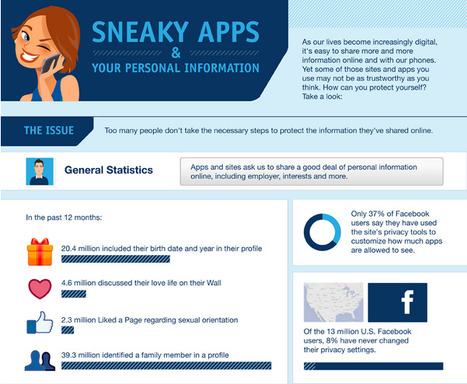
Most apps are fun, useful, and harmless, but there are apps out there that are less than trustworthy. Learn how you can protect your information from sneaky apps.
|
|
Scooped by
Beth Dichter
July 8, 2012 10:39 PM
|
This infogrpahic takes a look at how connected modern kids are -- and how much cyberbullying plays a role in their lives. The statistics may surprise you. One finding..."90% of teens who witness cyberbullying online say they ignore it, just 40% tell their parents and 81% of kids say it’s easier to get away with bullying online than in person." For more statistics check out this infographic.
|