Your new post is loading...

|
Scooped by
Beth Dichter
August 2, 2012 8:21 PM
|
Personalized learning is a term you hear when talking about education. Have you wondered what personalized learning is? This post defines personalized learning as “the process of contouring learning to the individuals that you’re dealing with, recognizing that we all have different strengths and weaknesses, different interests [and] different ways of learning…” (The quote is from elementary school principal, Paul Lorette.)
This post goes on to explore Personalized Learning, and provides information from the Personalized Learning Foundation, which states that personalized learning is more effective because the “model fosters a collaborative partnership between teacher, parent, student and school that designs a tailored learning program for each student according to the needs and interests of each student.”
However, there are individuals who state that data does not support that students learn differently. This data would argue that personalizing learning ac tually makes us categorize kids.
Read on to learn more about the many issues that need to be addressed when it comes to personalized learning.
|
|
Scooped by
Beth Dichter
August 2, 2012 10:58 AM
|
Is your school district considering deploying iPads? There are many issues to be considered and this articles discusses issues to consider prior to deployment as well as after deployment. The author "went through each of these cases and tried to ascertain the biggest takeaways." Learn from the experiences of others! Some of the sections in Before You Deploy iPads include: * Take Your Time * You'll Want to Beef Up Security (Online & Offline) * Be Able to Defind the Decision Some of the sections in the After You Deploy iPads include: * Apps? We Don't Need No Stinkin' Apps! * It Ain't Easy Bein' Synced
|
|
Scooped by
Beth Dichter
August 1, 2012 9:43 PM
|
You have students creating projects that will include music, so where do you go to find music that is permissable to use, esp. if the final project will be posted on YouTube or Vimeo? This post provides information on 3 sites that are easy to use and have royalty-free music that students may use. Lessons which involve the potential of using copyrighted material is great time to teach students about ethical use of such materials. Many of our students believe that they may post videos with copyrighted materials, but such videos will be stripped of the music when uploaded to YouTube or Vimeo, and the accounts may be suspended.
|
|
Scooped by
Beth Dichter
August 1, 2012 4:33 PM
|
"If you've ever looked at a teenager's text message and thought it looked more like a kindergartener's scrawl, you might not be far off. Middle school students who frequently use "tech-speak"—omitting letters to shorten words and using homophone symbols, such as @ for "at" or 2nite for "tonight"—performed worse on a test of basic grammar, according to a new study in New Media & Society." The survey was only 226 students (Grade 6 - 8) so the sample size is small. Some of the interesting points were that students who received text message that used "tech-speak" were more like to send messages back in "tech-speak" and it did not matter if the students were male or female, although "teenage girls usually receive twice as many messages per month as boys do."
|
|
Scooped by
Beth Dichter
July 31, 2012 5:54 PM
|
"Some of us are really out-going and enjoy being around other people, which is also known as an extrovert; while others rather be an observer and keep to themselves, which are called introverts. Many of us pretty much know which one of these we fall under, but can our personality affect how well we multitask? This graphic shows you which one multitasks better; will it be the introverts or extroverts?"
|
|
Scooped by
Beth Dichter
July 31, 2012 6:33 AM
|
Many schools are exploring going BYOD. Learn from schools that have already done so in this post. The stories tend to be positive yet also provide a look at some of the issues that may come up.
|
|
Scooped by
Beth Dichter
July 30, 2012 8:46 PM
|
Are you looking for a free software program that will allow you to make 3D movies? Muvizu has recently released a new version of their software which is free for non-commercial and educational use. Available in both a full version and a light version you may download the software and begin to create animations. Muvizu allows you to build your set, direct your characters and publish your films. Have fun and make some animated films!
|
|
Scooped by
Beth Dichter
July 30, 2012 6:48 AM
|
David Warlick shares a wonderful post about inspiring others, asking the questions "What meaning might there be in education?" to which he responded "To learn and be learned." He then goes on to look at the word learned - is the goal to create "graduates who are learned (learn’•ed), with two syllables — an adjective"? What would happen " if we change learned to a one-syllable intransitive verb, where the learner is an unstated object, then the experience starts to reflect and is reshaped by the behavior of the learner. It becomes an exchange between the learner, what has been learned, and what is to be learned, and it provokes an active and deliberate investment by the learner. It becomes personal." Read on to learn how play inspires learning in four ways. How can we take this information and use it in our classrooms?
|
|
Scooped by
Beth Dichter
July 29, 2012 3:50 PM
|
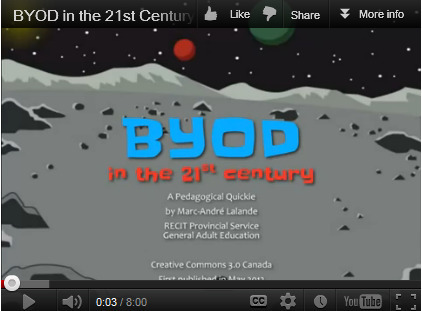
Whenever schools look at BYOD (or BYOT) there are pros and cons. This post provides links to a number of resources that discuss the advantages and limitations and includes an excellent (and enjoyable) short video that presents a quick pedagogical look at BYOD in the 21st century. Well worth watching in my opinion.
|
|
Scooped by
Beth Dichter
July 28, 2012 10:56 PM
|
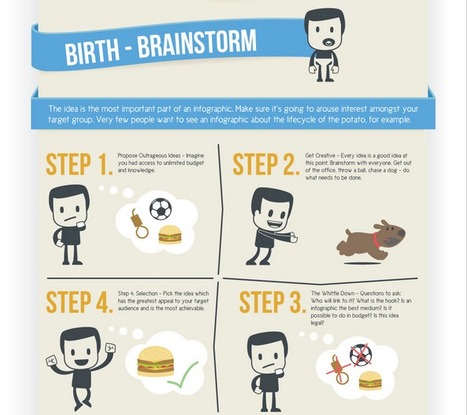
Have you ever wondered what about the life cycle of an infographic? Here is one view from Birth - Brainstorm to Infancy - Research to Adolescence - Design to Adulthood - Promotion to Death or Resurrection.
|
|
Scooped by
Beth Dichter
July 28, 2012 5:35 PM
|
Have you tried blogging with your students? Wesley Fryer discusses using "interactive blogs" in your class in this post. An "interactive blog" is one that allows posts from teachers, students, and blog visitors, but it is moderated. Fryer has been working with educators and polling them this summer and discusses his findings in this article. He also links to an article, "Why Word Press? Class Blogging with Moderated Posts and Comments" which walks you through how to set up a moderated blog with Word Press.
|
|
Scooped by
Beth Dichter
July 27, 2012 9:05 PM
|
Did you know that in 2011, Google Apps released 100+ new updates? With so many new updates how to keep does one keep up with all the new releases and updates? Try Ask Google Guru where you can find Google Apps Training Videos by topic, by level (beginner, intermediate, Gooru), and Migration Guides.
|
|
Scooped by
Beth Dichter
July 27, 2012 12:37 PM
|
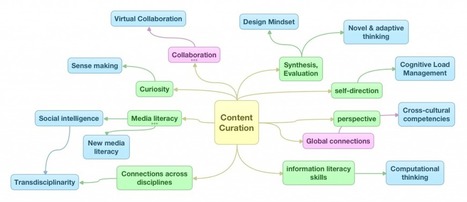
Does content curation also help develop future workskills? This post addresses this question. To do this effectively the Apollo Research Institute Future Workskills 2020 study was used to identify critical workforce skills. (The link to this research study is in the post and also may be found in this Scoop.it.) Many of the skills identified align with the skills of content curation. Ten skills are identified in this post and each skill may be found in content curation. The ten skills identified are: * Sensemaking * Computational Thinking * New Media Literacy * Transdisciplinarity * Cognitive Load Management * Social Intelligence * Novel and Adaptive Thinking * Design Mindset * Cross Cultural Competency * Virual Collaboration Each skill is defined and followed by a short discussion on how content curation is connected to the skill. If you missed the first article published, Understanding Content Curation, you will find a link to it in the article.
|
|
|
Scooped by
Beth Dichter
August 2, 2012 4:17 PM
|
There are so many resources available it can be difficult to find the great ones for teaching. This post recommends that you ask three questions providing and continues with other issues to consider when choosing new tools. For example, does the new tool save you time? Is it the "right tool for the right job?" Take time to read this article and you may learn some new ideas on what to consider when you are thinking of new web resources for teaching.
|
|
Scooped by
Beth Dichter
August 1, 2012 10:07 PM
|
Figment is a community where students may publish their work and receive feedback from a teen writing community. This post provides insights into teens use of this site. For more information about Figment, and to use it with your students scroll to the end of the article where you will find a section 'Using Figment in School.'
|
|
Scooped by
Beth Dichter
August 1, 2012 9:18 PM
|
Are you looking for tips and resources that will make your students be more engaged with their textbooks? This post provides suggestions to help "bring this tool to life for more hands-on, student-centered learning."
Along with a SlideShare on Bringing Your Textbook to Life 17 tips are listed with suggestions such as Tip #5 - Using Word Clouds (suggestions here include dividing students into small groups based on the number of sections in a chapter; have students create word clouds and have other students determine what section the words came from; and there is a link to Word Cloud tools and Pinterest.
|
|
Scooped by
Beth Dichter
July 31, 2012 10:25 PM
|
"Gooru is a search engine for learning that allows you to explore and study over 2,600 standards-aligned and personalized study guides. Study guides cover 5th-12th grade math and science topics, and resources include digital textbooks, animations, instructor videos and more. All resources are vetted and organized by teachers or Gooru’s content experts, so you don’t have to sort through the mess of subpar educational resources available online yourself."
|
|
Scooped by
Beth Dichter
July 31, 2012 1:33 PM
|
What can we do in our classroom to inspire students to be more innovative and creative? This post shares one way we might do this, by instituting a 20% project. Read the post to explore the why, what, how, when and who, and to access additional resources.
|
|
Scooped by
Beth Dichter
July 30, 2012 9:24 PM
|
Suan Oxnevad has created "an interactive learning experience designed to provide students and teachers with opportunities to focus on digital citizenship while engaging in constructive play." This post demonstrates one way you might use ThingLink as a tool with your students.
|
|
Scooped by
Beth Dichter
July 30, 2012 12:25 PM
|
Have you wondered about relationships between various Internet entitities? The Internet Map is an amazing look at "350,000 websites based on their popularity and relativity." You can look at the mega-sites or the small ones that surround the large ones. The designer of this map, Rusian Enikeev said "The Internet map is a bi-dimensional presentation of links between websites on the Internet. Every site is a circle on the map, and its size is determined by website traffic, the larger the amount of traffic, the bigger the circle..." To go directly to the map: http://internet-map.net/.
|
|
Scooped by
Beth Dichter
July 29, 2012 6:03 PM
|
Can you talk faster than you can type? For most of us the answer would be yes. This infographic looks at how dictation tools may speed up your work and the amount of time you would save if you switched to voice recognition software (and the figures are pretty amazing). One tool they do not mention is TalkTyper which is available for free, but requires that you use Chrome as your browser. You can check out TalkTyper at http://talktyper.com/.
|
|
Scooped by
Beth Dichter
July 29, 2012 10:45 AM
|
In this post Grant Wiggins shares some of his concerns about national standards. He notes "The problem of allowing each state to do things its way has resulted in states low-balling expectations for kids on their tests...A terrible scam has been going on for decades where kids and their parents are led to believe that graduates are college and workplace ready when they are not – simply because no one has had the guts to set a valid passing score." He then asks "why is there only one set of graduation requirements in this modern world? Why can’t kids major in a favored area in middle and high school? Where are our plumbers and carpenters going to come from? Why can’t there be many different kinds of diplomas, as there used to be?" He continues to explore these issues, reflecting on his experience as both a teacher and student. More and more we hear talk of "individualizing education' and this post makes one look at alternate way we might approach a variety of issues. He also has several excellent links, a post on "new players in the natioanl readiness test" by Catherine Gewertz and one by Yong Zhao on "the lack of correlation between high international scores and entrepreneurialism."
|
|
Scooped by
Beth Dichter
July 28, 2012 10:20 PM
|
Do you wonder how you might incorporate social media into your classroom? This infographic will give you some ideas on ways faculty are using social media in class, which may include connecting, notifying, teaching and curating. Although geared to college many of the ideas are useful for secondary education.
|
|
Scooped by
Beth Dichter
July 28, 2012 4:50 PM
|
Are you interested in learning the design process? The five-week virtual class will share the tools and methods of the process. With creativity being the top item wanted by many CEOs this has the potential to provide you with resources you may use in your classroom. Edutopia, IDEO and New York's Riverdale Country Day School have teem up to offer this free course.
For more information check out the article at GOOD. To see the workshop schedule and register for the course you may go directly to http://www.edutopia.org/design-thinking-workshop-schedule. Move quickly, the course starts on July 30th! Ooops...I just checked and the course has sold out...hopefully they will offer it again.
|
|
Scooped by
Beth Dichter
July 27, 2012 2:55 PM
|
Should teachers be required to learn about the brain, to understand how neuroscience reseach has implications for teaching? This post looks at how neuroscience knowledge strengthens a teachers ability to "help all children build their brain potential." Did you know that new research on the brains' neuroplasticity shows that educators may "help students literally change their brains - and intelligence." Learn about what triggers student behaviors, how to bring neuroscience into education, why frontloading is more critical than ever, and find a wealth of resourcesto help you learn more about the neuroscience of learning as well as resources for your students to learn more about the brain. And if you are looking for a free online course on Neuroscience and the Classroom: Making Connections check out this course from Annenberg Learner: http://www.learner.org/courses/neuroscience/.
|