One of the key issues this election season is America's dependence on oil. Is drilling the answer? Find out where we get oil and what we do with it.
This is the first of 8 interactive infographics that GOOD and MTV are creating "to get to the heart of some of the most important issues that America is facing again." This infographic looks at enery asking questions such as "Where does our energy come from? Can we source more energy from home? How much is renewable and sustainable?" To go directly to the interactive infographic:
The original Ten Commandments that most people are at least passingly familiar with represent rules for how Jews and Christians should conduct their lives.
Fractus Learning published 'The 10 (EdTech) Commandments' in July, and OnlineUniversities has taken their thoughts and focused them on online learning, specficially "a handy guide for the successful connected learner in the digital age." For more information and expanations of the 10 Commandments please read the post...and as a teaser here are the first two:
Harvard releases a fascinating report that concludes that the performance rate of students in 24 other countries is growing faster than students in the U.S.
There are some interesting conclustions that are drawn in this report. "It analyzes the possible causes for the results and the disparities in student performance, both abroad and at home. Interestingly enough, it finds no evidence to support the theory that an increase in spending has any influence on student performance, as many states that spend a lot on education exhibited as high performance improvement rates as states that do not spend as much. Bottom line: Throwing money at the problem does not fix it. So what does?" To learn more access the full report at: http://www.hks.harvard.edu/pepg/PDF/Papers/PEPG12-03_CatchingUp.pdf.
“How much can others learn about you from the Internet? Take a moment to Google yourself. You may be surprised how much information is public. While you think it doesn’t matter, what you post online could impact job prospects, your safety and more. Check out this infographic to learn more about what you may have shared online, how to Google yourself to learn more, see what others who are looking for you may find, and learn more about why it matters.
There are many reasons to consider Bring Your Own Device (BYOD) and this infographic provides reasons for going BYOD as well as potential costs, pros and cons, and additional information.
Have you considered using a wiki in your classroom to help students actively contribute to their learning? In this article Jason Bedell discusses his experiences using wikis with classes from Grade 4 though high school seniors and provides a variety of reasons. "The technology relies on the ideas of social constructivism that suggest that students consistently learn from one another, hone their own understanding, and actively create new knowledge in a discussion format, instead of passively receiving it in a typical lecture format..."
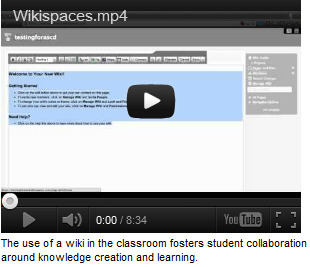
He provides a video that show how to set up and use a wiki using Wikispaces, and discusses how wikis promote collaboration and help make connections (and they are great for sharing professional knowledge). If you would like to use wikis this year with your class this article will assist you.
Although these four questions are written for a district to answer they are also questions we as teachers should answer before we consider ways to use technology in our classrooms. The first question, "What are the ultimate goals for student tech proficiency? In the area of technology, what would a well-educated student from your district know and be able to do with technology by the end of 12th grade?" Take the time to read the article and additional questions and how they may impact your classroom this year.
This post shares an experience in the Texas City High School and the implementation of a "digital media an design project with high school students." The author had worked with the school during the school year and observed many challenges including "the daunting and daily task of keeping students academically engaged; the corrosive effects of chronic absenteeism in the classroom; the impact of economic and familial instability on students, teachers, and schools; and the creative ways youth from poorly resourced schools and households are using digital media."
They set to work with a goal: "could we work with teachers and students to create a more dynamic learning environment?"
Read the article to see the project that was developed and what they have learned.
EdTechTeacher taught 10 iPad workshops this summer/ This post includes a lit of '10 New Things We Learned About iPads' as well as listing weekly resources for the iPad. The '10 New Things We Learned About iPads' include:
* Using our iPad as a mobiele document camera with Board Cam App and Reflection
* Using iMovie and GarageBand (they communicate with each other) to take an iPad interview and integrate it into a film
Nothing incredible is accomplished alone. You need others to help you, and you need to help others. With the right team, you can form a web of connections to make the seemingly impossible practically inevitable.
Take a look at: The Instigator, The Cheerleader, The Doubter, The Taskmaker, The Connector and The Example. Which one might you be and whom do you need to have around you to push your in new directions, to help you complete tasks, etc.? What role do you play for those around you?
There are so many apps available for Chrome it may be difficult to choose which have value. For some of the top web apps for students we may look to this list selected by Rahul Roy-Chowdhury who is considered a "Google's Chrome Web App Guru.
Suggestions include StayFocusd (a productivity extension); Todo.ly (a to-do list and task manager); Read Later Faster (save pages to read later - online or offline); and StudyStack (helps with memorization). An additional four apps are listed.
3D printing - have you wondered how it works? This new technology is available at costs that consumers are able to purchase 3D printers, but what does that really mean. How can a 3D printer print food or fashion? Click through to the article to see an infographic on 3D printers and how they work. How will this printer "disrupt" the world?
This week I have been part of the Content Team of the Massachusetts New Literacies Institute 2012. We shared this video today with our participants and although is is not current the points that are raised are still valid. As you watch think about how your school/district deals with change. For more information you may want to visit his blog at http://thefischbowl.blogspot.com/2006/09/what-if.html.
The NY Times has an interactive game that "measures how your reaction time is affected by external distractions." The goal, to reply to three text messages while you are driving on a six-lane highway...and it is not as easy as one might think. Although some may say this is a great game for teen drivers, I would suggest that anyone who sends text messages while driving should take this game for a drive!
Please use this link since the one I first put in seems not to work:
Game-based learning is gaining traction in many areas. There are concerns, but there is also much to suggest that game-based learning helps students learn academic subjects. Here is a listing of 20 blogs that discuss game-based learning, with descriptions that provide information so you may choose which you might like to follow.
"...school assessment lives primarily in the bottom left part of that graph, and that we rarely if ever get to the “immeasurable” stuff that resides toward the top right. To put it another way, we focus in schools on that which is quantifiable when, I think, our real value as places of learning rests in that messy stuff that isn’t."
Make a comment on this by going to Will Richardson's post.
If you students are engaged in creating and publishing digital content then chances are they are using Creative Commons materials. This post by Joyce Valenza introduces you to the new Creative Commons license chooser that was launched this week. Using this tool you may "enable Creative Commons licensing in the following formats: Images, Audio, Video, and Text." Additional information is found in the post.
Whether you're 8 or 88, you can learn something new on the web.
And this post shares 8 sources which will help you learn, from CodeAcademy to SkillShare to iTunes University and more. These sites are not just for adult learners...many of our students may benefit from them. This is a "shortlist of the best alternatives to traditional education that are currently on the market" according to Mashable.
Richard Byrne shares Pastelink, a free file sharing program where you may share files of oup 25MB in size without creating an account, or up to 2GB if you register for a free account.
"SlideRocket is thrilled to launch the new SlideBook, available now as a free template in the "Get Inspiration" tab in Slide Rocket. A Slide Book is a great way to package your blog posts, articles, images and videos into a visually engaging format..."
The SlideBook allows you to create a Presentation Newsletter, a Presentation News Release, a Presentation Resume, and more. If you have not signed up at SlideRocket you will need to do so to access these tools, which are free!
What happens when you allow students to play 'games' in the classroom? Based on the games you may see problem solving skills, tinkering skills, basic physics, trial and error, collaboration, coaching, and more.
This post by Will Richardson explores how games are on the rise in classrooms and the potential impact on student learning. Participatory games have been developed to help students learn curriculum while providing "a challange-based context for students to work within." Much more information may be found in this post.
A good question...why should techies care about education theory? In this post Audrey Watters notes that "Debates about education are by no means new: What’s the best way to teach? What’s the best way to learn? What should the curriculum be? Who should have access to specialized knowledge and specialized training? How does technology impact all of these questions?" Having a knowledge of the history of education and theories of education allows us to better understand and apply what we know. This post looks at five education theorists of the 20th century: John Dewey, Maria Montessori, Jean Piaget, B.F. Skinner and Paolo Freire. Watters invites you to provide suggestions as to whom is missing, or write a post on others 20th century education theorists, and to think about which one has influenced you the most.
Do you share technology in your school? There are many ways to "get the most out of shared resources" at school, and this post has six tips and ideas to help you "maximie the time you have access to shared resources." Each tip provides suggestions to help you effectively share computer resources.
Tips include:
* Model your new tool or website in your classroom.
* Make sure that you have used the tool and created the product you would like your students to create. Take into consideration how much time your students will have.
* How will your students hand in their work? Will they use a dropbox of some sort or will they place it in a shared folder? Make sure the students understand how to use this tool.
Marc Azéma, a French archaeologist and filmmaker, has come up with a pretty novel theory. Maybe the earliest cave paintings, created some 30,000 years ago at sites like Chauvet, weren't static creations.
This post from Open Culture includes a short film that shows cave paintings as a "sequential story." There is also a short audio interview with Chauvet.
To get content containing either thought or leadership enter:
To get content containing both thought and leadership enter:
To get content containing the expression thought leadership enter:
You can enter several keywords and you can refine them whenever you want. Our suggestion engine uses more signals but entering a few keywords here will rapidly give you great content to curate.


 Your new post is loading...