Your new post is loading...

|
Scooped by
Beth Dichter
August 16, 2012 9:20 PM
|
"There are several big movements underway that are worthy of debate and possible consideration as we look to help education become the 21st century, user-centered, on-demand, engaging, technology-centric activity that it has not been for much of its existence. Game-based learning (GBL), or gamification, is one of the models that commonly gets touted as a cure-all for the problems with education because of the popularity of gaming in our society (New Media Institute). While there are problems with the gamification movement as it currently stands, the model has several areas in which it differs sufficiently from traditional education to make it an intriguing possibility. Here is a look at several of those differences." Topics discussed include authenticity, student engagement, creativity and innovative thinking, and cost, as well as a discussion on the debate that exists over game based learning.
|
|
Scooped by
Beth Dichter
August 16, 2012 7:47 PM
|
Middle-class students tend to learn from their parents that asking for help is one way to problem-solve when completing assignments, whereas students from lower-income backgrounds tend to learn these skills from their teacher. A teacher shares her experience with students in her classroom on ways to help students learn to ask for help. An inspiring article!
|
|
Scooped by
Beth Dichter
August 15, 2012 9:50 PM
|
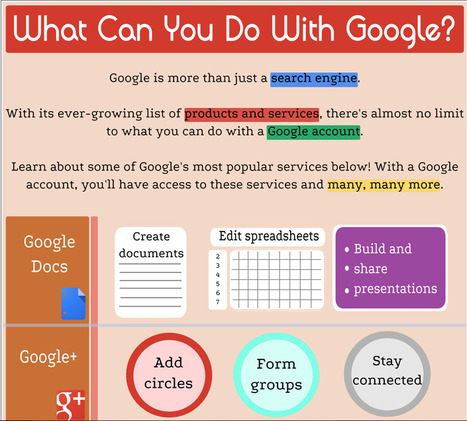
Google has many services available, and this infographic from GCLearnFree "briefly describes the 3 top things you can do with popular Google services." Along with Google Docs learn more about Google+, Google Calendar, YouTube, Blogger, and more!
|
|
Scooped by
Beth Dichter
August 15, 2012 6:55 AM
|
Are students who play sports more violent? Research done by Xin Jian (a PhD candidate at Ohio State) raises this question. Quoting from the post: "Her study, published this year in the Journal of Youth Adolescence, did not find "across-the-board advantages"—in other words, lower odds of being involved in violence—for young people who participated in sports-centered extracurriculars." Youth Radio has reported on this issue (http://www.youthradio.org/news/do-sports-really-prevent-youth-violence) and GOOD partnered with them to create this infographic. The research findings show "contributing factors behind youth violence." A key finding is "contact sports increase the chance of fighting dramatically."
Additional information is available in the post, as well as a link to the the study done by Xin Jian, which was published in the 'Journal of Youth Adolescence.'
|
|
Scooped by
Beth Dichter
August 14, 2012 9:48 PM
|
"The enemy of innovation and growth is routine. These auspicious weeks before the school year commences are the perfect time to create a new routine that will ensure innovation in your instruction and growth as an instructor. Here are some idea for those who want to take advantage of these next few weeks to guarantee the best year they’ve ever had." Below is the list of the five ideas. Read the full post to get additional information as well as links to resources. 1. Move Beyond the Textbook 2. Become an Expert in One Tool 3. Read About all Things Education 4. Revisit Your Homework Strategy 5. Make a Professional Development Schedule
|
|
Scooped by
Beth Dichter
August 13, 2012 9:58 PM
|
SOPHIA is a social teaching and learning network. It's where you can teach what you know and learn what you don't. SOPHIA for Learners: "SOPHIA is a powerful place for learners looking for assistance with a specific academic topic. Our social education platform offers thousands of credible academic tutorials, taught in many ways by teachers and experts, to help you learn the way you learn best. The platform also offers quizzes, assesses learning preferences and provides learning paths that lead students to mastery of a subject." SOPHIA for Educators: Use SOPHIA to provide additional instructional material (remedial and/or advanced), provide multimedia tutorials for your students, create private groups for your students and more. A site rich with resources. Be sure to check it out!
|
|
Scooped by
Beth Dichter
August 13, 2012 7:31 AM
|
There are so many iPad apps available now it is often difficult to determine which are best. This post provides links to 50 apps, many of which are free, that would help us learn across disciplines. Although geared to "lifelong learners" many are appropriate to students in our schools. Categories include: History and Geography; Language, Reading, and Writing; Open Source and General Learning; Reference; and Science and Math.
|
|
Scooped by
Beth Dichter
August 12, 2012 10:43 PM
|
Have you asked yourself the question "What does it mean to be a great teacher?" Here are ten ideas from a teacher three days into teaching 6th grade this year, reflecting on his first 3 days and his previous years in teaching he asked himself this question, and came up with a list which he has shared. Read through the post and consider responding with your thoughts. What would you add to the list? And to give you a taste, here are a couple of his thoughts (but read on for his explanations): 1. A love of students 2. A love of good content 3. Solid pedagogy
|
|
Scooped by
Beth Dichter
August 11, 2012 4:19 PM
|
A great list of blogs focused on special education. There are six categories: * Special Education Topic Strategies * Technology and Assistive Technology * Special Topics * Special Education News and Policy * Special Education Law * Various Topics on Special Education Great resouces to be found.
|
|
Scooped by
Beth Dichter
August 10, 2012 7:55 PM
|
Are you looking for some new ideas for icebreakers with your students this year? Here are 10 icebreakers that use technology. Begin your school year with an activity that greets the student as a 21st century learner.
|
|
Scooped by
Beth Dichter
August 10, 2012 12:26 PM
|
A collection of 100 sites to find videos, split into the following categories: * Educational Video Collections - "specfically designed for education, these collections make it easy to find video learning resources"; * General Video Collections - "Network TV, inspiring talks and more are available in these collections..."; * Teacher Education - "Featuring higher-level learning, these video sites are great resources for finding education that's fit for teachers."; * Lesson Planning - "Put together your lesson plans with the help of these video sites."; *Science, Math, and Technolog - special attention to STEM subjects; * History, Arts and Social Sciences - Videos that explore history and more; * Video Tools - "Make it easy to find, share and view videos with these tools."; * Network and Program Videos - sites for public broadcasting and other education programs; * Free Movies and Clips - Documentaries and other educational videos; * How-Tos - "Satisfy students' desire for knowledge and hands-on learning by sharing how-to videos from these site"; *Government and Organizations - "Offered as a service from government organizations and other groups...great places to find top-notch education videos and often, historical treasures." A wonderful resource to find videos for your classroom.
|
|
Scooped by
Beth Dichter
August 9, 2012 7:53 PM
|
Gleeson shares three scenarios that may happen in your classroom (they did in his) and in each case the result was that the students were not able to use the Internet. When we work with technology things often happen, and the end result may be the lesson plan that you had goes out the window. This post asks us if we are prepared for these types of scenarios and raises some other questions that may be considered.
You may also want to check out a post he refers to in this post that shares Web 2.0 tools that may be used by students under 13. The post, Web 2.0 for the Under 13s Crowd, is located at: http://mgleeson.edublogs.org/2012/07/05/web-2-0-for-the-under-13s-crowd/. (It is also in this Scoop.it).
|
|
Scooped by
Beth Dichter
August 9, 2012 9:32 AM
|
This year August is Connected Educator Month (so sayeth the U.S. Department of Education) and there is an amaing number of opportunities to learn more about this with keynotes, webinars, book chats and more. This article also discusses five educator "Be-Attitudes". Each "Be-Attitude" has a brief description as well as links to resources. Are you "able to define what it means to be a connected educator"? That is "Be-Attitude" 1, and although the definitinion is not provided, lots of links are and you will be able to figure out your definition. Read on for four additional "Be-Attitudes" and consider getting yourself involved in Connected Educator Month!
|
|
|
Scooped by
Beth Dichter
August 16, 2012 8:42 PM
|
szoter is easy to use, free, online image annotation tool. It makes expressing Your ideas and thoughts easy. It can be used to share Your ideas with friends, highlight important parts of images or even to create readable bug reports.
|
|
Scooped by
Beth Dichter
August 15, 2012 9:59 PM
|
Who knew? Infogr.am, a tool that allows you to create infographics, now allows you to include videos in your infographics...with the caveat they must come from YouTube or Vimeo. For more information check out this post from Richard Byrne!
|
|
Scooped by
Beth Dichter
August 15, 2012 3:03 PM
|
If your school is using Google Docs this year here are three great tips that may make the process run more smoothly. Susan Oxnevad's school introduced Google Docs last year and has shared what she wishes she had done. Each tip provides resources to help you with the process. And the three tips are... * Encourage teachers to create an in box with a Google form * Teach teachers and students how to use the revision history * Encourage teachers to create and use templates
|
|
Scooped by
Beth Dichter
August 14, 2012 9:55 PM
|
Read on to learn why so many education reformers are enamored with Finnish education and what their system can teach us about reforming our own. Why are people looking at Finland? Their students have "consistently scored near or at the top of international assessments regardless of economic or social background, despite spending fewer hours in school that their American counterparts." Some of the 15 points listed are below, and each point is followed with additional information. * Schools don't assign much homework. * Classwork focuses on creativity. * All schools in Finland are public schools. * Finland is all about cooperation in education, not competition.
|
|
Scooped by
Beth Dichter
August 14, 2012 5:13 PM
|
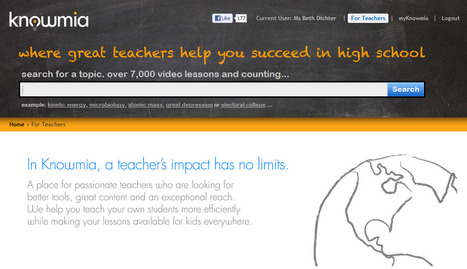
Knowmia for Teachers – Add your own lessons (and you may create lessons on the site), upload lessons, add lessons from YouTube or Vimeo, and share. A lesson planning and recording tools is available for the iPad. Using this tool you may bring in resources from multiple sources, organize them, and create a video lesson on any subject. Coming soon is MyKnowmia, a tool to help you flip your class.
There is a free lesson library of short-form educational videos available free! Students and parents may also create accounts and access materials.
|
|
Scooped by
Beth Dichter
August 13, 2012 7:53 PM
|
Here are some points about education spending that have been illuminated by research and raw data. Some of the 10 points (each has additional information posted): * The U.S. spends more than any other nation on education. * Math and science scores for U.S. students are substantially lower than many other nations. * Education spending is often inconsistent. * More money isn't alwasy the solution, but better allocation of it can be. * Teacher pay does matter. * The earlier money is spent on education, the better the investment. Read on for additional information.
|
|
Scooped by
Beth Dichter
August 13, 2012 7:06 AM
|
This PBS Learning Media Infographic explores teachers and technology. What do teachers want in the classroom? Briefly, more technology, affordable technology, web-based tools, and to engage students. For more specific information check out the infographic!
|
|
Scooped by
Beth Dichter
August 12, 2012 9:34 PM
|
Part 4 of the 'Ten Steps...Transforming Past Lessons from the 21st Century Classroom' has been published! In this post Steps 8, 9 and 10 are presented. * Step 8 - The Final Product - A final product should be authentic and relevant. Students should be provided with a rubric that addresses "content standards and facilitate 21st century skills." Technology should be integrated in a way that "compliments the curriculum. * Step 9 - Planning the Time Limit - Make sure to create a timeline that includes "major points including introductions, pre-organizers, lesson, work activities, formative assessments, tutorials to scaffold learning, and submission of the final work." * Step 10 - Assessment - Going back to the rubric mentioned in Step 8, it is necessary to have a rubric that assesses both content and 21st century skills. Each step has additional information as well as links to resources. There are also links to the three previous posts (which are also in this Scoop.it).
|
|
Scooped by
Beth Dichter
August 11, 2012 3:03 PM
|
Tom Barrett has once again put together an "Interesting Ways" presentation. This one provides 36 ways (and tips) to use Twitter in your classroom. Quite a few folks have provided ways they use Twitter with their students, so if you are thinking of using Twitter this presentation is worth checking out.
|
|
Scooped by
Beth Dichter
August 10, 2012 6:19 PM
|
Digital textbooks are in the news these days. Many publishers are providing digital textbooks at a cost. However, Boundless has "just launched the public beta version of its brand new site. What is Boundless? It’s a way to easily turn all of the open source information that exists in the world into a simple easy-to-use digital textbook. And it’s free." Boundless uses open source materials to create their digital textbooks. Additional digital resources are also generated. For more information on how it works check out this article, or go directly to the Boundless website to sign up: http://www.boundless.com/.
|
|
Scooped by
Beth Dichter
August 9, 2012 8:27 PM
|
"Students are currently enjoying the last gasps of summertime in most countries right now. They’re outside, engaging in social activities, and constantly on the move. So what would happen if these students were thrown into a slow-moving and old-fashioned classroom? The students would get distracted, disconnected, and feel lost.' This post explores the term "digital native" and has a short video that may get you "more excited about engaging active learners."
|
|
Scooped by
Beth Dichter
August 9, 2012 9:40 AM
|
Do you ask yourself how Smartphones might be used in education? Why they work for students? How they make a difference in education? This infographic looks at these issues as well as their benefits, great apps for students and how higher education is using the smartphone.
|