Your new post is loading...

|
Scooped by
Beth Dichter
September 22, 2012 10:30 PM
|
With the NCLB Act schools have been required to increase their testing. In this post Gerstein states "I believe that tests provide an illusion that something has been learned, one that all stakeholders; teachers, administrators, parents, and students, themselves, have bought into." She also states that she believes there "are qualitatve differences between assessment, measure, and tests." Gerstein brings in information from Cathy Davidson's post 'How Do We Measure What Really Counts in the Classroom" as well as information about the recent cheating scandal Harvard.
|
|
Scooped by
Beth Dichter
September 22, 2012 5:41 PM
|
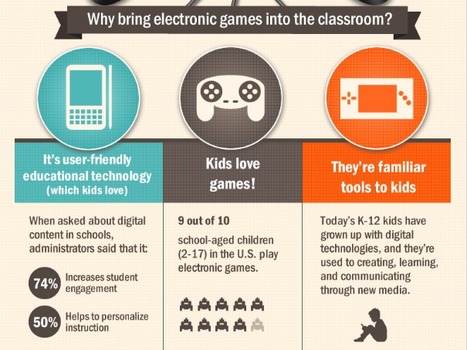
Does gaming have a place in the classroom? The information on this infographic provides reasons why gaming should be in the classroom (with resources provided on the infographic). A few of the reasons discussed are:
* The students love games and are familiar with them. * The students are engaged. "Computer games stimulate the brain to produce dopamine" which helps with attention and making connections. * Student are motivated by games. For more information check out the infographic!
|
|
Scooped by
Beth Dichter
September 20, 2012 10:00 PM
|
A look at how Wikipedia is "misunderstood because many educators have yet to recognize the distinction between Wikipedia as a tool for teaching and Wikipedia as a tool for research." Why use Wikipedia? This post suggests that the collaboration that takes place provides a number of incentives including (quoted from post): * Similar benefits to traditional writing assignments. * Digital literacy training. * Multi-layered feedback. The post also looks at using Wikipedia as a tool for research. This portion of the post is a response to some of the arguments made by Brian Proffitt's post that "recommended against Wikipedia's use in the classroom." The response suggests that the use of Wikipedia teaches one information literacy. More information may be found in the post.
|
|
Scooped by
Beth Dichter
September 20, 2012 9:20 PM
|
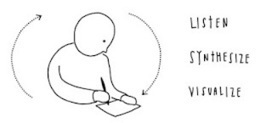
This post provides a look at the "basics of sketchnoting" which you might think of as visual note-taking. Combine sketches and images, and you hvae sketchnoting, which is different than "graphic facilitation" ("one person listend to a group and graphically represents the key points of the discussion"). The post discusses note-taking in school today (which of often linear) and that students have little "interaction or engagement with the material." Sketchnoting requires "listening, thinking, and visualizing at the same time." For more information click through to the article.
|
|
Scooped by
Beth Dichter
September 19, 2012 11:01 PM
|
"When we speak of the education crisis in the United States, there's one fallacy: We refer to it as ONE singular crisis or problem when in reality, it's a set of issues that in the end combine into one wicked problem. How do we solve such a big problem systematically, one bite at a time?" This post notes that todays "schools are preparing children for the 21st century using a 19th century model." Is it possible for us to use a 19th century model with issues that have "never been seen before?" How do we break away from conventional thinking and embrace creativity? There are three areas of focus that are necessary for creativity according to this post: entrepreneurship, communication, and media literacy. For more information click through to the post.
|
|
Scooped by
Beth Dichter
September 19, 2012 9:37 PM
|
It seems that every week you hear of another free educational site that offers free courses. This post looks at 15 sites that may be new to you, those that may be considered "under the radar." Click through to learn some new sites that may be of interest to you or your students.
|
|
Scooped by
Beth Dichter
September 18, 2012 10:29 PM
|
We're number one? Hardly. The entire idea of American exceptionalism should be called into question. Five myths about the American education system are 'demolished' in a report by the Organization for Economic Cooperation and Development "which compares the educational systems of over 30 developed nations, provides data that, when it comes to education, proves we're so frombeing number one, that the entire idea of American exceptionalism should be called into question." Below are two of the myths. Click through to the article to see the other three as well as additional information on each of them. Myth #1: Our educational system provides more upward mobility than any other in the world. Myth #4: We provide excellent early childhood education. Check out this article to find out where we statistically compared to other nations.
|
|
Scooped by
Beth Dichter
September 18, 2012 9:17 PM
|
"In his book, 'Outliers: The Story of Success', Malcolm Gladwell hypothesizes that 10,000 hours of practice at something makes someone an expert, and if they can get those hours under their belt ahead of others..." If this is true, many young children today will have reached the expert level when they are 11 or 12. One question to ask, what does game based learning teach us? Think 21st Century skills. This post discusses the following skills and how game based learning helps to meet them. * Critical Thinking * Problem Solving * Collaboration/Communication * Digital Citizenship * ICT Literacy (defined in the post)
|
|
Scooped by
Beth Dichter
September 17, 2012 9:18 PM
|
Teachers' expectations about their students' abilities affect classroom interactions in myriad ways that can impact student performance. Students expected to succeed, for example, get more time to answer questions and more specific feedback. A fascinating look at what can happen when teachers expectations for their students change, looking at "how do we get teachers to have the right expections?" Seven suggestions are provided for ways "teachers can change their expections."
|
|
Scooped by
Beth Dichter
September 17, 2012 7:47 PM
|
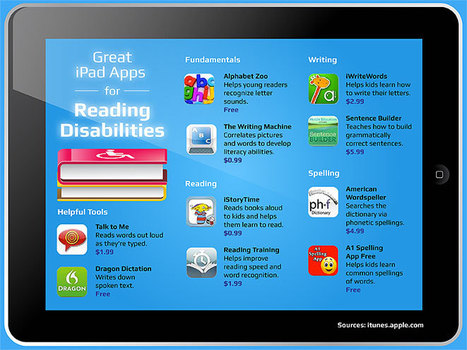
Whether you're the parent of a child with a reading disability or an educator that works with learning disabled students on a daily basis, you're…... Fifty helpful tools - Some will help "educators and students with reading disabilities," others focus on "fundamentals of reading, writing, and spelling." Suggested apps are also provided for reading, writing and spelling.
|
|
Scooped by
Beth Dichter
September 16, 2012 9:27 PM
|
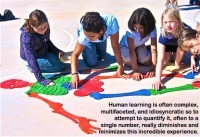
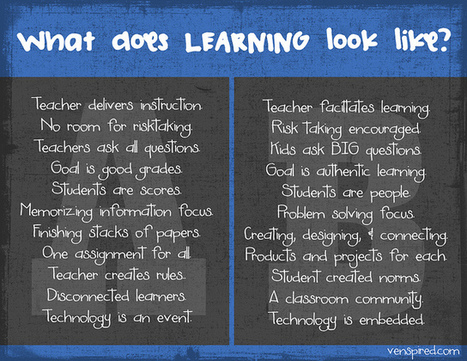
What Does Learning Look Like?...
|
|
Scooped by
Beth Dichter
September 16, 2012 8:30 AM
|
This post asks the question "Is creativity an end, or a menas to an end?" After a short discussion about creativity the post notes "schools do not produce inventions; they produce inventors. For this reason, to incubate the creative mind is a crucial role of the teacher. To foster imagination is a key pathway toward entrepreneurship and discovery."
To help explain this they have created an "Axis of Education" with a coordinate system that "lays our two variable of what we teach and how we teach, seeking an escalting ideal of skills ans self-discovery." To read more about the "Axis of Education" or to download a pdf of the graphic click through to this article.
|
|
Scooped by
Beth Dichter
September 14, 2012 9:50 PM
|
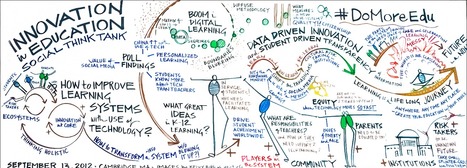
Click closer to scan this sketch and you just might learn something new. If anything, you’ll get a peek into the value of what a “graphic facilitator” can provide to a discussion....
|
|
|
Scooped by
Beth Dichter
September 22, 2012 7:11 PM
|
Are you interested in following some blogs that focus on mobile learning? Here is a list of 20 blogs that look at "tablets, smartphones, and other mobile computing devices" that may help you come up with new ideas on how to use them in your classroom. Check out apps to download, ways to create quizzes, m-learning strategies, the m-learning movement, and much more.
|
|
Scooped by
Beth Dichter
September 21, 2012 10:55 PM
|
An infographic that also provides text information on how colleges are using iPads this year. Preparing for big games, as part of the application process, to facilitate discussions, creating new apps...these and other innovative ways are explored in this post.
|
|
Scooped by
Beth Dichter
September 20, 2012 9:36 PM
|
If you are a newly qualified teacher, an existing teacher moving schools, or getting a new IWB, here’s a couple of handy tips to get you started. The post provides information on Promethean Boards, SMARTboards, Easiteach, and Mimio Boards as well as other tools and resources that you may find helpful. It is also a great website to put in favorites and return to for more ideas!
|
|
Scooped by
Beth Dichter
September 20, 2012 6:22 AM
|
Film offers us a powerful tool to shift awareness and inspire action. It offers a method to break our dependence on the mainstream media and become the media ourselves. We don't need to wait for... This post lists 100 world changing documentaires with short explanations. The website has over 1150 films listed so if you are searching for a documentary this is one site to check out.
|
|
Scooped by
Beth Dichter
September 19, 2012 9:56 PM
|
What do you think the 10 characteristics of a highly effective learning environment are? This post says an environment is "highly effective and conducive to student-centered learning." Read this post to learn more. Each characteristic listed also includes an explanation. Characteristics listed include: * The students ask questions - good questions. * Questions are valued over answers. * Ideas come from a variety of sources. * Learning is personalized by a variety of criteria.
|
|
Scooped by
Beth Dichter
September 19, 2012 9:28 PM
|
"Jay McTighe and I have written a white paper on implementation of the Common Core Standards entitled From Common Core Standards to Curriculum: Five Big Ideas. In it we propose a strategy for ensuring that the Common Core Standards are appropriately addressed in curriculum and assessment design locally. We also highlight common misconceptions about what the Standards do and do not demand of educators locally." The paper has five big ideas (quoted below): #1 - The Common Core Standards have new emphases and require a careful reading. #2 - Standards are not curriculum. #3 - Standards need to be "unpacked." #4 - A coherent curriculum is mapped backwards from desired performances. #5 - The standards come to life through the assessments. A short excerpt is also available if you click through.
|
|
Scooped by
Beth Dichter
September 18, 2012 9:57 PM
|
The Internet Archive plans to make more than 350,000 programs available on its Web site beginning Tuesday. Are you interested in exploring news produced from 2009 to present? If so, check out a new online collection at Internet Archive. "...every morsel of news produced in the last three years by 20 different channels, encompassing more than 1,000 news series that have generated more than 350,000 separeate programs devoted to news..." is now available in one location. The site will continue to add news from years prior to 2009 as well as adding new material (as in current news) 24 hours after broadcast. This article in the NY Times provides additional information.
|
|
Scooped by
Beth Dichter
September 18, 2012 8:31 PM
|
A sneak peek at an article that will appear in the October 2012 issue of Educational Leadership. To download as a pdf go to the website.
|
|
Scooped by
Beth Dichter
September 17, 2012 8:43 PM
|
More and more teachers, researchers, and developers contribute their ideas and inventions toward the cause of more interactive learning environments. Augmented reality - "a medium which the known world fuses with current technology to create a uniquely blended interactive experience." A wide range of augmented reality experiments are discussed including Second Life, Reliving the Revolution, Physics Playground and much more!
|
|
Scooped by
Beth Dichter
September 17, 2012 7:24 PM
|
Why do so many students choose Wikipedia when asked to find information on the Internet? I believe the answer is that Wikipedia is like the McDonalds of the Internet, you can always find it and you know what you’re going to get. Check out the 10 free tools, including Google Search Education, Google Custom Search, the Find Tool, a variety of search engines (although I would also include Carrot2 at http://search.carrot2.org/stable/search) and more!
|
|
Scooped by
Beth Dichter
September 16, 2012 12:09 PM
|
Can computers learn to teach students, and respond to cues that students put out that comuters may not recognize? Neil Heffernan has been working on this question since 1995. Back in 1997, two years into a graduate program at Carnegie Mellon Institute, he had "come to believe that the programs did little to assist their users." But his perspective changed when he began to videotaple tutoring sessions of a human tutor. This article explores the issues of computerized tutors and looks at a specific program, ASSISTments (http://www.assistments.org/) that is primarily used to tutor math. To learn how ASSISTments is working in a variety of districts and more about computerized tutoring take the time to read this article.
|
|
Scooped by
Beth Dichter
September 15, 2012 2:15 PM
|
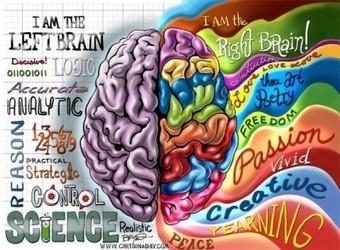
The first of a two part series, this post explores "the creative prociess and how your IQ level is critical in this process." Sections include "left brain vs right brain and creativity...convergent thinking and divergent thinking...free association theory of creativity...left brain right brain re-visited: convergent and divergent...what is creative inspriation? Unfocused and unconscious...sleep and creativity...humor and creativity..." and more. The second post will look at "IQ level and working memory capacity."
|