Your new post is loading...

|
Scooped by
Beth Dichter
September 30, 2012 9:10 PM
|
In the world of educational technology, we often hear Pedagogy Before the Technology. hmmmm . . . really? Then why are there so many 60 tool in 60 minutes presentations? Lists of 100 Web 2.0 too... Jackie Gerstein takes a look at "truths about educational reform" with a small t...a look at teaching and learning. She raises a number of questions, asking us to think about how we would like to be taught, at how we can create the classroom that our learners want. A thought provoking post that includes a slideshare show.
|
|
Scooped by
Beth Dichter
September 29, 2012 9:38 PM
|
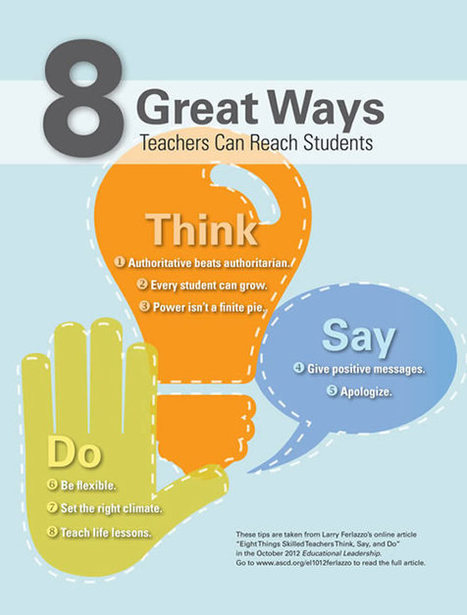
An article from Educational Leadership on "how to engage students whom seem unreachable, who resist learning activities, or who disrupt them for others." Larry Ferlazzo reflects on his yers of teaching and shares ways he engages students by developing "their intrinsic motivation." The post provides eight detailed recommendations. The infographic above shares the short hand version!
|
|
Scooped by
Beth Dichter
September 29, 2012 7:20 PM
|
Web 2.0 tools - the tools we look to use that are online and interactive. Here is a round-up of tools that are organized by core content area. A few may require downloads but most are online. Look by subject area (ELAR, Mathematics, Science, Social Studies) or by category (which is a lengthy list including Audio, Avatars, Backchannels, to Video, Website/Creator Tools, and Wikis, with may more listed). A great place to start to look for a tool with short descriptions provided as well as hot links to the tools.
|
|
Scooped by
Beth Dichter
September 29, 2012 7:01 PM
|
A look at ways we can make learning more relevant to students with conversations from a number of education technologists including Sugata Mitra and Sal Khan.
The video is just over 12 minutes and explores where education is going. Eli Kaufman (the producer of the film) notes that the people interviewed may not have taught in a classroom and recognizes that there are "real limitations to tech-based solutions." He also notes that "a computer can't teach 'those life skills that only a master teacher can teach' - and which require people to be in the same room - 'how to become a citizen, how to problem solve, and learning how to be a collaborator.'"
|
|
Scooped by
Beth Dichter
September 27, 2012 9:28 PM
|
The Library of Congress is an amazing resource. It is the largest library in the world and has put much of their collection online. What is available? "Spoken history, photographs, and iconic cultural resources are available as teaching resources, and many of them are neatly organized into lesson plans, collections, and themes, perfect for bringing them into the classroom." Since searching for the resources may be "overwhelming" this post provides "a short guide to making the most of the Library of Congress, with tips and ideas for activities, plus links to guides, resources, and tools that you can put to work in your classroom."
|
|
Scooped by
Beth Dichter
September 27, 2012 8:02 PM
|
While we’ve witnessed many effective approaches to incorporating iPads successfully in the classroom, we’re struck by the common mistakes many schools are making with iPads, mistakes that are in some cases crippling the success of these initiatives. The five critical mistakes (and more information is in the post): * Focusing on content apps. * Lack of teacher preparation in classroom management of iPads. * Treating the iPad as a computer and expecting it to serve as a laptop. * Treating iPads like multi-user devices. * Failure to communicate a compelling answer to "Why iPads?"
|
|
Scooped by
Beth Dichter
September 26, 2012 9:24 PM
|
These facts show the extent of the achievement gap between Latino students and their peers, as well as some of the origins and repercussions. The 2010 census estimates that Latinos are 16% of America's population. The information in this post shows an achievement gap in the Latino population. * Did you know that "most Latino students are American citizens"? * Did you know that "bullying is a major concern"? The post provides information on these two issues as well as 18 other issues.
|
|
Scooped by
Beth Dichter
September 25, 2012 11:03 PM
|
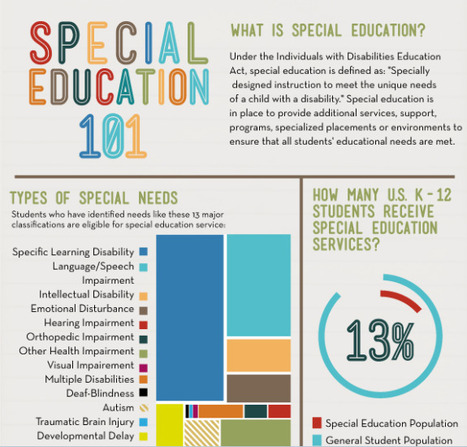
An overview of Special Education that helps to define the term special education, looks at types of special needs, the percentage of students who receive special education services, and much more. In this infographic special education is defined as "specially designed instruction to meet the unique needs of a child with a disability." Today one of the buzzwords in education is personalized learning. As our classrooms move towards this goal it is important to recognize how technology may impact both our special education and our regular education students.
|
|
Scooped by
Beth Dichter
September 25, 2012 7:20 PM
|
While browsing some of the terrific resources at the Harvard Graduate School of Education, I happened across a fabulous list of useful links and resources that I wanted to pass on to Edudemic readers. This list starts with Adult Literacy and ends with Testing and Standards. It is maintaned by the Gutman Library Research Services staff and Harvard, and may become one of your Go To lists when you need to find resources quickly (esp. if related to education).
|
|
Scooped by
Beth Dichter
September 24, 2012 8:50 PM
|
Are you looking for some new ideas for your classroom? Have you heard of "spaced learning" or "flexible Fridays" or "engagement"? Each of these is explored in this post.
|
|
Scooped by
Beth Dichter
September 24, 2012 8:01 PM
|
Who knew there were so many tools to help you create screencasts (as in videos of what is happening on your screen) or annotate screen captures? Richard Byrne has done a great job with this post of 17 free tool that will help you "create screen capture videos and images."
|
|
Scooped by
Beth Dichter
September 23, 2012 8:43 PM
|
Are you looking for some great websites that provide access to digital stories? This post focuses on children's audio books and provides links to stories that may be downloaded or streamed (for free!). In some cases children may also "read" the book online (again, at no charge).
Why choose to use digital books? They help students "develop listening skills and can increase comprehension and reasoning ability...(and) site word recongition when accompanied by text." Many valuable academic skills can be reinforced through digital text. Check out the links by clicking through to the post.
|
|
Scooped by
Beth Dichter
September 22, 2012 10:44 PM
|
Introduction to and directions for using Google Drive and Google Documents. Just updated by Richard Byrne, this book provides great information on using Google Drive and Google Documents.
|
|
|
Scooped by
Beth Dichter
September 30, 2012 7:21 PM
|
As part of iOS 6 Apple has provided "Guided Access" which allows you to lock the iPad into a single app. Why would you do this? To limit options for a student. For directions check out this post by Tony Vincent.
|
|
Scooped by
Beth Dichter
September 29, 2012 8:17 PM
|
What can we do to make our students better at online searching? Here is an article that provides tools to help your students learn to be better online researchers. Students need to lear to focus and 'distill [the] idea into a few key specific search terms', a skill we must teach. The post provides suggestions on how to teach digital literacy skills. The levels that need to be taught are (quoting from the post): * It begins as a critical thinking and language skill... * Utilizing various "search help" tools that may search engines offer... * Critically sorting through the results... * Sometimes, supply your kids with the internet resources you want then to use... A list of useful links is also included.
|
|
Scooped by
Beth Dichter
September 29, 2012 7:10 PM
|
"Connexions is a dynamic digital educational ecosystem consisting of an educational content repository and a content management system optimized for the delivery of educational content. Connexions is one of the most popular open education sites in the world. Its more than 17,000 learning objects or modules in its repository and over 1000 collections (textbooks, journal articles, etc.) are used by over 2 million people per month. Its content services the educational needs of learners of all ages, in nearly every discipline, from math and science to history and English to psychology and sociology. Connexions delivers content for free over the Internet for schools, educators, students, and parents to access 24/7/365. Materials are easily downloadable to almost any mobile device for use anywhere, anytime. Schools can also order low cost hard copy sets of the materials (textbooks)."
|
|
Scooped by
Beth Dichter
September 27, 2012 9:43 PM
|
Learn how cellphones, e-book readers, and tablets are getting kids engaged with learning, focused on working smarter, and ready for the future. Edutopia has published a new guide on Mobile Devices for Learning. What's inside? (quoting from the post): 1. Introductions: Pros and cons? Bridging the digital gap? 2. Know your mobile devices 3. Resources for teachers getting started with mobile learning 4. K-12 Apps and Web tools: elementary, middle, and high schools 5. Getting parents on board the mobile train You may download the guide as a pdf file (black and white or color). Registration is required to download but there is no cost.
|
|
Scooped by
Beth Dichter
September 27, 2012 9:20 PM
|
This past summer Edutopia, IDEO, and Riverdale County School sponsored a "Design Thinking for Educators" online course that quickly was over enrolled. Lucky for us that the folks at ASIDE were participants and have shared this post that will help us learn design thinking. The post provides many links to resources that will teach you about design thinking. If you are not sure of what design thinking is this post describes it as "the posing of a problem, perhaps elegantly framed but more likely ill-structured or open-ended -- and with some constraints." For more information click through to the post.
|
|
Scooped by
Beth Dichter
September 26, 2012 10:19 PM
|
If you’re an educator, surely you know that technology has and will continue to have an incredible impact on learning. The talks are in split into the following categories: * General - learn about making technology work in education and more. * Sharing education - exploring open, shared education. * Creativity and innovation - new ways to foster innovition and the creative spirit. * Internet and new media - how does the Internet and new media impact teaching and learning? * Leadership -new leadership skills. * Educational technology - explore technology made for education. * Brain and Psychology - how does the brain work? * Technology education - what is the state of technology education? * Teaching methods - check out innovative teaching methods. * Institution - how does technology impact institutions.
|
|
Scooped by
Beth Dichter
September 26, 2012 8:55 PM
|
Can intelligence be changed? This article explores this issue, looking at work by Carol Dweck (and colleagues). It looks at "fixed mindsets" and "growth mindsets" and student whom have "growth mindsets" engage "in adaptive behaviors, such as focusing on mastering concepts and developing new strategies after making mistakes." Students with "fixed mindsets showed decrements in performance when faced with negative feedback or failure." Additional information is found in the article.
|
|
Scooped by
Beth Dichter
September 25, 2012 8:31 PM
|
Are you looking for curriculum that will allow your school to meet the "requirements associated with receiving E-rate funding"? If so, check out these resources from Common Sense Media. They will help you "turn your students into safe, smart, responsible digital citizens and help your school keep valuable federal support for technology at the same time!" Lessons are provided for students from Kindergarten through Grade 12 as are teacher verification documents. They provide an overview tutorial plus lessons with handouts, videos, assessments and parent tip sheets.
|
|
Scooped by
Beth Dichter
September 24, 2012 9:34 PM
|
Any educator who wants to take advantage of the benefits video can have in the classroom needs to create and implement a video strategy. Check out this article for 11 reasons why you should think about using videos in your classroom. What do videos offer? * Online and open source - with many sources to choose from * Accessibility - another method for students to learn and to review/retain/remember information (and many sites provide transcripts also) * Visual learners - some students learn better with visuals An additional 8 reasons are provided in the post.
|
|
Scooped by
Beth Dichter
September 24, 2012 8:36 PM
|
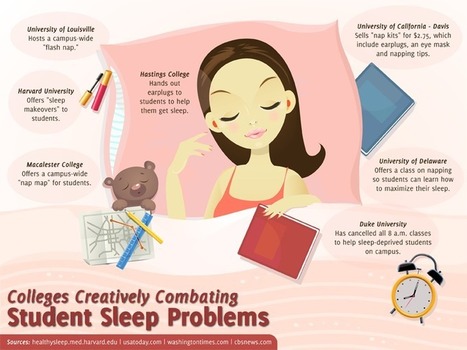
Read on to discover 13 of the most interesting ways colleges are taking steps to help student get a good night's rest. Based on current research most students are not getting enough sleep. This infographic shows that some colleges are taking notice. Will other schools also choose to look at this issue?
|
|
Scooped by
Beth Dichter
September 23, 2012 9:34 PM
|
Did you know that by 2013 " China will have 200 million college graduates—more than the entire U.S. workforce—and by 2020 India will be graduating four times as many college graduates as the United States"? This infographic looks at finding from the Center for the Next Generation and the Center for American Progress report 'The Competition that Really Matters: Comparing U.S., Chinese, and Indian Investments in the Next Generation Workforce.' This link also provides links to the full report and the introduction and summary as will as information on the polling resources.
|
|
Scooped by
Beth Dichter
September 23, 2012 11:15 AM
|
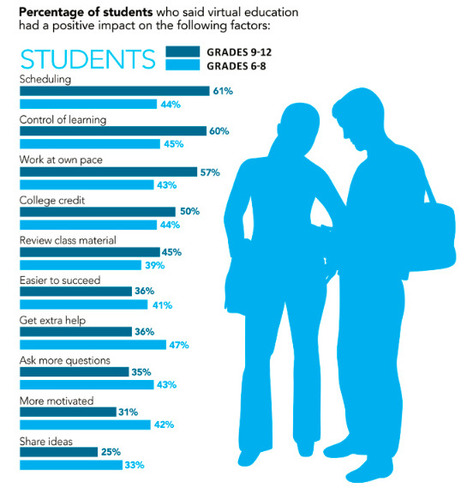
A look at statics gathered y Project Tomorrow. The aim of Project Tomorrow is "to make student voices heard in education." This information is from a survey of students, teachersl, parents and others in the fall of 2010 with a focus on determinint "the benefits of certain types and uses of technology for teaching and learning." More information is in the infographic.
|