Your new post is loading...

|
Scooped by
Beth Dichter
October 8, 2012 3:25 PM
|
Joyce Valenza shares LibGuides, guides created by libraians that are available to search and to use. The search tool within it allows you to search all institutions, or choose academics, publics, special interesests, K-12, partner sites, or guide authors. You may also search by keywords and by best of sites by topic. Take a few minutes to check out her post which has additional information, or go directly to Library Guides: http://libguides.com/community.php?m=i&ref=libguides.com.
|
|
Scooped by
Beth Dichter
October 7, 2012 7:05 PM
|
In ten short weeks TeachThough has posted a variety of posts and the ten listed in this article all looked at issues around iPad integration. They range from a post that looks at "The Past, Present, and Future of the iPad in Learning" to "10 Questions to Ask Yourself Before Deploying iPads" to "What the iPad's Popularity Says About Education." With an additional 7 posts you will find a range of information about using iPads in the classroom...and many resources!
|
|
Scooped by
Beth Dichter
October 6, 2012 9:54 PM
|
The first of a two part series on professional education learning communities. It looks at "Connecting and Collaborating...In and Out of the Classroom."
The post begins with a number of definitions of learning communities, how this concept is addressed in the new Common Core, and how learning communities benefit educators (and students).
A ten step approach is also discussed, beginning with "developing awareness" and finishing with "thinking like a living museum...and." For more information click through to the post.
|
|
Scooped by
Beth Dichter
October 5, 2012 9:22 PM
|
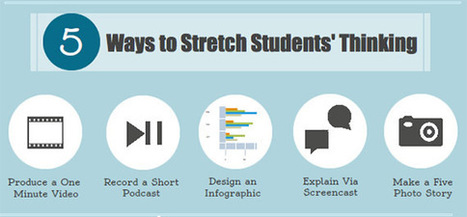
Mobile apps and Web 2.0 tools can facilitate implementation of activities requiring students to use skills at the top three levels of Bloom’s Revised Taxonomy--analyzing, evaluating, and creating. Five great ideas that will help your students with critical thinkings. Most examples will work with elementary through high school students.
|
|
Scooped by
Beth Dichter
October 5, 2012 8:26 PM
|
Technology integration - what is the best way? This post explores this topic, by sharing reflections from teachers who identified issues when issues did not go as planned to helping identify solutions to how to make the most of your time.
|
|
Scooped by
Beth Dichter
October 4, 2012 9:42 PM
|
Teach your Monster to Read is a free game that helps children practice the steps of reading. "Combining top quality games design with essential learning, the games is built on the principles of synthetic phonics." Children may "practice blending and segmenting", play games to "develop accuracy and speed of letter recongition" and more. The game may be played at home or school and progress reports are available.
|
|
Scooped by
Beth Dichter
October 4, 2012 8:23 PM
|
When it comes to high achievement, grit may be as essential as intelligence. A look at a research study on grit, defined as "sticking with things over the very long term until you master them." Her "esearch suggests that when it comes to high achievement, grit may be as essential as intelligence. That’s a significant finding because for a long time, intelligence was considered the key to success." This post provides links to a variety of articles and a look at some recent reseach. It also suggest that "grit is something that people can probably learn."
|
|
Scooped by
Beth Dichter
October 3, 2012 10:00 PM
|
Have you wondered what cloud computing is? At the infographic says, "it has nothing to do with the sky." Learn what others think cloud computing is as well as what it really is in this infographic.
|
|
Scooped by
Beth Dichter
October 3, 2012 8:34 PM
|
What does it mean when we say students need to be able to "tranfer" their learning? Grant Wiggins explores this in the post with a look at what it means to "know" something as opposed to "understand" and/or "apply" a specific piece of knowledge. Using the Pythagoreum Theorum as the example he walks us through these concepts and how they require students "to realize which specific prior learning is called for and apply it." He also states "If you can only recall and state something you don't really understand it...(you need) a Meaning Goal...and...(a) Transfer..."
A great read.
|
|
Scooped by
Beth Dichter
October 2, 2012 10:35 PM
|
Why do we ask students to create charts? Perhaps to help them tell a story. Charts and graphs help students understand data through visualization. Many websites exist today that help students create charts and graphs. This post explores a variety of resources and shares some graphs made by 8th graders. Once again ASIDE has put together a robust post with excellent resources.
|
|
Scooped by
Beth Dichter
October 2, 2012 10:10 PM
|
Online, in workshops, and even with friends, I frequently get asked What can the iPad actually do? as a sort of challenge to the worth of the device. I would rather that they ask, What can you actually do with an iPad? A look at using iPads with a focus on how an English teacher approaches the question. One example (of four) provided (and quoted): I want my students to demonstrate their knowledge of the parts of the story. Learning Objectives: In addition to learning the story elements, students learn... * To write a constructive review (plus three more objectives) Followed by a project, in this case a book poster and suggestions on what apps might be used. So perhaps the question is not what can a student do, but what can a student do with an iPad (that demonstrate their skills and expertise - think Bloom's taxonomy).
|
|
Scooped by
Beth Dichter
October 1, 2012 9:49 PM
|
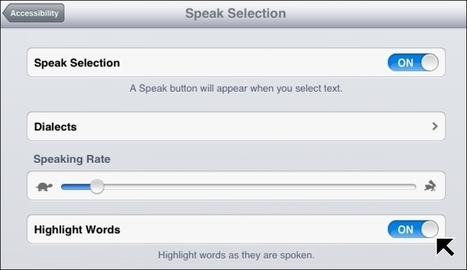
Speak Selection has been an accessibility feature since iOS 5. With the release of iOS 6 you may choose to have each word highlighted as it is spoken. For more information click through to this article for screen shots of what you need to do.
|
|
Scooped by
Beth Dichter
September 30, 2012 9:32 PM
|
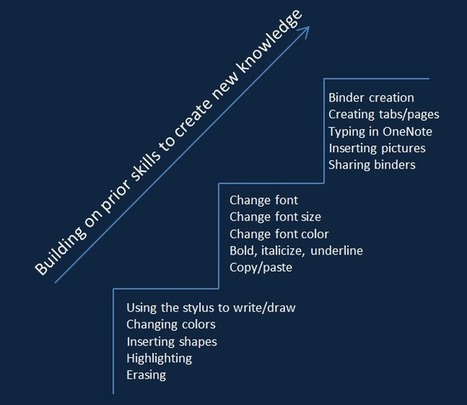
As teachers we think about scaffolding for our students, but at times we neglect to consider scaffolding when asking students to use new technology in the classroom. This post shares experiences from two teachers and their use of technology. It includes a great table that begins with the "Helpful Hint: Never assume that your students know how to do anything when it comes to technology."
|
|
|
Scooped by
Beth Dichter
October 7, 2012 9:15 PM
|
Take a journey though the woods and learn about trees and the environment as you collect merit badges. This game, geared to students aged 9 - 12, provides resources for teachers as well as a wide variety of resources for students including: * information on conifers, broadleaf trees and annual ring growth * the cycle of the life of a tree through the seasons * a look at biodiversity, habitats and ecobalance * trees in our lives * forest protection * a variety of experiments/activities * a photo album of trees in North America with information about each * a glossary * links to many additional resources
|
|
Scooped by
Beth Dichter
October 7, 2012 4:48 PM
|
Ira Socol raises a question in this post, asking if teachers want to move from being "replicators to design thinkers...(to) move our focus from the needs of those who work in schools to the needs of those for whom school exists...to understand that 'user experience' of school from the perspective of those students for whom it is not working." With detailed explanations, links to a variety of resources, and a look at current brain research Socol asks that you look at the job of teaching from what may be a different lens that you have in the past. Once again, Socol has provided a thought provoking article.
|
|
Scooped by
Beth Dichter
October 6, 2012 9:12 PM
|
Looking to become an expert in something? Need a hand with your research? Forget Google for a minute and check out these 50 other search engines you should start using. The post is divided into sections:
* Meta Search and Multi Seach Engines * Multimedia and Interactive * Google Search Engines * Great Niche Sites for Librarians * Custom Searches * Reference Searches * Library Search Engines There are so many search engines available and many turn to Google, Bing and Yahoo. This post provided links to many ones new to me, but to some of my favorites, such as Carrot2, RedZ, Slikk, DuckDuckGo and Twurdy.
|
|
Scooped by
Beth Dichter
October 5, 2012 8:54 PM
|
10 great educational online games to use with students. From climate change to surgery, every child will find something to engage and excite. The games listed are: * Danger Zone * The Blood Typing Game * Kodu * Climate Challenge * Play My Code * Wasteland Adventure * Electrocity * Virtual Surgery * Peace Doves Each game has a short explanation and a link is provided to the site.
|
|
Scooped by
Beth Dichter
October 4, 2012 9:54 PM
|
That's right with iOS 6 you have "the ability to use Upload , Select File , or Choose File buttons and links found on websites for submitting files." Moving files has not been easy when there are multiple users of an iPad in school environments. Email often presents issues due to size limts (and the same would hold true with video). This post provides details about how to do this, and also looks at the process to add media to an Edmodo post. There are also suggestions on ways to collect student work.
|
|
Scooped by
Beth Dichter
October 4, 2012 8:41 PM
|
New research suggests that American schoolchildren are becoming less creative. This post looks at research that documents "a continuous decline of creativity among American schoolchildren over the lats two or three centuries." At the same time research has pointed to the fact that "American ingenuity" is a strength, that Americans are "great innvoators, specialists in figuring new ways of doing things and new things to do." The post includes references to a number of studies and is a part of a series.
|
|
Scooped by
Beth Dichter
October 4, 2012 7:37 PM
|
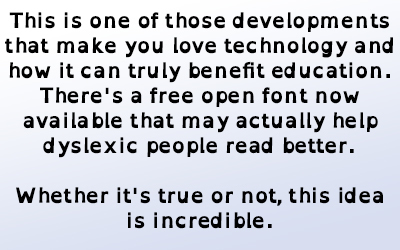
This is one of those developments that make you love technology and how it can truly benefit education. There's a free open font now available that may actually help dyslexic people read better. Whether it's true or not, this idea is incredible. A font that may make more students successful...and it is free! In late June I posted an article that spoke about this font. If you search for the term dyslexic you will find additional information about this font and dyslexia.
|
|
Scooped by
Beth Dichter
October 3, 2012 9:35 PM
|
Many creativity research programs are narrowly focused on one aspect of creativity to the exclusion of others; an integrative focus will help move the field forward. This post asks a variety of questions about creativity (quoting from post below): * What is (a) creative (product)?
* How is creativity achieved (the process)? * Who is creative/what makes someone crative (the person)? * What conditions (historically/everyday) are conducive to creativity (the press)? These questions are then explored, with information form a variety of other sources included. Recent articles in the news have suggested that creativity in childen is decreasing. This post provides a look at this issue from perspectives that may be new to you as well as the author's perspective on "what factors are necessary for Genius."
|
|
Scooped by
Beth Dichter
October 3, 2012 7:55 PM
|
What do we owe our students? This post lists 14 items and asks that you add anything that may have been missed, and since many are visual learners you may also see as an infographic...one that was created using Piktochart...so perhaps it will inspire you to create an infographic yourself!
|
|
Scooped by
Beth Dichter
October 2, 2012 10:18 PM
|
Writing and reading go hand-in-hand, so learning these reading strategies can actually make you a better writer. A list of tips and tricks (with explanations) that will help you become a better writer. Some of the strategies are listed below: * Close reading (as in reading slowly, highlighting, taking notes...read carefully as opposed to quickly); * Try out loud, and not to a group but yourself...for more information on this and other strategies click through to the article.
|
|
Scooped by
Beth Dichter
October 1, 2012 10:07 PM
|
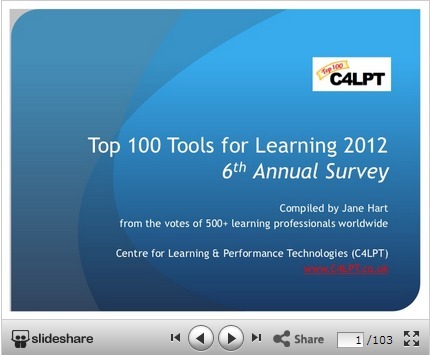
A list of the top 100 learning tools for 2012 from the Centre for Learning & Performance Technologies. The post defines a learning tool as "a tool to create or deliver learning content/solutions for other, or a tool for you own personal or professional learning." Five hundred eighty-two "learning professionals" weighed in the list. You can view the list on this page, or link to Slideshare. You may also see a short analysis of the list, a best of breed (categorized) and a Winners and Losers 2012.
|
|
Scooped by
Beth Dichter
October 1, 2012 8:34 PM
|
Before the days of tweeting and texting, people communicated very differently. Here's a look at the evolution of communication – our methods and tools over the ages. This infographic starts with oral communication and moves from B.C. to A.D. ending with the year 2011 and online content collaboration. Perhaps a great way to have a discussion about communication through the ages!
|