Is text complexity a new way to look at text? This post notes that the Common Core State Standards have explicitly identified text levels, which has not been done in the past. The seven actions below are detailed in the post, and you may choose to download it as a pdf.
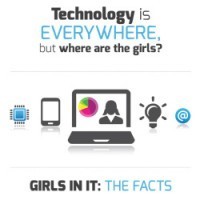
An infographic from the National Center for Women & Information Technology that provides statistics on how women/girls are represented in information technology.
Some of the numbers: *Girls comprise 56% of all Advanced Placement (AP) test-takers, 46% of all AP calculus test-takers, but only 19% of all AP Compuer Science test-takers.
* The US Department of Labor estimates that by 2020 there will be more than 1.4 million computing-related job openings. At current rates, however, we can only fill about 30% of those jobs with U.S. computing bachelor's grads. Girls represent a valuable, mostly untapped talent pool.
It seems that each day you hear something else about the Common Core. This post explores "five myths about the new standards and shows what the standards really entail."
The five legends are listed below. Each is explained in detailed in the post.
Legend 1: The new standards prohibit teachers from setting purposes for reading or discussing prior knowledge.
Legend 2: Teachers are no longer required to teach phonological awareness, phonics, or fluency.
Legend 3: Teachers are no longer required to teach phonological awareness, phonics, or fluency.
Legend 4: Teachers must teach students at frustration levels.
Legend 5: Most schools are already teaching to the new standards.
This post begins "The common understanding is that if students work hard in school they earn "A’s." For many however, there is a much straighter route to that "A." Some of the most creative learners are able to figure out what the course expectations are and do the minimum to meet them, and get the grade they want."
What happens to students that are bored with the curriculum? What would happen if we moved away from grades, and replaced them with badges? It turns out that there is evidence from a July 2012 report called "Do Schools Challenge Our Students?"
This report states "Many schools are not challenging students and large percentages of students report that their work is 'too easy.'"
The post also provides some statistical information.
The final portion looks at badges vs grades. It notes that switching from "traditional letter grades or percentage grades to badges signifying achievement could open up many possibilities for a more fine-grained tracking of student progress, address some of the criticisms regarding schools not teaching concrete skills, and motivate students to learn" (with additional information also included). As the Common Core becomes a driving force behind public education it will be interesting to see how the issue of badges vs grades play out.
This post begins "Have you checked your assumptions about student learning at the door?" It then provides 31 research findings that may make you pause and reconsider some of your beliefs.
* Are there any benefits to "playing scary and violent video games"?
* Can video games impact "disruptive behaviors and enhance positive development in ADHD children"?
* Is it best to teach very young children how to play with a toy or should we allow them to explore on their own?
An additional 28 findings) are provided in this post.
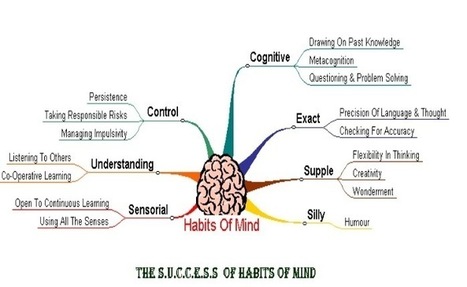
This post begins to look at the Sixteen Habits of Mind (developed by Art Costa) using the S.U.C.C.E.S.S. model. The S.U.C.C.E.S.S. model splits the habits of mind into:
* Sensorial
* Understanding
* Control
* Cognitive
* Exact
* Supple
* Silly
This post focuses on the "Control" habits, which include persisting, managing impulsivity and taking responsible risk. Each habit is looked from the perspective of a student and as a teacher.
This is the first post of a series. The next post will look at the habits under cognition.
How can we make our classrooms more engaging, creating "spaces that help students connect, get inspired, and achieve deeper learning and better results."
This post provides five simple ideas. Each is followed with short descriptions. Three are listed below:
* Try out new teaching techniques, don't just read about them.
* Try out technology tools that allow you to work side by side with your students rather than positioned next to the board.
* Explore new learning opportunities by accessing a web portal and connecting with another classroom studying the same topic.
TEd-Ed is a great resource to find videos. This post provides a look at six of their videos. Each video has a multiple choice quiz as well as some questions with short answers. They also include additional resources. You also have the ability to flip the lesson on your own. A tour of TED-Ed is available at http://ed.ted.com/tour.
This post shares six videos in six subject categories (out of 11 categories). Click through to see videos on:
The latest update to my Best of the Web presentation for teachers.
According to his blog only seven or eight of the items shown have been shared in previous presentations. If you are looking for some new tools for your classroom (or for you) then chances are good you will find them in this presentation!
Have you heard of Project RED (hint - RED stands for revolutionizing education)? They have "conducted a national survey of educational technology that focused on student achievement and financial implications."
There are seven key findings. These are listed below and additional information on each is in the post.
1. Nine key implementation factors [that] are linked most strongly to education success.
2. Properly implemented technology saves money.
3. 1:1 schools employing key implementation factors outperform all schools and all other 1:1 schools.
4. The principal's ability to lead change is critical. Change must be modeled and championed at the principal level.
Grant Wiggins discusses how he has "become a big believer in the power of crowd-sourcing ideas via social medium..." He starts this post by sharing an twitter experience, where he asked "Who has a great essential question that works really well with kids?" and proceeds to share approximately 15 questions that were shared. Wiggins continues to share some additional experiences in this post as well as a link to a video.
Recent research illustrates how writing by hand engages the brain in learning. And in an interesting twist, new technology is starting to reinvigorate this age-old practice.
So how does writing by hand engage the brain in learning? Research shows that:
* One study using an MRI machine which looked for "neural activity in the brain" showed that "children who had practiced printing by hand [showed] neural activty [that] was far more advanced and 'adult-like' than those who had simply looked at letters."
* Another study "demonstrated that in grades two, four and six, chilren wrote more words, faster,and expressed more ideas when writing essays by hand versus computer."
There are a number of other studies discussed in this post as well as a link to a short video that discusses some of the research.
Storytelling is one of the most overused and underused techniques at the same time. In this post, we are revealing what storytelling does to our brains.
Long before we had writing as we know it there has been an oral tradition of storytelling. This post looks at the science around storytelling.
Learn about how a story "can put your whole brain to work" and why "our brains become more active when we tell stories." Find out why the brain "learns to ignore certain overused words and phrases" and much more. If you enjoy telling stories, writing stories, or listening to stories check out this post to learn more!
Just think about all the schemas (pockets of information) we have for everything we do. Even though we have never taken part in many activities, we could easily build plausible stories based on those schemas and even devise theories, which may be testable. This is imagination which is one example of brain power, audrey@homeschoolsource.co.uk
"Anything you’ve experienced, you can get others to experience the same. Or at least, get their brain areas that you’ve activated that way, active too:"
"use simple, yet heartfelt language."
"Quick last fact: Our brain learns to ignore certain overused words and phrases that used to make stories awesome"
Storytelling allows us to make connections. We often turn to stories as a tool to teach (and reach) our students. "Stories bring information, knowledge, and truth to life." This post provides 30 great tips to help you engage your students with stories. A few of them are listed below. Within the post each tip comes with additional information.
Are mistakes a part of the learning process? If they are, what does this say about our current education system? This post explores these ideas, asking the following questions and following each with a number of responses that explores each question in greater detail. The first section has two questions:
* Why are mistakes important to achieve engagement and learning?
* Why do we avoid mistakes in our current model?
The second section, Turning Mistakes into Learning Opportunities asks one question:
* How can we use learning errors to our advantage?
At the beginning of this post the author speaks of James Joyce, and also does so at the end where she states (referring to Joyce) "a true genius sees all learning as an opportunity to improve and discover. Errors are taken at will. In making mistakes, we can reach new heights and find our true genius." Will schools move in this direction?
"Who knew a YouTube video of a nine-year old boy's cardboard creation would hit such a nerve?" This post updates us on what has happened since Caine's Arcade went viral. The videographer who made Caine's Arcade provides a look at what his cardboard creation has moved others to create. Caine is also in this video sharing his thoughts, including "the three biggest lessons he's learned in the process of this adventure" (quoted below):
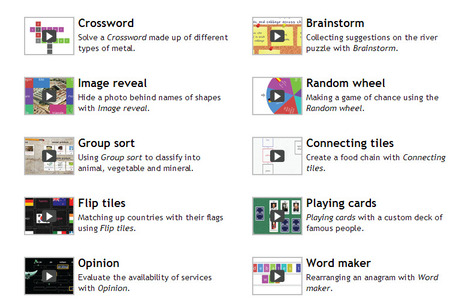
Wordwall is an interactive activity maker which allows teachers to make resources to use with a whole class. You can use them on an interactive whiteboard, or just with a projector. Word Wall allow...
That's right, you may download WordWall for free with one caveat. At this point you need to be located in the UK or in the US. Read through the comment section looking for the 2nd one from Danny. This comment provides additional information (including the fact that if you are in a private school in the US or a Canadian school you should contact Josh at WordWall).
To explore a bit of what you will get if you choose to download this go to http://getwordwall.com/.
Is traditional reading and writing enough to be considered literate in the 21st century?
Check out this slideshow from Silvia Rosenthal Tolisano which asks us to "rethink our notion of critical literacy." She also suggests that we "develop authentic learning and assessment opportunities {as we} upgrade and amplify our curriculum."
Check out these six iPad apps to create fun, engaging, interactive study guides for your students.
Better yet, have students create their own study guides using these tools and share them with other students. Apps suggested include ScreenChomp, StudyBlue and Socrative.
How do we help novice learners become more expert? Peter Skillen uses collaborative journal writing environments to move kids beyond social talk into deeper thinking.
Skillen begins this post by comparing novice learners and expert learners. He states (all quoted below):
* Novices typically don't plan, monitor, and reflect on their learning.
* Expert learners use 'multiple representations."
* Novices typically don't generate a number of potential solution strategies.
* Novices engage in 'knowledge telling' rather than 'knowledge transformation.'
* Expert learners make multiple passes at knowledge.
* Experts view 'mistakes' as opportunities.
There are two additional statements and each includes additonal information.
He then looks at scaffolded journal writing and provides a variety of sentence starters to help students move "along the continuum from novice to expert." You will find Planning Starters, Reflection Starters, Comment or Discussion Starters, and Elaboration Triggers.
The final portion of this post discusses challenges, and the need "to engage your students in developing their own sentence starters."
If you're a teenage speaker brought in to address a crowd of teachers on the subject of how you and your peers learn best . . . what are you going to say? "I...
Listen as a nervous Ned Cephalus shares his thoughts beginning with "I'm just a very average teenage brain" and then provides "eight powerful conditions of learning that can change everything for students."
Cultural anthropologist and media ecologist Mike Wesch examines how the internet has changed communication and relationships today.
Mike Wesch, who has a number of viral videos, such as The Machine is Us/ing Us, Information R/evolution and An Anthropological Introduction to You Tube, is currently writing a book about "wonder". Below is a quote from an interview.
"I am working on a book about “wonder”—what it is, how to harness it, how to inspire it, why it is on the decline right now, and how to bring it back. Wonder is both a sense of awe and a capacity for contemplation. More than just curiosity, wonder allows us to see beyond the surface of things, to seek patterns, or even better, to question the patterns we have taken for granted. To wonder is to embrace the possibility that we have it all wrong, that the frameworks around which we have built our view of the world might need to change, that the pillars upon which our worldview sit might need readjusting or be destroyed altogether..."
For more from Mike Wesch click through to the post.
To get content containing either thought or leadership enter:
To get content containing both thought and leadership enter:
To get content containing the expression thought leadership enter:
You can enter several keywords and you can refine them whenever you want. Our suggestion engine uses more signals but entering a few keywords here will rapidly give you great content to curate.


 Your new post is loading...