Your new post is loading...

|
Scooped by
Beth Dichter
December 17, 2012 9:14 PM
|
"Temple Run...What does the popular video game Temple Run have anything to do with algebra?" Check out some of the new materials available at CK12 and you will find that they are using Temple Run as "a real-world application of using algebra." CK12 has been providing open education resources (OER) for quite a few years and "has recently added more interactive resources to its offerings, including quizzes, videos, and real-world application examples." For additional information on new features click through to the post, or go directly to CK12 at http://www.ck12.org/.
|
|
Scooped by
Beth Dichter
December 15, 2012 11:58 PM
|
Once again Susan Oxnevad has created a great tool in Google Docs. This one will elp students with multimedia presentations
"The Google Docs Presentation is well-suited for use as a starting point for short student driven research projects because of the availability of efficient integrated research tools right on the page. To introduce students and teachers to the built in features, I created a simple template to guide the learning and help everyone discover the usefulness of the tool."
The post goes on to share tips on how to use the template, a look at the template, how to access the template and how to make your own.
|
|
Scooped by
Beth Dichter
December 15, 2012 11:31 PM
|
Check out this infographic with 30 sayings from Dr. Seuss. Many of us remember many of his stories from our childhood. The quotes from his work are great for teachers and students. A few are below, and many more within may be found by clicking through!
* Don't cry because it's over. Smile because it happened.
* You miss the best things if you keep your eyes shut.
* Think. You can think any think that you wish.
|
|
Scooped by
Beth Dichter
December 14, 2012 10:33 PM
|
In this age of information how do we teach our students (or children) to be critical thinkers, to be able to look at the information available to them and filter out the good from the bad. This post explores ways to work with students in the curation process.
It looks at curating with friends (through social networks, curating resources, curating images, and curating links and content.
|
|
Scooped by
Beth Dichter
December 13, 2012 9:44 PM
|
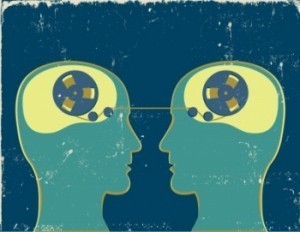
RSA Animate recently released a video called 'The Power of Outrospection'. The video intrigued me and this post has helped me pull together some of my thoughts about the links between empathy and creativity.
The post explores empathy in a variety of fields, including design, human services, and the creative fields, and the video is also embedded in the post. Take the opportunity to read the post, watch the video, and ponder how empathy allows us to be creative as we look for new solutions for whatever issues we face.
|
|
Scooped by
Beth Dichter
December 12, 2012 8:56 PM
|
Getting Smart® today launched “How Digital Learning Contributes to Deeper Learning,” a white paper that examines how key aspects of personal digital learning – common standards, next-generation assessments, blended learning, and affordable devices... This links to an infographic. There is also a report available that discusses: * Personalized skill building in preparation for deeper learning (e.g., adaptive learning in the Learning Lab at Rocketship Elementary)' * Schools and tools that foster deeper learning (e.g., project-based learning networks like New Tech) * Extended access (e.g., access to quality courses and teachers online) This report is available at http://gettingsmart.com/cms/wp-content/uploads/2012/12/Digital-Learning-Deeper-Learning-Full-White-Paper.pdf.
|
|
Scooped by
Beth Dichter
December 11, 2012 9:56 PM
|
Here are 10 steps to help launch a successful iPad program at your school. The author, Sam Gliksman, provides additional detail to each of the items listed below.
* Determining Whether You’re Ready
* Communicating Why You Want iPads
* Targeting 21st Century Learning Objectives
* Developing Simple iPad Management Tratgies
* Understanding that iPads Aren’t Laptops
* Overcoming “There’s an App for That” Syndrome
* Share and Share Alike – but not with iPads
* Developing an Ongoing Training and Support Structure
* Connecting
* Enabling the Unpredictable
Much food for thought may be found in this post.
|
|
Scooped by
Beth Dichter
December 10, 2012 9:56 PM
|
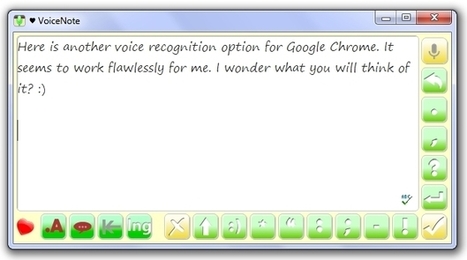
Once again Paul Hamilton brings us another great tool to use with Chrome, VoiceNote. He states that it "offers excellent voice-to-text...VoiceNote opens as a dictation window." Therefore it may "sit on top of a document being written" (or occupy your entire screen). A few of the features he mentions are: * dictating directly into a text box facilitates creating paragraphs or longer selections of text * on-screen buttons for adding punctuation * suport for multiple languages For more information click through to the post.
|
|
Scooped by
Beth Dichter
December 10, 2012 9:20 PM
|
A quick look at Bloom's Taxonomy.
|
|
Scooped by
Beth Dichter
December 9, 2012 4:54 PM
|
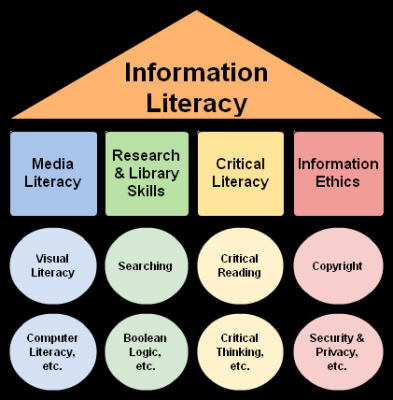
Are we living in a world of information overload or information abundance? This post by Jackie Gerstein poses suggests we look at this as a time of information abundance. "... we have technologies to access any type of information and to create products that match the pictures and voices in our minds; and we can use technology to get the assistance and feedback from folks around the globe." In this post she looks at the implications this has for education, exploring five points (quoted below): * Educators are no longer gatekeepers to information. * The Internet needs tobe open and available to students. * Information and media literacy needs to be integrated across the curriculum and grade levels. * Global-oriented and mulitcultural education also needs to be integrated across the curriculum and grade levels. * Students developing their own Personal Learning Networks (PLNs) should be viewed as major instructional strategy. Additional resources are referenced in the post.
|
|
Scooped by
Beth Dichter
December 8, 2012 11:18 PM
|
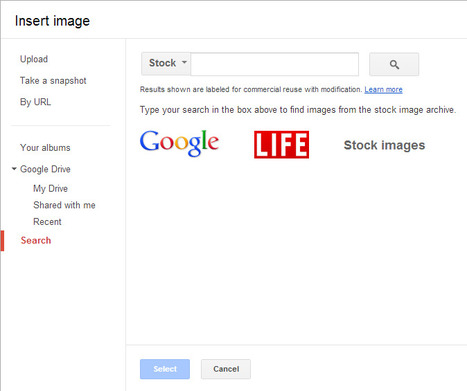
Did you know that Google now has a "stock image gallery" with more that "5,000 images that are labeled for re-use." The images are for use with Google Drive while creating documents or presentations. "To access these images select 'image' from the 'insert' menue when you're working on a document or presenation. Then select the 'search' option and finally select 'stock image' to search for a stock image to use..." You may also search Google images and Life images.
|
|
Scooped by
Beth Dichter
December 8, 2012 10:33 PM
|
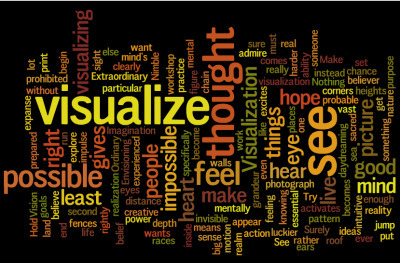
There's a new way to teach using wordle. It involves actually withholding a bit of information and making students think a bit harder. What fun! If you are looking for a way to use word clouds in your classroom here is one idea. The post asks you to look at a list of quotations and at the word cloud (pictured above) and consider "which is more powerful."
|
|
Scooped by
Beth Dichter
December 7, 2012 9:01 PM
|
We can't think of a better time than the holidays to learn a few forgotten tenets about the craft of listening. Do we really know how to listen, in this society that so engaged with 21st century technology that we often seen students sitting next to each other and texting or messaging rather than having a face2face conversation. Is the art of listening being lost? Check out this post for 10 rules that might help you become a better listener. Read on to learn how to listen actively; what it means to clean your lenses; and much more!
|
|
|
Scooped by
Beth Dichter
December 16, 2012 6:14 PM
|
So how do you motivate your students? They're an odd bunch with a myriad of distractions just waiting to take their mind off the task at hand.
This post provides a number of suggestions that you might want to try in your classroom. A few are listed below. In the post each suggestion has additional information.
* Give students a sense of control
* Give students responsibility
* Help students find intrinsic motivation
|
|
Scooped by
Beth Dichter
December 15, 2012 11:44 PM
|
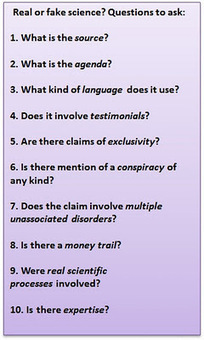
How do you tell real science from pseudoscience (also known as fake science)? This post explores the 10 questions shown in the image above in depth, helping you to learn questions to ask. In fact, many of these questions could also be used to evaluate websites for accuracy and authenticity.
|
|
Scooped by
Beth Dichter
December 14, 2012 11:11 PM
|
This infographic provides 10 suggestions on ways to connect with the "digitally distracted students." Below are a few of the suggestions, For more click through to the post.
* Encourage communication
* Use cooperative learning
* Utilize peer instruction
|
|
Scooped by
Beth Dichter
December 13, 2012 10:12 PM
|
A list of 32 ways that students learn...put into words. You may find something new to you, or have an idea that is not listed. Feel free to share new ideas in the insight section...and below is a taste of some from the post:
* By watching predictions play out.
* Through self-initiated transfer.
* Through making mistakes.
* By self-awareness, not content-awareness.
* Through modeling.
|
|
Scooped by
Beth Dichter
December 12, 2012 10:00 PM
|
We hear so much about tablets these days, and new ones seem to be appearing at a rapid pace. Yet we also see teachers who question the use of technology in the classroom. This post looks at the many ways that tablets may be used in the classroom from art to simulations, foreign languages to presentations, ebook and more. To learn more about the ways listed here and an additional twenty, each of which have some additional descriptions click through to the post.
|
|
Scooped by
Beth Dichter
December 11, 2012 10:16 PM
|
In the 2014-2015 school year it is expected that most schools will be testing students on computers. The question is are schools ready, and is the necessary infrastructure available, so that the Common Core tests may successfully be administered online?
This post explores this issue. Did you know that "All devices must have a 10” screen, a keyboard, internet access, and the ability to disable features that could be used to cheat during the test"? or that "in addition to computers, iPads, Android tablets, and Chromebooks running on newer operating systems will be able to be used for testing"?
The post also links to some posts that explore issues that Wyoming experienced with online testing and notes that "Adaptive testing is really beneficial and can pinpoint a student’s learning level more closely."
|
|
Scooped by
Beth Dichter
December 11, 2012 8:15 PM
|
This site not only allows you to look at the lights across the earth at night, but also to drill down to specific areas, and to see a map image and then overlay the night view.
This map is a great way to explore population across the world. What do the night lights tell us?
According to the website the images were taken over nine days in April 2012 and thirteen days in October 2012. To get the clarity required took 312 orbits. For more information check out the website.
|
|
Scooped by
Beth Dichter
December 10, 2012 9:39 PM
|
This is the first post in a series on resources to discover and curate digital curriculum. In this post Michael Gorman introduces three tools in depth: Symbaloo, Diigo and Evernote. "This series is really not centered on all the amazing resources available, but rather how to we find quality material and how do we archive it so we can find it later." Although you may be aware of these three tools Gorman many show you techniques to using them that are new. The post explores these tools with both the teacher and student in mind. Based on your AUP these tools have the potential to be used by both groups. If you wonder why you would want your students to become digital curators think about how it would require them to "be informed and practice proper digital citizenship."
|
|
Scooped by
Beth Dichter
December 9, 2012 7:35 PM
|
Are you looking for a resource that might help you determine if you are "correctly integrating technlogy" in your classroom? If so, you may want to check out the Technology Integration Matrix (TIM) put out by the Arizona K-12 Center at Northern Arizone University. "...the TIM is designedto assist schools and districts in evaluating the level of technology integration in classrooms and to provide teachers with models of how technology can be integrated throughout instruction in meaningful ways.” Briefly, the TIM "illustrates how teachers can use technology to enhance for K-12 students. The TIM incorporates five interdependent characteristics of meaning learning environments: active, collaborative, constructive, authentic< and goal directed." The full version of the matrix also contains some lesson plans and a short video of the lesson.
|
|
Scooped by
Beth Dichter
December 9, 2012 12:13 PM
|
An updated and revised look at the three components of digital differentiation by Susan Oxnevad. Each is a ThingLink image, so as you scroll over the image links articles, slideshows, tools and more will be available.
|
|
Scooped by
Beth Dichter
December 8, 2012 10:50 PM
|
You heard constantly about the millennial generation--that they’re tech-savvy, and different from everyone that came before. This infographic looks at four areas: an overview, their politics, lifestyle, education, and work.
|
|
Scooped by
Beth Dichter
December 7, 2012 10:01 PM
|
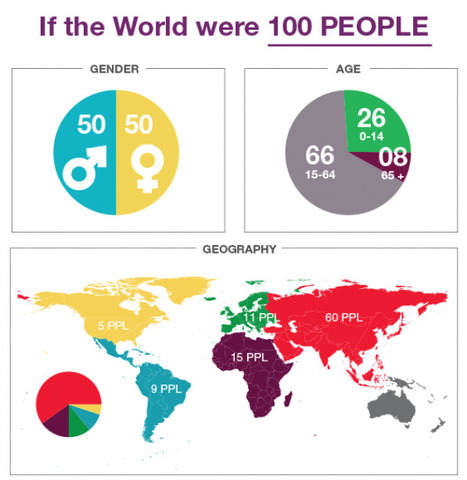
What would the world look like if there were 100 people? This infographic provides a look at gender, age, geography, religion, first lanaguage, literacy, education, and living conditions. If you want additional information visit 100 People: A World Portrait - A Global Information Toolbox at http://www.100people.org.
|