



Eclectic Technology
230.9K views |
+0 today
Filter by date
Tags
Tech tools that assist all students to be independent learners & teachers to become better teachers
Curated by
Beth Dichter
 Your new post is loading...
 Scoop.it!
Beth Dichter's insight:
This SlideShare provides a look at how iPads my be used to tranform education. Chock full if examples and activities as well as pedagogy chances are you will find some new ideas and resources in this resources from SilviaTolisano.
Scoop.it!

“So many times we encourage students to be creative, but we don’t always provide an explanation nor assessment. I think it is important to provide a definition. You can see that Dictionary.com defines creativity as ‘the ability to transcend traditional ideas, rules, patterns, relationships, or the like, and to create meaningful new ideas, forms, methods, interpretations, etc.; originality, progressiveness, or imagination: the need for creativity in modern industry; creativity in the performing arts’.”
Beth Dichter's insight:
This is the last in a series of posts on Creativity in the Classroom, with a focus on websites that help promote creativity. Included in this post are: * Arts Edge, a wonderful source from the Kennedy Arts Center that "offers free, standards-based teaching materials for use in and out of the classroom. It also offers professional development resources, student materials, and guidelines for arts-based instruction and assessment." * Exploratorium - "a twenty-first-century learning laboratory, an eye-opening, always-changing, playful place to explore and tinker" * Google Lit Trips - a great way to explore literature and Google Earth * Odyssey of the Mind - "an international educational program that provides creative problem-solving opportunities for students from kindergarten through college." * Diffen - a website that allows you to compare anything An additional ten websites are listed that provide a range of online learning opportunities that help promote creativity!
Scoop.it!

"As any parent or teacher knows, tests can create crippling anxiety in students–and anxious kids can perform below their true abilities. But new research in cognitive science and psychology is giving us a clearer understanding of the link between stress and performance, and allowing experts to develop specific strategies for helping kids manage their fears."
Beth Dichter's insight:
What can we do to help our students with test anxiety? New research is providing some strategies that my help students. This post discusses three strategies you may want to consider trying in your classroom. * Unload on paper – Research has shown that allowing students to write their concerns on paper for about 10 minutes before a test allows them to relieve some of their anxiety, allowing them to score higher on a test. The post provides a link to this research. * Affirm your values – It may come as no surprise that minorities and females often are apprehensive when required to take a test, and it turns out that writing may also play a role here. In this study students were asked to write “about something they value and write about why it matters.” * Engage in relaxation exercise – Younger students may have a more difficult time expressing concerns over a test. Research has found that teaching younger students (1st, 2nd, and 3rd graders) relaxation and breathing exercise reduces test anxiety (providing you also have them do the exercises prior to the testing). For more information on these strategies click through to the post.
Scoop.it!

Project Tomorrow is a national, education nonprofit organization. Our vision is to insure that today's students are well prepared to be tomorrow's innovators, leaders and engaged citizens of the world.
Beth Dichter's insight:
Have you wondered what students views are on digital learning? Not just the students in your school but students from across the U.S.? For Digital Learning Day a survey was conducted and some of the results have been published. This post provides a top ten list of students views on digital learning. Below are a few of the points, but additional information is available (including statistics) if you click through. 1. Use the Internet to help with homework at home? 2. Learning any time, any place, any pace. 3. What do kids think about flipped classrooms? 4. Pixel or print, what is your reading style? Take these questions into your classroom and see if your students agree or disagree with the survey findings. 
eduPLEX's comment February 7, 2013 6:01 AM
I really like this article, because it confirms for me that the programs and support we offer on eduPLEX is based on pedagogies that reflect the K-12 student's views on digital learning.
Thanks for the web-site. It's fascinating!
Scoop.it!
Beth Dichter's insight:
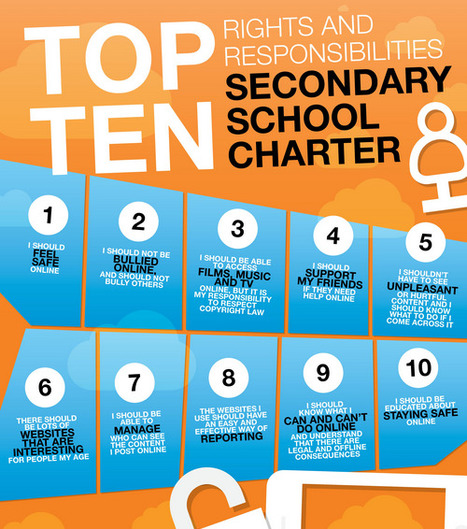
Check out this "survey of young people’s attitudes toward online rights and responsibilities. Over 24,000 young people age 7-19 from across the UK responded to the survey, and a further 90 young people explored these findings in focus groups." This post provides a look at two infographics that look at how students look at the top ten online rights and responsibilties. One infographic is for primary schools and the other for secondary schools. In addition there is a link to the actual report put out by the UK Safer Internet Centre - "Have your Say: Young people’s perspectives about their online rights and responsibilities."
Scoop.it!

"A new app for the iPad and Android devices uses a highly visual format to provide a different search experience for the tablet user. More than just a pretty interface, Izik—which debuted last month as the top reference app in iTunes—is based on Blekko, the search engine that boasts higher quality results based on human curation."
Beth Dichter's insight:
This search engine is designed for a tablet and provides some unique features. The visual format is based on categories so you can swipe horizontally to view additional entries, and or vertically to see more categories. Their website states "our goal is to have the practicality of the Web unfold at your fingertips in a fun and playful manner." To download the app (iPad or Android) or to check it out online check out their website at http://izik.com/.
Scoop.it!

"Tests now being designed for the common standards are likely to gauge deeper levels of learning and have a major impact on classroom instruction, according to a study of the common assessments released today."
Beth Dichter's insight:
The Common Core testing is rapidly approaching and this article discusses a research paper that was just released by UCLA's National Center for Research on Evaluation, Standards & Student Testing. They state that "the assessments hold a lot of promise for improving teacher practice and student learning" and that "the test-making projects face key financial, technical, and political challenges that could affect their success." They also reference a variety of resources, including one new to me called the Depth of Knowledge Levels (DOK), which provides four levels (the link to the DOK is at http://dese.mo.gov/divimprove/sia/msip/DOK_Chart.pdf): * Level One is recall * Level Two is skill/concept * Level Three is strategic thinking * Level Four is extended thinking The link to this DOK reminds me of Bloom's Taxonomy with verbs to help you understand each section as well as activities based on the level. The question that remains to be answered is if the tests being created by the Partnership for Assessment of Readiness for College and Careers (PARCC) and the Smarter Balanced Assessment Consortium will reach these levels, and according to this report it appears that will have "the more lengthy, complex performance tasks being crafted by the two groups...seemed likely to assess skills at DOK Level 4." The post also discusses some of the issues that remain, including cost and time of testing, cost of scoring, dealing with accomocations, and "Managing the "shock to the public and to teachers' instructional practice" that the tests' increased intellectual rigor will demand."
Scoop.it!
The second annual Digital Learning Day is on February 6, 2013. We've compiled some useful resources on digital learning to help you celebrate the day with your class.
Beth Dichter's insight:
Digital Learning Day is happening this week and Edutopia has put together a great list of resources are will be helpful for Digital Literacy Day and beyond. The list is split into topics: * Integrating Technology into Schools * Online Learning and Blended Classrooms * Teaching with New Media Tools * Video Games in the Classroom * Working with Digital Learners * Additional Resources on the Web You will find links to videos as well as resources from Edutopia and beyond. The resources from Edutopia include brief descriptions.
Scoop.it!

"Getty “Polynomial functions!” “Trig identities!” “How about the properties? Commutative, associative, distributive.” So unfolded a laundry list of what a group of math teachers considered the more painful and less necessary concepts covered in the average high school math curriculum.
Beth Dichter's insight:
This post explores what might happen to math teaching if it were re-visioned. Rather than all math being taught in "math classes" some components would be covered through chemistry, biology or other courses, providing the opportunity for math to be more inquiry based. A goal of this suggested approach is to "streamline a high school student’s general math experience, and empower and encourage them to learn additional math skills to solve real-world problems of their own interest." 
Mr. Jordan DHS math's curator insight,
June 11, 2015 9:31 AM
This is an awesome thought provoking article!
Scoop.it!
Beth Dichter's insight:
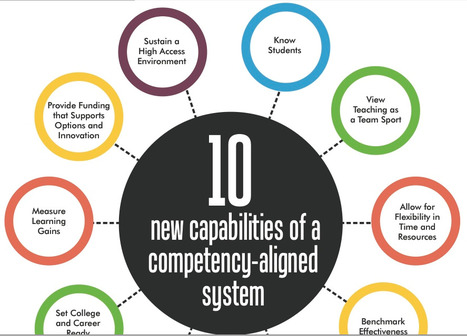
What would happen if education shifted away from the cohort system that is used to one based on competency? This report looks at this issue in depth. The page that is linked to includes a full report, an executive summary, a link to the infographic (of which part is shown here), and a link to download the infographic. Perhaps the first question to ask is what is competency education? "CompetencyWorks defines competency education as a system of education, often referred to as proficiency or mastery based, in which students advance upon mastery. Competencies include explicit, measurable, transferable learning objectives that empower students. Assessment is meaningful and serves as a positive learning experience for students. Students receive timely, differentiated support tailored to their individual learning needs. Learning outcomes include the application and creation of knowledge, along with the development of important skills and dispositions." For a quick overview check out the infographic, which discusses: * Why Competency? * 10 Design Choices * 10 New Capabilities of a Competency-Aligned System * What Does Competency Education Mean for Students?
Scoop.it!
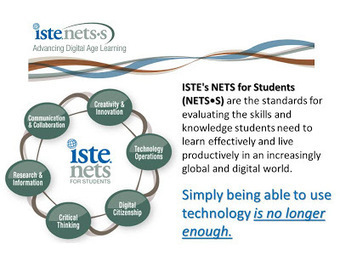
There is a laser-like focus on cool tools and apps these days. Eric Patnoudes encourages you to take a step back and take time to focus on skills.
Beth Dichter's insight:
How do we prepare out students to be 21st century learners? Should we focus on cool tools, or should we focus on skills? This post urges us to focus on skills. Tools come and go, but skills stay. If you question this concept look at the ISTE NETS for students, which include (and are quoted from the article): * Improving higher-order thinking skills, such as problem solving, critical thinking, and creativity * Preparing students for their future in a competitive global job marke * Designing student-centered, project-based, and online learning environments * Guiding systemic change in our schools to create digital places of learning * Inspiring digital age professional models for working, collaborating, and decision making. None of these mention a specific tool. As you plan a new lesson rather than focusing on a tool, focus on the skill you want to teach. As you read the Common Core standards the ability to transfer knowledge is evident. If we teach students skills the students will know how to find the best tool!
Scoop.it!

"It’s an age-old saying, “Give a man a fish, and feed him for a day. Teach a man to fish, and feed him for a lifetime.” What separates good teachers from the excellent ones? The excellent ones are handing out fishing poles; creating a culture in the classroom of independence and self-reliance. These students don’t just recite facts or regurgitate information- they have learned how to learn. They know that if the answer isn’t in front of them, they have the tools to do the investigation and research."
Beth Dichter's insight:
This post provides 20 suggestions on "how" you can "develop a culture of 'can' in our classroom." Below are five of the suggestions. Click through to see all of them as well as more detailed explanations. * Make it a safe place to fail * Encourage curiosity * Give your students a voice * Use natural consequences * Model how to learn |
Scoop.it!

"Next week marks the beginning of parent-teacher conferences. I can count on a few issues to come up: how I calculate grades, the degree to which I am willing to chase students for late work, and individual parents' expectations about the flow of information between school and home. But this year, I am hearing lot of questions about how to best educate introverted students and, specifically, the fairness of class participation grades."
Beth Dichter's insight:
This post raises an important question on how we should work with students whom are not comfortable speaking up in the classroom. Do we give them a pass or do we create situations where they are expected to speak up, to present material to their classmates? The author is clearly in the side that students need to learn to speak up. In fact, the Common Core has Speaking and Listening as one of the requirements. The author also references a book by Susan Cain, 'Quiet: The Power of Introverts in a World that Can't Stop Talking' stating "Cain champions the often-overlooked talents and gifts of introverts, and offers parents and educators strategies for communication and evaluation. This year, I drew on this advice and made a number of changes to my classroom in order to improve learning opportunities for my introverted students." If you find parents of students whom are introverts questioning your requirements or you have students whom are introverts and would like to read about some ways others think about this issue check out the post. 
Jennifer Snapp's curator insight,
July 31, 2015 8:02 PM
I chose this article because it addresses the importance of communication for students who are introverts. Students must be able to speak up not just for a grade, but for their health, happiness, and success in society. Hopefully, others will look differently at the introverts in their classes and help them become better communicators so that they can speak up for themselves in and out of the classroom. Interesting article. 
Jennifer Colin's curator insight,
October 20, 2015 9:56 AM
This is a very insightful look at teachers dealing with introverts in their classrooms. It is true that parents may advocate for giving their child a pass on participation or presentations because of his/her personality type. Author Lahey says, in essence, that's bunk. "A student who is unwilling to stand up for herself and tell me that she does not understand the difference between an adverb and a verb is also less likely to stand up for herself if she is being harassed or pressured in other areas of her life." Encouraging students to speak up is not just important for making the grade, but can also be a matter of personal health and safety. "If you can't stand up for yourself...the world will be a very intimidating and frightening place. I don't want my kids to be intimidated by the world." As an aspiring administrator, this is an important stance to keep in mind. Teachers may be tempted to cave to the wishes of parents of introverted students. But doing so is not helping the children; it is ultimately doing them a disservice.
Scoop.it!
Beth Dichter's insight:
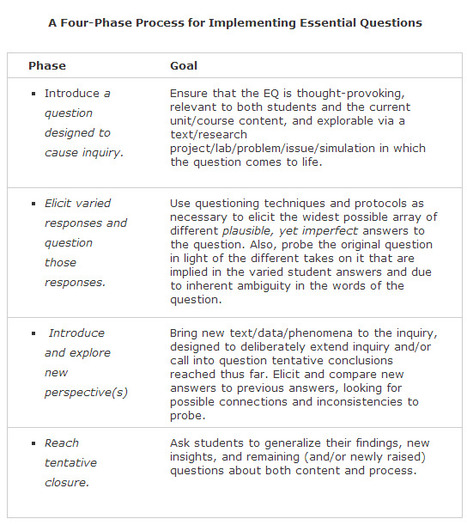
This post from Grant Wiggins explores how Essential Questions are used in classrooms, and provides strategies to help teachers use them so that they become part of student work. Wiggins states "the aim is to use the question to frame specific activities, to provide perspective and focus, to prioritize the course, and to signal to students that, eventually, THEY must – on their own – pose this and other key questions." A number of examples are provided as is a more detailed description of an essential question. This description states that an essential question has seven parts. The shorthand version is below. 1. Open ended 2. Thought provoking and intellectually challengine 3. Higher order thinking 4. Important, transferable ideas 5. Raises additional questions 6. Requires support and justification 7. Recurs over time If you are using essential questions, or plan to in the future this post is a great resource!
Scoop.it!
Beth Dichter's insight:
Check out this new guide from Digital Learning on how to implement blended learning. The image above is an from an infographic, which explores the following areas (after discussing what blended learning is): * The Process - This area has four sections, Create the conditions for success (what do you do before you launch), Plan (what are the key decisions that must be made), Implement (what are the keys to success) and Improve (what are the next steps). * Top Features of a Blended Platform * Steps in the Right Direction * 10 Drivers of Blended Learning * Get Blended This link will take you to the page where you may access the five reports that have been published (at this time). This report is available as a full report, as an executive summary and as an infographic.
Scoop.it!
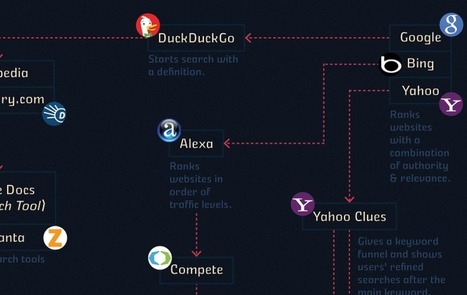
There's a lot more to online research than Google. This handy flowchart we've lovingly dubbed 'The Students Online Research Cheat Sheet' should help.
Beth Dichter's insight:
Check out this infograhic that may help students learn some new ways to search online. It provides a series of paths based on what information you might be looking for and in all likelihood there may be some sites on this that are new to you.
Scoop.it!
Beth Dichter's insight:
This national survey of preK - 12 teachers across the U.S. "provides a current snapshot of how teachers are utilizing technology in America’s classrooms, the types of technology teachers have access to and their attitudes toward technology." A great look at how teachers view technology in the classroom. Some additional information may be found at http://www.pbs.org/about/news/archive/2013/teacher-tech-survey/.
Scoop.it!
Beth Dichter's insight:
This infographic explores how humans learn. It starts by defining "What is learning" and then explores non-associative and associative learning. This is followed by a look at formal learning (as between a teacher and a student, although it may not be face to face. This part of the discussion takes a look at Gardner's theory of multiple intelligences and the last portion looks at the three learning styles. The infographic provides a quick overview of a number of theories that discuss how people learn.
Scoop.it!
Beth Dichter's insight:
Are you looking for online interactive games and simulations for students in grades K - 5. Here is a website that provides links to a wide variety of sites across the curriculum. Click on a topic, such as science, and you will be taken to a page where a variety of topics associated with science, and each of these sub-topics drills down to yet another page which has links to specific sites that you may choose to use. The areas covered are shown in the screen shot above, and it appears that new games and categories are being added (currently the site music says coming soon and the others have links to games).
Scoop.it!

"You don’t mean to bore students. In fact, sometimes you’re downright interesting–the students are engaged, the buzz in the room is palpable, and even the hesitant students are asking questions. But the fact of the matter is, even the most charismatic and experienced teachers bore students sometimes. But the good news is, it may not be your fault."
Beth Dichter's insight:
This post begins with a quote from Plato who "advised against force-feeding of facts to students" (those are not his words, but his words follow this quote) and then moves to the present day and what we know about learning based on neuroscience research into learning. Read about how "stress and curiosity edits which sensory information", how the brain has evolved and must make choices about which information to process based on the multititude of "sensory information" being received. This system, the Reticular Activating System or RAS, determines what passes from the lower brainstem to the higher regions. Other sections include how the brain receives threats and that when it is not under stress the brain is ready to be engaged and learn. Learn ways to work with students so they are engaged and learning, and willing to answer the question "What did you learn in school today?" 
Audrey's comment,
February 4, 2013 5:57 AM
Teaching is a two way process. Students of all ages should be encouraged to take a more active part in their learning. When students say to teachers "we want the lesson to be more fun". Why can students not explain what "fun" means? Why can they not demonstrate, using the learning materials how they would like the subject presented in a fun way?
Scoop.it!

Progressive school admins understand teachers need room to explore and experiment to uncover ways to use technology in creating a culture of innovation.
Beth Dichter's insight:
What if we taught our students that failure is mandatory, a part of our lives, that we can learn from our failures and move forward? This post states "We understand that failure is crucially instructive and necessary on the road to success and learning." We might ask ourselves (as teachers) if we embrace failure or if we are fearful of the possible outcomes. The post provides some foundational material, such as a graphic that looks at a "cycle of experiment and experience" as well as suggesting four strategies: * Remove the fear of failure * Create skunkworks * Promote success * Align IT and curriculum And last but not least, that our schools should be cultures of innovation. Additional material is provided on each of the four strategies in the post.
Scoop.it!

"Here are some tips that can help you potentially secure grants that will make your fellow teachers green with envy. There are hundreds of programs out there that offer teachers the chance to win funds for their classrooms, tech development, or for pioneering educational programs. Despite the wealth of options for this kind of funding, many teachers don’t know where to look for the best grants and how to successfully apply. Here are some tips that can help you potentially secure grants that will make your fellow teachers green with envy."
Beth Dichter's insight:
Technology costs money and writing a grant take time and they are competitive, but many grants are awarded by a wide range of organizations. This post from Online Universities provides information about 13 programs that may be available to you (some are limited to specific states) as well as helpful information. Good luck!
Scoop.it!
Beth Dichter's insight:
If you are looking for some interactive games check out this post from media specialist Julie Greller. She provides links to 136 interactive games. The following categories are represented: * Civics * Geography/History * Language Arts * Library Skills * Math * Mind Games * Science * Various Educational Games * Virtual Labs The games range from those in elementary schools through high school.
Scoop.it!
Beth Dichter's insight:
If you are looking for "mobile learning and technology-based activities that facilitate a sense of community in a variety of educational and training settings" then this post is for you. The site provides over 25 activites with detailed descriptions that include goals, procedures and samples of final products. You may also choose to look at the site as an eBook. If you are planning to make use of mobile technology as a learning tool this site will provide a wealth of ideas! 
Alistair Parker's curator insight,
January 31, 2013 3:24 AM
Beth Dichter's insight:
If you are looking for "mobile learning and technology-based activities that facilitate a sense of community in a variety of educational and training settings" then this post is for you. The site provides over 25 activites with detailed descriptions that include goals, procedures and samples of final products. You may also choose to look at the site as an eBook. If you are planning to make use of mobile technology as a learning tool this site will provide a wealth of ideas! |











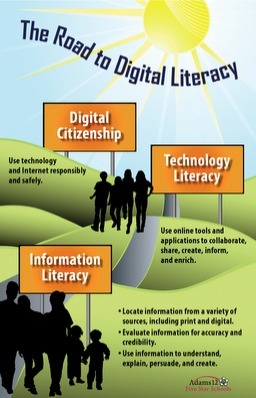
A simple infographic that helps students understand "the road to digital literacy". Designed by the Adams 12 Five Star Schools this infographic discusses digital citizenship, technology literacy and information literacy as the components of digital literacy.
* Information Literacy includes the ability to find, evaluate and use information
* Technology Literacy is the use of software and the multitude of online options available to create digital products
* Digital Citizenship is the ability to use technology appropriately and responsibly