Eclectic Technology
230.9K views | +0 today
Eclectic Technology
Tech tools that assist all students to be independent learners & teachers to become better teachers
Curated by Beth Dichter
Your new post is loading...
Scooped by Beth Dichter
March 29, 2013 11:01 PM
Scoop.it!

An interactive video round-up (seven tools to explore)

An interactive video round-up (seven tools to explore) | Eclectic Technology | Scoop.it

"Interactive video is a powerful new tool that allows teachers and learners to enhance video they make themselves–as well as the videos they discover on the Web–with text, images, maps, links, and other media...It appears that a new subgenre of interactive video creation tools is emerging...if you want to be part of the conversation, if you believe that video can do more than talk at you, you’ll be a lover of these powerful interactive annotation tools for video."

Beth Dichter's insight:

If you are looking for "powerful interactive annotation tools for video" look no further than this post from Joyce Valenz. She discusses seven tools that you may want to explore:

* Mozilla Popcorn Maker

* The Mad Video

* TED-Ed's Flip this Lesson

* wireWax

* YouTube Video Annotation Tools

* Embed Plus (available as a Chrome extension and coming soon for Firefox

* Blubbr

Each of the tools is discussed and in most cases samples of work are also provided. 

Ruth Bass's curator insight, May 27, 2013 10:21 AM

add your insight...

Ruth Bass's curator insight, June 6, 2013 1:17 PM

add your insight...

Scooped by Beth Dichter
March 28, 2013 11:54 PM
Scoop.it!

36 Things Every 21st Century Teacher Should Be Able To Do

36 Things Every 21st Century Teacher Should Be Able To Do | Eclectic Technology | Scoop.it

Originally published on educatorstechnology.com TeachThought took the 36 ideas and "added the twist of ranking them from least complex to most complex, so novices can start at the bottom, and you veterans out there can skip right to 36."

Beth Dichter's insight:

Do you have teachers in your building at all levels of technology? This post may help you come up with some ideas for professional development. The first suggestions on the list of thirty-six is:

* Select the right platform to communicate.

Several others include:

* Explain how and why to use technology to those who don’t use it.

* Model digital citizenship.

* Highlight the limits of technology.

* Record, process, mash, publish, and distribute digital media.

For many other suggetions (and additional resources) continue on to the post.

No comment yet.
Scooped by Beth Dichter
March 27, 2013 10:06 PM
Scoop.it!

Teachers’ Ultimate Guide to Using Videos | MindShift

Teachers’ Ultimate Guide to Using Videos | MindShift | Eclectic Technology | Scoop.it

"With one billion monthly users (and growing), YouTube's popularity is a pretty clear indication that video is a powerful medium. And kids' unrelenting fascination with videos is motivating many educators to find ways to leverage them for all kinds of purposes."

Beth Dichter's insight:

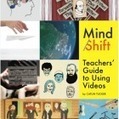
If you are looking for a great guide on using videos in our classroom check out this post and download this Teachers' Guide to Using Videos. The guide is split into the following sections:

* 5 Awesome Sites for Instructional Videos

* 6 Excellent Sites that Supplement your Lessons

* What’s Good? Curating and Evaluating Video Content

* Blending Videos into your Curriculum – This section looks at:

     Ignite Conversations

     Pique Interest, Create Perplexity and Inspire Inquiry!

     Flip Your Classroom: Extend and Engage!

     Exercises for Flipped Classrooms

     Demonstrate Labs, Experiments and Abstract Concepts

     Opportunities for Publishing

     Ten Great Examples of Educational Videos

The post ends with this statement: "You’ll find a slew of valuable resources, including video links for all kinds of subjects — history, math, science, language arts, and more — and ideas on how to inspire students to use videos as a conduit to dig in, ask questions, and learn." Take the time to download the pdf (available at the site).


Sheila Sillery's curator insight, October 25, 2014 3:58 PM

Using Videos with purpose 

Scooped by Beth Dichter
March 25, 2013 9:41 PM
Scoop.it!

Edu-Gadgetry - Is it a Panacea?

Edu-Gadgetry - Is it a Panacea? | Eclectic Technology | Scoop.it

"If communication does not happen in a vacuum, neither does magic. As many know,iPads have become one of the most recent panacea to the many woes in education. From primary education to higher education, iPads are being introduced in classrooms. What do they fulfill?"

Beth Dichter's insight:

This post explores iPads and how they are used in classrooms, noting that "hey will not magically increase learner engagement if learners are not themselves motivated to learn, nor can they be used in the same way in all educational contexts." Patras goes on to discuss mobile learning, again raising questions such as "...doesn’t there need to be a differentiation among the educational levels and environments in order that the use of the tool better fits the needs and demands of learners?" (In this question she is referring to iPads as the tool.)

At the end she provides she looks provides the table (image above) that shows the difference between Web 1.0, Web 2.0 and Web 3.0, the directions she says we are moving. What are your thoughts?

Bryan A. Sonda Piña's curator insight, March 26, 2013 6:45 PM

I guess this process will take time to be a reality

Scooped by Beth Dichter
March 24, 2013 9:58 PM
Scoop.it!

Teaching & Learning Style Comparison « rossparker.org

Teaching & Learning Style Comparison « rossparker.org | Eclectic Technology | Scoop.it
Beth Dichter's insight:

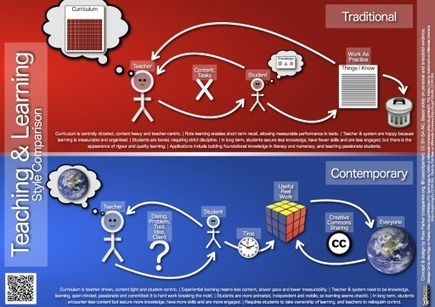
Check out this infographic that explores the difference between traditional teaching and learning, and contemporary teaching and learning. Where is your classroom in this continuum...and where to you think teaching and learning will be 10 years from now?

Darren Smith's curator insight, March 25, 2013 5:43 PM

I love this!

Monica Lamelas's curator insight, March 27, 2013 11:23 PM

This will help us as we transition from a primarily face-to-face training service to providing more online options for our students.

Ken Morrison's comment, July 8, 2013 10:20 PM
Hi Monica. Thank you for following my topic and welcome to Scoop.it. It looks like you are off to a great start. My advice for all new curators is to create a tagging system and tag all posts. It helps you find your old posts, it helps your visitors, and Scoop.it will reward you with a high score. Good luck.
Scooped by Beth Dichter
March 23, 2013 9:18 PM
Scoop.it!

8 Ways to Make Your Teaching Sparkle > Eye On Education

8 Ways to Make Your Teaching Sparkle > Eye On Education | Eclectic Technology | Scoop.it
Beth Dichter's insight:
An infographic that provides suggestions on how to make your classroom S.P.A.R.K.L.E. - Sharing Powerful Activities Really Keeps Learners Engaged. Click through to see a variety of suggestions!
No comment yet.
Scooped by Beth Dichter
March 22, 2013 5:55 AM
Scoop.it!

Free Technology for Teachers: Studies of iPad Use in Education

Free Technology for Teachers: Studies of iPad Use in Education | Eclectic Technology | Scoop.it

Richard Byrne states "This week I got the itch to go beyond anecdotal stories about iPads in the classroom and look for some more substantial research and writing on the topic. Below are some of the reports that I’ve been reading through this week."

Beth Dichter's insight:

We often hear stories of how iPads are being used in education, but when you choose to search for studies on the use of iPads in education few are to be found. Richard Byrne shares five studies in this post. 

* "The Department of Education and Early Childhood Development for Victoria, Australia iPads for Learning – In Their Hands field trial studied the use of iPads in nine schools."

* "The iPad as a Tool for Education is a study based on iPad use at Longfield Academy, Kent, England." (This study was posted in this Scoop.it.)

* "Reading With iPads – The Difference Makes a Difference studied the impact on the reading comprehension, knowledge of content, and analysis skills of boys aged 11 to 13 who read using iPads."

* "Promoting Student Engagement by Integrating New Technology into Tertiary Education: The Role of the iPad studied the use of iPads by teachers and students in distance learning and in-person learning environments."

* "The Impact of the iPad and iPhone on Education was published in 2010 and is speculative in nature as the students surveyed had not yet been given iPads."

Nigel Franciscus's curator insight, March 22, 2013 6:47 AM

Another example about mobile technology impact to make the learning activities become lot easier.

Amir Shamsul's curator insight, March 22, 2013 8:30 AM

Yes I agree to this notion. I'm all for the introduction of iPads into the education system, both junior and senior. One of the small reasons is that it's more convenient than to carry heavy books around all day.

Love Technology's curator insight, April 19, 2013 8:11 AM

On my reading list.

Scooped by Beth Dichter
March 21, 2013 8:34 PM
Scoop.it!

2012 Digital Learning Report Card | Digital Learning Now

2012 Digital Learning Report Card | Digital Learning Now | Eclectic Technology | Scoop.it
Beth Dichter's insight:

Digital Learning Now has released their 2012 Digital Learning Report Card. This report looked at 10 areas to create an overall score for each state. The image above is of an interactive map that allow you to see how each state scored on each of the 10 areas.

The 10 areas that are scored are: Student Eligibility, Student Access, Personalized Learning, Advancement, Quality Content, Quality Instruction, Quality Choices, Assessment and Accountability, Funding and Delivery. 

You click on your state and each area will be scored, as well as a final score provided. A quick look at the image above tells you that there is room for improvement for most states.

For the full report go to: http://www.digitallearningnow.com/wp-content/uploads/reportcard/2012/2012ReportCard.pdf.


No comment yet.
Scooped by Beth Dichter
March 20, 2013 8:34 PM
Scoop.it!

5 Thoughts About Technology | ASCD Inservice

5 Thoughts About Technology | ASCD Inservice | Eclectic Technology | Scoop.it
Beth Dichter's insight:

The March 2013 issue of Educational Leadership is focused on “Technology-Rich Learning.” There are a number of articles that are available on the site that you might be interested in reading. A list of some is below:

* "Students First, Not Stuff" by Will Richardson discusses how "technologies reframe learning, but educators reimagine schooling."

* "Our Brains Extended" by Mark Prensky discusses "What will humans do with their new enhanced capabilities?"

* "A Bold New Math Class" by Salman Khan and Elizabeth Slavitt discusses how "Khan Academy offers a student-centric, self-paced learning model."

* "New Literacies and the Common Core" by William Kist discusses "Strategies for learning the fundamentals of reading, writing, and comprehending in the information age."

To go directly to the page of these articles (and others): 

http://www.ascd.org/publications/educational-leadership/mar13/vol70/num06/toc.aspx ;

No comment yet.
Scooped by Beth Dichter
March 19, 2013 10:04 PM
Scoop.it!

27 Actions That Promote Self-Directed Learning

27 Actions That Promote Self-Directed Learning | Eclectic Technology | Scoop.it

"So I'm trying to better understand how people learn--not now they're taught in terms of teaching strategies, but more so learning strategies--only not really strategies...Learning actions, or cognitive actions."

Beth Dichter's insight:

How can we help out students become more self-directed in their learning? What tools can we provide them with to help them become self-directed learners (using 21st century tools and skills)? 

This post provides a list of 27 actions. The post states:

"The big idea is that these kinds of “brain actions” are not only the kinds of tasks you can use to create assignments, but more importantly are the kinds of acts that promote inquiry-based understanding. So rather than start with a topic–fractions, metaphors, or racism–you can simply insist on the cognitive action itself. Learners can choose topics of their own, or you can offer a range of topics."

With that as a background five of the actions are listed below. There is additional material in the post as well as another 22 actions.

* Challenge something

* Test the validity of a model

* Study the relationship between text and subtext

* Critique something

* Transfer a lesson or philosophical stance from one situation to another

JoAnn Delaney's curator insight, August 6, 2013 12:08 PM

27 cognitive actions #edchat #21stedchat

Don Berg's curator insight, July 10, 2014 3:53 PM

Interesting how much of challenge it is to distinguish between teaching and learning. That is one of the obstacles to getting self-directed learning to become a mainstream feature in schools.

Scooped by Beth Dichter
March 18, 2013 10:22 PM
Scoop.it!

Free apps list for Education by Grade Levels

A list of free apps recommended by the STaRT Education Department
Beth Dichter's insight:

If you are looking for free apps that are divided by grade level and rated by a school district this post may be helpful. Apps are split into K-2, 3-5, 6-8, 9+, and teachers, and raged from 3 to 5. A great place to begin if you are going to getting iPads into your classroom.

hatem deif's curator insight, March 20, 2013 10:13 AM

with my best wishes/respectfully

Scooped by Beth Dichter
March 17, 2013 9:36 PM
Scoop.it!

Math, Physics, Languages: Minecraft is the Teachers’ Ultimate Multi-Tool | MindShift

Math, Physics, Languages: Minecraft is the Teachers’ Ultimate Multi-Tool  | MindShift | Eclectic Technology | Scoop.it

"Need more convincing that Minecraft can be a powerful tool for learning? Check out this fun video from PBS Idea Channel's Mike Rugnetta, who specifically (and very quickly) lists a number of ways the video game can and has been used to learn everything from physics to history."

Beth Dichter's insight:

Check out this video that discusses why you might use Minecraft to teach physics to history. Gamification anyone?

No comment yet.
Scooped by Beth Dichter
March 16, 2013 10:45 PM
Scoop.it!

6 Basic Benefits Of Game-Based Learning

6 Basic Benefits Of Game-Based Learning | Eclectic Technology | Scoop.it

"There seems to be a perception that online gaming has a detrimental impact on children’s development. Nothing could be further from the truth, and there are countless–and complex–reasons for this, but it also makes sense at the basic benefits of game-based learning."

Beth Dichter's insight:

Can games increase a child's learning and development? It appears that answer is yes. Below are six benefits and additional information is available in the post.

* Increases A Child’s Memory Capacity

* Computer & Simulation Fluency

* Helps With Fast Strategic Thinking & Problem-Solving

* Develops Hand-Eye Coordination

* Beneficial Specifically For Children With Attention Disorders

* Helps Children With Particular Skills (e.g. map reading)


No comment yet.
Scooped by Beth Dichter
March 29, 2013 9:26 PM
Scoop.it!

Connect! Transform the Future - A Portfolio of Energy Resources

Connect! Transform the Future - A Portfolio of Energy Resources | Eclectic Technology | Scoop.it
Find educator resources about energy sources and resources, energy efficiency, and energy conservation.
Beth Dichter's insight:

National Geographic has a new site that provides excellent resources on energy for students in Grades 4 - 12. Along with energy activities for students in Grades 4 - 8 and Grades 9 - 12 the site also provides an interactive map to explore energy data, a student friendly encyclopedia on common energy topics, energy videos, energy literacy principles, a photo gallery, teacher resources, and a link to a game "Plan it Green: The Big Switch" that allows "that allows players to design and create their own energy-efficient city of the future!"

David McPherson's curator insight, March 24, 2014 4:21 AM

Great way to educate young minds about the issues facing society with regards to resource usage.

Scooped by Beth Dichter
March 28, 2013 11:35 PM
Scoop.it!

Learners Should Be Developing Their Own Essential Questions

Learners Should Be Developing Their Own Essential Questions | Eclectic Technology | Scoop.it

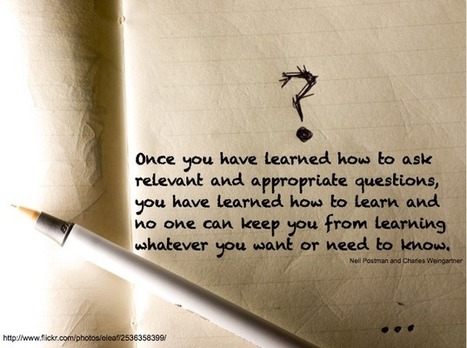
"Having essential questions drive curriculum and learning has become core to many educators' instructional practices.  Grant Wiggins, in his work on Understanding By Design, describes an essential quetion as:  

A meaning of “essential” involves important questions that recur throughout one’s life. Such questions are broad in scope and timeless by nature. They are perpetually arguable – What is justice?  Is art a matter of taste or principles? How far should we tamper with our own biology and chemistry?  Is science compatible with religion? Is an author’s view privileged in determining the meaning of a text? We may arrive at or be helped to grasp understandings for these questions, but we soon learn that answers to them are invariably provisional..."

Beth Dichter's insight:

Why should we teach students to develop their own essential questions? Perhaps because they may be able to develop questions that are engaging and of interest to them. 
Gerstein explores this issue by sharing a variety of resources that look at question, including Jamie McKenzie who describes "what actually happens in most schools and classrooms in terms of questioning", Paul Harris who "argues that questions occupy a more central role than we realize in childhood cognitive development", and others.

In addition there is information on how to help students generate their own essential questions (additional information in the post):

* Begin a New Unit with Students Developing Questions

* Create a Taxonomy of Questions

* Ask Students to Create Questions as Homework

She also shares information on the QFT (Question Formulation Technique) which has six steps, beginning with "Teacher Design a Question Focus" and immediately moves to "Students Produce Questions" and then to "Students Improve Question" and finishes with "Students Reflect on What they have Learned." For more information (and steps 4 and 5) check out the post!

Patrice Bucci's curator insight, September 29, 2013 7:00 PM

So true... I cringe when I am in classrooms with the packaged program "essential question" of the week on the board...and very often those "essential questions" lack cognitive clarity for the students

Mary Reilley Clark's curator insight, January 8, 2014 1:33 PM

A great summary of why questioning still matters.  We've been talking about metacognition a lot this year in the library.  Learning how to develop questions is a large part of learning how you learn and think.

Stacey Jackowski's curator insight, February 19, 2014 8:20 PM

This quote is so true.  Learning how to ask essential questions is a skill that we can carry with us for the rest of our lives and facilitates a lifetime of learning. 

Scooped by Beth Dichter
March 26, 2013 10:36 PM
Scoop.it!

Innovation Design In Education - ASIDE: Are Today's Students Afraid Of Intellectual Risk?

Innovation Design In Education - ASIDE: Are Today's Students Afraid Of Intellectual Risk? | Eclectic Technology | Scoop.it

"An increasing refrain from various rungs of the educational ladder is that students are scared to take intellectual risks. Teachers note that pupils are reluctant to guess, to stretch themselves, or to experiment. Perhaps it's a consequence of the "praised" generation, when kids receive trophies for participation and adults shield adolescents from failure..."

Beth Dichter's insight:

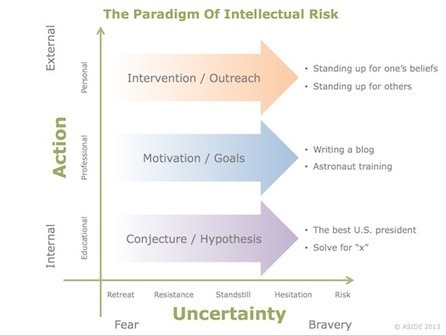
If students are unwilling to take intellectual risks what other risks might they be unwilling to make in the future? This post explore this issue from an educational, professional and personal viewpoint. The image above is a representation that explores "some of the issues we're wresting with in guiding our students. The different spectra on the "x" and "y" axes represent the different ways people respond to uncertainty and action."

No comment yet.
Scooped by Beth Dichter
March 25, 2013 7:27 PM
Scoop.it!

America's Math Problem - Online Colleges

America's Math Problem - Online Colleges | Eclectic Technology | Scoop.it

"Whether you love it or hate it, if you’ve partaken in the American school system, there’s no doubt that you’ve studied math in a wide range of forms and subjects. From algebra to geometry to the rigor of calculus, math is something that is a part of the average student’s life from kindergarten to college."

Beth Dichter's insight:

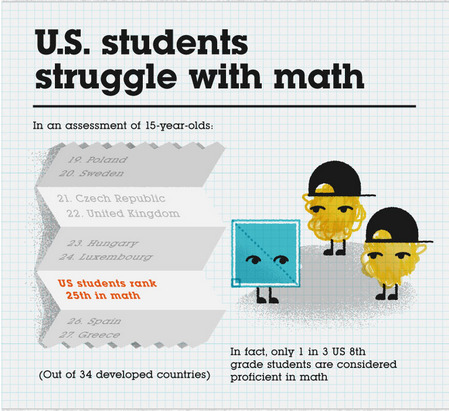
This infographic explores math in America. Did you know that 1 in 5 Americans is "functionally innumerate"? What does this mean? Sixty-two million Americans cannot do basic math such as adding fractions, working with measurement or doing whole number problems. 

Learn about how other countries compare to the U.S., how the U.S. compares to Singapore and South Korea in terms of "high achiever", what happens when we "hate" math, and what could be done to help the next generation succeed in math.

No comment yet.
Scooped by Beth Dichter
March 24, 2013 7:08 PM
Scoop.it!

Teachers, Students, Digital Games: What’s the Right Mix? | MindShift

Teachers, Students, Digital Games: What’s the Right Mix?  | MindShift | Eclectic Technology | Scoop.it

"When St. Louis fifth-grade teacher Jenny Kavanaugh teaches history, she uses her laptop to look at a map, or to give kids a virtual 

our of the historical landmarks they’re studying. “Students can interact with history in very cool ways online,” she said."

But when it’s time for math, she puts the computer away. Even though Kavanaugh thinks technology is a great tool to enhance and deepen certain lessons, for drill and practice of key concepts in class, she finds one-on-one practice to be much more effective than its technological equivalent – digital practice games.

Beth Dichter's insight:

When is the right time to use computer games and when is practice with paper and pencial a better way to learn concepts in teaching? Below are two quotes that appear in this post.

"...Gary Stager, founder of theConstructing Modern Knowledge Summer Institute, recommend that computers be used to add “deep and meaningful experiences” to teachers’ lessons, much of what the 91percent of teachers with access to computers are doing may be just the opposite."

and "43 percent of classroom computing goes to playing educational digital games, while a Joan Ganz Cooney study showed that nearly 50 percent of teachers use digital games in class. But with nearly half of all classroom computer time dedicated to games — many of which are played to reinforce basic skills like phonics, spelling or multiplication tables — some teachers are wondering if games really are innovative techniques used to enhance student learning. Or are they just flashy, colorful ways of dishing out more of the same?"

The post also discusses the best use of iPads as well as SimCityEDU. Two questions are also raised in this post, are games being used to enhance instruction, and do we lose something when students use technology rather than paper and pencil to learn?

Katie S.'s curator insight, April 9, 2015 4:29 PM

This blog post discusses the use of technology and games in the classroom.  While teacher Jenny Kavanaugh uses games and technology for teaching history, she criticizes the drill like nature of math games and the post sees that developments need to be made in educational games to make them more useful and engaging.  It seems that history is at the forefront though, as online content is able to give a more direct experience of past, place, and events.

benjamin costello's curator insight, May 20, 2015 5:36 PM

Kids like many people learn in a variety of ways so whether you teach the "old fashion" way or through technology I think you must be aware of this. Digital games are just one way to achieve this but I think you have to fully immerse yourself and your students in the technology to be able to fully grab the good intention of it. Trial and error still work.

Gabrielle's curator insight, May 21, 2017 8:53 PM
Helps students engage in historical periods they're studying.
Scooped by Beth Dichter
March 22, 2013 11:06 PM
Scoop.it!

Schools are doing Education 1.0; talking about doing Education 2.0; when they should be planning Education 3.0

Schools are doing Education 1.0; talking about doing Education 2.0; when they should be planning Education 3.0 | Eclectic Technology | Scoop.it

"Schools are doing Education 1.0; talking about doing Education 2.0; when they should be planning and implementing Education 3.0. This post seeks to to compare the developments of the Internet-Web to those of education."

Beth Dichter's insight:

Gerstein provides an interesting look at where education is and where education is going. She provides a look at research that shows that schools are "living within and functioning through an Education 1.0 model." She quotes an article that states "Essentialists argue that classrooms should be teacher-oriented. The teachers or administrators decide what is most important for the students to learn with little regard to the student interests. The teachers also focus on achievement test scores as a means of evaluating progress."

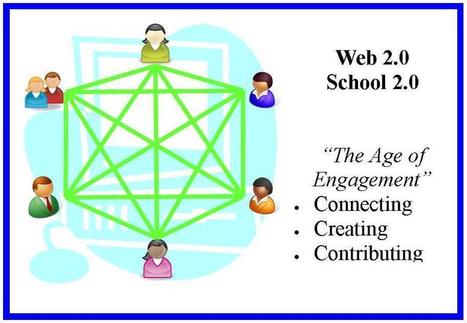
So what defines Education 2.0? "Education 2.0 includes more interaction between the teacher and student; student to student; and student to content/expert."

Education 3.0 moves us into a new direction, one that we are beginning to see. Content is free (think open educational resources) and readily available, It is more self-directed with a focus on creativity, problem solving and innovation.

As always there is a wealth of resources available in the post.

Betsy Eubanks's curator insight, March 23, 2013 10:39 AM

Excellent content, although evaluative testing issue remains unaddressed.

claudine pierron's curator insight, April 17, 2013 3:10 AM

Le changement phénoménal de la technologie provoque de nouvelles transformations au sein de l'éducation. Éducation 3.0 arrive avec toutes les répercussions sur "savoir apprendre " comment apprendre"

Scooped by Beth Dichter
March 21, 2013 10:23 PM
Scoop.it!

50 Ways To Integrate Art Into Any Lesson

50 Ways To Integrate Art Into Any Lesson | Eclectic Technology | Scoop.it

"As children, young children, everything meant playing and art. We saw the world as a playground and a canvass. It didn’t matter whether or not we could actually draw. What mattered was the thrill of creating something beautiful.

We were all artists. We still are."

Beth Dichter's insight:

If you are looking for some great websites and ideas to help you integrate art into your curriculum this post may provide everything you need. The information is split into the following categories:

* Math

* Geometry

* Science

* Computer Science

* Movies Across the Curriculum

* Writing and Grammar

* Reading

* Social Studies

Each suggestion includes additional information and in many cases provides links to specific website. Have fun exploring the wide range of options!

Lewis Evans's curator insight, March 22, 2013 9:42 PM

Creativity needs to be integrated into all education - not just the arts.

Shradha Kanwar's curator insight, March 23, 2013 11:43 AM

Enjoying with Art..

Agustina Diaz's curator insight, November 6, 2013 3:39 PM

Very interesting! Bear it in mind...

Scooped by Beth Dichter
March 20, 2013 9:09 PM
Scoop.it!

5 Tools to Help Students Learn How to Learn | MindShift

5 Tools to Help Students Learn How to Learn | MindShift | Eclectic Technology | Scoop.it

"Helping students learn how to learn: That's what most educators strive for, and that's the goal of inquiry learning. That skill transfers to other academic subject areas and even to the workplace where employers have consistently said that they want creative, innovative and adaptive thinkers. Inquiry learning is an integrated approach that includes kinds of learning: content, literacy, information literacy, learning how to learn, and social or collaborative skills. Students think about the choices they make throughout the process and the way they feel as they learn. Those observations are as important as the content they learn or the projects they create."

Beth Dichter's insight:

If we want to teach students to learn how to learn what tools would help them out? Using the concept of inquiry learning this post recommends the following tools to help the students guide their inquiry learning process.

* An Inquiry Community is the class itself.

* An Inquiry Circle is a small group where students can talk to one another...

* The Inquiry Journal

* The Inquiry Log helps students to keep track of the learning journey

* The Inquiry Chart is a great tool to help students identify a central question.

Additional information on these five processes is available in the post.

Shradha Kanwar's curator insight, March 23, 2013 11:45 AM

Learning how to learn..the Brilliant Human Brain

Scooped by Beth Dichter
March 19, 2013 10:14 PM
Scoop.it!

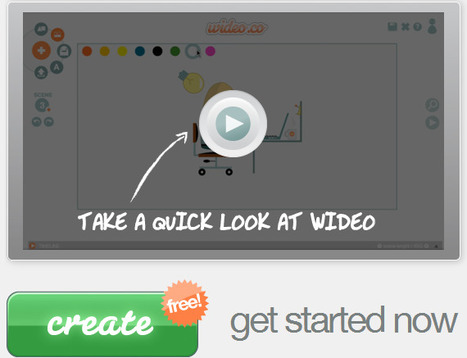
Wideo - Create Animated Videos With Voiceovers

Wideo - Create Animated Videos With Voiceovers | Eclectic Technology | Scoop.it

"Wideo allows you to create short, animated videos and Common Craft like videos in your web browser. Today,Wideo announced that you can now upload your own audio files into your video projects. This means that you could record a voiceover and add it to your video."

Beth Dichter's insight:

Wideo is a free online tool that allows you to create your own animation. You can use images, fonts, animations and videos available on the site or upload your own...and shre your final project!

This post provides a quick look of how it works (with a short video) or you can go directly to the site: http://wideo.co/.

Matthew Renner's curator insight, March 20, 2013 10:49 AM

This is very cool.  It's expensive to get these done otherwise.

Shradha Kanwar's curator insight, March 21, 2013 1:00 AM

An interesting tool!

Scooped by Beth Dichter
March 18, 2013 10:42 PM
Scoop.it!

Teachers Love Technology - Online Universities.com

Teachers Love Technology - Online Universities.com | Eclectic Technology | Scoop.it

"Once upon a time, the role of the teacher in the classroom conjured up images and ideas of blackboards, rulers, chalk, and pencils. But now, technology is becoming more and more integrated into modern school systems—not just as an added bonus, but as a necessity to how students learn and how teachers teach."

Beth Dichter's insight:

An infographic that explores the changes taking place in our schools. Sections include:

* A look at high-tech teaching

* Now tablets are joining the classroom

* Teachers have 'em, love 'em

* Teachers use more and more tech...Does it help?

* Tech is used to teach outside the classroom, too

* So it's not surprising that..

For more information on this "tech-teaching phenomenon, and why teachers love it so much" check out this infographic.

Jenny Cha's curator insight, March 19, 2013 10:25 AM

How do we encourage more instructors to embrace technology in the classroom (and the flipped classroom)? The students have spoken but are the instructors really listening?

Yiran Liu's curator insight, March 20, 2013 2:37 PM

funny way for learning!

Scooped by Beth Dichter
March 18, 2013 10:03 PM
Scoop.it!

20 Quick Actions To Set Your Classroom Up For Massive Success

20 Quick Actions To Set Your Classroom Up For Massive Success | Eclectic Technology | Scoop.it

"When the school year begins, teachers spend a lot of time getting the classroom ready, planning lessons, and getting to know his/her students. The following list includes 20 ideas that you may not have thought of in terms of a successful classroom arrangement or organization.

Each item takes no longer than an hour and can make a big difference throughout the year."

Beth Dichter's insight:

This post comes out of Australia, and the school year begins in February...so for some of us this may be a bit late (or very early) but the 20 quick actions they suggest may still be of use this year. Several of the ideas are listed below. Each is explained in more detail in the post and in some cases links are provided for additional resources.

Action #1 Set up your classroom in an “active learning” format (15-30 minutes).

Action #5 Develop a plan for quieting the class (10 minutes a day for a few days)
Action #9 Create a list of “question words” that help you with effective questioning (10 minutes) (This one has a link to a resource on how to practice effective questioning.)

Action #20 Use a learning styles assessment (1 hour)
Check out the post for the 16 additional suggestions.

No comment yet.
Scooped by Beth Dichter
March 17, 2013 9:08 PM
Scoop.it!

6 Common Misunderstandings About Assessment Of Learning

6 Common Misunderstandings About Assessment Of Learning | Eclectic Technology | Scoop.it

"Over the past two decades there has been a lot written, and much discussion, around the use effective use of assessment in the classroom.

Unfortunately many educators, particularly at the secondary school level, continue to cling tenaciously to “traditional” practices which are, at best ineffective and at worst, counterproductive to the goals of modern education.  Here are six common misconceptions about assessment and evaluation that we could stand to rethink."

Beth Dichter's insight:

Read the list below and see if you find yourself in one or more of these misunderstandings...and for more information on each click through to the post.

1. Assessment and evaluation are the same. 

2. Most assessment is summative. 

3. Assessment is one way communication, the teacher gives feedback on student work. 

4. Assessment is for grading purposes.

5. Student work should be given a grade or a mark. 

6. If assignments are late, a teacher should deduct points. 


No comment yet.