


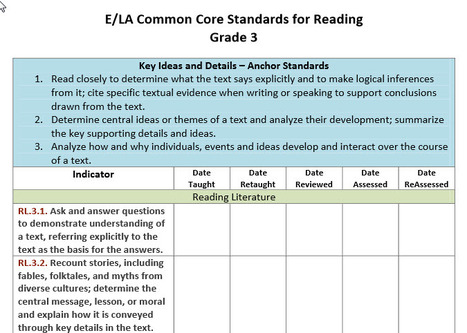

Our common core standards checklists are just what you need to help you keep track of the standards taught in your classroom. Use these to make sure you are addressing all that you need to teach throughout the course of the school year.

 Your new post is loading...
 Scoop.it! Our common core standards checklists are just what you need to help you keep track of the standards taught in your classroom. Use these to make sure you are addressing all that you need to teach throughout the course of the school year. 
Monica Principe's comment,
September 16, 2013 11:24 AM
Has anyone seen this for secondary school?
Sign up to comment
Scoop.it!
"What if, when students failed, teachers praised them? In the business world, the world of entrepreneurship, failure remains inevitable but so does success if you keep plugging away at your goal. Embracing this in education teaches students to learn that mistakes lead to success. Science teachers probably understand this concept better than most teachers. They just happen to call it hypothesis or refer to it as an experiment instead of failure."
Beth Dichter's insight:
What would happen if we taught our students (or learners) that failure is a gift, that we learn lessons when we fail. This post provides 50 tips to use with students to help them "fail well." Five are below. Find the forty-five in the post, as well as additional information on each. * Point out their mistakes * Praise them immediately * Experiment with them * Expose them to the unknown * Teach them to start over Use these tips to shift communication around failure. Help your students see failure as an opportunity to learn, to grow.
Scoop.it!

Find out more about the do's and don'ts on online manners. For more information about internet issues visit Knowthenet today.
Beth Dichter's insight:
Students often struggle with understanding do's and don'ts of online behavior. This infographic provides at manners online, noting that they do matter. What do you do online? What don't you do online? With a list of 10 do's and 10 don'ts this will help bring out discussion in the classroom. There are also many other great resources available from this website, Knowthenet, out of England. 
Cindy Powell's curator insight,
April 10, 2014 2:09 PM
From Infographic...and Informational Text TCC 4-5 This is a graphic example for the article, but the site is a cybersafety site in the UK and has lots of information for parents about online safety for their children. It also tests their knowledge. 
Rachael Johnston's curator insight,
October 20, 2014 10:53 PM
It is important to build your own brand and to promote yourself positively. You want to be polite to other users and make sure you have nothing on your profile that could be damaging to your reputation. This includes swear words, inappropriate or rude comments, and pictures and videos of drinking or drugs. This is really important for graduating students who, most likely, need to go through and delete pictures that have been tagged in one Facebook Make sure you give credit to others if you share something of theirs. Also make sure you are writing your own posts and not just sharing others. However, make sure you are posting valuable and relevant information. Listen and think before you write and make sure you are using proper english. It is okay to have debates on social netowrks with other users, everybody has the right ti voice their opinion, but don't let things get too personal or nasty. It is also essential to understand that there are also hings to be very careful of when using social networks. For one, people are not always who they seem. You should also make sure you do not assume a false identity. It is important to keep some kind of professionalism, but don't change yourself or hide who you really are. You must also make sure you are abiding by the rules of the network and report others who dont. Last but certainly not least, be very careful about who you share things with. There are certain places to share certain things. For example, you may post something bout your personal life in your Facebook status, but it is not appropriate to do so on your LinkedIn profile. Do not share pictures and videos with strangers, you never know how they will use these.
Scoop.it!
Beth Dichter's insight:
This pdf file looks at "differentiated instructional strategies that included digital pedagogy and 21st Century skills." There are five major sections which include: * Content - What Students Need to Learn * Process - How Students Learn * Product - How Students Demonstrate what they Know * Environment - How Learning is Structured Each of the sections above also include: * Guiding Focus Questions * Digital Pedagogy which relates to the specific area * Resources which support the digital pedagogy This is a work in progress with the goal to create a website in the future. Additional areas to be covered include "Dimensions or Learning and Literacy demands." There are many great resources in this as well as guiding questions that you may find valuable. 
Nancy Jones's curator insight,
August 19, 2013 10:51 AM
Beth's summary is a good one. Some food for thought. This thorough and thoughtful study includes a variety of digital tools as options.
Scoop.it!
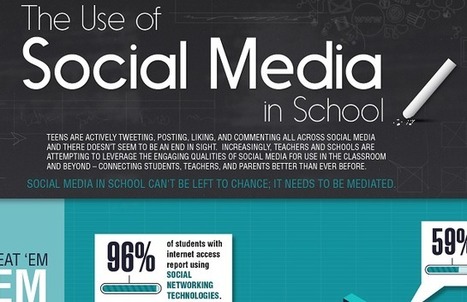
Teachers and schools are attempting to leverage the engaging qualities of social media for use in the classroom and beyond.
Beth Dichter's insight:
This infographic explores the use of social media in schools. We know that teenagers (and tweens) are actively engaged with social media. As educators how can we leverage this use and bring it into our classrooms. We know our students are actively using this technology outside of school...so why do so many schools ban it? This post explores reasons why we should look at this issue. The infographic is divided into a number of sections. * If You can't Beat 'Em, Join 'Em - Social Networking Stats * Benefits of Social Media in the Classroom - a look at Student Benefits, Educator Benefits and Parental Benefits * Examples of Social Media in the Classroom: Looking at Facebook, Twitter, Pinterest and Blogging * Social Media Pilot Program: Learn about a program in Portland, Oregon and the difference it made Resources are also provided at the bottom of the infographic. 
Jessica Trcka's curator insight,
November 8, 2013 3:58 PM
Social Media is a very major topic that needs to be addressed in the health classroom. Students need to become aware of safety issues that may arise when using Social Media. This document reflects how Social Media is being utilized in the perspective of the teacher and student. Students should read this document and highlight and underline the main points and be prepared for a discussion about the topic of Social Media in the classroom.
Scoop.it!
Beth Dichter's insight:
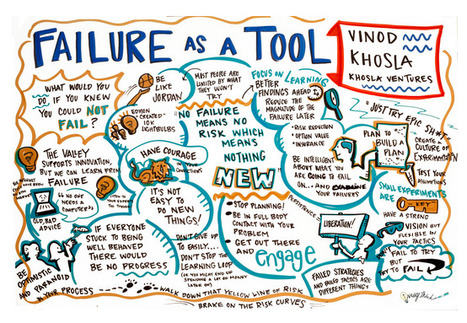
Check out the notes from the talk above, consider watching the video embedded within the post and think about new ways to work with your students this year about the concept of failure. If you are an engineer failure you understand that failure is a teaching tool, allowing you to improve the project, but in education most students consider failure just that...they have failed. A couple of quotes found in this visalization are below. What are your thoughts as you read them? * Have courage. It's not easy to do new things! * No failure means no risk which means nothing new.
Scoop.it!

Is there "a difference between a 'student' and a 'learner,' between a 'teacher' and an 'educator.'
Beth Dichter's insight:
Have you had yourself what your students expect from you as a teacher. ASIDE has and this post is the first of two. This one explores what students expect from their teachers. The next one will be "5 Things Learners Expect From Their Educators." If you see the image above you know the five items in this post are: * Wonder * Understanding of their world * Mutual trust * A bit of humor * A lively environment Each of the points are discussed and may make you smile and laugh as they discuss these five points from the students point of view as well as the teacher point of view. 
Audrey's curator insight,
August 16, 2013 3:17 PM
Psychology incorporates all of these "things": You should be in the classroom when Freud's 5 psychosexual stages are put forward (humour, lively environment and wonder!). Start the class with pop music which links to the topic (understanding their world). At the first lesson when I have asked students to write on the board what they want from the lessons (the only one of the above they have ever written down was humour). When I asked them to give me examples of what they meant, they could not. When I explained that they needed to tell me what they meant by "fun classes", as I was I trained to teach and tutor, not to make jokes, they were unable to tell me. When I conducted conformity research by having a group of students walking down the corridor dancing to music played over the intercom to see whether other students would conform by joining in, I demonstrated what they meant by fun. I have learnt from more enlightened others that a Tutor / Educator guides by pointing out where to find the relevant information plus discussion questions which allows learners to share information, analyse and evaluate during class. After more questions which stimulate arguments, the learners are given a question to answer. 
Sue Alexander's curator insight,
August 17, 2013 10:51 AM
Some wonderful questions that I look forward to answering. 
Beatriz Montesinos's curator insight,
August 20, 2013 12:42 PM
¿Hay diferencia entre "alumno" y "aprendiz" y entre "profesor" y "educador"?
Scoop.it!
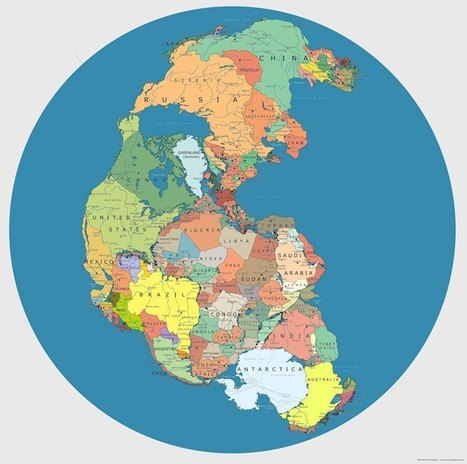
If you're a visual learner like myself, then you know maps, charts and infographics can really help bring data and information to life. Maps can make a point resonate with readers and this c...
Beth Dichter's insight:
Maps are great visuals for teaching about concepts of space (as in spatial intelligence) and data. This collection of forty maps is diverse and you will find quite a few that you may want to share with students but check them out first. Based on the grade level you teach there may be maps you will not share. Luckily there are links to where the map was first found. A few of the maps are listed below. The one in the image is a "Map of 'Pangea' with Current International Borders." * Countries that do not use the Metric System * The Only 22 Countries in the World that Britain has not Invaded * Map of Time Zones in Antarctica * Global Internet Usage Based on Time of Day * World Map of Earthquakes since 1898 * The 7000 Rivers that Feed the Mississippi River
Scoop.it!
It's just one little word, but says world-renowned Stanford psychologist Carol Dweck, it has the power to inspire your child to do incredible things.
Beth Dichter's insight:
Carol Dweck has written about mindset, specifically the difference between growth mindset and fixed mindset (and you can search these terms on this Scoop.it). This short (less than 1 minute) video looks at a three letter word and how it helps us see that a student has a growth mindset. Listen and learn. 
Dico Krommenhoek's curator insight,
August 16, 2013 7:36 AM
Dit ga ik zeker gebruiken. 'Nog' (niet) goed ergens in zijn. Yet maakt dit wel mooier, omdat je het na de uiting van een leerling kunt plaatsen... 
Tony Meehan's curator insight,
April 18, 2014 9:21 AM
How many of our learners come with the fixed view that they are "no good at maths", "don't get English" etc? Well, this is a good solid growth mindset come-back: " you don't get it yet......."
Scoop.it!
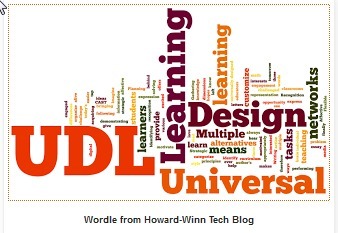
"I don't know about you, but I love TED talks. (TED = Technology, Entertainment, Design.) Although I have known about and preached Universal Design for Learning (UDL) since I began this blog, I could have never explain it as well as Todd Rose did in his TED Talk, "The Myth of Average". Thank you, Todd, for providing this concept so beautifully. (This is 18 minutes, but worth every one!)"
Beth Dichter's insight:
This post discusses Universal Design for Learning (UDL), a tool that is helpful to know about since the Common Core requires that we need to ""provide a consistent, clear understanding of what students are expected to learn, so teachers and parents know what they need to do to help them." In addition it provides access to a TEDTalk by Todd Rose, where he discusses "The Myth of Average", a talk that will make you re-think how you view your students (and ask yourself "What is average when it comes to my students?"). In addition Glenda Hampton Anderson provides an excellent overview of UDL, perfect for someone new to these concepts or as a review. Many links are included which provide access to some of the best sites for materials on Universal Design for Learning. 
Brad Reitzel's curator insight,
July 4, 2014 10:31 AM
Our #alcpqp group is loving TED talks. Here is one about Universal Design that will help us all get acquainted!
Scoop.it!
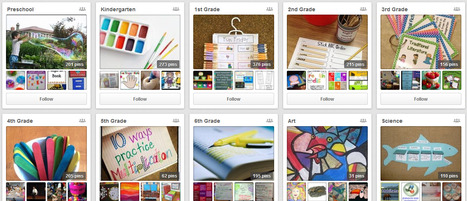
"A pinspiring place for teachers to find and share creative ideas. Follow these boards for lesson plans, classroom decor and lots more for lively learning."
Beth Dichter's insight:
Pinterest has become a great location to find educational sources, and now they have launched a teachers hub. Currently they are boards that share information for grades PreK through Grade 6 (one board per grade) as well as boards for Art, Science, Math, Classroom Decor, Classroom Management, Home School, Literacy, Sensory Learning, Gold Star Supplies, Back to School and Educational Blogs. For more information on this new feature you may travel over to the Pinterest Blog where they posted "Say Hello to Pinterest" at http://blog.pinterest.com/post/58175180377/say-hello-to-teachers-on-pinterest The current boards are for elementary school but the post also notes that they will "work together with Edutopia—an online resource for educators—to build out the education-focused community on Pinterest." If you are looking for lesson plans, ideas for your classroom, and more it is worth checking out this resource. 
The Teacher Treasury's comment,
August 22, 2013 1:54 AM
This is a wonderful idea. Really looking forward to the development of this Teacher Hub.
Scoop.it!

"The Practitioner’s Guide to TPACK is an initiative jointly undertaken by the members of the National Technology Leadership Coalition (NTLC). Technology is rapidly changing how we teach and how we learn. Emergent technologies offer opportunities to understand concepts in deeper, often different, and more meaningful ways. However, this growth in understanding will occur only if teachers learn to use these technologies in effective ways."
Beth Dichter's insight:
If you have not heard of TPACK here is a brief explanation. Think of a digagram that has three intersecting circles.The circles are: * technological knowledge * pedagogical knowledge * content knowledge To make the best use of technological knowledge one must also have an understanding of pedagogical and content knowledge and how they interact with one another. What makes this site unique to me is that it includes case studies of the use of TPACK in English, History. Mathematics and Science in both elementary and secondary education and they have recently posted a video study on elementary mathematics. To do this site justice you will find yourself spending time exploring...and you may walk away with some new ideas and lesson plans! 
Viv Hall's curator insight,
November 10, 2013 6:18 PM
A must watch for all educators interested in TPACK. Excellent model to enable the viewer to follow the theory being effectively put into practice. #plpnetwork #edchat #ceoelearn
Scoop.it!
Free educational online games for children. Our games reinforce the skills that are vital to elementary students. We offer many math and reading games.
Beth Dichter's insight:
If you are looking for some games that are free and that reinforce skills then consider checking out RoomRecess. There are about 30 games available for students in K-1, 2-3 and 4-5. Find games "with the goal of reinforcing fundamental learning concepts in math, reading, spelling, language arts, and basic problem solving." All games are free and no sign-up is required. 
April Ledesma's curator insight,
October 6, 2014 11:18 PM
Educational games are great ways for learners to have technological interaction in the classroom, plus the students love it! |
Scoop.it!

"A recent survey by WeAreTeachers and VolunteerSpot of more than 1,000 parents and educators indicates that there is strong support for parent volunteers in the classroom, critical gaps between teacher needs and how parents are currently pitching in, and a wish from both groups to see the current parent volunteer roles grow."
Beth Dichter's insight:
Sections in this infographic include: * We can work it out * Beyond the bake sale * Teachers say the need help with.... * One last tip (click through to see it) This poster would be great to have in your classroom for Open House and to share with the PTO/PTA or whatever oganizations of parents you have that support your school!
Scoop.it!
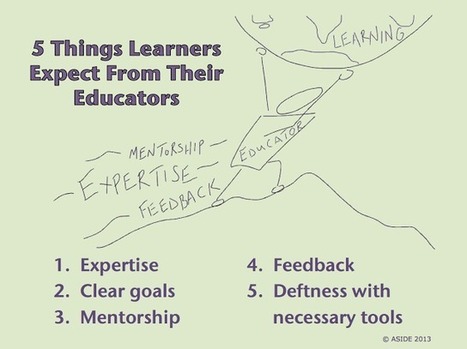
Quoted from post: More and more in recent years, we've started referring to the kids in our classes as "learners" rather than "students." It began unintentionally but became more and more frequent. We gradually realized that the relationship between learner and educator is not always the same as between student and teacher.
Beth Dichter's insight:
Do you think of the children in your class as learners or students? Do you think of yourself as a teacher or an educator? And how do you define these words: learner, student, teacher, educator. This post explores how the word learner differs from the word student. One statement in the post "The word "learner" suggests an open-mindedness and a self-initiation. The word "student," however, implies a hierarchy. It defines a status, where one is the instructor and the other is the pupil." If we view our classroom as individuals whom are learners then what is the role of the educator? The five ideas listed below are explored: * Expertise * Mentorship * Feedback * Deftness with necessary tools The first post in this series (of two) explored '5 Things Students Expect from their Teacher' was scooped here). This post continues the dialogue and may provide you with some new insights into how you view yourself in your classroom this year...food for though.
Scoop.it!
Beth Dichter's insight:
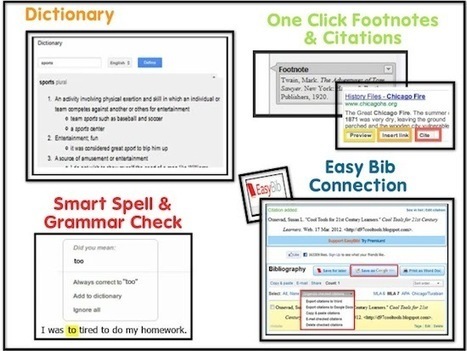
Are you using Google Docs? This post explores many of the options available to you in Google Docs including: * Google Docs for Research - Look under Tools to access Research. As well as allowing you to research within Google Docs this tool streamlines " the process of creating hyperlinks and appropriately formatting citations." * Google Docs for Collaborative Writing - Some of the features of this tool include sharing and commenting, built-in dictionary, smart spell check and grammar check, one click footnotes and citations, Easy Bib connection and revision history. The Common Core stresses the need for students to collaborate. Google Docs may assist your students in the process. The post also contains quite a few screenshots.
Scoop.it!
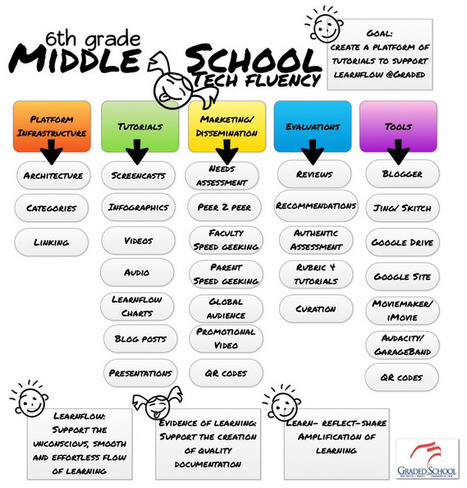
As part of my job interview for the Middle School Academic Technology Coordinator position at the American School of São Paulo, Brazil, I was asked how I would re-design a class for 6th graders, en...
Beth Dichter's insight:
Check out how one might design a technology course for 6th graders if your goal is to use "LEARNFLOW which supports the unconscious, smooth and effortless flow of learning." This post provides a visual of how a course designed with LEARNFLOW in mind might be organized. It is based on Alan November's work on tutorial creation which "empowers learners...to become creators and contributors." The image above may provide you with ideas on how you might work with students this school year with technology.
Scoop.it!
Beth Dichter's insight:
This infographic discusses how audio books may increase students reading scores. The infographic is split into a number of sections: * The Problem in National * The Benefits of Spoken, Sophisticated Language * How Audio Books Help A few of the statistics in this post are below. * Students who don't read by 3rd grade are 4 times more likely not to graduate from high school. * Only 32% of 4th grade students are proficient readers. Many infographics that we find provide evidence but neglect to provide the resources to help us assess the evidence. This infographic provides links to over 20 resources that were used in its' creation. In addition, the website that posted the infographic, Tales2Go, provides audio books for students and provides access to additional resources on their website (http://www.tales2go.com/). Audio books available through Tales2Go are primarily for students in grades K - 5.
Scoop.it!
Beth Dichter's insight:
Actually there are two sets of classroom rules in this post. The one above will help teach students how to deal with problems that may be escalating...with the student being asked to help solve the problem. The other poster is "almost entirely focused on the human being the rules were written for, rather than the rules themselves. Take risks and make mistakes, Do your best, Say please and thank you, and Work hard. All good stuff." These two sets of rules may help you revise the rules for your classroom this year. Check them out and see what you think.
Nancy Jones's curator insight,
August 17, 2013 9:48 AM
I really like the accentuating of the positive in both of these posters. 
Joshua Farber's comment,
August 17, 2013 1:51 PM
Interesting. I often try to test rule-sets like this by running them past an anecdotal example - in this case, "how would student texting during class be managed by this poster's rules?" Which may expose a dilemma of application - because students texting during class can get an educator a black mark in an impromptu learning walk or unnanounced observation, and because it can tempt other students who cannot afford to be so distracted to think that texting would be a good idea for THEM, I'd define it as a "problem" - but cannot think of many students who would agree. The primary issue here, then: who defines what is a "problem for someone else"? If teacher and student cannot agree on that category, I see little use - and some distraction and danger - in such a set.
Scoop.it!
"Catherine Lacey, a student at the University of Western Australia, is a Level 40 Hero in biology. That’s her ranking on OpenStudy, where she spends up to 30 hours per week answering homework questions posed by students around the world. Hero is the hardest badge to attain on the site, indicating considerable time spent helping other students. And Lacey doesn’t just help beginners—one of the many merit badges she’s earned from OpenStudy is for tutoring students in MIT open biology courses."
Beth Dichter's insight:
Are you wondering what badges are? Do you ask yourself why there is so much hype around them? This post answers these questions and more. Sections include: * Background on Badges looks at how badges have been used for hundreds of years (think Boy Scounts and Girl Scounts) up through the initiative started through the Mozilla Foundation work on badges through what is happening at a variety of colleges and universities. * What do Badges have on Traditional Degrees? This section looks at how badges can transform the current resume with 15 points (each with short explanations). Three of the points are below. * Skills-based Learning * Designed by Education Reformers * Comparing skills, not students * How to Spearhead your own Digital Badge Movement - Learn about issues that may come up if you choose to begin to use badges. There are seven points (again with explanations). Two are below. * Use different badges for different types of assessment * Use Mozilla's Open Badges Infrastructure 
Yasemin Allsop's curator insight,
August 16, 2013 2:35 AM
As someone who just started to elarn about badges, this is really intresting for me! 
Laura Graceffa's curator insight,
August 16, 2013 6:15 PM
Can it work in an environment that discourages making differences in achievement obvious? 
Yvonne Marie Webber's comment,
August 26, 2013 11:35 PM
@Laura, I really think it can. the badges do not have to focus on product, but can focus on each student collaborating, sharing, contributing in the way that is best for that student. The badges do not have to be given in a hierarchal manner.
Scoop.it!
Beth Dichter's insight:
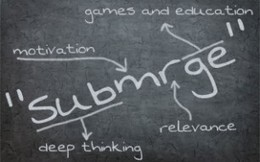
Submrge is a website that has the tag line “Deeper Thinking About Games and Education.” It is divided into a number of sections including Games, Activities and Links. What makes this site unique is the information it provides on each game. “Each game page includes important information for teachers, like benefits of play, educational issues for discussion, easily accessible game information, and activities related to the game on Submrge.” In addition to this information there is also a page for each game that includes “important information on the level and subject, but also the activity’s relationship to Bloom’s Taxonomy, Common Core Standards, 21st Century Skills, and the H.E.A.T. Framework. If you are wondering what HEAT Framework stands for think of Higher Order Thinking, Engaged Learning, Authentic Connections and Technology Use. This page also provides a list of learning styles and the games I checked included an Essential Question, The Links section has resources in the following areas: * More on Games as Text * Advice on Games in the Classroom * General Games Collections (many content-specific) If you use games in your classroom, or are considering doing so, this website will provide additional resources that may provide you with new ideas.
Scoop.it!

If you're committed to shifting your curriculum to e-textbooks, consider trying free first. Here are the best sites for digital books that won't cost your students a dime.
Beth Dichter's insight:
Are you looking for resources for free digital books? This post provides information on 12 sites (plus 3 bonus sites with hot links but no information) including the types and levels of books available. Although most are for college level you will find some of middle school and high school. Some of the sites listed are below: * Bookboon * Boundless * California Learning Resource Network (for K-12 and higher ed) * The Global Text Project (some books available in Chinese, Spanish and English) * Open Stax which also provides some additional teaching materials (high school and college) * Open Education Group (out of Brigham Young University) has six science textbooks designed for middle and high school. Find more information at the site.
Scoop.it!

"Excellent educational content can be found on YouTube. However, not every teacher can access YouTube in his or her classroom. That's why a few years ago I compiled a big list of alternatives to YouTube. Over the years some of those sites have shut-down, started charging a fee, or have switched into another market. So this evening I went through and eliminated some sites from the list and added a few new ones."
Beth Dichter's insight:
Richard Byrne has updated his list of sites that provide free videos. His top five list is below: * Next Vista * PBS Video * Explore.org * The National Film Board of Canada * Vimeo Each link provides a short description of what the site has to offer. You will also be able to access the fill list of sites through this post. Videos are a great tool to quickly engage students in learning and this list of websites as well as this search engine are great options to put in your toolbox. 
Gary Faust's curator insight,
August 14, 2013 2:10 PM
So nice to have an update of video resources. Thanks! 
Kimberly House's curator insight,
August 15, 2013 4:35 AM
I will certainly be sharing this with staff at my school! The list is thorough and gives a brief desciption of each of the sites mentioned. The list is also up-to-date, having just been checked and edited by it's original creator.
Scoop.it!
Beth Dichter's insight:
Check out this infographic that shows fifty facts about the earth divided into the following categories: * Atmosphere * Sea * Under Earth * Ground * Man and sources are provided for the information. If your class studies the earth this may be a great visual to use with your students!
Scoop.it!
"I have often suggested to teachers that when students have access to technology, whether it is provided by the school in a 1:1, BYOD, or simply the smart phone in their pocket, there should never be a question that goes unanswered –or un-followed. These are teachable moments for how to effectively search for information (information literacy & digital literacy) ...What I discovered in the 300+ observations I have done for our 21st Century Learning grant work was that the problem isn’t necessarily about allowing time for students to answer questions. The problem is that they rarely ask questions beyond simply clarifying what needs to be done for the assignment."
Beth Dichter's insight:
As teachers we ask our students questions all the time...but how often do your students ask questions...perhaps a better question would be do they know how to ask good questions? This post provides some background material as well as ideas for "how you might begin to shift from a culture of compliance, to a culture of questioning in your classroom." One of the ideas she suggests is looking at information from the Right Question Institute and purchasing a book "Make Just One Change: Teach Students To Ask Their Own Questions." I have been reading this book and find it an incredible resource. |












If you are a teacher in Grades K through 6 this site has a great resource...Common Core Checklists. You will find checklists for Reading, Writing, Language, Speaking & Listening, and Math.
The anchor standard is written at the top of the page. Underneath the indicator(s) will be listed in one column and you find columns for: date taught, date retaught, date reviewed, date assessed, date reassessed. All are uploaded as pdf files so you can easily download them for easy access. A screenshot of one page of Grade 3 ELA is in the image above.