



Every student has the capacity for rich, meaningful learning experiences. How can educators tap into the motivation that helps drive a love of learning in students? They key might be found in the "deeper learning" movement.

 Your new post is loading...
 Scoop.it! Every student has the capacity for rich, meaningful learning experiences. How can educators tap into the motivation that helps drive a love of learning in students? They key might be found in the "deeper learning" movement. No comment yet.
Sign up to comment
Scoop.it!

"Welcome to a post devoted to turning STEM to STEAM. It is exciting to cover the topic of STEAM since it is important to include the Arts. I have also included 25 resources to help make it happen!..."
Beth Dichter's insight:
Take STEM, add A for Art, and you get STEAM. As this post states, if you think of Leonardo di Vinci and his work this is a logical connection. This post discusses why adding the A for Art is important and the changes that may happen because of it, such as more innovation and creativity. The list of resources includes links for all five letters and chances are you will find a few that you may not have checked out. Below are five of the resources listed...but click through to see the rest, and all are hot linked in the post. (Most tools listed are free but a few have costs.) * Cardboard Challenge * Why Scientific Innovation Needs the Arts * PBS Learning Makers Party * Odyssey of the Mind * The Arts Institute of Chicago Have fun exploring this diverse set of STEAM resources!
Scoop.it!
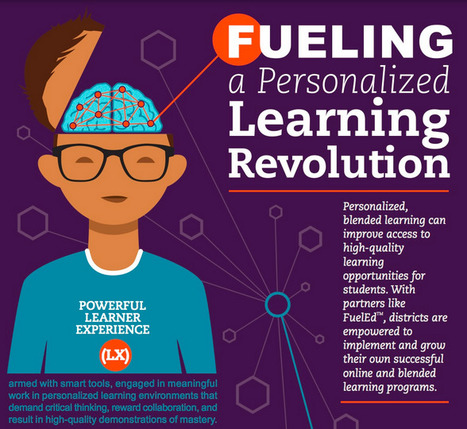
As a graphic representation of the paper, FuelEd released the infographic, “Fueling A Personalized Learning Revolution.” The infographic lists the 10 blended learning design principles.
Beth Dichter's insight:
What are the ten blended learning design principles? * Shared Vision and Strong Center * Teacher Support * Appropriate Technology to Match Learning Goals * Ease of Use (Learner Experience) * Student Progress and Data-Processing * Large and Deep Searchable Content Catalog * Tools that Give Instant Access * Open Online Platform That Does Not Limit This infographic is geared to secondary education, but most of the principles listed above (and explained in more detail when you click through) also apply to schools whom would like to begin blended learning in the elementary school. The infographic also includes descriptions of a number of school districts that have implemented blended learning.
Scoop.it!

Quoting from the post: Statistically speaking, the strength of the relationship between two variables. John Hattie, Professor of Education and Director of the Melbourne Education Research Institute at the University of Melbourne, Australia, says ‘effect sizes’ are the best way of answering the question ‘what has the greatest influence on student learning?’
Beth Dichter's insight:
So the question is, what does research tell us are the best teaching and learning strategies? This list, from John Hattie's research, provides insight into this question. After an introduction that describes how the effect size is applied and the cautions that must be observed, there is a short section that discusses how you might apply this data...and then there are six scrollable pages where the data is shared. There is also a list of of the 39 strategies that is to the point. The scrollable list provides additional insights for better understands. What is least successful? Retention. What is most successful? Teacher credibility in the eyes of the student. This post is worth reading, and reading again. The strategies may not be new to you, but as you read through the research you may choose one or two to work on as this school year continues.
Scoop.it!
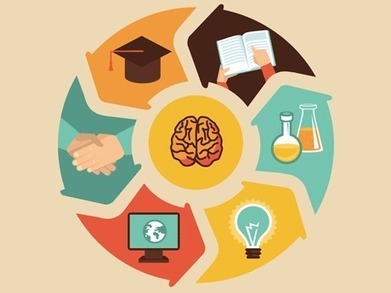
Do you wish your students could better understand and critique the images that saturate their waking life? That's the purpose of visual literacy (VL), to explicitly teach a collection of competencies
Beth Dichter's insight:
What is visual literacy? The Institute of Museum and Library Services defines it as "Demonstrate the ability to interpret, recognize, appreciate, and understand information presented through visible actions, objects and symbols, natural or man-made" (http://www.imls.gov/about/21st_century_skills_list.aspx). This is a 21st century skill and our students need to be visually literate. This post shares: * Standards that support visual literacy (from Common Core, National Council of Teachers of English Standards and the Mid-Continent Research for Education and Learning Corporation. * A lengthy list of the many formats you will find visuals that you can use as teaching tools, such as political cartoons, symbols, dioramas, and advertisements. * Visual Thinking Routines - each of the routines is described and two have videos that demonstrate them. The ones with videos are Model Think Aloud Strategy, and Introduction to Visual Thinking Strategies that is "a specific approach to whole-class viewing and talking about art that primarily uses [three] questions." Additional resources include Asking the 4Ws, Five Card Flickr, Image Analysis Worksheets (five different ones), and a lesson: Step-by-Step: Working with Images that Matter. We know that many of our students are visual learners and that they need to be able to "read" images. This post provides a wealth of resources that will help make your students adept at this process. 
Crystal Delatorre's curator insight,
October 29, 2014 1:37 AM
A helpful tool to use in helping teach the common core standards.
Scoop.it!
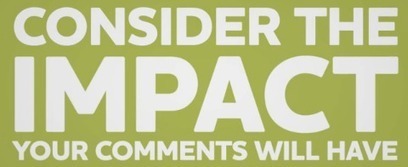
"This motion graphic speaks volumes about using good digital citizenship in social media. Educators did not design it. Instead, Curated Content created it for the Australian based company Origin. Instead of opting for the traditional “white paper” policy guidelines for social media, Origin chose to inform its employees about its usage with an entertaining approach involving a motion graphic."
Beth Dichter's insight:
What if we had our students design a motion graphic that explained how our school views digital citizenship? Would more students understand why we consider digital citizenship important and how it may impact them in future years? This post provides a motion graphic that discusses the policy of Origin, an Australian based company. In 3 plus minutes you are shown what you should do, and what you should not do. As always you will find links to other articles that also discuss social media at the end of the post.
Scoop.it!

"Today, more than ever before, technology plays an important role in society. It is changing and will continue to change every aspect of how we live. It is changing the way we communicate, the way we do business, how we learn and teach, and even it’s changing the way our brains work."
Beth Dichter's insight:
This infographic provides four key points about e-learning. When you click through to the post you will find detailed descriptions for each of the four ways technology is changing how people learn. * What does it mean to move from individual to collaborative learning? * What is this shift from passive to active or brain based learning? * Multitasking - Does it work? The infographic is very simple and it worth reading the text (which is above the inforgraphic when you click through).
Scoop.it!

We've combed through thousands of resources to offer you our first official guide to flipped classrooms. It's a curated list just for you.
Beth Dichter's insight:
If you are considering flipping your classroom check out this resources from Edudemic. It provides links to many resources to make this journey easier. Resources include: * The ten best web tools for flipped classrooms * Eight crucial resources for flipped classrooms Many more resources are available in the post. 
GNG's curator insight,
September 10, 2014 5:41 PM
GrowNextGen curricular units are built upon this philosophy. Great guide!
Scoop.it!

Setting aside the two predominant narratives of education, there's a third vision taking shape that's yet to be defined. What would a reimagined education system value and teach?
Beth Dichter's insight:
As we move closer to the implementation of Common Core testing in many states we might consider discussing what a "reimagined education system" would value and teach? Would it be Common Core curriculum or would it address other issues, such as the need to: * Be inquiry based * Provide authentic learning experiences * Teach students how to manage information (as more and more comes online daily) * Teach students how to learn This list could continue. The post addresses the issues listed above (and additional ones as well). In many ways we are at a crossroads in education and this post explores some of the issues. How would the teachers at your school feel about these issues? Is this a discussion that has taken place? Does it need to take place? Each of us may come to different conclusions but the conversation is worth having.
Scoop.it!

Learning differences or disabilities are frequently misunderstood, but some of the most common myths are easy to dispel with a look at the facts.
Beth Dichter's insight:
There are myths surrounding many things, including learning disabilities. This post looks at four myths and provides the actual facts. Which of the following do you believe are true? What are the realities? Myth #1: Learning disabilities are intellectual disabilities. Myth #2: ADHD is a learning disability. Myth #3: Dyslexia is a visual problem. Myth #4: The incidence of students with learning disabilities in US schools is on the rise. The post also provides a food for thought section and references. You may find that this is an article you will share with parents.
Scoop.it!
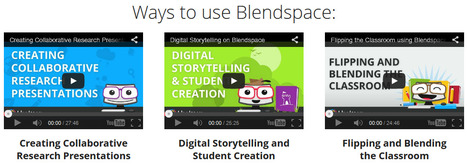
This Quick and Easy Free Web App is Great for Creating Flipped and Blended Learning Materials In the current Online Flipped Classroom Workshop that we're just
Beth Dichter's insight:
Here is a new tool (at least to me) that allows you to create online content. In fact, you can get an educator account and have students also create content (but make sure to have permission from parents for students under the age of 13). You can get an educator account or your school may want to sign-up. School wide features include:
You can easily
Take a few minutes to click through to the website and check it out. You may find yourself creating a new lesson!
Scoop.it!

A new study makes it clear what growth in standardized test performance doesn’t buy us: cognitive ability.
Beth Dichter's insight:
Today we have students taking more and more standardized tests. This post shares information on "standardized test scores (Math and English language arts) and cognitive ability (working memory, processing speed, and abstract reasoning)" from ~1400 students 8th grade students in Boston (schools include traditional, exam and charter). The question I would ask is why are we focused on standardized tests? Is this the primary way we should assess our students? Do standardized tests become critical thinkers, creative thinkers? This list could go on. The information in this post may surprise you and there are links to the original paper and supplement.
Scoop.it!
Beth Dichter's insight:
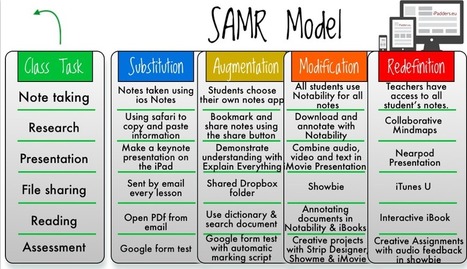
This post is geared to courses being offered through iTunes U but many of the ideas and tools may be helpful for any online class. The list includes: * Describe clear learning outcomes * Articulate an active learning pathway * Incorporate diverse learning materials * Make it interactive * Leverage mobility and built-in tools * Leave the classroom * Start from scratch * Apply the SAMR model to your class tasks Although the apps provided are geared to the iPad the SAMR model provides ideas that you might use with other tablets or computers. 
María Dolores Díaz Noguera's curator insight,
February 17, 2014 6:44 AM
Techiniques to Help Take an Online Class.... 
Rosemary Tyrrell, Ed.D.'s curator insight,
February 17, 2014 1:06 PM
A number of good tips that are useful for any online course. |
Scoop.it!

"Modern pedagogy speaks frequently about interdisciplinary learning. A student's ability to make cross-curricular connections is one of the surest signs of understanding. Interactive tablets and project-based learning put a priority on these unions of product and skill, but often the attempts at collaborative exploration remain within comfortable sphere's of academic neighbors.
Beth Dichter's insight:
Can you do the same with science and the humanities? This post says yes, and provides three great motion graphics that you may choose to use with your students. The second motion graphic that is shared Duelity, explores religion and physics, literally side by side. The third one is called Humanizing Motion Graphics and explores language and biology. Would showing this type of video engage your students? Check them out by clicking through to the post.
Scoop.it!
Beth Dichter's insight:
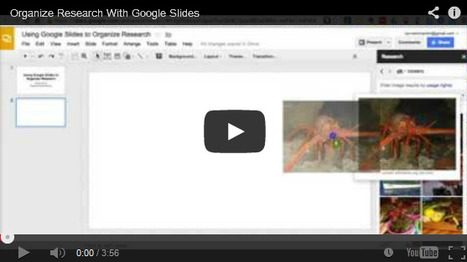
If your students have Google accounts you might consider having them use Google Slides to help them organize research. With the tools available for searching next to the slides it is an easy way for them to begin to organize their materials. Richard Byrne has created a video that walks you through what to do.
Scoop.it!
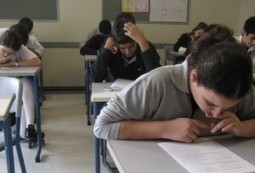
Allowing learners to struggle will actually help them learn better, according to research on “productive failure” conducted by Manu Kapur, a researcher at the Learning Sciences Lab at the National Institute of Education of Singapore.
Beth Dichter's insight:
We often walk students through the process of learning new concepts and ideas, providing scaffolding and guidance. This post says that new research show that this may not be the best way to learn...that the struggle in learning how to solve a problem. Although they may not successfully solve the problem they may score better when they are tested later on. There is more information about this study in the post. To go directly to the study, Classroom-based Experiments in ProductiveFailure, you can click through to this link: http://mindmodeling.org/cogsci2011/papers/0644/paper0644.pdf. 
niftyjock's curator insight,
February 26, 2014 9:58 PM
Absolutely, its the impasse where real learning takes places. Manu Kapur has a great presentation about this http://youtu.be/LnljG9I33KM Needs more research. 
Reontay's curator insight,
March 15, 2016 8:52 AM
Yes i totally agree with the author. Allowing kids to strugggle as they learn will make them understand and solve the problem better.
I think that the education system will change, as now of days, the teachers usually guide the students on how to solve the problem. But now after it is proven that allowing the students to struggle will let the students learn better. The school should adapt and instead of guiding the students,they should only explain the problem and allow the students to solve it themselves.
Some of the bad influence will be that the student will find the problems to hard and give up more easily or start to hate school. Some good influence are that the student may learn better and will very much help in their futures.
Everyone benifits from it as the students will learn better and also learn more values like not giving up easily. Besides the students the economy will also benifit as when the student start working, it would be easier for him to understand and adapt and Singapore economy could improve faster.
No it is not foolproof as everychild is different. So diffferent students may take different time to understand or they may not even understand at all.
Scoop.it!

"Time to plan ahead! One week from this Monday is Dr. Seuss' birthday! As many of you know by now, my mega-holiday listing of teacher resources can be found in this posting."
Beth Dichter's insight:
Students of all ages love Dr. Seuss stories, and this post provides a plethora of information including videos, coloring pages, printables, games, activities, and more.
Scoop.it!

Video, audio, and images can help students gain deeper understanding of a question. Previously, struggling readers might have had assessment questions read aloud to him or her. Now, multimedia tools allow these students to take tests independently.
Beth Dichter's insight:
Check out these five tools that will help students present their knowledge using different forms of multimedia. * Metta * ImageQuiz * eduCanon * Kahoot * Google Forms For many students these tools will help them create a more authentic product. Click through to the post to learn more about each tool and find short videos to help you with ImageQuiz, Kahoot and eduCanon.. 
Drora Arussy's curator insight,
February 25, 2014 7:32 PM
Great ideas and tools - let the creative assessment begin!
Scoop.it!
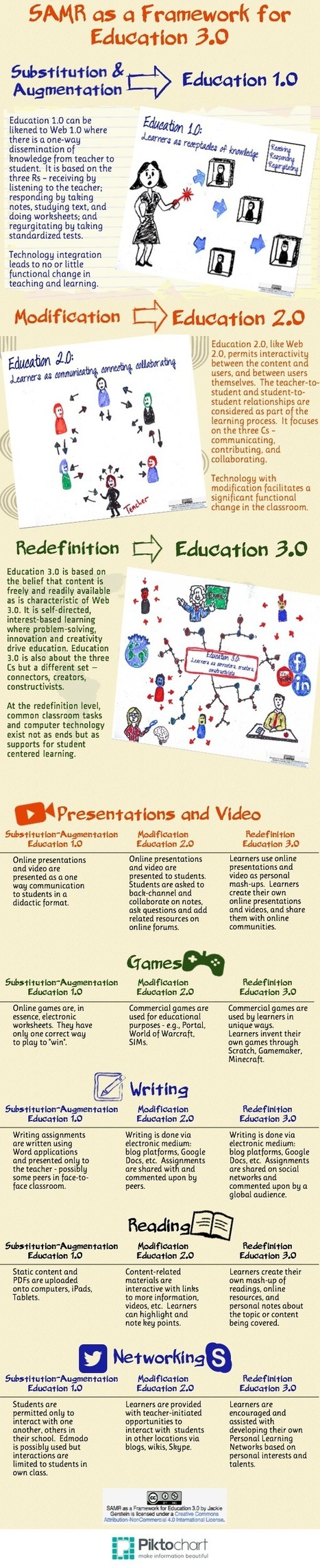
Evolution, in its broadest sense, serves as a force to help humans move towards a better way of living given the current times or Zeitgeist. It follows, then, that the education field should evolv...
Beth Dichter's insight:
This infographic illustrates how SAMR may be used as a framework as we move from Education 1.0 to Education 2.0 to Education 3.0. The actual post also includes a wide variety of links to additional resources. Have you considered using the SAMR model as you develop new curriculum or revise curriculum. As you move up SAMR (Substitution, Augmentation, Modification, and Redefinition) Gerstein would say that Substitution and Augmentation are Education 1.0, Modification is Education 2.0 and Redefinition is Education 3.0. For more information on these concepts click through to the post.
Scoop.it!
Beth Dichter's insight:
ThingLink continues to add new features for educators, and one new item is the ability to create a ThingLink Channel (and you can also create a class and have your students create ThingLink). Check out this interactive album that provides access to some posts from the ThingLink blog...and if you have not yet created a ThingLink account you might want to head over to ThingLink (http://www.thinglink.com/) and create an account. 
Kimberly House's curator insight,
February 22, 2014 6:28 AM
Love ThingLink and now it's even better for teachers and classes! Teachers can see all their students' work in one place. Teachers can add student accounts. I'm interested to see how it works on the iPad and am hopeful that these features are transferred to the app as well. ThinkLink is a great product and I'm pleased to see it getting better and more useful for education.
Scoop.it!
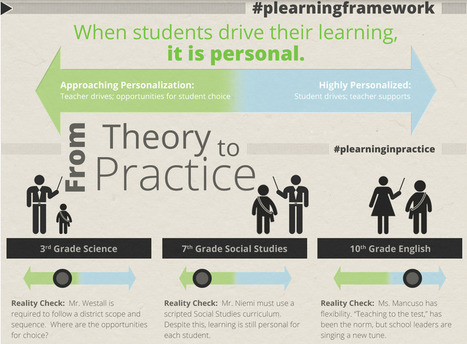
Feeling confused about personalized learning? Not sure what it means, what it looks like, how to implement or support it? You’ve come to the right place. We hope to answer your questions through our#plearning infographic series.
Beth Dichter's insight:
This is the first of four infographics that will be published on personalized learning. The focus for this is providing a definition, providing examples of what it may look like in a classroom, and providing solutions and resources. Many of us believe that personalized learning is new, but according to this post it has been around since the early 1990s. For more information click through to the post.
Scoop.it!

Public Science Project has been successful at enlisting the help of young people and motivating them to engage in highly academic work in large part because they value what those youth bring to the table. This model offers interesting insights for educators struggling to motivate and challenge learners that seem disengaged or disinterested in learning.
Beth Dichter's insight:
Talk about authentic learning, this post provides the model to help your students become engaged and motivated researchers. Train students in "statistics and research methods" and they can actively participate in research. The post provides details of this project (which is in New York) and may move you to see if you could bring this opportunity to your students.
Scoop.it!
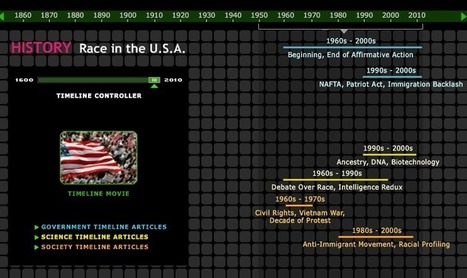
"“Race: Are we so different?” was developed by the American Anthropological Association in collaboration with the Science Museum of Minnesota. It was the first national traveling exhibition to tell the story of race through biological, cultural, and historical points of view. The exhibition was also the winner of the American Association of Museums’ Excellence in Exhibition Competition in 2008."
Beth Dichter's insight:
This website looks at race through three lenses: * History * Human Variation * Lived Experience It provides many resources, including an interactive timeline. The section on Human Variation includes information on the human spectrum, the science behind variations in skin color, and three other topics plus a quiz to test your knowledge of race and human variation. The section Lived Experience begins with this quote by historian Robin D.G. Kelley: “[Racism] is not about how you look, it is about how people assign meaning to how you look.” This section provides a cultural viewpoint and students will be drawn to several of the activities. This post was a follow-up post to one titled Let's Talk About Race. I would urge folks to also check out this post. Talking about race is not always easy and there is a video that shares some research published by the Harvard Business Review (The Costs of racial "Colored Blindness"). This post provides additional information as well as resources for younger students and is at http://theasideblog.blogspot.com/2014/02/lets-talk-about-race.html
Scoop.it!
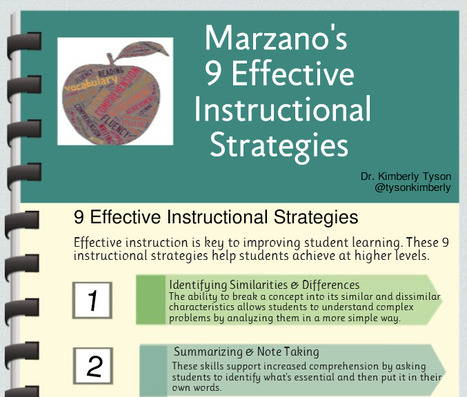
"Effective schools make a big difference in student achievement. Effective leadership makes a positive difference, too. Effective teachers, however, directly impact student learning and achievement. It’s been shown that teachers who have a large repertoire of effective instructional strategies teach differently."
Beth Dichter's insight:
This infographic shares Marzano's nine effective instructional strategies and may also be downloaded as a pdf. As teachers we may "know" these strategies but we may not "remember" them all the time. As we learn how important visual aids are for students we should also recognize they are important for teachers. Take time to review these strategies by checking out this infographic. It may make a difference in your classroom! 
Kirsten Macaulay's curator insight,
February 19, 2014 4:30 AM
A literacy-rich environment in classrooms and schools, for example, is an important K-12 foundation to support and extend effective instruction. And, effective vocabulary instruction (here, here, here, and here, too) is an integral part of a comprehensive literacy framework and supports student learning and achievement. Building a common language educators is also important, though frequently lacking. A common language helps teachers, coaches, and administrators communicate more easily and specifically around instructional strategies associated with literacy instruction, educational initiatives, and the Common Core State Standards
Scoop.it!

Ebooks and paperless books now give students access to millions texts. Here are some of the best sites for accessing them quickly, easily and for free!
Beth Dichter's insight:
If you are looking for ebooks there are many sites to find them. This post provides information of four locations: * Open Library has over 3 million ebooks. * Bookboon specializes in academic and instructional texts. * Lit2Go has books and poems in audio format. * Google Book Search allows you to put search for specific text (that Google may have scanned). They have a huge catalogue of books that "you can preview, read for free, borrow and buy through Google." Links to each site and additional information is available in the post. |









What is deeper learning? This post defines it as the following six competencies:
* mastering content
* critical thinking
* effective written and oral communication
* collaboration
* learning how to learn
* developing academic mindset
The post shares an example from one school that uses deeper learning, provides additional resources on how to cultivate academic mindset, and deeper learning and the common core, educators and deeper learning, and getting started with deeper learning.