Photographer James Balog shares new image sequences from the Extreme Ice Survey, a network of time-lapse cameras recording glaciers receding at an alarming rate, some of the most vivid evidence yet of climate change.
Your new post is loading...
From
ed
Photographer James Balog shares new image sequences from the Extreme Ice Survey, a network of time-lapse cameras recording glaciers receding at an alarming rate, some of the most vivid evidence yet of climate change. No comment yet.
Sign up to comment
"At its simplest, a flipped format can involve a teacher inviting students to view YouTube videos at home as a preview to the day's topic. At its most rigorous, a flipped curriculum involves teachers writing, producing, directing, editing, and posting their own original lessons -- complete with custom narrations and visualizations -- via third-party applications."
Beth Dichter's insight:
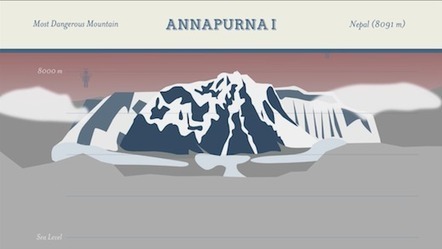
Finding great videos that you may use in your classroom takes time. This post provides four videos with a STEM focus that you may choose to use in your classroom. These are often referred to as motion graphics. The ones within this post include: * The Solar System, Our Home in Space is "an infographic trip through the wonders of the solar system" that allows students to explore the inner and outer planets; * Measuring the Universe, which combines math and scale and helps students begin to comprehend how vast the universe is; * For the Love of Mountains, where you will learn more about some of the "extremes" of the earth's mountains; * Forest (the English version), a "study in ecology and the environment. I find videos are a great hook for students, providing opportunities for them to quickly engage with the subject and begin to ask questions as they want to learn additional information. These four videos would work with a wide range of ages and are well worth checking out.
Ness Crouch's curator insight,
March 29, 2014 5:13 PM
These motion infographics look interesting. I wonder if I can find content for my class?
Jeongbae Kong Enanum's curator insight,
August 16, 2014 9:48 AM
Won Ho :<생각이 깊은 교수님의 글이라서 연구해봐야겠다.> Why should the video watching previous to in-class? The core is quality video access and intensive in-class interaction. The lecture can't complete with these superb ones. 꼭 뒤집어야만 하는가? 내게 플립러닝의 핵심은 수준 높은 비디오와 강력한 상호작용이다. 순서와 방식은 여러 가지가 가능하다. 선생님이 개념 설명 행위는 여기 비디오를 보면 조만간 사라질 게 당연해 보인다.
María Dolores Díaz Noguera's curator insight,
February 4, 2016 7:39 AM
Flipping The Flipped Classroom - Motion Infographics For STEM Learning | @scoopit via @BethDichter http://sco.lt/...
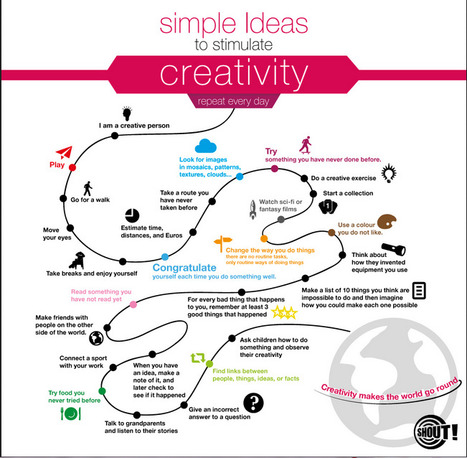
Sometimes you're just stuck in a creativity rut. Check out these 27 simple ideas to boost your creativity!
Beth Dichter's insight:
There are times when we run out of steam and feel little to no creativity...and this infographic provides some quick and easy ways to move ourselves towards a more creative space. The post provides the 27 ideas as a list (which some folks may prefer). As you read through you might also think of sharing some of these with students, especially if you are going to have a conversation about growth mindset.
Maryalice Leister's curator insight,
March 16, 2014 7:44 AM
Appropriate when considering my personal creativity focus. Excellent visual.
Ness Crouch's curator insight,
March 29, 2014 6:05 PM
I love this infographic. What do you think about the ideas?
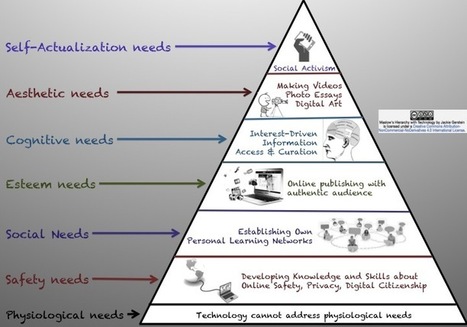
A major criticism I have of most educational institutions is that their primary focus is on students' intellectual and cognitive development. Too often individual learner's needs do not enter into...
Beth Dichter's insight:
Although our jobs as educators is to teach our students we must also be aware of their other needs. In this post Jackie Gerstein explores how Maslow's Hierarchy of Needs intersects with education and technology. The infographic above (from the post) shows how each of the area of needs intersects with technology and some of the 21st century learning skills. The post looks at each area Maslow's Hierarchy of Needs and provides additional information in the six areas that may be addressed through technology. (Physiological needs, the base of the needs, is not addressed via technology.)
David Baker's curator insight,
March 15, 2014 7:21 PM
This is the second perspective on Maslow's hierarchy I have seen in the past few weeks. As we try to make learning more rigorous and more inclusive for all students the importance of meeting student needs in a variety of ways is very important. This must include Social/emotional as well as technological.
Ali Anani's curator insight,
March 18, 2014 4:42 AM
A fresh perspective on Maslow's Pyramid of Needs
Ness Crouch's curator insight,
March 29, 2014 5:43 PM
I really like this pyramid. It certainly makes the psychology of learning clear.
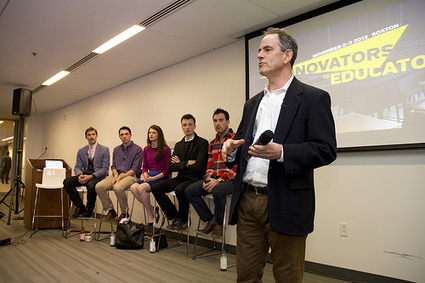
"What insights would you gain if you asked 13 innovators (architects, artists, engineers, scientists, entrepreneurs and a media savvy baker) what they would urge educators and parents to do to best develop the next generation of innovators and creative thinkers?"
Beth Dichter's insight:
This post shares 12 insights from a variety of innovators. What are some of their ideas? (Ideas below quoted from the post) * Realize that Out of School time tends to be more inspiring and powerful ... * Provide unique Experiences that surprise and allow children to see things from new perspectives... * Refining the skill of Asking Questions is the fuel that ignites innovators... The post includes some sharing of how innovators explored in their own unique ways as children. You will also find one short video of an innovator sharing their story as well as a link to eleven videos from the conference Innovators to Educators. This post may bring some fresh ideas to use with students of all ages.
Dr Pam Hill's curator insight,
March 13, 2014 8:54 AM
Race to the Top demands that we prepare learners to be innovative creators. Wouldn't it be fabulous to have this type of training happening in PD and classrooms?
The best science on the web -- a place where you can search, learn, share, contribute, and earn points and rewards!
Beth Dichter's insight:
Sparticl is a website that promotes STEM and is geared to teens (and open to anyone). Sections include: * Living Things * Matter & Energy * Tech & Invention * Body & Brain * Earth & Science You can do a search for any topic and then filter the results by type which include: * Text (article/site) * Interactive/Quiz * Game * Images * Scientist Profile * Hands-on Activity This site is sponsored by Twin Cities PBS and provides many opportunities for students to interact online, allows them to earn points, make suggestions and more. This is a new resource to me that I will be using with students.
"If you’ve scratched your head over suggestions to manage your “digital footprint,” you aren’t the only one. A surprisingly large percentage of people..."
Beth Dichter's insight:
How can we teach students the importance of managing their digital tattoo (or footprint)? It is not an easy task. This post provides 11 suggestions that you may want to share with your students (and perhaps with staff members and parents). The suggestions are more detailed than what is below so make sure to click through to the post to learn more information. * Use privacy settings * Keep a list of accounts * Use a password keeper * Sending is like publishing - forever If you are concerned about this and would like to see a detailed infographic that look at How to Disappear Online you might want to check out this infographic: http://www.whoishostingthis.com/blog/2013/12/12/how-to-disappear-online/
Ileanna Gama's curator insight,
March 9, 2014 8:27 PM
Not just for my future students, but for myself as well!
Maryalice Leister's curator insight,
March 16, 2014 7:45 AM
Excellent - important to consider for our students - and ourselves!
"Getty Images’ new embed tool is huge news for those of us who look for great images to use in teaching, digital storytelling and presentation. Why huge? We’re talking 35 million photographs. Up until right now, over the course of years, some folks paid serious money for the use of this art. Other folks have not."
Beth Dichter's insight:
This is amazing news for teachers and students...access to phenomenal images at no cost. Joyce Valenza provides an excellent overview of how to use the website and the background to this decision. Learn more from the post and then head over to Getty Images and have fun exploring.
Maryalice Leister's curator insight,
March 16, 2014 7:47 AM
Huge announcement for all of us who search for graphics and photos. Check it out.
"In this posting, we’ll look at options to increase the depth of your instruction. What you’ll notice throughout the activities is a shift to student ownership of learning, as well as the need to think at higher levels to complete the activities."
Beth Dichter's insight:
Are you looking for ways to increase rigor in your classroom? This post provides three strategies as well as a number of examples to help you. The strategies are: 1. Design With Inquiry & Diversity 2. Have Students Create Videos–From Beginning To End 3. Use Virtual Tours Additional detail is available in the post for each of the strategies and suggestions for adding rigor in ELA and math is also discussed. In fact, the final paragraph states asking "students to write riddles about words, rather than having them simply write a definition...requires students to think at higher levels to complete the activity." Adding rigor may not be as difficult as might think...but it may require that we rethink how we are teaching.
Gary Harwell's curator insight,
March 6, 2014 12:23 AM
Definitely some good ideas worth initiating in the teaching program.
From
glean
Explore awesome math and science video lessons from the best teachers online! High quality videos to save you time and help you ace your homework
Beth Dichter's insight:
This site is geared to math and science and currently has videos for algebra, geometry, algebra 2, calculus, biology, and chemistry, with physics and organic chemistry coming soon. The videos are "tagged by educational standards and wrapped in interactive tools (like Q&A and practice exercises)." The website tagline "Glean adapts to your learning style to find the best lessons for you." This site is free for students and teachers.
Laurent Picard's curator insight,
March 5, 2014 4:42 AM
Le site est gratuit pour les étudiants et les enseignants. Dommage que ce ne soit qu'en anglais...
Rocio Watkins's curator insight,
March 5, 2014 11:27 PM
Similar to Khan Academy. Great audio resources for teachers and students.
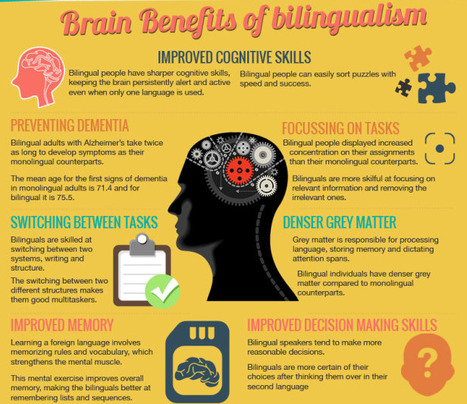
I often hear language learning is much easier when you are younger, and that we must teach our young students another language when they are young so that they can be ‘more competitive’ in an increasingly globalized, connected world. While I don’t argue with that at all, there are many other benefits that come from being …
Beth Dichter's insight:
Are there benefits to being bilingual? Current research says yes, and this infographic shares information on some of the benefits. Click through to the post to see all the benefits...and perhaps you will decide that it is time to study another language!
Drora Arussy's curator insight,
March 4, 2014 7:46 AM
Really states clearly and understandably so many of the benefits of speaking a second language - how much more does the culture of Hebrew bring into the mix?
Tandoo Barcelona's curator insight,
November 25, 2014 9:26 AM
An intersting article about the advantages of bilingualism. So start learning! :) (Karina)
"When it comes to personalized learning, there’s one area we tend to neglect whether we realize it or not, and that area is cultural background. Despite the fact that students are constantly engaged in a complex transformation of culturally influenced identity–which in many cases can have a major impact on academic performance–instructors seldom respond to cultural needs the way they respond to psychological, behavioral, or social characteristics."
Beth Dichter's insight:
This post is split into three sections. The first section looks at the term "culturally responsive instruction" and provides not only a definition but also a list of ten characteristics that provide a more robust understanding. The second section provides a look at "common assumptions placed on students from other cultures." Eleven common misconceptions are shared (based on research from the Center for Research on Teaching and Learning at the University of Michigan. The final section has 30 recommended instructional strategies. The post states "The cultural inclusiveness of a learning environment will depend upon the kinds of interactions that occur among you and your students." The post discusses the various types of interactions that may take place and then provides a lit of the recommended strategies. Three are listed below. All are briefly discussed in the post. * Anticipate possible responses to controversial topics. * Be ready to challenge assumptions that groups will either be aided or hindered by having certain kinds of students in their group. * Include, as much as possible, materials written or created by people of different backgrounds and/or perspectives.
As the number of ELL increases in schools within the United States the need for us to be aware of cultural diversity increases. This post provides many suggestions that will be helpful in helping you to meet the needs of these students.
Fran Ros's curator insight,
September 13, 2014 10:35 AM
`` La cultura es la transmission de comportamiento del tanto Como Una fuente Dinámica de Cambio, Creatividad y libertad, Que abre Posibilidades de Innovación. Para Los Grupos y Las Sociedades, la cultura es Energía, Inspiración empoderamiento y, al Mismo Tiempo Que Conocimiento y Reconocimiento de la diversidad''. Javier Pérez de Cuellar
Desde this visión, la cultura Juega Papel fundamental de las Naciones Unidas en la Educación y es im
Remember that professor you had in college who took you under his wing and made you feel like you had something unique to contribute to the world? How do you know if you're doing the same for students?
Beth Dichter's insight:
How can you tell if you are making a difference with your students? This post provides 20 signs that you can look for such as (quoted from the post) : * Students are asking questions, not just giving answers. * Your shy students start participating more often without being prompted. * You’ve let your passions show through in your lessons. * You practice strength and patience. Click through to the post to read 16 additional signs!
The Rice Process's curator insight,
March 2, 2014 8:44 AM
This post highlights the many ways educators make a difference in the lives of their students. The difference takes root in the present and lives on in the future.
Rosemary Tyrrell, Ed.D.'s curator insight,
March 2, 2014 4:22 PM
There are some wonderful signals here. Something we should always be looking for.
Mary Cunningham's curator insight,
March 16, 2014 12:50 PM
This is a great list for thinking about monitoring our work in school and board improvement. |
'Inspiration and ideas often arise seemingly out of nowhere and then fail to show up when we most need them, and creative thinking requires complex cognition yet is completely distinct from the thinking process.'
Beth Dichter's insight:
What do creative people do that may be different from others. This post explores this stating: 'While there's no "typical" creative type, there are some tell-tale characteristics and behaviors of highly creative people. The post shares 18 ideas, each of which are explained in detail if you click through...but five are listed below. * They observe everything * They turn life's obstacles around * They ask the big questions * They constantly shake things up You may find that some of the ideas presented make you think of specific students in your classroom. As teachers are we recognizing that some of our students are more creative in their learning and may improve if we differentiate the instruction to help them engage their creativity?
David Baker's curator insight,
March 16, 2014 11:06 AM
The traits and habits of creative people are things we all do sometimes. How dynamic might learning be if I purposefully built these ideas into my teaching and made it a part of my students routines?
Rosemary Tyrrell, Ed.D.'s curator insight,
March 17, 2014 2:01 PM
This includes a list of things creative people do. Many of the things on this list we should all be doing - like making time for solitude.
"Meaningful conversation can make learning more personal, immediate, and emotional. During meaningful conversations, students are forced to be accountable for their positions, to listen, to analyze opposing perspectives, and to adapt their thinking on the fly."
Beth Dichter's insight:
Some students find it difficult to engage in higher-level thinking. This post shares 26 sentence stems that may help students with participate in discussion and allow them to more easily engage in higher-level thinking. The prompts are split into the following sections: * Clarifying * Paraphrasing * Agreeing * Disagreeing * Building upon * Summarizing The post provides a list of the prompts as well as an image. You might consider posting these on a wall or sharing a copy with your students.
Sue Alexander's curator insight,
March 15, 2014 12:39 PM
This will be so helpful in our Socratic Seminars!
David Baker's curator insight,
March 15, 2014 3:06 PM
Sentence stems are exceptional for helping students process thinking. Sheltered instruction (SIOP) strategies are excellent for helping students understand and make personal meaning of learning. Stems with a targeted purpose can help teachers to use them most purposefully.
What keeps students motivated to learn? Relevance, connections, and their teachers' emotional investment, among just a few criteria.
Beth Dichter's insight:
Who better to ask students what motivates them to learn but students, specifically students whom are part of the "deeper learning" movement (and a link to an article on "deeper learning" is in this post). This post shares ideas from seven students. The short hand version is below but much more detail is in the post. * Integrated projects * Interest-based and relevant * Make it hands on * Knowing teachers care * Learning from failure * Evaluating work
"A new study shows that we are far better at remembering what we see and touch than what we hear."
Beth Dichter's insight:
How do we learn best? This is a critical question for educators to understand and to keep up-to-date with research, and this post from the National Geographic looks at new research that shows that our auditory memory is not as robust as our visual and tactile memory. Much more information is available in the post but the shorthand is that having students engage as many senses as possible is the best way for us to reach our learners!
David Baker's curator insight,
March 13, 2014 4:33 PM
Important to remember that we structure classrooms to support learning.
Beth Dichter's insight:
Richard Byrne (of FreeTech4Teachers) has created a new slideshow of his top picks of web tools for 2014. He states "I shared only tools that are new-to-me since last year's NCTIES conference and or have released significant enhancements in the last year." As always it is worth looking through this lengthy slideshow, which is embedded in the post and also available through Google docs so you may choose to save a copy. He notes that he will continue to add speaker notes to include "more links." Some of these tools have been mentioned in this Scoop.it but there are quite a few that are new to me that I will be checking out.
Infographics are popular. They’re a fun way to present and read data, and many people believe that information that is presented visually is often retained better (at least for some learners). Many teachers today are using infographics, both in their classrooms and for their own professional development. There are so many tools out there to …
Beth Dichter's insight:
What steps can one take to make an infographic more interactive? How about creating one that will allow the users to interact with data? This post explores this concept, providing information on four tools that will help with the process. Learn more about: * Many Eyes is a free tool that IBM provides. * Google Public Data allows you to use data from Google or upload your own and create interactive content. Have fun exploring the options!
It's no secret that I am a passionate advocate for using video in the classroom. When used well, videos can help students make connections to people and ideas beyond their usual frame of reference. Th
Beth Dichter's insight:
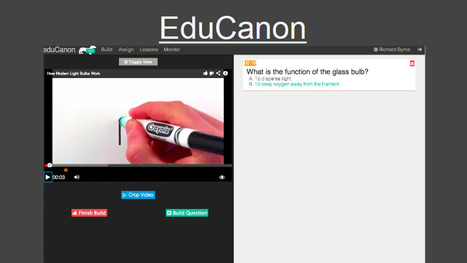
This post not only provides 8 interactive video tools it also a section on "Reviews and Guides for Interactive Video Tools" and "Sources and Ideas for Using Videos in the Classroom." * Zaption * TED-Ed Website Tour * How to use Vialogues * Using Metta.io * Add Questions and Quizzes to YouTube Videos! * VideoNot.es: Improving How We Learn with Online Videos * eduCanon * Huzzaz
Frances's curator insight,
March 8, 2014 9:42 AM
Multiple ways to represent info and idea; to ask qs; to stimulate engagement
Charlotte Lovie's curator insight,
March 9, 2014 6:33 AM
An amazing collection of tools that allow you to add a range of learning tools to existing videos.
Leslie Minton's curator insight,
March 29, 2016 5:05 PM
This post not only provides 8 interactive video tools it also a section on "Reviews and Guides for Interactive Video Tools" and "Sources and Ideas for Using Videos in the Classroom." * Zaption * TED-Ed Website Tour * How to use Vialogues * Using Metta.io * Add Questions and Quizzes to YouTube Videos! * VideoNot.es: Improving How We Learn with Online Videos * eduCanon * Huzzaz
There are a lot of web tools out there. Many of which are free or, at the very least, freemium. In other words, you can do a free trial to see if you like it. With so many to choose from, it’s tough to figure out which ones work best, are popular, are well supported, …
Beth Dichter's insight:
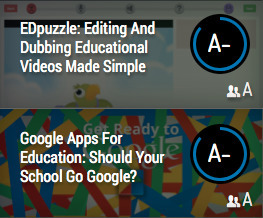
Have you heard of the Global Education Database? It collects data from users and allows you to search for apps, hardware, software and web tools. This post looks at the top ten web tools. Each tool has a short description and it hot linked. Click through to the post to learn more. If you would prefer to check out the Global Education Database here is the link: http://www.gedb.org/ * EdPuzzle: Editing and Dubbing Educational Videos Made Simple * Google Apps for Education: Should Your School Go Google? * DebateGraph: A Powerful Way to Collaborate and Learn Together Online * Popplet: A Simple Way to Generate Your Next Big Idea When you click through to the link in the database you will see an image of the web tool, suggestions on how to use it in the classroom, key information, pros and cons, an overview of the tool, ratings (in five categories), and the "bottom line." Are you thinking of offering some professional development and would like to explore some new tools? This (as in the Global Education Database) might be a great place to do some searching and check out tools that might meet needs of your school or district!
Wendy Farren-Price's curator insight,
March 6, 2014 10:45 PM
There are various tools that are mentioned, but IXL maths is a great way to consolidate mathematic concepts via technology.
Beth Dichter's insight:
Check out this slideshow on Google Presentation and see description for 56 different formative assessments in the following areas: * Student Work * Self-Reporting Strategy * Technology * Peer Assessment * Teacher Observation * Teacher Feedback * Self-Assessment This slideshow provides many great ideas...some of which may be new to you, but all in one location!
Pearta Nolan's curator insight,
March 12, 2014 5:45 AM
This scoop is fantastic for educators, formative assessment is a pivital part of assessment and all teachers must be aware that there are many examples to do formative assessment. Within the Australian Curriculum all Key Learning Areas will benefit from this document. The document is also downloadable, this is great to allow teachers to change examples to suit their specific needs.
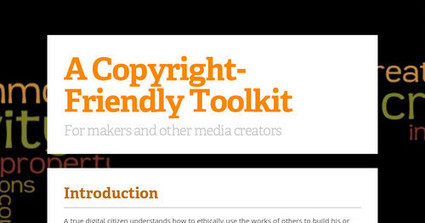
A true digital citizen understands how to ethically use the works of others to build his or her own creative products—music, art, video,...
Beth Dichter's insight:
Today we want our students to create, yet we know they do this by remixing and reusing "intellectual property" from others. Do they understand the need to give credit where credit is due. This toolkit provides a wide range of resources to help them make the correct decision (or to help you teach them how to make that decision). Sections include: * What is Creative Commons? * What do those Creative Commons License icons mean? * Creative Commons licenses are for you too! What if your students create content and license it under Creative Commons? * Public Domain resources * Fair Use * And more! This is a great resource that is probably best for older students but the resources will guide you to locations that you may use with younger students also.
"Oppia is a tool for creating interactive online activities that enable students to learn by doing. Its creators believe that this is often a more effective and efficient way of learning than either watching videos or reading texts, since it allows the student to engage more deeply with the activity in a way that videos or books often do not."
Beth Dichter's insight:
Oppia is a new open source tool that allows you to create interactive learning activities. When you sign up (which is quick if you have a Google account) you will be informed that any explorations you create will be licensed under Creative Commons and will be shared. The exploration will be private until you are ready to publish. There are a number of explorations you may explore. The ones I checked out are set up as quizzes, with each question showing up individually. A wrong answer came up with a response to try again. Google maps was included in a different quiz where you had to locate a specific city. It is important to realize that this is beta and that changes may be made over time. An online tutorial is available at https://code.google.com/p/oppia/
Beth Dichter's insight:
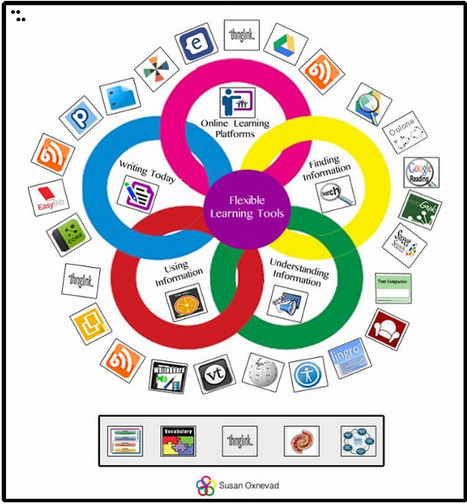
This ThingLink image created by Susan Oxnevad is chock full of resources in the following categories: * Online Learning Platforms * Finding Information * Understanding Information * Using Information * Writing Today * SAMR Model of Tech Integration * CCSS Vocabulary * Build a ThingLink Classroom and The ThingLink Toolkit * Google Forms: Create an Assignment Tracker to Collect Work * Avatars and Internet: Using Avatars to Teach Internet Safety There is also a ThingLink on Digital Differentiation, 2014 edition. If ThingLink is new to you as you scroll over you will see a variety of symbols appear. Each links to a specific resource. |
Your new post is loading...
If you are studying climate change in your classroom this video from TED-Ed is well worth watching. James Balog has been a nature photographer for over 30 years and in the last six years or so has set cameras up in a number of places (primarily in the northern hemisphere) that are taking pictures and videos of the changes taking place in areas with glaciers and icebergs.
To say the least the images are amazing and to have the ability to not only see what is happening, but to hear how quickly the changes are happening is mind blowing (at least the students whom watched this video with me expressed this sentiment) and it brought forth quite a conversation.
This video is longer than most TED-Ed videos (about 19 minutes) and includes a series of questions as well as a resource. You might also want to check out the video trailer for a documentary created by Balog and his crew, Chasing Ice. The full movie runs about 75 minutes.