Eclectic Technology
230.9K views | +6 today
Eclectic Technology
Tech tools that assist all students to be independent learners & teachers to become better teachers
Curated by Beth Dichter
Your new post is loading...
Scooped by Beth Dichter
March 28, 2014 10:13 PM
Scoop.it!

7 Ways Teaching Has Changed

7 Ways Teaching Has Changed | Eclectic Technology | Scoop.it

"Teachers are the arbitrators of knowledge and culture.

Knowledge and culture are each dynamic, endlessly crashing and churning.

This makes teaching significantly important and difficult work, and can leave teaching—as a craft—wide-eyed and nonplussed in response.

Worse, those outside the bubble of education can understandably struggle to understand the problem.

What are the teaching in those schools anyway? How is it any different from when I was in school?"


Beth Dichter's insight:

How has teaching changed? Below are the seven key ideas. .

1. A culture of emerging literacies

2. A society that is mobile

3. A world where equity is a central theme

4. A society of constant connectivity

5. A world where the technology learns, too

6. A context that demands new credibility in an era of information

7. A culture that can seem, well, distracted

Many teachers may be overwhelmed with these changes and may require professional development to help them develop new skills that technology brings. But change has happened before and will continue to happen. The question is how are we adapting to the changes and how can we assist our students in becoming independent  learners in this new age of learning?

María Dolores Díaz Noguera's curator insight, March 29, 2014 9:09 AM

7 Ways Teaching Has Changed

Scooped by Beth Dichter
March 27, 2014 9:41 PM
Scoop.it!

10 Free Online Educational Game Sites

10 Free Online Educational Game Sites | Eclectic Technology | Scoop.it
Web-based games can prove to be a treasure trove of learning opportunities, and there are a variety of content-areas, age ranges, and skill levels to choose from. The true pay dirt for browser-based learning games can be found on large online digital game hubs. Here are 10 game hubs players that teachers can use to as one tool in their arsenal.
Beth Dichter's insight:

Finding games that you can use in the classroom is not always as easy as one would like it to be. This post shares 10 websites that are "game hubs" and the games range from one for students as young as preK to students in high school. The list of the sites is below and additional information is in the post (as are links to each). Have fun exploring them and sharing them with your students, and if you know a site that is not listed leave in the Comment section.

* Shepperd Software

* PBS Kids Games

* Mr. Nussbaum

* National Geographic Kids

* Poptropica

* Funbrain

* BBC Schools: Games

* Primary Games

* ABCya.com

* Arcademic Skill Builders

Rosemary Tyrrell, Ed.D.'s curator insight, March 28, 2014 1:08 PM

Some wonderful resources here. 

Scooped by Beth Dichter
March 26, 2014 10:11 PM
Scoop.it!

Gamification in Education - An Educator's Experience

Gamification in Education - An Educator's Experience | Eclectic Technology | Scoop.it
The breakthrough happened after the student took the Bartle's Gamer Profile Quiz and we found out that he was a "killer." Off-the-charts killer, but achievement meant nothing to this student. Just li
Beth Dichter's insight:

Gamification...do you ask yourself if this will work in your classroom? In this post Vicki Davis shares her experience of bringing games into the classroom. You will learn how games may be the tool for some students to break through barriers, and also that the language used by games is not always up to school standards.

She shares five elements of gaming that should be considered as gaming and education come together.

1. Game Mechanics (think game theory)

2. Bartle Test of Game Psychology (more information on this in the post)

3. Gamification is a Process - In this section she shares the experience of another teacher whom has gamified his classroom, including an embedded video from a Google Hangout he hosted. Take the time to watch the video and learn from his experience with his 6th grade class.

4. Serious Games can be Used Anywhere - from elementary through college level (and some businesses are using games to help train future employees).

5. Serious Games can Tackle Serious Issues, and serious issues may help us promote rigor in our classrooms.

6. We Can't Trust App Stores to Curate our Games

Click through to the post for more information. After reading the post do you think that gaming has the potential to be a "powerful 'killer' tool in a 21st century teacher's toolkit?

Eloy Piña Jr.'s curator insight, May 19, 2025 4:06 PM
Game mechanics and theory as a quick introduction, putting points and badges in a lesson does not mean you have gamified your activity. In fact there are four-game player types and as an educator begins incorporating gamification into their lessons, they should account for all of them. What I found most interesting in this article was how Michal Matera determined the difference between grading and gamifying in his sixth grade classroom. An educator can not share grades with other students but rather uses a badge system for them to display in their notebooks instead. Kids can figure it out.
Scooped by Beth Dichter
March 25, 2014 10:04 PM
Scoop.it!

7 Ways To Use Google Tools To Maximize Learning - Edudemic

7 Ways To Use Google Tools To Maximize Learning - Edudemic | Eclectic Technology | Scoop.it
There are a boatload of awesome Google tools that we use every day. And they’re free, too, which tends to be a big winner for teachers and students. Free is probably the number one reason for giving Google’s tools a try – you haven’t lost anything but a bit of time if you decide you …
Beth Dichter's insight:

Google provides so many tools it is hard to keep track of all of them. This post provides information on 7 tools that may find a place in your classroom.
Would you like to provide audio feedback to your students, or have peers provide audio feedback? If you are using Google Drive this is possible.

Do you have a student that needs a clean and clear space to write, with no distractions? If Chrome is available as a browser consider installing the app Write Space, a "minimalist text editor."

If students are working in Google Drive and are researching a paper they may have found the Research Tool that allows you to quickly search the web for specific information, make suggestions and more.

Google Forms continues to add features, including the ability to create surveys. Have your students design a survey and graph their data, or use it the survey tool to do a quick formative assessment as an exit ticket.

Learn more about Moderator, Image Directory, and Google Templates (that's right, Google has templates designed for students and teachers) in the post. Chances are you will find at least one or two tools to use for yourself or with your students (or both)!

LibrarianLand's curator insight, March 26, 2014 7:20 PM

More from Google. Maybe useful, but all-knowing. 

Ali Anani's curator insight, March 27, 2014 3:47 AM

Discover delightful Google tools

Ness Crouch's curator insight, March 28, 2014 8:12 PM

I love my Google tools! What do you use them for?

Scooped by Beth Dichter
March 24, 2014 9:47 PM
Scoop.it!

How to Reinvent Project Based Learning to Be More Meaningful

How to Reinvent Project Based Learning to Be More Meaningful | Eclectic Technology | Scoop.it
Project-based learning continues to be misinterpreted as a single teaching strategy rather than as a set of design principles that allow us to introduce the philosophy of inquiry into education in an intelligent and grounded way. It’s time to not only address the flaws in PBL, but to reinvent it in a way that leads to deeper learning, creative inquiry, and a better fit with a collaborative world in which doing and knowing are one thing.
Beth Dichter's insight:

So how would one go about reinterpreting project-based learning? This post explores this idea in depth, providing five key areas where change must occur, and detailing one to five additional ideas that will help move project-based learning to a "philosophy of inquiry."
What are the five key areas?

1. Put PBL on a continuum of inquiry.

2. Blend surface knowledge and deeper learning.

3. Start with a sophisticated student-centered culture.

4. Make collaboration as important in school as it is in life.

5. Understand that PBL cannot be done alone.

If you are using project-based learning, or are considering implementing project-based learning next year take the time to check out this post. There are many great ideas that will lead our students to "deeper learning, creative inquiry, and a better fit with a collaborative world in which doing and knowing are one thing."

Kate JohnsonMcGregor's curator insight, March 25, 2014 10:04 AM

This is helpful as a philosophical vision - how to rethink our teaching to effectively integrate the inquiry process. Love it! 

Rosemary Tyrrell, Ed.D.'s curator insight, March 25, 2014 2:32 PM

This post includes some strategic suggestions on how to make PBL more meaningful for your students. 

Scooped by Beth Dichter
March 23, 2014 9:10 PM
Scoop.it!

The case of the vanishing honeybees - TED-Ed

The case of the vanishing honeybees - TED-Ed | Eclectic Technology | Scoop.it
In the past decade, the US honeybee population has been decreasing at an alarming and unprecedented rate. While this is obviously bad news for honeypots everywhere, bees also help feed us in a bigger way -- by
pollinating our nation's crops. Emma Bryce investigates potential causes
for this widespread colony collapse disorder.
Beth Dichter's insight:

Honeybees play a critical role in food production. They are a key pollinator and colony collapse disorder may soon have a significant impact on not only the cost of food but what is available. This TED-Ed video looks at this issue. As always you will find a  "Think" section with questions students may answer as well as an in-depth look at additional resources.

No comment yet.
Scooped by Beth Dichter
March 22, 2014 6:24 PM
Scoop.it!

5 Assessment Forms That Promote Content Retention

5 Assessment Forms That Promote Content Retention | Eclectic Technology | Scoop.it
If we hope to construct enduring understanding in our students, it's critical that, now more than ever, we know their strengths and interests. By incorporating students' strengths and weakness into a
Beth Dichter's insight:

As teachers today we are told that we must teach our students and help them construct "enduring understanding", providing them with the ability to transfer knowledge from one subject area to another subject area. We are also told that we should personalize education, requiring us to know the strengths and weaknesses and incorporate this into our lessons. And let's not forget that we must also assess our students. How can we make our assessments help students with content retention? This post focuses on this question, and provides five suggestions on ways to do this.

The first three suggestions are:

  • Tests Where Notes or Textbooks are Permitted
  • Take-Home Tests
  • Student-Made Tests

These types of tests may take more time to create but they have the ability to be written so that students have to do more than memorize information. There is more information on this in the post.

The next suggestion is:

  • Projects Pre-Approved by the Teacher

This requires that students demonstrate mastery of the subject. This will require the student to create (a 21st century goal) and additional information is in the post, including a discussion of what this might look like.

The final suggestion is:

    • Revisions and Retests to Build Skillsets

    This section discusses what we may do to help out student build their skillsets through feedback and opportunities to construct accurate information.

    As you read this post you may begin to consider alternative ways to assess your students that help them with content retention.

    Kathy Lynch's curator insight, March 23, 2014 1:25 PM

    Ideas to expand thinking on current assessments, particularly for those who do not test well. Thx Beth Dichter!

    Rosemary Tyrrell, Ed.D.'s curator insight, March 24, 2014 1:46 PM

    As teachers today we are told that we must teach our students and help them construct "enduring understanding", providing them with the ability to transfer knowledge from one subject area to another subject area. We are also told that we should personalize education, requiring us to know the strengths and weaknesses and incorporate this into our lessons. And let's not forget that we must also assess our students. How can we make our assessments help students with content retention? This post focuses on this question, and provides five suggestions on ways to do this.

    The first three suggestions are:

    Tests Where Notes or Textbooks are PermittedTake-Home TestsStudent-Made Tests

    These types of tests may take more time to create but they have the ability to be written so that students have to do more than memorize information. There is more information on this in the post.

    The next suggestion is:

    Projects Pre-Approved by the Teacher

    This requires that students demonstrate mastery of the subject. This will require the student to create (a 21st century goal) and additional information is in the post, including a discussion of what this might look like.

    The final suggestion is:

    Revisions and Retests to Build Skillsets

    This section discusses what we may do to help out student build their skillsets through feedback and opportunities to construct accurate information.

    As you read this post you may begin to consider alternative ways to assess your students that help them with content retention.

    Scooped by Beth Dichter
    March 20, 2014 8:16 PM
    Scoop.it!

    What Do Students Really Learn When Watching Videos?

    My PhD: http://www.physics.usyd.edu.au/super/theses/PhD(Muller).pdf It is a common view that "if only someone could break this down and explain it clearly en...
    Beth Dichter's insight:

    This video may surprise you with what students actually learn (or do not learn) when watching videos. If you are going to be creating videos to flip your classroom, or you using videos created by others take the time to watch this one. You may find yourself making some revisions to help your students better understand key concepts.

    Deborah Rinio's curator insight, March 24, 2014 12:56 PM

    SCIENCE TEACHERS: WATCH THIS VIDEO! This is a great video that explains what students gain from watching videos dealing with science concepts. Watch this and use the information to choose great videos. Or add components to the videos you already watch to help make sure your students will learn. 

    Raquel Oliveira's curator insight, March 28, 2014 11:38 AM

    5 maneiras para aumentar a chances de aprendizagem por meio de videos. O comparativo é feito com videos da  Kahn Academy . Great reserach ! 

    AMPA Santa Teresa. 's curator insight, March 31, 2014 7:41 AM

    Aquest vídeo et pot sorprendre amb el que els estudiants  aprenen (o no aprèn) quan miran vídeos. Si eres mestre, si estàs creant vídeos per a estudiants o tal vegada utilitzes els d'altres,  agafeu temps per mirar aixo. 

    Scooped by Beth Dichter
    March 19, 2014 10:43 PM
    Scoop.it!

    Click and Clunk-A 5 Step Reading Strategy for Students

    Beth Dichter's insight:

    This one page infographic provides a five step reading stategy for students using super heroes to help them become enaged. The five steps are:

    Step 1: Preview the text for two to three minutes.

    Step 2: Grab a pencil and read the passage aloud.

    Step 3: What "clicked?"
    Step 4: What "cluncked?"

    Step 5: Put fix-up strategies into play.

    Suggestions are provided in all but Step 2. Consider printing a copy of this out and using it as a poster in your room...or perhaps sending a copy home with students whom might need additional support!

    Kate JohnsonMcGregor's curator insight, March 20, 2014 8:25 AM

    In our pursuit to make literacy skills accessible, this quick, 5-step infographic has appeal.  

    Reading Power's curator insight, March 23, 2014 10:15 AM

    This certainly infuses power in reading. What are some of your favorite strategies?

    Scooped by Beth Dichter
    March 18, 2014 10:13 PM
    Scoop.it!

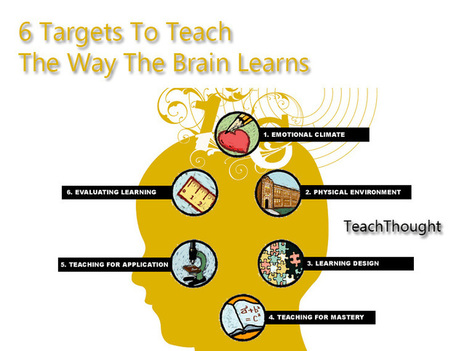
    6 Targets To Teach The Way The Brain Learns

    6 Targets To Teach The Way The Brain Learns | Eclectic Technology | Scoop.it

    "When you’re standing in front of a classroom of students who’re not quite sure they even want to be in your class, much less pay attention to what’s being said, things like neuroscience, research studies, and teaching the way the brain learns are an abstraction.

    Yet, brain-targeted teaching can engage and excite students because it taps into factors that stimulate the brain, grab the attention, and set the stage for learning."

    Beth Dichter's insight:

    What if we were able to design our curriculum to support the way the brain learns? Would our students be more engaged in class? Learn about this new model, Teach the Way the Brain Learns, in this post. There is a short discussion about some of the concepts as well as six brain targets, each of which includes a brief neuroscience explanation as well as a "translation" so that you will understand how to implement each target in your classroom.

    What are some of the targets?

    Brain Target 1: Establish the emotional climate for learning

    What does this mean? "Stress impedes learning." Make connections with students and then begin the lesson.

    Brain Target 2: Creating the Physical Learning Environment

    What does this mean? The physical space impacts our students. Changing the space may help them learn. What changes could you make in your classroom?

    Four additional brain targets are provided. You may also want to check out the website Brain Targeted Teaching (http://www.braintargetedteaching.org/) where you will find additional information as well as sample units that utilize this method (and a template to create your own lessons).

    Nicole Wallace's curator insight, March 19, 2014 12:57 AM

    Great comments in here and how it links to neurobiology.

    Dr. Helen Teague's curator insight, March 19, 2014 12:48 PM
    strong>Referencing Beth Dichter's insight:What if we were able to design our curriculum to support the way the brain learns? Would our students be more engaged in class? Learn about this new model, Teach the Way the Brain Learns, in this post. There is a short discussion about some of the concepts as well as six brain targets, each of which includes a brief neuroscience explanation as well as a "translation" so that you will understand how to implement each target in your classroom. What are some of the targets? Brain Target 1: Establish the emotional climate for learning What does this mean? "Stress impedes learning." Make connections with students and then begin the lesson. Brain Target 2: Creating the Physical Learning Environment What does this mean? The physical space impacts our students. Changing the space may help them learn. What changes could you make in your classroom? Four additional brain targets are provided. You may also want to check out the website Brain Targeted Teaching (http://www.braintargetedteaching.org/) where you will find additional information as well as sample units that utilize this method (and a template to create your own lessons).
    James J. Goldsmith's curator insight, July 28, 2014 3:29 PM

    Six practical suggestions for applying neuroscience in the classroom.

    Scooped by Beth Dichter
    March 17, 2014 9:13 PM
    Scoop.it!

    25 Tricks to Stop Teacher Burnout - InformED

    25 Tricks to Stop Teacher Burnout - InformED | Eclectic Technology | Scoop.it

    "There’s a reason why teachers receive a sad, knowing nod from others at a dinner party or when meeting new people. The profession kicks us around and often kicks hardest when we’re down."

    Beth Dichter's insight:

    What can we do to protect ourselves from burn-out? Check out 25 suggestions in this post. Five are below. Click through to the post to learn more about each of them as well as an additional 20 ideas...and consider sharing them with your school faculty.

    * Mindfulness meditation

    * Laugh - all the time and wildly

    * Sink into teaching something new

    * Take your own advice

    * Create small sanctuaries

    Rosemary Tyrrell, Ed.D.'s curator insight, March 18, 2014 12:52 PM

    Some useful, if familiar, tips for avoiding burnout. 

    Kathy Lynch's curator insight, March 18, 2014 7:37 PM

    Thx Beth!

    Scooped by Beth Dichter
    March 16, 2014 9:27 PM
    Scoop.it!

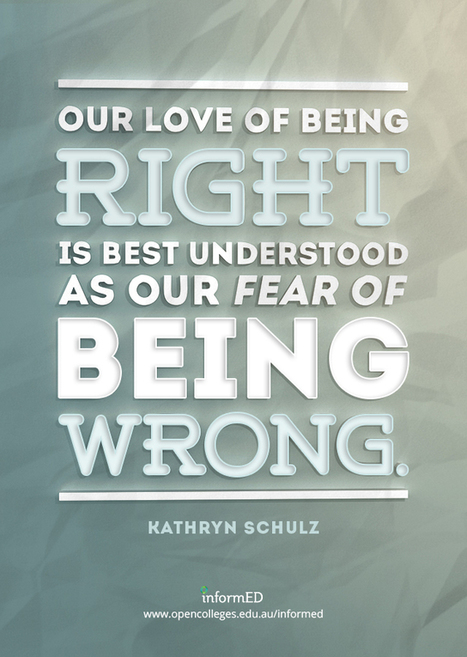
    Overcoming the Fear of Being Wrong: 20 Ways To Help Your Students

    Overcoming the Fear of Being Wrong: 20 Ways To Help Your Students | Eclectic Technology | Scoop.it

    "Like cheating on a test, ignoring a friend’s phone call, wallowing in self-pity, or eating a pint of ice cream in one sitting, being wrong feels the worst when someone else is around to witness it. Unlike these things, being wrong is unjustly stigmatized as unacceptable. Everyone answers a question incorrectly now and then, but it’s the shame associated with being wrong, especially in front of others, that harms us more than the fault itself."

    Beth Dichter's insight:

    Many students are afraid to fail. Therefore they may be afraid to try new things or to ask questions. Too often we may hear the words "I don't know" because the student may feel embarrassed if the give an incorrect answer. This post discusses this topic in some detail before it provides 20 suggestions on ways to work with students to help them overcome the fear of being wrong. Five of the suggestions are below. Additional information on each is in the post as well as fifteen additional suggestions.

    * Learning has two definitions and one is failure.

    * Always respond to an answer with more than No."

    * Turn wrong answers into a learning experience for all.

    * The "wrong" answer is often more educational than the "right" answer.

    * Remember that everyone is wrong sometimes.

    Nancy Jones's curator insight, March 18, 2014 2:48 PM

    We will never grow if we don't make mistakes and then learn from them. I am sure Bill Gates and James Dyson would agree. Look up any interview with them as they talk about their products.

    Scooped by Beth Dichter
    March 16, 2014 8:37 PM
    Scoop.it!

    Why It’s Imperative to Teach Students How to Question

    Why It’s Imperative to Teach Students How to Question | Eclectic Technology | Scoop.it
    Are our schools doing a good job of preparing students for a world where questioning is a survival skill?
    Beth Dichter's insight:

    The complete title of this post is Why It's Imperative to Teach Students to Question as the Ultimate Survival Skill? Do you believe this is important? If so, how do you go about teaching your students to ask good questions?

    This post begins by looking at the importance of questioning, and notes that many leaders in the high-tech world began with a Montessori education, a system that encourages curiousity from a young age.

    The ability to ask insightful questions is something that may be more critical as we move forward. The question is how to we do this. The post notes that many teachers do not feel like they have time for students to ask questions. If this is true what should we do? It suggests that we make it both "safe" and "cool" to ask questions, and also suggests looking at resources available from

    The Right Question Institute and from Question Day 2014.


    Nancy Jones's curator insight, March 18, 2014 2:52 PM

    Risk taking and questioning have always been learning skillls. It just seems that students, and possibly their parents, aren't willing to acknowledge them as the best way to learn. The whole idea of thinking critically and making a "best guess' seem to be unacceptable to some folks. What does that say about the whole quality/gift  of wonder?

    Scooped by Beth Dichter
    March 28, 2014 9:41 PM
    Scoop.it!

    Bloom's Taxonomy: Teacher Planning Kit

    Bloom's Taxonomy: Teacher Planning Kit | Eclectic Technology | Scoop.it
    Beth Dichter's insight:

    This pdf file is fairly large and looks at the original version of Bloom's Taxonomy but it is an in-depth look that moves from the lower ordering thinking skills to the higher order thinking skills and includes a definition for each level as well as:

    * Key Words - an extensive list for each level

    * Actions and Outcomes for each level

    * Questions specific to each level

    To access the full pdf: 

    http://educatingmatters.files.wordpress.com/2012/04/blooms_taxonomy_teacher_planning_kit1.pdf 

    No comment yet.
    Scooped by Beth Dichter
    March 27, 2014 9:14 PM
    Scoop.it!

    How to Infuse Digital Literacy Throughout the Curriculum

    How to Infuse Digital Literacy Throughout the Curriculum | Eclectic Technology | Scoop.it

    "So how are we doing on the push to teach “digital literacy” across the K12 school spectrum? From my perspective as a school-based technology coach and history teacher, I’d say not as well as we might wish – in part because our traditional approach to curriculum and instruction wants to sort everything into its place."


    Beth Dichter's insight:

    How often have you heard the term digital native or digital immigrant? Are our students digital natives because they were born after digital items were widely available? Does this factor mean that they understand how to use these tools effectively and that they are digitally literate? For me the answer to that is that they do not fully understand how to use digital tools effectively and they are not digitally literate. This is something we need to teach them.

    This post does an excellent job looking at this issue. Specifically it looks at these areas:

    * Students must learn how to evaluate online content - Think of this as a research skill.

    * Students must be able to engage with others online and communicate - Think of this as a communication tool.

    * Students need to learn how to create and projects can be digital.

    These three areas come together and create the skill sets needed to digitally literate. More information is available about this in the post.

    And if you happen to live in the New England area you might consider checking out the Massachusetts New Literacies Institute that will be taking place in at the Kittredge Center in Holyoke, MA from July 8 - 10. Information for this may be found at http://mnli.org/. This institute looks at three cornerstones: Online Content Reading, Online Collaborative Inquiry and Online Content Construction "preparing future-ready teachers."

    Melissa Marshall's curator insight, October 25, 2014 10:42 AM

    A very interesting article that examines whether digital literacy is a surface approach, or something understood clearly by students. I think we could do it a little better, and this involves some extra awareness of these teaching moments when they arrive! For instance, I use the first presentation-style assignment for my Year 7s to teach about plagiarism and referencing online sources. 

    Julie Hogarth's curator insight, November 4, 2014 9:09 PM

    Digital Literacy should be integrated into every day curriculum to be effectively instilled into student thinking and behavior.

    Scooped by Beth Dichter
    March 26, 2014 9:48 PM
    Scoop.it!

    Disconnect.me - Private and Encrypted Web Searching

    Disconnect.me - Private and Encrypted Web Searching | Eclectic Technology | Scoop.it

    "Disconnect Search is a specialized VPN that lets you search privately using your favorite search engine. We don’t log searches, IP addresses, or any other personal info."


    Beth Dichter's insight:

    Are you concerned about how much information is collected about you when you do searches? Do you have any idea how many sites are tracking you without your knowledge?

    Disconnect.me has come out of beta and is now available as an extension for Chrome, Firefox, Safari, Internet Explore and Opera or you can use a web-based version. The program allows you to continue to use your favorite search engine (well...some of the top ones: Google, Bing, Yahoo, blekko, DuckDuckGo).

    There is also a "kid's version" available for the iPad and iPhone.

    If you are concerned about privacy this tool is worth checking out. They have several videos that describe just what is happening (so you can see how many places may be tracking you without your knowledge) as well as an extensive FAQ section.

    Many students are now asking questions about privacy online. This tool may help them get a deeper understanding of what happens in a search, providing them with a knowledge base to help them decisions about how they search and what is shared.

    No comment yet.
    Scooped by Beth Dichter
    March 25, 2014 8:32 PM
    Scoop.it!

    Are Public Schools Shortchanging Your Child's Creativity?

    Are Public Schools Shortchanging Your Child's Creativity? | Eclectic Technology | Scoop.it
    See how public school are spending on the arts vs various other programs and what this means for your child's education today and their career options in the future.
    Beth Dichter's insight:

    Today teachers are asked to provide opportunities for students to show their creativity, but in many schools are programs are being cut due to budget concerns...and STEM is being renamed STEAM to include the arts.

    This infographic explores why it is important to have the arts as a player in public education. Below are a few of the reasons from the infographic. Click through to see all the reasons (eleven if I counted correctly).

    * Have you wondered how much federal funding goes to the National Science Foundation as compared to the Arts and Humanities? Do the figures of $5 billion versus $250 million surprise you?
    * The No Child Left Behind Act outlines the arts (music, art, foreign language) as core academic subjects, but the Huffington Post notes that fewer elementary schools are offering it...and research shows that students whom study arts are three times more likely to be awarded for good attendance.

    You will also find a list of the resources used in the infographic.

    This is an infographic that you may want to share with administrators and with parents.

    No comment yet.
    Scooped by Beth Dichter
    March 23, 2014 10:00 PM
    Scoop.it!

    5 Tech Savvy Teaching Tools That Your Students Will Love

    5 Tech Savvy Teaching Tools That Your Students Will Love | Eclectic Technology | Scoop.it
    These Fun, Free Web Applications Make it Quick and Easy to Create Cool Learning Content (Watch out Though, Other Teachers Will be Banging Down Your Door Looking
    Beth Dichter's insight:

    Five resources are shared in this post, with explanations about how to use them in your classroom. All have free versions available.

    * LessonPaths (http://www.lessonpaths.com/) allows you to put together groups of web resources and other digital resources in one location. (This was called MentorMob.)

    * Blendspace (https://www.blendspace.com/schools) is similar to LessonPaths but with a different look to it. Check them both out to see which fits your needs.

    * Geddit (http://letsgeddit.com/) provides a space where you can ask questions and students can respond using most any digital device that can access the Internet.

    * TED-Ed (http://letsgeddit.com/) is a resource that provides lessons that include a video, questions, resources and a discussion forum and allow you to flip any lesson you find. Additional videos are added frequently.

    * Powtoon (http://www.powtoon.com) allows you to create videos using templates. It is a little more complex to learn and you will be limited to five minute videos unless you subscribe. There is an educational version available.

    Have fun exploring these tools and creating content to engage your students!

    Lori Wilk's curator insight, March 23, 2014 11:14 PM

    This list of webistes offers suggestions for sites with tools  to help teachers to create interactive learning environment from surveys, to lessons, to making short videos. Super helpful escpecially since there's both free and paid versions available. You can have teaching tools on a zero or low budget.#education#technology.  

    Scooped by Beth Dichter
    March 22, 2014 9:32 PM
    Scoop.it!

    Google Docs adds add-ons — @joycevalenza NeverEndingSearch

    Google Docs adds add-ons — @joycevalenza NeverEndingSearch | Eclectic Technology | Scoop.it

    "Take a close look at the Google Doc or Sheet you likely have open right now and you’ll see something new on a tab about the WYSIWYG tools.

    Last week Google launched add-ons–easily accessible tools created by Google’s developer partners that offer on-the-fly features for your documents and spreadsheets."

    Beth Dichter's insight:

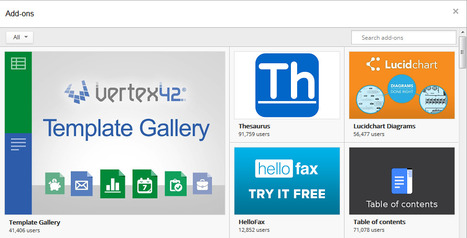
    Google has just launched add-ons, tools that provide more resources for you to use with Google Doc and Sheet. Over fifty are now available (and more are expected to be added). A few are listed below.

    * EasyBib Bibliography generator allows you to search EasyBib and generate citations (MLA, APA and Chicago Manual)

    * Open Clip Art provides quick access to over 50,000 images you can insert

    * Kazena Shortcut allows you to provide audio feedback with Google Doc and Sheet

    * LucidChart allows you to insert a mindmap, flow chart or diagram directly into your doc (and LucidDiagram is also available)

    * ProWriting Aid - check for plagiarism, grammar and redundant phrases

    The post includes a short video as well as listing some of the other tools available.

    No comment yet.
    Scooped by Beth Dichter
    March 21, 2014 10:21 PM
    Scoop.it!

    The Science of Character: Developing Positive Learning Traits

    The Science of Character: Developing Positive Learning Traits | Eclectic Technology | Scoop.it

    "What are your top five strengths? In the last ten years psychologists have done a lot of research into the character qualities and strengths that help people feel happy and satisfied with their lives. There’s been a similar emphasis on the personality traits that help students succeed in school by remaining engaged and motivated to learn over an extended period of time."

    Beth Dichter's insight:

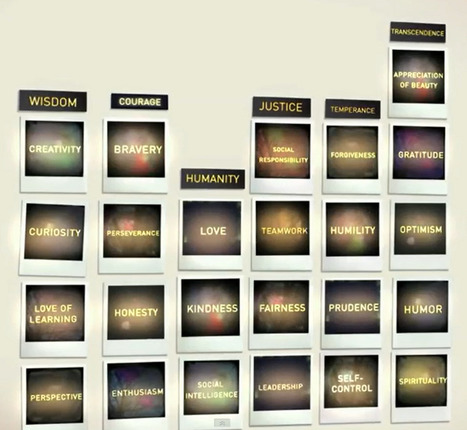
    What character traits help people lead more satisfied lives? It turns out that neuroscience has determined that mindset makes a difference (think of growth mindset) and that there are 24 character traits that you may have (some stronger than others) that can be strengthened. The video that accompanies this post is about 8 minutes long and one that you may want to share in a faculty meeting or with students (and parents).

    The organization that made this film also provides a list of resources. These resources are available at http://www.letitripple.org/character.

    The Rice Process's curator insight, March 22, 2014 4:19 PM

    Inspiring and insightful.  The content helps to focus on growing and living through one's strengths and character.  Education is liberating and can be accomplished through character education. 

    Scooped by Beth Dichter
    March 20, 2014 7:26 PM
    Scoop.it!

    Teaching Ethics in the Age of Technology

    Teaching Ethics in the Age of Technology | Eclectic Technology | Scoop.it
    Ethical decision-making should be included as a 21st century skill (overused term but don't know of an alternative).  Some would profess that ethical decision-making has always been a needed skill....
    Beth Dichter's insight:

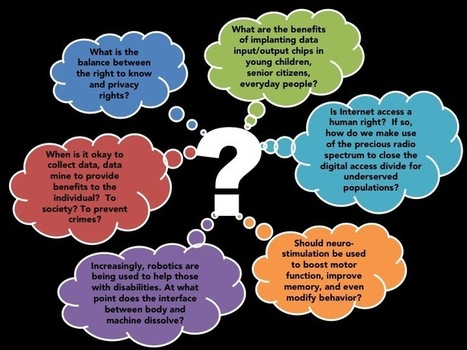
    In this post Jackie Gerstein states that ethical decision-making is a skill needed today. Technology is advancing at a speed that is often beyond our comprehension and our understanding of how this technology may impact our future may not yet be known. After looking at why it is important to integrate ethical decision-making into the education of young people she shares a resource that "can be used as a source for ethical dilemma discussions in middle school and high school classes."

    Some of the ideas suggested include:

    * The Right to Privacy versus the Right to Know

    * Internet Access as a Human Right

    * Neuro-enhancements

    She also shares some recent court cases related to online behavior that students might be interested in analyzing.

    Teaching ethical decision-making helps students use critical thinking skills, focuses on Bloom's higher order levels, and provides additional skills discussed in the post. As always she provides additional resources.

    Daniel Diaz's curator insight, August 1, 2018 11:04 AM
    Ethics has been underestimated since it is believed that ethics is already integrated in education; however, it is obvious that society is way more complex that it was before since technologies brought new problematics that must be faced right now. Unfortunately, they cannot be solved because a sort of incompetence exists towards it. For this reason, ethics and moral should be taught way more explicitly than it was before.
    Scooped by Beth Dichter
    March 19, 2014 10:02 PM
    Scoop.it!

    Speech to Text and Text to Speech In Your Web Browser

    Speech to Text and Text to Speech In Your Web Browser | Eclectic Technology | Scoop.it

    Richard Byrne shares two speech to text tools and three text to speech tools that are browser based in this post.

    Beth Dichter's insight:

    If you are using Chrome and looking for a speech to text app Bryne suggests that you check out the Dictanote Speech Recognizer app, a free app and also Dictation.io.

    For text to speech he suggests three app.

    Speak It is for use with Chrome and will read most web pages. Announcify works with Chrome and also comes for the Android. Select and Speak work with Chrome and will read any text on a web page. Bryne explains each of the tools in his post.

    If you have students whom struggle with reading text to speech tools provide a way for them to work more independently online. For students whom may struggle with the writing process but whom speak cleary a speech to text tool may make an enormous difference in their ability to keep up with work.

    No comment yet.
    Scooped by Beth Dichter
    March 18, 2014 9:06 PM
    Scoop.it!

    How to Teach the Standards Without Becoming Standardized

    How to Teach the Standards Without Becoming Standardized | Eclectic Technology | Scoop.it
    Teaching standards doesn't necessitate a standardized approach to teaching. Teachers share ideas for providing a standards-based, but authentic learning experience for all students.
    Beth Dichter's insight:

    Can teachers teach the Common Core standards and provide authentic learning so students are engaged? This post explores this issue and provides eight strategies for teaching in authentic ways. Below are four of the strategies.

    * Make the standards fit into student interests.

    * Teach students to question.

    * Emulate effective risk taking.

    * Be open to many answers.

    For additional information the four strategies above and for four more click through to the post.

    Dr Pam Hill's curator insight, March 21, 2014 9:04 AM

    Wonderful article that points out some of the challenges of Standards Based Learning as well as ways that instructors can maintain their own unique teaching styles and interests.  Great article for discussion in PD meetings, online learning, and teacher prep courses!

    Scooped by Beth Dichter
    March 17, 2014 9:01 PM
    Scoop.it!

    Can Focus On ‘Grit’ Work In School Cultures That Reward Grades?

    Can Focus On ‘Grit’ Work In School Cultures That Reward Grades? | Eclectic Technology | Scoop.it
    Education circles are abuzz with a new concept: that resilience and persistence are just as important as intelligence to predicting student success and achievement. But can "grit" actually be taught?
    Beth Dichter's insight:

    Grit, persistence, determination, growth mindset...there are many buzzwords in education today that focus on similar ideas. This post is actually from NPR. (You could hear the interview on their website. The link is at the end of this post.)

    It explores the concept of grit and how the term has come to enter the field of education.

    Do you think grit "a better predictor of success than IQ or other measures"? Can "grit" be taught? Can you develop a school around the concept of grit? Will teaching students about growth mindset change make a difference in their education? These and many other ideas are addressed in this post.

    To go to NRP to hear the article: http://www.npr.org/2014/03/17/290089998/does-teaching-kids-to-get-gritty-help-them-get-ahead

    No comment yet.
    Scooped by Beth Dichter
    March 16, 2014 9:07 PM
    Scoop.it!

    Unite for Literacy Offers Free Early Literacy eBooks

    Unite for Literacy Offers Free Early Literacy eBooks | Eclectic Technology | Scoop.it
    Beth Dichter's insight:

    Unite for Literacy is a new website that is providing free eBooks online for young children, Currently there are 120 books available. The books may be read in 15 languages, including English, Spanish, French, Hindi, Russian, Somali and Vietnamese. Each book was written for Unite for Literacy and each is read by a fluent native speaker for each language. This is a great new site for teachers of preK and K (and possibly Grade 1 and 2 if ELL). As far as I can tell they continue to add additional books. Thanks to Joyce Valenza for sharing this jewel...and to go directly to the website click this link: http://www.uniteforliteracy.com

    No comment yet.