


Click here to edit the title

 Your new post is loading...
 Scoop.it! 
Learning is a result of listening, which in turn leads to even better listening and attentiveness to the other person. In other words, to learn from the child, we must have empathy, and empathy gro...
Beth Dichter's insight:
Have you considered how empathy may be an important component of your classroom? Should it be a "concern of educators"? Should it be "intentionally used as a primary instructional strategy?" This post looks at these questions and provides a number of definitions for empathy as well as benefits of empathy in teaching and learning. There is also an excellent short animated video from RSA Shorts - The Power of Empathy.
Scoop.it!
Beth Dichter's insight:
If you are looking for a chart that shares 8 ways to do formative assessment look no further. Keep it close at hand to use with your students.
Scoop.it!

"Knowing how to research and find the information you seek is an important skill. Fortunately, the Internet is a vast font of knowledge. The trick is in using the right tools. Here are a few that can aid learners in their search for answers."
Beth Dichter's insight:
Finding great tools for students to use is often overwhelming. This post shares six specific tools as well as two lists from EdShelf. The six tools shown also include a video overview. They are: * InstaGrok * Colwiz * SweetSearch * DocsTeach * Boolify * Scrible One list from EdShelf includes 18 tools and the other includes 12 tools. The range of tools is applicable for students from elementary school though high school and college.
Scoop.it!
Dr. Seuss, the writer and illustrator behind children’s classics The Cat in the Hat, How the Grinch Stole Christmas! and The Lorax, would have turned 110 on ...
Beth Dichter's insight:
Are you new to Twitter? Do you like Dr. Seuss? Check out this guide to Twitter, inspired by Dr. Seuss. Learn more about Twitter and think back to stories you heard as a child!
Scoop.it!

Silicon Schools Fund and the Clayton Christensen Institute have teamed up to provide insight and guidance on delivering high-quality blended learning. Learn more about how to personalize K-12 education for all students by combining the best of traditional schools with the transformative power of online learning.
Beth Dichter's insight:
Are you interested in learning how to create and deliver a blended learning course? To learn about the four types of blended learning? This free online course offered through the Silicon Schools Fund, the Clayton Christensen Institute and Khan Academy is worth checking out. They have created an online course that is self-paced and includes the following areas: * Introduction to Blended Learning * Creating the Ideal Student Experience in a Blended Classroom * Teaching in a Blended Learning Environment - Rethinking the Role of the Teacher * Redesigning a School Towards Blended Learning * Making Aligned Hardware, Software, and Space Decisions in a Blended Learning Environment Each section has a number of videos and you may choose to participate in a discussion. If you are interested in learning more about blended learning this course may provide insights to increase your understanding and move you towards planning a blended learning class.
Scoop.it!

Last summer we told you that the J. Paul Getty Museum launched its Open Content Program by taking 4600 high-resolution images from the Getty collections, putting them into the public domain, and making them freely available in digital format. We also made it clear -- there would be more to come.
Beth Dichter's insight:
Getty has added an additional 77,000 images to their Open Content Program (which means they have made available over 87,000 images). This post, from Open Culture, provides additional information or you may want to head directly to The Getty and begin to search. 
Kate JohnsonMcGregor's curator insight,
April 25, 2014 3:03 PM
Amazing resources for student researchers and art lovers alike! THIS is the sort of thing that makes me love the internet!
Scoop.it!

One of the take aways from the Curriculum Mapping Institute this past week was that it brought an upgrade to THE trusted KWL (Know, What to Know and Learned) Chart to the forefront. It seems a no b...
Beth Dichter's insight:
Not too long ago I posted an article that suggested we move from the KWL chart to the KWHL chart...and here is another post that suggests we make it more in-depth by adding the letters A and Q. What do all these letters stand for? K - What do I know? W - What do I want to know? H - How do I find out? L - What have I learned? A - What action will I take? Q - What new questions do I have? More in-depth discussions of these new letters are included in the post.
Kate JohnsonMcGregor's curator insight,
April 24, 2014 8:43 AM
I love this idea - it fits beautifully with the concept of Inquiry-based learning and students assuming ownership of the research process - Yay ACTION! The idea that learning and research are ongoing - and active - is a key element to new learning models. Very exciting!
Scoop.it!
A video that explains the difference between a person who has a growth mindset and person who has a fixed mindset. All design and animation was done by me. A...
Beth Dichter's insight:
This short video does a great job comparing Growth Mindset and Fixed Mindset. You can find additional resources about mindset at a post Musing on Mindsets located at http://insidetheclassroomoutsidethebox.wordpress.com/2014/04/13/musings-on-mindset 
LibrarianLand's curator insight,
April 24, 2014 2:38 PM
Slick but effective video illustrating the difference between a fixed, less conducive to learning mindset and the more open, growth-oriented type of outlook.
Scoop.it!

This post discusses some of the challenges and proposed solutions for implementing maker education activities into a learning setting. Several trends drive this post: The Play Deficit - diminishin...
Beth Dichter's insight:
Jackie Gerstein discusses how we can bring maker education activities into our schools beginning with a look at three current trends: * The Play Deficit - for many children time to play is minimal as they lead very scheduled lives * "Lack of creativity and play in children's lives and toys" * The Maker Movement as in Maker Education The first two trends are also apparent in our education system. In many schools playtime has decreased with the rollout of Common Core curriculum. Students in pre-school and Kindergarten have specific benchmarks that they need to hit to move on, and it often comes with a decrease in play time. And many toys we find on the market today do not promote creativity. We often think of Legos as a toy to promote creativity. Gerstein shares her thoughts on this, noting buckets that contain freeform Legos that promote free play are often in the back of the store while the packages of Legos that come with directions on how to build a Star Wars character or a Harry Potter character are in the front. At the end of this section Gerstein concludes that the literature shows that (quoting from the post):
The final section of the piece explores how the Maker Movement may impact the two issues noted above and provides a look at six areas that we as educators need to consider if we are going to become a part of the Maker Education.
Scoop.it!
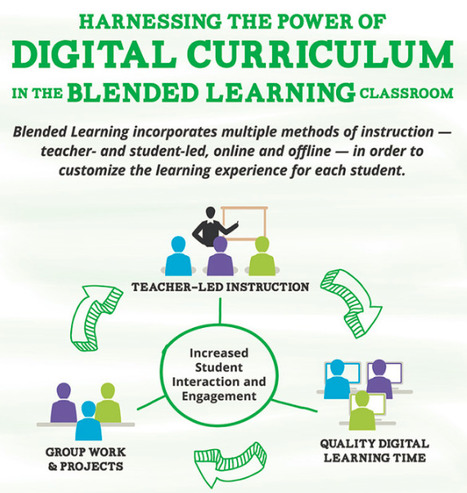
"Blended learning incorporates multiple methods of instruction in order to customize the learning experience for each student, leading to increased student interaction and engagement."
Beth Dichter's insight:
The blended classroom is beginning to happen in many school districts. This infographic provides a great overview of blended learning. In addition to the section shown above, which looks at how teacher-led instruction connects to quality digital learning time to group work and projects (and the ongoing cycle) you will find sections on: * Turning Computer Time into Quality Learning Time * Empowering Teachers with Real-Time Student Performance Information * Tying It All Together Online learning happens in a variety of ways. This post looks at some of the critical features that must be included for an online or blended class to be successful. 
Coolwired's curator insight,
April 16, 2014 2:31 PM
This Infographic illustrates the best of both worlds in modern education! 
Melissa Marshall's curator insight,
August 27, 2014 12:15 AM
This method of teaching harnesses both teacher expertise and flipped, student-lead learning, all enriched with technology. It is beginning to sit quite well with me as I have noticed some students still want to take notes, listen and learn from you - the expert teacher in this case is still valued! This could also be supplemented with teachers online and so on!
Scoop.it!

The educator's role has or should change in this age of information abundance or Education 2.0-3.0. The educator's role has always been to model and demonstrate effective learning, but somewhere ...
Beth Dichter's insight:
The world is changing at an ever growing pace and in todays world students need to learn "how to learn." How do we as teachers help our students learn "how to learn"? By modeling it in our daily work with our students we can instill the skills and help them understand that we too are in the process of learning. Jackie Gerstein provides a post that explores how our roles are changing and how the roles of our learners are chaning because of Education 2.0-3.0 (with a link to a post that describes this). What does "teaching the process of learning" mean? A few of her points are below:
There are two additional points (well worth reading) as well as three points on shifts that need to be made for this to occur. As always Gerstein brings up an issue, provides insight into the issue as well as links to additional resources, and make you sit back and think about your teaching and your classroom.
LibrarianLand's curator insight,
April 14, 2014 9:25 AM
I especially like the idea of modeling by explaining what thought processes one is going through when demonstrating or learning a task. It could be helpful to apply this when demonstrating how to do research or how to search a database.
Scoop.it!
Beth Dichter's insight:
This detailed tutorial from California State University - Chico provides students with an opporunity to learn how to:' * Investigate - What does this mean? To choose a topic you must first identify your topic. This section walks you through this concept, providing examples as well as having the student make decisions about specific areas based on what has been presented. * Search - Searching the web provides a vast amount of information that is unfiltered...so learn how to do effective and efficient searching, using key words and phrases, as well as learning about databases, scholarlly articles, popular articles and more. * Locate - Finding information in a library or online requires that you undersand the system used to locate it and how to cite the resource. * Evaluate - Evaluating requires that you use higher order thinking skills and determine which information is accurate. The tutorial introduces the CRAAP test as a tool students may use. Is the information Correct, Relevant, Authority, Accuracy, and Purpose. Each "clue" is explored and you are given information to evaluate for each. * Use - Learning how to put it together, taking the information you have learned it is time to communicate this to others. The form may vary but you still must be alert to issues such as plagiarism and the need to cite information. Again there are interactive components in the tutorial for students to practice with. This is a great resource but it is written for the college level. It could be used with high school students and you might use sections with students in lower grades as a class tool. 
Ra's curator insight,
April 12, 2014 4:42 PM
Neat slide share that gives students examples of how they might develop an investigative process. |
Scoop.it!
From
cosn

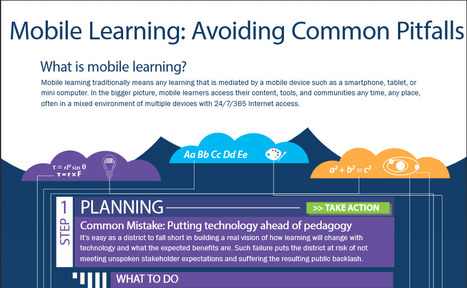
CoSN has just published a "guide provides key information and tips to educate and support administrators interested in implementing mobile learning. It addresses common questions from administrators including...:
Beth Dichter's insight:
Is your district considering mobile learning? If so this guide and infographic may be helpful as you begin the planning. Both are available free of charge. The guide provides best practices, resources and outlines. The infographic is split into three sections. * Planning * Implementing * Continually Improving Within each section you will find: * A Common Mistake * What to Do * Pitfalls You may find that the infographic provides sufficient information or you may want the detail included in the guide. Links to both are found in the post.
Scoop.it!

"The difference between students and learners is something we’ve discussed before. On the surface it’s a matter of tone and compliance, but it also has to do with purpose–why are they learning? How much of themselves are invested in the process? And does it lead to personal change, or mere performance? So below are 32 habits–or strategies, actions, or behaviors–that can lead to that critical shift that moves students from mere students to learners who are able to think critically for themselves. Key themes? Patience, scale, and perspective."
Beth Dichter's insight:
How often have you tried to get your students to show their critical thinking abilities and walked away frustrated as they struggled to reach the depths you had hoped for? This post shares a wide range of habits (or strategies, actions, behaviors, use the word that suits you) that will help students reach the depths of higher order thinking. Four of the suggestions are below. Click through to the post see all 33 (that's right, one more has been added). * Thinks laterally, endlessly connecting this to that, here to there. * Can move back and forth from micro to macro thinking. * Asks “Why?” almost annoyingly. * Values questions over answers.
Scoop.it!
Beth Dichter's insight:
Check out this visual summary of a talk by Harold Rheingold on the Future of Digital Media that looks at "You" and "Us" as well as how to use social media mindfully and effectively. 
malek's curator insight,
April 28, 2014 10:15 AM
Big consultants are big for a reason. The IBMs and McKinseys of the world are used to looking at deep client data, including sales and CRM data. They can get their hands on both media data and client data directly. 
Rocio Watkins's curator insight,
April 30, 2014 10:28 PM
Where will Infotention lead? Thoughtful and futuristic read.
Scoop.it!

"Blended learning is constantly evolving. And most of the innovations and refinements have been developed to support student-centered learning. That means leveraging technology into learning activities, in and out of the classroom. There is mounting evidence that complementing or replacing lectures with student-centric, technology-enabled active learning strategies and learning guidance—rather than memorization and repetition—improves learning, supports knowledge retention, and raises achievement. These new student-centered blended learning methods inspire engagement, and are a way to connect with every student right where they are while supporting progress toward grade level standards."
Beth Dichter's insight:
This infographic looks at ten trends occurring in Blended Learning: * The Student-Centered Learning Experience * Soaring Numbers of Digital Learners * Building Higher-Order Thinking Skills * Realizing Benefits for both Teachers and Students * A Framework for Data-Driven Decision-Making in Education * Personalized Learning Accompanied by a Lean, Blended, Interactive Approach * Productive Gamification * The Mobile World is Where Learners Live Now * Students' Personal Access to Mobile Devices * More Broadband, Please! You may also access a white paper that "provides a snapshot of some of the dominant trends in the ever-evolving blended learning landscape, and takes a look at how innovative approaches are boosting achievement in elementary mathematics classrooms." 
Mika Auramo's curator insight,
April 28, 2014 12:04 AM
Erinomainen infografiikka sulautuvasta opetuksesta, vertailun vuoksi myös arkaaisesta menetelmästä. 
StudentGeneratedInduction's curator insight,
October 28, 2014 6:06 PM
Links to an interesting set of infographics showing how learning can be made more active. The outcome of doing this has benefits for teachers and students. It is also noted to be an influence on student retention. 
Anthippi Harou's curator insight,
December 26, 2014 1:36 AM
Very interesting article on 'blended learning'.
Scoop.it!
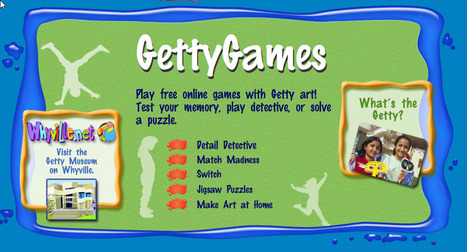
Online games from the Getty Museum - explore works of art with educational games.
Beth Dichter's insight:
Allow students to play games and explore images from the Getty Museum. Four games are available at this website. They are: * Detail Detective - There are four images on the left side, but which one comes from the picture on the right. The clock ticks as the seconds count down for you to find the correct image. Four games to play. * Match Madness - A memory game where you have to match two items, perhaps a word and an image, or the top half and bottom half. Four ways to play. * Switch - Compare two images and find the difference...but be aware the clock is ticking and you may find yourself out of time! Four subjects to choose from. * Jigsaw Puzzle - Solve the jigsaw puzzle. Twelve works of art. You choose the number of pieces: 16, 25, 49, 81, or 144 * Plus 3 activities that you can do at home You may also visit the Getty at Whyville from the site. Based on playing games these games are probably best for students in upper elementary through middle school. The site also links to the Getty Museum at Whyville, also designed for middle school students.
Scoop.it!

We all know that when it comes to consuming content, text alone no longer makes the cut. We are multi-sensory beings and the more we can plug into our senses to
Beth Dichter's insight:
Who better than Visual.ly to share 7 online tools that will help you create visual, be they simple images, infographics or a mind map. This post shares the following tools: * Canva - a free tool * Pixlr - a free tool * PicMonkey - a free tool, but you may pay for additional tools * Quozio - free tool * Share As Image - a free tool, but will show a watermark; pay for no watermark * Skitch - free through Evernote * Coggle - free tool that allows you to create mind maps Visuals are a key part of learning. These seven tools provide a range of options that you may want to use when designing materials for your classes (or perhaps students would find use for them in your class).
Scoop.it!
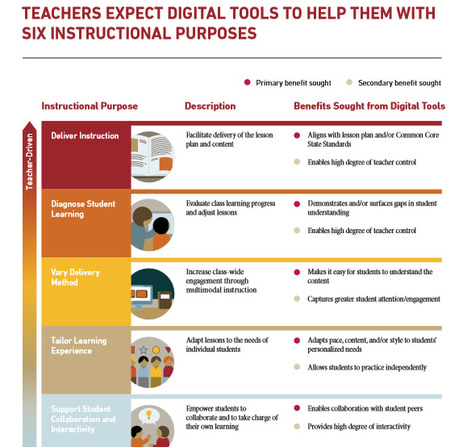
The Gates Foundation released a report today surveying teachers and students on the kinds of digital tools they'd like to see available in classrooms.
Beth Dichter's insight:
This report focused on four questions: ● What do teachers want and need from digital instructional tools? ● How can product developers use this information to more effectively serve students, teachers, and schools? ● What do we know about how teachers and districts select and purchase digital instructional tools? ● What do we know about the overall market for digital instructional tools? The report identified six instructional purposes for technology, moving from teacher-driven to student-driven and identify both a primary and a secondary benefit. The areas are: ● Deliver Instruction ● Diagnose Student Learning ● Vary Delivery Method ● Tailer Learning Experience ● Support Student Collaboration and Interactivity ● Foster Independent Practice One piece that pops out quickly is that 54% of teachers surveyed did not find the digital tools they use effective. 
KCenter SKEMA's curator insight,
April 25, 2014 4:53 AM
"The Bill and Melinda Gates Foundation just released a report detailing the results of 3,100 teacher surveys and 1,250 student surveys on the kinds of digital instruction tools that are useful and effective. The foundation has asked teachers and students what they need when it comes to digital instruction, aiming to close the communication gap between commercial developers and schools. One of the biggest takeaways is that most teachers — 54 percent — don’t find many of the digital tools they use effective. That’s partly because teachers often aren’t making purchasing decisions. When they do have a say in tool selection they often report on its effectiveness more favorably. When asked about free products, teachers reported that free products are just as likely to be effective as the products the district purchased for them."
Scoop.it!

In the classroom, fiero -- excitement that gamers experience when they overcome challenges -- makes students see that they're empowered players in their own education. They're released into the exciting adventure that learning can be. Without the intrinsic motivating power of fiero, however, gamification becomes nothing more than semantic spin: a language game in which a letter-based grade system is replaced by a points-based reward system. In these cases, gamification does little to address the shortcomings of a system that relies on high-stakes testing.
Beth Dichter's insight:
This post is the first of a series that will by published by Mind/Shift. It explores the various ways that games promote learning, such as how they scaffold skills and if you are not successful you replay at a lower level. Isn't this something we would like to see in our classrooms? After the introduction the article explores two areas: * Tapping into the Natural Instinct to Learn (which is what many of these games do) * Game-Based Learning vs Gamifcation (and yes, there is a difference) This post is full of pithy quotes such as: When learning is structured as a game, students intuitively understand the cumulative nature of learning. They’re motivated to master a compounding sequence of skills. Any teacher can implement a “gamified” approach fairly easily — you don’t need tablets or laptop computers. It’s a matter of reframing traditional assignments as inquiry-based individual or group projects. It’s also a matter of employing a more mastery-based assessment strategy that’s grounded in project-based learning and understanding the motivational benefits of a more game-like structure. The author, Jordan Shapiro, shares that this series of posts (over a period of months) will: * Explain key ideas in game-based learning * Discuss pedagogy, implementation and assessment * Summarize research * Discuss pros and cons of game-based learning * And provide a guide for game-based learning in the classroom There is much to learn about bringing games into our rooms and this series is a great way to learn.
Scoop.it!

"Education can scratch the surface, or it can go deep – providing students with not just subject knowledge, but the skills required to master that subject. Skills such as inquiry, critical thinking, and collaborative problem solving equip students with the tools they need to succeed in college and the workforce. Tools that set the foundation for lifelong learning. In order to move to a competency-based system, we should take advantage of the opportunity to model that approach for those at the head of the classroom: teachers."
Beth Dichter's insight:
This infographic provides a look at what may need to change in teacher education. Areas explored include: * Preparation and Professional Development, including sections on - The Problem - The Question - The Answer - The Opportunity * Design Principles for the Next-Gen Teacher * Competency-Based Development System * Get Involved in Shaping the Future of Teacher Preparation * What's Next This infographic may make you look at the professional development that is offered in your school. Is it helping you become a "Next-Gen Teacher"? Do you have the necessary skills to help your students become critical thinkers? Collaborative problem solvers? Do you think we should be moving towards compentency based learning and do you model this in your classroom? This infographic may raise many questions. 
Valeria Ríos Bedoya's curator insight,
August 22, 2017 3:20 PM
For me, the topic of this article is very important since in order to get our students to think critically and achieve each of the levels of thinking, as teachers, we need to learn how to think critically first; we need to embrace this ability so we can reflect it to your students.
Scoop.it!

Could e-books actually get in the way of reading? In a study looking at students’ use of e-books created with Apple’s iBooks Author software, the Schugars discovered that the young readers often skipped over the text altogether, engaging instead with the books’ interactive visual features.
Beth Dichter's insight:
Do students retain more information from e-books or from traditional books? Some studies have shown that they retain more from traditional books but this post shares research that take stock of the features of e-books, noting that "the very “richness” of the multimedia environment that e-books provide—touted as their advantage over printed books—may actually overwhelm kids’ limited working memory, leading them to lose the thread of the narrative or to process the meaning of the story less deeply." The post provides suggestions of books that provide multimedia that is beneficial as well as ways to effectively use ebooks with young children.
Scoop.it!
Beth Dichter's insight:
This infographic describes the principles of Universal Design for Learning (UDL) and also provides a range of online resources to help you begin to implement the principles. If you want a quick overview, or are looking for some ideas on what to use address specific principles, or just want to know more about UDL this infographic is worth checking out. 
Brad Reitzel's curator insight,
July 4, 2014 10:29 AM
Good vision for moving forward with Universal Design!!
Scoop.it!

Brain breaks are short mind-body challenges that offer students a reprieve from routine learning activities. Not only are brain breaks fun, they’re a simple way to refocus students’ energy and get them back on track!
Beth Dichter's insight:
Do you have a set of dice in your classroom? If not you may want to locate a set. This infographic provides 36 brainbreaks for students, all based on rolling the dice. Although many of these activities may not be new to you the fact that the decision is made by rolling two dice is a great way to engage your students, and to teach them a lesson in probability. In fact, if you choose to do this over a period of time you might also record each activity and at some point discuss probability with them. You might also print a copy.This would allow one student each time to roll the dice, and the other to read out the brain break. Please be aware that you will need to fill in a form to access the graph. If you find this version too difficult for your students you will find a simpler version of it at http://www.yourtherapysource.com/files/Roll_Some_Fun_Freebie2.pdf 
Mick D Kirkov's curator insight,
April 18, 2014 4:02 AM
Kind of Isaac Asimov's Multivac decisions based on flipping a coin, "Heads or tails, gentlemen?" http://www.olivenri.com/machine_won_files/The_Machine_that_Won_the_War01.pdf
Educative, no doubt. |







This infographic from SNAP!Learning is one component of this post by Heidi Morgan (a guest poster on a blog by Vicki Davis). It is followed by a detailed explanation of what close reading is as well as a breakdown of each step and how she uses it in her classroom. There is also a great list of additional resources (and right above the list you will find a link to a presentation that is worth watching).