Eclectic Technology
230.9K views | +6 today
Eclectic Technology
Tech tools that assist all students to be independent learners & teachers to become better teachers
Curated by Beth Dichter
Your new post is loading...
Scooped by Beth Dichter
June 24, 2014 10:29 PM
Scoop.it!

20 Things You Can Do In (About) 10 Minutes For A Better Classroom

20 Things You Can Do In (About) 10 Minutes For A Better Classroom | Eclectic Technology | Scoop.it

"When the school year begins, teachers spend a lot of time getting the classroom ready, planning lessons, and getting to know his/her students. The following list includes 20 ideas that you may not have thought of that can help produce a successful classroom. Each item takes no longer than an hour and can make a big difference throughout the year."

Beth Dichter's insight:

For many of us this is our summer break, and it is a great time to reflect on the past year and look forward to the new one that is quickly approaching. This post provides 20 'actions' that you might want to take to create a more successful classroom. Be aware that while some will take less than 10 minutes, others may take an hour or more. Four of the 'actions' are below.

* Set your classroom up in an "active learning" format.

* Set up a system for make-up work.

* Create a list of "question words" that help you with effective questioning.

* Create a risk reward procedure to encourage kids to not fear mistakes.

Click through to the post to find more information on these actions as well as 16 additional ideas!

Gary Harwell's curator insight, June 25, 2014 1:08 AM

These all make sense.

Scooped by Beth Dichter
June 23, 2014 11:30 PM
Scoop.it!

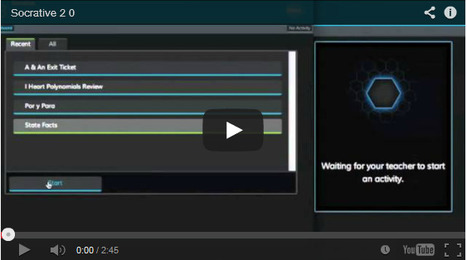
Socrative Was Acquired by MasteryConnect - Here's What You Need to Know

Socrative Was Acquired by MasteryConnect - Here's What You Need to Know | Eclectic Technology | Scoop.it

"Last week the popular student response service, Socrative, was acquired by MasteryConnect. This afternoon MasteryConnect sent out a message about the acquisition."

Beth Dichter's insight:

The good news is that Socrative will remain free! According to this post by Richard Byrne MasteryConnect. At this point MasteryConnect and Socrative will run independently. In the future Socrative will be merged within MasteryConnect.

No comment yet.
Scooped by Beth Dichter
June 22, 2014 6:18 PM
Scoop.it!

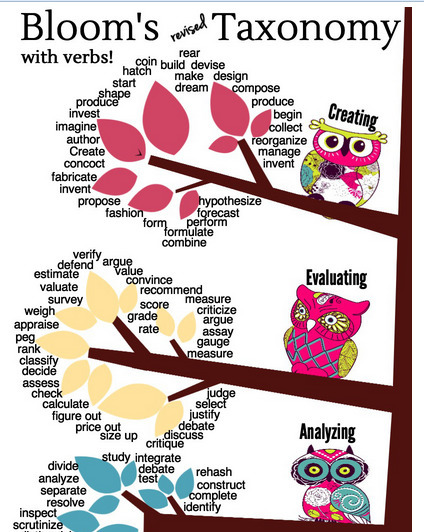
Bloom's revised Taxonomy with verbs! (Infographic)

Bloom's revised Taxonomy with verbs! (Infographic) | Eclectic Technology | Scoop.it
  Need some extra verbs? Here you go!           ~Mia
Beth Dichter's insight:

Check out this infographic from Mia MacMeekin that looks at verbs that help us meet the six levels of Bloom's taxonomy. This would be a great infographic to print out and put up in your classroom!

No comment yet.
Scooped by Beth Dichter
June 19, 2014 9:28 PM
Scoop.it!

Intrinsic Motivation for the Classroom

Intrinsic Motivation for the Classroom | Eclectic Technology | Scoop.it
Bring on the i. I just finished reading several books about intrinsic motivation. None of the research is new, so why aren't we incorporating intrinsic motivation into the classroom more? Here are ...
Beth Dichter's insight:

We are told that it is best for students to have intrinsic motivation, yet we often turn to rewards in an effort to help students do better. Mia MacMeekin has created another excellent infographic that looks at this concept and that shares 27 ideas to help you incorporate intrinsic motivation into your classroom. This is another great infographic to share with colleagues.

Agisa Abdulla's curator insight, June 21, 2014 11:44 PM

authentic learning can happen with intrinsic motivation

Raquel Oliveira's curator insight, July 2, 2014 7:01 PM

ahhh...esse tal MOTIvo para AÇÃO... vale a pena conhecer mais a respeito para auxiliar os aprendizes a encontrarem o seu próprio caminho: interiormente ou exteriormente ?


Mafe Dominguez's curator insight, April 27, 2018 11:45 PM
There are different strategies that can be applied in class in order to motivate students and get a better quality education. These strategies involve some ingredients such as student, teacher, content, method (process) and environment that help to analyze the context, and therefore to increase learner’s motivation. Williams and Williams (2011) suggest some strategies that can be considered during class to increment this motivation. To begin with, Williams and Williams (2011) state that the first ingredient in order to increase motivation is the student. Since every student is different one to another, teachers need to find different procedures that allow students to learn as much as possible. In order to establish these procedures, teachers need to keep in mind the individual and social factors that affect students; in that way, the first strategy that should be considered to increase motivation is to provide students with support, if they have any difficulty with a particular topic, and opportunities for them to become active participants; it is also important to involve parents during the learning process, this means, parents should encourage and motivate students to do well in school.
1
Scooped by Beth Dichter
June 18, 2014 11:23 PM
Scoop.it!

A Professional Learning Teacher Toolkit

A Professional Learning Teacher Toolkit | Eclectic Technology | Scoop.it
Beth Dichter's insight:

Australia has published an in-depth professional learning toolkit that has resources that many teachers may find helpful (not just those in Australia). This link shares a range of activities that will enhance your professional learning, including sections on:

* The Essential Guide to Professional Learning which has three sections: Evaluation, Leading Culture and Innovation. Each of these areas has a downloadable resource. The one for Evaluation discusses  the rationale for evaluation, evaluation design, examples of effective data collection method, effective evaluation of professional learning (with a great visual on how the evaluation should measure the impact on students, the individual practitioner and the organization, as well as how it improves the professional learning program, the professional learning outcomes and the sustained impact), and much more.

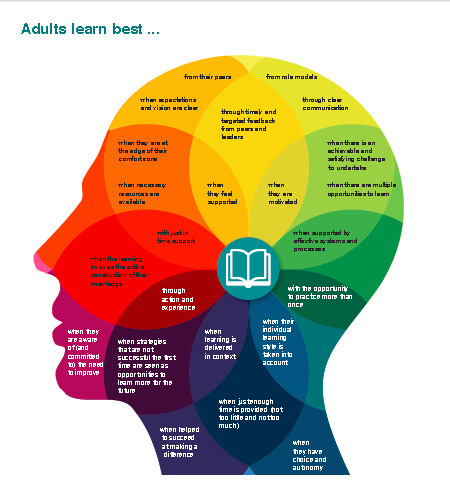
* One visual from the Essential Guide to Professional Learning: Leading Culture is shown above. The image looks at the many ways adults learn. As with the one on evaluation the resource provides a list of questions one should consider and then explores ways to build holistic learning cultures.

Find some time to explore this resource and share it with others in your building. You might also check out the short video that looks at innovation. You can also find it on YouTube at https://www.youtube.com/watch?v=e6ZifjWftc8

Ajo Monzó's curator insight, June 20, 2016 2:01 AM
Molt bo!
António Leça Domingues's curator insight, June 24, 2016 2:54 AM
Kit de desenvolvimento pessoal para professores.
Munira Mansoor's curator insight, March 20, 2018 3:51 AM

This topic shows how to put professionalism in our Routine and get it accommodate in our work.

Scooped by Beth Dichter
June 16, 2014 9:01 PM
Scoop.it!

10 Characteristics Of A Highly Effective Learning Environment

10 Characteristics Of A Highly Effective Learning Environment | Eclectic Technology | Scoop.it

"Wherever we are, we’d all like to think our classrooms are “intellectually active” places. Progressive learning (like our 21st Century Model, for example) environments. Highly effective and conducive to student-centered learning. But what does that mean?

The reality is, there is no single answer because teaching and learning are awkward to consider as single events or individual 'things'..."

Beth Dichter's insight:

Have you thought about what the characteristics of a highly effective learning environment are? This post may provide many ideas for you. Several of the characteristics are listed below. You will find many more in the post as well as some detailed descriptions.

* The students ask the questions—good questions. Do your students know how to ask good questions?  Do you know how to teach them to ask good questions? Are they supported when they ask questions?

* Ideas come from a divergent sources. Are we asking students to use multiple sources and to see more than one view of an issue?

* Criteria for success is balanced and transparent. This is a tougher one to meet (based on the post). Do your students understand the criteria for success?

As we come to the end of this school year this is a great time to reflect and think about what we might change next year. Looking through these 10 characteristics may lead you to some changes in your classroom next year.

Henrietta Marcella Paz-Amor's curator insight, June 17, 2014 11:15 AM

What are the characteristics of an effective learning environment? Read on...

Ruby Day's curator insight, June 18, 2014 3:24 PM

These criteria really outline some solid  principles that should direct our planning and thus be evident in our learning environments. Principles such as: student enquiry, work readiness, personalised learning, flexibility, authentic and transparent assessment. I like the focus on critical thinking here :)

Sue Alexander's curator insight, June 21, 2014 5:02 PM

Great scoop Beth. I love the goal of "intellectually active" classrooms.

Scooped by Beth Dichter
June 14, 2014 9:21 PM
Scoop.it!

15 Rules of Netiquette for Online Discussion Boards

15 Rules of Netiquette for Online Discussion Boards | Eclectic Technology | Scoop.it

"Follow these 15 rules of netiquette to make sure you sound respectful, polite, and knowledgeable when you post to your class’s online discussion boards."

Beth Dichter's insight:

This infographic is designed for college, but in fact the rules apply to students of all ages. Teaching students how to be good citizens online is a component of digital citizenship. The 15 rules in the infographic are wise to follow not only on online discussion boards, but may be considered a foundation to build your digital identity, tattoo, footprint...you choose the word that works best for you.

With younger students we may need to modify some language or introduce the rules over a period of time, helping them to learn just what good netiquette is.

Kimberly House's curator insight, June 15, 2014 1:31 PM

Fabulous graphic to post in the classroom (and for teachers too!)

Lyn Pat's curator insight, August 7, 2015 8:03 PM

This infographic is designed for college, but in fact the rules apply to students of all ages. Teaching students how to be good citizens online is a component of digital citizenship. The 15 rules in the infographic are wise to follow not only on online discussion boards, but may be considered a foundation to build your digital identity, tattoo, footprint...you choose the word that works best for you.

With younger students we may need to modify some language or introduce the rules over a period of time, helping them to learn just what good netiquette is.

Scooped by Beth Dichter
June 13, 2014 9:31 PM
Scoop.it!

Copyright Flowchart: Can I Use It? Yes? No? If This... Then...

Copyright Flowchart: Can I Use It? Yes? No? If This... Then... | Eclectic Technology | Scoop.it
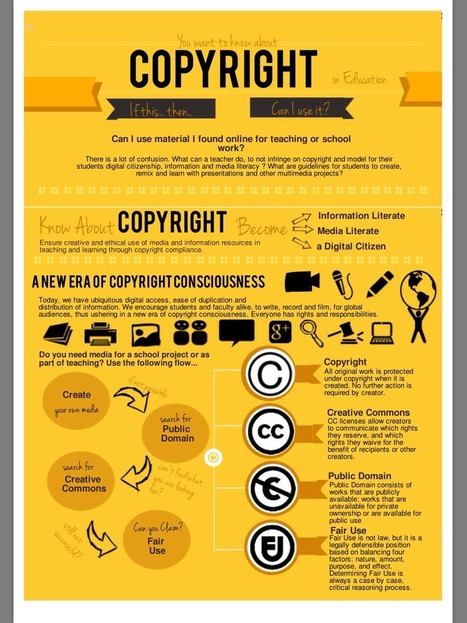
It is the responsibility of all educators to model good digital citizenship for their students. Especially when it comes to copyright, plagiarism and intellectual property. The waters are murky. No...
Beth Dichter's insight:

Teaching teachers and students about copyright and asking them to respect intellectual property is not an easy task, but it is critical that we teach students that plagiarism is not acceptable (and that we follow the same rules). This infographic provides one way for teachers and students to determine what they may do and also provides information on how you may take material you have created and either place it under Creative Commons or choose to copyright the work.

niftyjock's curator insight, June 15, 2014 3:33 AM

less "catch me if you can" and more "I'll be a responsible  digital citizen"

Kimberly House's curator insight, June 15, 2014 1:32 PM

Fantastic! This is so helpful for students and teachers who are always a bit unclear on the grey areas of copyright. No matter which country you live in, these are clear and helpful.

Scooped by Beth Dichter
June 11, 2014 9:45 PM
Scoop.it!

Collective Consumption: Social Media And Active Learning

Collective Consumption: Social Media And Active Learning | Eclectic Technology | Scoop.it

"It comes as no surprise that the Internet grows exponentially by the minute, and in some cases by the second. It’s too late to turn back the clock, and it’s no wonder that our learners view school regulations of social media archaic and restrictive. We see the weekly chats with frustrated teachers who try to get colleagues to see the benefits of Twitter; yet this is not even the most popular media with our tweens, let alone young people under thirty."

Beth Dichter's insight:

Students use social media. Do they know how much social media is used (and do teachers know this information)? This post shares two great websites that provide data on how social media is being used today. Both are interactive, but in very different ways.

The Internet in Real Time provides an up to the second look at 23 social media tools, letting you see how quickly data is generated and you can also see "the real-time accumulation of wealth."

The second resource is an infographic Social Media 2014which looks at ten social media websites and provides "facts, figures, numbers and statistics from 2014." A few are below:

* 23% of teens consider Instagram their favorite social network.

* 100 hours of video is uploaded on YouTube every minute.

Given this data many of us may be questioning policies at our schools. Is it time for public schools to look at how social media is being used by their students when they are outside the walls of the school and understand that social media provides a platform that we could use to deliver lessons?

This post explores this issue and the final sentence reads "The collective consumption of knowledge has changed because of technology, and learners need to be able to use it, search it, and share it." What are your thoughts on this?

No comment yet.
Scooped by Beth Dichter
June 9, 2014 9:17 PM
Scoop.it!

Teachers Surveyed on Using Games in Class

Teachers Surveyed on Using Games in Class | Eclectic Technology | Scoop.it
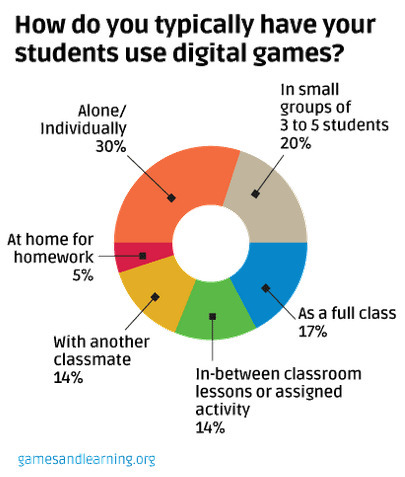
We have an early look at some of the interesting data coming out of a larger report on teacher attitudes around the use of games in the classroom. The numbers hint at wider use of games in the classroom and indicate teachers see the real benefit of games in helping low-performing students.
Beth Dichter's insight:

Do you think games have a place in your classroom? This newly released data is from a survey of 694 K-8 teachers in the U.S. that the Joan Ganz Cooney Center conducted in 2013 to see how teachers are using digital games in their classrooms.
What are some of the findings?

* 74% of teachers are using games in their classroom

* 55% of students play games at least once a week

* 72% of students access games on a PC or a Mac, and 41% of teachers use a white board to share games

* The two greatest barriers are the time it takes to implement games (45%) and the cost of the games (44%)

This post from Games and Learning provides the current data in both a visual and written form. There is much more to be found on the website. You may also want to check out the Joan Ganz Cooney Center. They have also published an article on this which may be found at http://www.joanganzcooneycenter.org/2014/06/09/digital-games-in-the-classroom-a-national-surevy/

No comment yet.
Scooped by Beth Dichter
June 7, 2014 9:37 PM
Scoop.it!

What’s Lost as Handwriting Fades

What’s Lost as Handwriting Fades | Eclectic Technology | Scoop.it
Even as the emphasis shifts to the keyboard, experts say that learning to write by hand improves motor skills, memory and creativity.
Beth Dichter's insight:

Did you know that the Common Core standards do not require students to learn to write in cursive, but they do require that students become proficient at keyboarding? Recent research is showing that it is important for students to write in cursive. Why?

Quoting from the article:

“When we write, a unique neural circuit is automatically activated,” said Stanislas Dehaene, a psychologist at the Collège de France in Paris. “There is a core recognition of the gesture in the written word, a sort of recognition by mental simulation in your brain.

There are some states that are still requiring cursive. One wonders if this new research will lead to a shift in Common Core standards.

Click through to the article for additional information.

Kimberly House's curator insight, June 15, 2014 1:35 PM

I am so happy to see this article. Both keyboarding and handwriting are essential skills. One cannot replace the other. There are critical connections that happen in the handwriting process (as shown in Beth's comment). These connections help with not only spelling but the flow of writing. 

Scooped by Beth Dichter
June 4, 2014 10:52 PM
Scoop.it!

3 Edtech Tools You Can Use To Gamify Your Classroom

3 Edtech Tools You Can Use To Gamify Your Classroom | Eclectic Technology | Scoop.it
Gamification is one of the buzzwords in education right now, and for a good reason: Gamification is empowering, exciting, and under the right circumstances can be the disruptive innovator many teachers desperately need in order to change the dynamics between knowledge and the learner. There is an explosion of EdTech tools destined to gamify the …
Beth Dichter's insight:

As schools are coming to the end of the year in my part of the world, many of us will begin to think about changes we might make next year in our classroom...and chances are for some that will include the concept of gamification.

This post from Edudemic provides descriptions of three edtech tools that may help you in this process.

* Socrative is a free program that allows you to create questions and students may answer using a wide variety of platforms.

* Kahoot is also a response system, but is designed gaming mechanics to provide motivation and engagement. There are many unique features to this tool and it worth checking out their website at https://getkahoot.com/

* FlipQuiz is similar to Jeopardy. It "makes it easy to design game-show style activities in the classroom that transform learning into an engaging and entertaining experience."

The post includes an introductory video for each tool.

Kathy Lynch's curator insight, June 5, 2014 4:11 PM

Thx Beth Dichter!

Scooped by Beth Dichter
June 3, 2014 10:50 PM
Scoop.it!

MAKE STEAM: Giving Maker Education Some Context

MAKE STEAM: Giving Maker Education Some Context | Eclectic Technology | Scoop.it
As an experiential educator who has fully embraced technology as a means for allowing and facilitating learner voice, creativity, innovation, inventiveness, the Maker Education movement fits into m...
Beth Dichter's insight:

It is rare that I curate two articles from the same author over two days. This post by Jackie Gerstein is an exception. Gerstein has been discussing Maker Education for quite some time and in this post she states:

"...recent discussions with other educators and administrators made me realize that the idea of maker education is often vague and seems unrealistic in terms of regular classroom instruction.  As such, in the future, I am going to associate and discuss Maker Education in the context S.T.E.A.M. – science, technology, engineering, arts (including language arts), math, hopefully, encouraging regular classroom teachers to integrate maker education projects into their classrooms."

What follows is a lengthy list of articles and other resources that may assist you in learning about Maker Education and moving you towards implementing it in your classroom. The image above is also a ThingLink image, and will provide you with links to the same articles.

No comment yet.
Scooped by Beth Dichter
June 24, 2014 10:53 AM
Scoop.it!

How the Brain Learns—A Super Simple Explanation

How the Brain Learns—A Super Simple Explanation | Eclectic Technology | Scoop.it
eLearning professionals should learn more about the biological basis of learning. Check out this simple explanation.
Beth Dichter's insight:

Are you looking for a simple explanation on how learning happens in the brain? The infographic above shows the shorthand version and a more detailed version is available in the post. Although this post is geared to e-learning the four processes that take place are also found in the traditional (and the blended) classroom.

Process 1: Getting the information which takes place in the sensory cortices. This is the time to touch as many of the senses as possible. Try to create lessons when introducing new material that include audio, visual and kinesthetic experiences.

Process 2: Make meaning which takes place in the temporal lobe. To make meaning of new information we must provide time for reflection.

Process 3: Form abstractions which takes place in the prefrontal lobe. The learner has received new information, reflected on the information and now begins to make meaning in their brain by making relationships, forming abstractions and creating new knowledge.

Process 4: Active testing which takes place in the motor cortex. The abstract becomes active, providing guides for future learning.

You will also find a link on this page which will allow you to download an eBook - Neuroscience Based eLearning Tips.

Scooped by Beth Dichter
June 22, 2014 10:01 PM
Scoop.it!

25 Ways to Create A Sticky Lesson - InformED

25 Ways to Create A Sticky Lesson - InformED | Eclectic Technology | Scoop.it
How do we create learning that lasts? It's a hard question to answer, and in some cases an even harder reality to achieve, particularly with the pressure
Beth Dichter's insight:

After describing the three phases of the learning process based on cognitive science. The first two phases:

* Students decide what to attend to.

* Students organize the information

These work with short term memory but to know the information students must also activate long term memory which may begin in class with a review but should also includes well crafted assignments.

What can you do?The post continues by exploring ways to capture a students attention and ways to help them create a framework. The final section explores how to make the lesson stick. Three examples are below (quoted from the post).

* Begin lectures with a high level question that the upcoming information can answer.

* Highlight the "unfinished" nature of each subject.

* Don't use too many types of different presentation materials at once.

Throughout the post there are links to additional resources.

Nancy Jones's curator insight, June 23, 2014 1:38 PM

I love this image. It captures it all. Beth Dichter posts great stuff on a regular basis. I am really spending some serious time inviestigating this topic of buy-in by the students by givening them more ownership .

Ness Crouch's curator insight, June 25, 2014 5:38 AM

I like the analogy of a 'sticky lesson'... something that sticks in your head. That's the aim of every lesson... get what you are teaching to stick in the learners head!

Scooped by Beth Dichter
June 21, 2014 8:26 AM
Scoop.it!

Computational Thinking - What is it? Why Teach It?

Computational Thinking - What is it? Why Teach It? | Eclectic Technology | Scoop.it

"As the cities that have hosted Code for America teams will tell you, the greatest contribution the young programmers bring isn't the software they write. It's the way they think. It's a principle called "computational thinking," and knowing all of the Java syntax in the world won't help if you can't think of good ways to apply it."


Beth Dichter's insight:

Should we be teaching coding to our students? What does computer literacy mean? And what is computational thinking? These are some of the questions addressed in this article from Mother Jones.

Let's start with the question 'What is computational thinking?' Below is a quote from the article.

"If you've ever improvised dinner, pat yourself on the back: You've engaged in some light CT...If seeing the culinary potential in raw ingredients is like computational thinking, you might think of a software algorithm as a kind of recipe: a step-by-step guide on how to take a bunch of random ingredients and start layering them together in certain quantities, for certain amounts of time, until they produce the outcome you had in mind."

There are so many quotes I could pull from this article to share. Below are two more and I would urge you to take the time to click through and read the entire article (and it is quite long). Along with a information on the history of literacy (as in reading and writing as well as computer) you will find a video of individuals (some of whom you will recognize) talking about how they became involved in computational literacy as well as many graphs and images. On to the quotes...

"Computational thinking involves solving problems, designing systems, and understanding human behavior," she writes in a publication of the Association for Computing Machinery. Those are handy skills for everybody, not just computer scientists.

And while many kids have mad skills in movie editing or Photoshopping, such talents can lull parents into thinking they're learning real computing. "We teach our kids how to be consumers of technology, not creators of technology," notes the NSF's Cuny.

Dr. Helen Teague's curator insight, June 25, 2014 9:57 AM

Is Coding the New Literacy?

Scooped by Beth Dichter
June 18, 2014 11:44 PM
Scoop.it!

10 Ways To Be A More Reflective Teacher

10 Ways To Be A More Reflective Teacher | Eclectic Technology | Scoop.it


"Teaching isn’t easy.

It will challenge your content knowledge, pedagogical skills, charisma, diplomacy, communication, statistical analysis skills, and a dozen other strands you didn’t know where strands. Some teachers may try to tell you that being happy doesn’t matter. That it’s about results. Data. Performance. Or more rhetorically, the students."

Beth Dichter's insight:

How can we become better teachers? One way is to reflect on our practice. There are times when we team teach or collaborate, but for most teachers our days are spent in our classroom with our students. This post provides 10 great suggestions on ways to reflect on your teaching. Below are a few of the ideas.

* Record video of your lessons (and then share the video with colleagues and have them provide feedback also).

* Ask the students for feedback (this may be a bit scary, but chances are they will have some insights that would assist you)

* Surround yourself with enthusiasm & possibility (all too often we see the negative...try going in the opposite direction and see what happens.

Seven additional ideas are found in this post. Check it out and make some notes for what you might try next year.

No comment yet.
Scooped by Beth Dichter
June 16, 2014 9:51 PM
Scoop.it!

Can Exercise Close the Achievement Gap?

Can Exercise Close the Achievement Gap? | Eclectic Technology | Scoop.it
Just 12 minutes of aerobic exercise can boost low-income college students’ academic performance. The effect is large enough to close the achievement gap.
Beth Dichter's insight:

In 2012 a study was published that noted there were academic benefits for low-income who had "short bursts of aerobic exercise. This article shares a new study where participants age 17 - 21 were placed in groups (based on income level) and assigned to either the experimental group or the control group. The experimental group jogged for 12 minutes while the control group watched a video on the benefits of exercise. And yes, these students also saw a significant increase in academic performance. For more information click through to the article.

Progressive training's curator insight, June 17, 2014 11:30 AM

Can Exercise Close the Achievement Gap?

Scooped by Beth Dichter
June 15, 2014 11:16 PM
Scoop.it!

Teaching Through Trauma: How 1 LA school teaches despite poverty, trauma

Teaching Through Trauma: How 1 LA school teaches despite poverty, trauma | Eclectic Technology | Scoop.it
In this first installment of a KPCC series, we look at new research that shows the mere act of being poor can affect the brain, making it hard for kids to learn. But the changes are reversible.
Beth Dichter's insight:

How does poverty impact our students, especially students whom live in urban areas where trauma and stress have a significant impact on the developing brain?

Quoting from the post "Children living in poor neighborhoods are more likely to suffer traumatic incidents, like witnessing or being the victims of shootings, parental neglect or abuse. They also struggle with pernicious daily stressors, including food or housing insecurity, overcrowding and overworked or underemployed, stressed-out parents."

Yet it is possible to make a difference, and one school in Los Angeles is proving this with by working with teachers with this goal in mind "...to figure out how to “use positivity and relationships to reverse some of the negative effects of poverty.”

This link will take you to part 1 of this story and the link to part 2 is available in the story. You may also listen to each installment.

Henrietta Marcella Paz-Amor's curator insight, June 17, 2014 11:13 AM

How does being poor potentially affect the brain and learning for kids? How one LA school teaches through trauma..

Scooped by Beth Dichter
June 13, 2014 10:26 PM
Scoop.it!

11 Bad Teaching Habits That Are Stifling Your Growth

11 Bad Teaching Habits That Are Stifling Your Growth | Eclectic Technology | Scoop.it

"There’s a certain class of mistakes that all educators can eliminate with conscious effort, and in this post we outline 11 of them. They range from habits of practice to habits of thought, but all of them have one important thing in common: they make your job harder."

Beth Dichter's insight:

For many of us this school year has come to an end or will shortly. Perhaps it is time to reflect on our year and consider habits that might need to be changed. This post looks at 11 habits. A few are listed below.

* Not learning from colleagues. This seems simple, but given how busy our day is it is tough to find time to observe another teacher, or have someone tape you and ask others to provide you with feedback.

* Assuming a lesson taught is a lesson learned. Have you asked yourself how many times you have repeated a portion of a lesson? With the range of students in our classrooms the need to rephrase, review, reteach key points may be more necessary than we think.
* Failing to establish relevance. At times this may seem difficult to do, but for our students to learn we need to make our topic relevant to them. When you are successful with this share your ideas with others!
Click through to the post to see 8 additional habits that you may want to change.
Rosemary Tyrrell, Ed.D.'s curator insight, June 14, 2014 11:15 AM

#11 - Not getting to know your students. I think this is the most important tip -- but they're all good. 

Scooped by Beth Dichter
June 12, 2014 10:23 PM
Scoop.it!

The 7 characteristics of a digitally competent teacher - Infographic

The 7 characteristics of a digitally competent teacher - Infographic | Eclectic Technology | Scoop.it
Being a proper digitally competent teacher is not as simple as picking up an iPhone and tweeting. You need to be a good digital citizen, understand privacy, and more. In an effort to clarify and explain some of the most important characteristics that a digitally competent teacher must have, we whipped up this fun visual. …
Beth Dichter's insight:

What do you think it takes to be a digitally competent teacher? This infographic shares seven characteristics. Do you understand and model what it means to be a digital citizen to your students? Do you help them understand privacy and teach your students how privacy has changed in the digital age? Do you students understand that technology skills transfer to the curriculum you teach? Check out this infographic to learn more.

Maryalice Leister's curator insight, June 13, 2014 7:38 AM

I like this take on the issue. Since we have moved teaching skills online, educators are charged with the same level of role modeling as they do on the ground in brick and mortar. In fact, it is even more critical to help young people understand the risks.

Ness Crouch's curator insight, June 13, 2014 10:29 PM

I really like this infographic. Are you a digitally competent teacher?

Kimberly House's curator insight, June 24, 2014 4:50 PM

Good one to remind teachers that they are more competent with digital tools than they realise! If you can shop online, you can teach online! :-)

Scooped by Beth Dichter
June 10, 2014 11:48 PM
Scoop.it!

Raise a Reader Infogram

Raise a Reader Infogram | Eclectic Technology | Scoop.it
Beth Dichter's insight:

Here is a great infographic to share with parents as schools come to an end (at least in my state). Learn some of the many reasons why it is important for students to have parents (or siblings, friends, etc.) read to them after school is out. Learn some of the statistics for students whom have too much screen time and the best places to keep books in your house.

Terri Goldson's curator insight, June 12, 2014 6:32 AM

Reading is a fundamental skill that all children must develop. The foundation for the joy of reading can be developed at home. Check out the info-chart, read, learn, explore and form your own opinion.  ....Knowledge IS Power!   Terri Goldson, Sr

Molly Frances Sheridan's curator insight, May 13, 2016 8:46 PM

This is a "numbers porn" infograph because of the amount of numbers and charts that are in it. The infograph has little other pictures so it just purely directs your attention to the numbers and the words written to back up their idea. I like how clear their ideas are but I think they need to include where they got the numbers, because some seem illegitimate. 

Scooped by Beth Dichter
June 9, 2014 8:13 PM
Scoop.it!

30 Ways to Inspire Divergent Thinking - InformED

30 Ways to Inspire Divergent Thinking - InformED | Eclectic Technology | Scoop.it

"When we stop talking about creativity and innovation in abstract terms and start thinking about how they originate, we get divergent thinking. Divergent thinking is more than thinking outside the box; it’s thinking without the box, and imposing structure later."

Beth Dichter's insight:

Why is divergent thinking important in education, and how can we inspire our students to become divergent thinkers? This post explores this idea, beginning with a definition of divergent thinking and providing a look at current research on divergent thinking.

Did you know that divergent thinking "stems from logical, unbiased thinking" or that divergent thinking "leads to positive mood swings while convergent thinking leads to negative mood swings." After this discussion (and there is much more in the post) you will find 30 tips on how to teach your students to become divergent thinkers. A few of the tips are below.

* Fast, frequent failures (with the suggestion that students quickly lay out all possible solutions). Identifying mistakes helps to lead to the students to the correct solution.

* Google - Today students like to Google the answer...but what if you create questions that require deeper thinking, where Google will not supply an answer quickly.

Many more ideas are available in the post. Click through to read more.

Scooped by Beth Dichter
June 5, 2014 9:51 PM
Scoop.it!

What do you want to do with the iPad in education?

What do you want to do with the iPad in education? | Eclectic Technology | Scoop.it

"Below I have outlined a number of tasks, for use with the iPad in the classroom. I believe that if you understand these 5 tasks from beginning to end, you will have an excellent foundation to build any engaging classroom activities."

Beth Dichter's insight:

This post discusses the need to define the outcome you expect before you design your project (understanding by design where you begin at the end product and work backwards). The focus is on the iPad, but the questions he proposes for students to answer should work with most digital apps or online tools we use in our classrooms. Within the post you will find five projects that are designed with Bloom's taxonomy in mind. The projects are:

* Create a movie

* Create a podcast

* Create an interactive book

* Create a presentation

* Create a PDF

Of more interest (to me) are the steps he suggests you follow as you create the workflow that students will need to follow.

Clearly define the outcome providing an explanation that the students will understand and also define the context, providing sufficient information that the student know what they will need to accomplish.

When you click through to the post, you will see that each of the projects includes five areas that students work through. In each project students will begin with a clear concept of what they need to remember. They then move up (Bloom's taxonomy) to understanding, with another task to complete. From there they look at applying and analyzing, with additional questions and specified work to be accomplished. This is followed by analyzing and creating, and as a final component collaboration comes into play. In each of these areas there are one or more iPad apps recommended.

Kimberly House's curator insight, June 15, 2014 1:36 PM

Fantastic breakdown of basic iPad tasks. Perfect to use with my teachers who are new to our iPad programme.

Scooped by Beth Dichter
June 4, 2014 8:34 PM
Scoop.it!

Blooms, SAMR & the 3 C's - iSupport

Blooms, SAMR & the 3 C's - iSupport | Eclectic Technology | Scoop.it

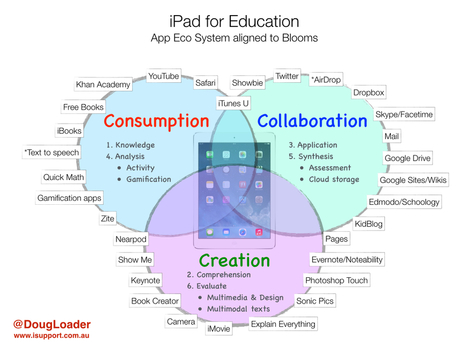
All the iPad apps you'll ever need. Aligned to Blooms Taxonomy and SAMR

Beth Dichter's insight:

Do you use iPads in your school? Do you work with Bloom's Taxonomy and/or SAMR? Are you interested in seeing how you might combine Bloom's and SAMR using specific apps? If so, click through to this post.

The post takes apps and organizes in three categories:

* Consumption - which includes Knowledge and Analysis (split into Activity and Gamification)

* Collaboration - which includes Application and Synthesis (split into Assessment and Cloud Storage)

* Creation - which includes Comprehension and Evaluate (split into Multimedia & Design and Multimedia Texts)

Then read on and see how you might take these same areas and apply them to SAMR (Substitution, Augmentation, Modification and Redefinition).

This is worth a look even if you do not have iPads. The ideas of placing work into the three Cs of Consumption, Collaboration and Creation may be applied to work that students do, with or without technology.

No comment yet.