Eclectic Technology
230.9K views | +6 today
Eclectic Technology
Tech tools that assist all students to be independent learners & teachers to become better teachers
Curated by Beth Dichter
Your new post is loading...
Scooped by Beth Dichter
July 16, 2014 10:58 PM
Scoop.it!

New Research: Students Benefit from Learning That Intelligence Is Not Fixed

New Research: Students Benefit from Learning That Intelligence Is Not Fixed | Eclectic Technology | Scoop.it

"Teaching students that intelligence can grow and blossom with effort – rather than being a fixed trait they’re just born with – is gaining traction in progressive education circles. And new research from Stanford is helping to build the case that nurturing a “growth mindset” can help many kids understand their true potential."

Beth Dichter's insight:

How can we help nurture a growth mindset? New research has been published shows that providing as little as "30-minute online intervention can spur academic gains for many students, particularly those with poor grades."

Learn more about the programs that were offered and about the gains that struggling students made based on the online intervention.

Carol Dweck is known for her research on growth mindset and this post provides up-to-date information that may make you consider creating a short presentation and discussion with students about the value of hard work and effort as well as various study techniques. It is important to remember that students of all ages need to be educated that they are able to learn.

Rosemary Tyrrell, Ed.D.'s curator insight, July 17, 2014 4:34 PM

New research on mindset. Definitely worth a read! 

Kathy Lynch's curator insight, July 17, 2014 5:05 PM

Thx Beth Dichter!

niftyjock's curator insight, July 17, 2014 6:04 PM

You can learn to be smarter, 

Scooped by Beth Dichter
July 15, 2014 8:32 PM
Scoop.it!

Being Pretty Isn’t Enough: Using the 5 Cs for eLearning Visuals

Being Pretty Isn’t Enough: Using the 5 Cs for eLearning Visuals | Eclectic Technology | Scoop.it
This post looks at a simple approach to creating effective visuals for eLearning by considering the 5 Cs.
Beth Dichter's insight:

How do you create effective visuals? This post provides 5 Cs to help guide you. Make sure the visual is:

* Clear

* Concise

* Connected

* Compelling

* Complete

Why is this important? People remember visuals, more so than words. As you create a visual make sure that it is easy to understand, that it shares critical information, that it engages the learners.

For each of the 5 C's consider the questions below (quoted from the post).

* Will a visual help make a point clearer?

* Will a visual summarize a point better than text?

* Will a visual help learners make connections?

* Will visuals make content more attractive?

* Will a visual help complete an idea?

Each of these questions are explored...and of course, each has a visual to help us understand the reason. Although the post is addressing eLearning, the same concepts apply in a face2face classroom.

No comment yet.
Scooped by Beth Dichter
July 14, 2014 7:07 PM
Scoop.it!

3 Ways to Use ThingLink for Video in the Classroom

3 Ways to Use ThingLink for Video in the Classroom | Eclectic Technology | Scoop.it
Recently ThingLink introduced ThingLink for Video, an exciting new editor for annotating video content with rich media.
Beth Dichter's insight:

With ThingLink for Video now available you might be wondering what you could do with it. Find examples of:

* How to Kick off a Unit and Target Instructional Goals

* Prepare a Flipped Lesson to Prepare Students for Work in Class

* Using ThingLink for Video for Professional Development

* 12 Examples Created by Teachers

* plus a How To Video to help you create your own

ThingLink has developed a resource that may become a staple in your classroom. If you do not yet have an account, go create one at the ThingLink website and you should be up and running pretty quickly.

Dr. Helen Teague's curator insight, July 15, 2014 1:59 PM

This post also discusses the Flipped Classroom model.

Scooped by Beth Dichter
July 13, 2014 8:08 PM
Scoop.it!

The ABC's of Collaboration

The ABC's of Collaboration | Eclectic Technology | Scoop.it


Beth Dichter's insight:

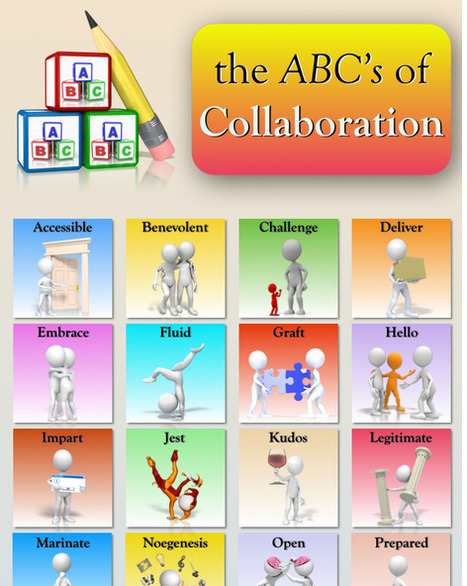
Dan Pontrefract has published a book called Flat Army: Creating a Connected and Engaged Organization. In this book he define collaboration as:

The unfettered allowance and encouragement of employees to both contribute and consume knowledge, insight or ideas with any direct relationship via professional or personal networks to achieve an outcome.

In addition to this definition he has created two infographics that look at the ABC's of Collaboration.

One infographic provides a key word for each letter of the alphabet as well as an image (as shown above). The second infographic also includes a definition for each word.

We know that collaboration is not always easy for students. The two versions available would be useful for different grade levels. In the younger grades students might share what they believe these words mean, or you may choose one or two key words to use for specific tasks. The version with definitions might be useful in promoting a dialogue with older students. Do  they agree with the definition? Is there a word that they think might better reflect collaboration that takes place in  a classroom?

Gary Harwell's curator insight, July 14, 2014 12:16 AM

Our students have to collaborate.

Scooped by Beth Dichter
July 13, 2014 6:07 PM
Scoop.it!

How To Take Notes: Strategies That Set Straight-A Students Apart

How To Take Notes:  Strategies That Set Straight-A Students Apart | Eclectic Technology | Scoop.it
Most students take notes without thinking twice about it. It's what a good student does, what the professor expects, what everyone around them is doing.
Beth Dichter's insight:

Learning how to take notes is a skill. Is there a better way to take notes? What do we know that works, and why does it work? This post explores many of these issues. It begins with a review of why we take notes and then takes a look at how much brain power is used.

The post then goes on to review the top five recognized note-taking methods.

* The Cornell Method - In this method you divide your paper into two columns. The right hand column is usually for note-taking and the left hand column for questions and key words. For maximum effectiveness the notes should be reviewed within 24 hours and one should answer the questions that were posed.

* Mapping is a more visual  method of taking notes. The key idea is often in the center, and facts radiate out from the center. However, if you add too many notes, your visual may become "more verbal" and therefore less effective.

* Outlines are another way to take notes. Concepts are organized into points and sub-points. Issues that may arise are when do you begin new sections, and how do you categorize points within sections.

* The Charting Method - This requires some knowledge of the topic to be covered. You create a chart with columns that provide the categories to be covered. Put your notes under the correct column and you are ready to go.

* The Sentence Method - This is a more free style method. "You simply write every new concept or topic on a separate line." After the lecture you go back and draw arrows, connectors, or images to help you connect knowledge together.

One of the issues with all these methods is to determine "when you should write and when you should listen." This topic is also explored as is the current research on typed vs. written notes.

Laura Saavedra's curator insight, July 14, 2014 4:54 PM

Good for students and even teachers!

LibrarianLand's curator insight, July 15, 2014 12:27 PM

Long hand note taking appears to beat typed note taking in many instances.

Scooped by Beth Dichter
July 10, 2014 9:12 PM
Scoop.it!

Sea Levels are Rising - What are the Causes? (Infographic)

Sea Levels are Rising - What are the Causes? (Infographic) | Eclectic Technology | Scoop.it
Beth Dichter's insight:

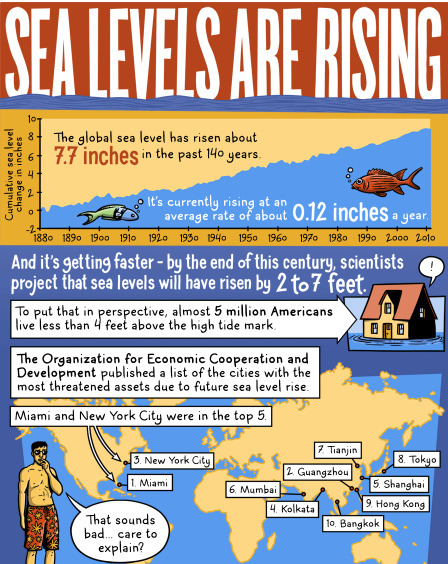
Sea levels are rising and recent research tells us the impact will happen more quickly than originally stated. This infographic shares information on how the sea level has risen over the last 140 years and how much it is predicted to rise by the end of the century. It also shares information on the two main reasons this is taking place. This infographic would be appropriate to share with students studying climate change/global warming.

Deanmignanelli's curator insight, July 15, 2014 10:28 PM

this photo shows how rising sea levels effect all of australia


Scooped by Beth Dichter
July 10, 2014 7:44 PM
Scoop.it!

Breathe New Life into Your eLearning Courses: 5 Helpful Mantras to Live By

Breathe New Life into Your eLearning Courses: 5 Helpful Mantras to Live By | Eclectic Technology | Scoop.it
The following five helpful mantras provide refreshing ideas for creating eLearning courses that go beyond a conventional approach.
Beth Dichter's insight:

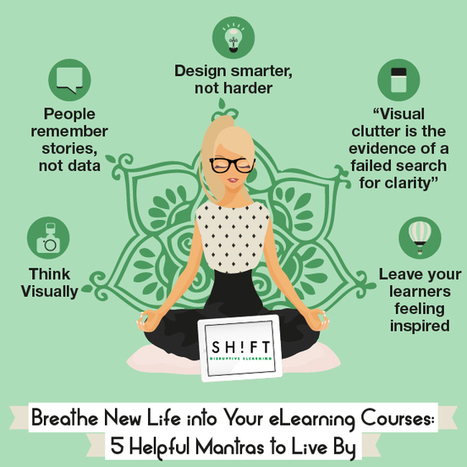
Once again SHIFT Learning has published an article that focuses on eLearning, but is applicable to face2face learning. The five mantras that are discussed work in either location. What are they? (All are quoted below):

* Think visually.

* We don't remember data, we remember stories.

* Design smarter, not harder.

* Visual clutter is the evidence of a failed search for clarity.

* Leave your learners feeling inspired.

Additional detail is provided in the post and an additional resource is shared in three of the five areas listed above.

niftyjock's curator insight, July 15, 2014 6:07 PM

coool

Julie's curator insight, July 16, 2014 4:30 AM

Perfect creative way to present it !

OOHMMMMM

Julia Echeverría's curator insight, July 16, 2014 4:03 PM

Genial, me encanta.

Scooped by Beth Dichter
July 9, 2014 9:11 PM
Scoop.it!

A ThingLink challenge and new video tagging

A ThingLink challenge and new video tagging | Eclectic Technology | Scoop.it

"One of the most versatile and easiest-to-use platforms I’ve used over the past several years is ThingLink.

I’ve used the interactive poster tagging tool to create and embed media-rich image maps, to annotate and evaluate the claims infographics make, as a portfolio and as a curation tool."

Beth Dichter's insight:

ThingLink has been around for quite some time and is a great tool for educators. This summer they are running a professiona development program which is free and self-paced (and it is not too late to join). For more information on this opportunity check out the Google+ Community.

ThingLink has also just launched a new video tagging tool. For more information on that check out the post.

Rosemary Tyrrell, Ed.D.'s curator insight, July 10, 2014 4:13 PM

Thinglink is providing some free professional development!

Scooped by Beth Dichter
July 8, 2014 9:36 PM
Scoop.it!

4 Stages Of Problem-Based Learning

4 Stages Of Problem-Based Learning | Eclectic Technology | Scoop.it

"We’ve written about inquiry-based learning in the past, as well as its mother project-based learning, and it’s aloof, hipster cousin self-directed learning.

So it made sense to take a look at challenge-based learning–the process of anchoring the learning process through problems–usually local, authentic, and personal to the student. This is a kind of place-based education that takes a project-based approach that begins and ends with the student and their respective and self-examined citizenships."

Beth Dichter's insight:

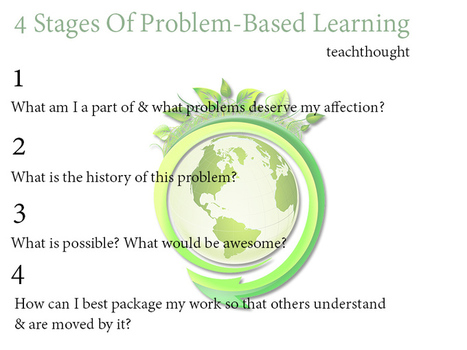
This post provides four areas that are covered in project-based learning. Each area has four questions, that will help students understand the process. Four of the questions are in the image above. Can you determine which area they fall into?

The four areas covered are:

* Connect & Analyze

* Research & Contextualize

* Imagine & Design

* Act & Socialize

Click through to the post to see the other questions. If you will be doing project-based learning with your students you may want to  save a copy of the questions to  share with your students.

No comment yet.
Scooped by Beth Dichter
July 8, 2014 8:39 PM
Scoop.it!

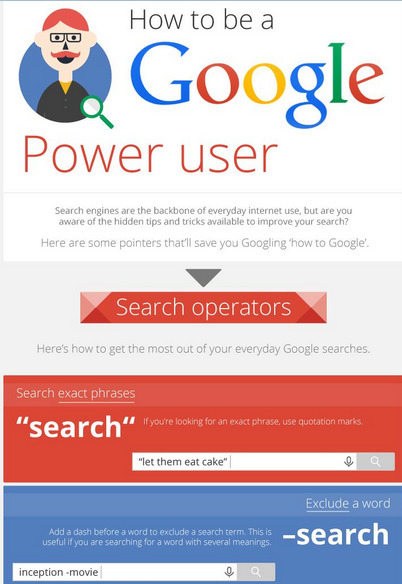
How to be a Google Power User - Infographic

How to be a Google Power User - Infographic | Eclectic Technology | Scoop.it
The most viral images on the internet, curated in real time by a dedicated community through commenting, voting and sharing.
Beth Dichter's insight:

Do you use Google? Do you understand the ins and outs of Google? If not, you may find this lengthy infographic of interest. It provides a visual representation of many of the tricks to searching, helping you find what you are looking for more quickly. Consider sharing this with students and colleagues.

Gary Harwell's curator insight, July 9, 2014 2:30 AM

This is power we can use.

niftyjock's curator insight, July 15, 2014 6:20 PM

Very helpful

Scooped by Beth Dichter
July 7, 2014 8:55 PM
Scoop.it!

The Periodic Table of iPad Apps

The Periodic Table of iPad Apps | Eclectic Technology | Scoop.it
Beth Dichter's insight:

Do you use iPads in your program? This visual Periodic Table of iPad Apps may provide you with another way to view apps. It divides apps into the following categories:

* Apple

* Google

* Creativity

* Productivity

* Teacher

* Mathematics

* Interacting

* Sharing

When you click through to the website you will be able to bring up a larger jpg image. This table may suggest some new apps, or allow you to see another way to use an app you have installed. Unfortunately the images are not linked to the actual apps.

No comment yet.
Scooped by Beth Dichter
July 5, 2014 11:26 PM
Scoop.it!

The Best List of Reading Response Questions Ever.

The Best List of Reading Response Questions Ever. | Eclectic Technology | Scoop.it
When I was in the classroom, I used the workshop model.  After students read silently every day, I asked that they write in their reading response journal for just five minutes.  They could choose ...
Beth Dichter's insight:

Are you looking for an extensive list of reading response questions? Look no further. This post provides an in-depth list of questions, as well as suggestions on how the author used them in her classroom.

Along with a lengthy list of great questions there is also a section called Test Readiness Terms that provides additional questions in the areas of Analyze, Compare, Contrast, Define, Describe, Differentiate, Discuss, Evaluate, Explain, Identify, Interpret, List, Main Idea, and Outline.

Below are five randomly chosen questions.

— Describe the most important event. Give at least three reasons why you think it is the most important event.
— Draw an interpretation of the passage – may be a picture, symbols, graphic organizer.

— If you could change what you’re reading, how would you change it?

— Is the setting described well enough that can put a picture of it in your mind? Why or why not?

— What have you found boring about what you’ve been reading? What made it boring? If you were the author, what would you do to make it more interesting?

If you have students using writing journals it is worth your time to check out this list. You may not want to use all of the questions (the author notes that a printed list ran to 10 pages) so take the time to review and select ones that will work with your students.

Gary Harwell's curator insight, July 11, 2014 12:38 AM

If yoiu are serius about reading, these are some great questions.

Scooped by Beth Dichter
July 4, 2014 9:40 PM
Scoop.it!

4 Belief Statements Underlying Student Performance

4 Belief Statements Underlying Student Performance | Eclectic Technology | Scoop.it

"David Dockterman would like to see more productive failure. But as a lecturer at Harvard’s GSE, Dockterman sees students afraid to blemish a polished transcript. As Scholastic’s chief architect of learning sciences, he sees K-12 students all too familiar with failure and schools that don’t know how to support productive struggle."

Beth Dichter's insight:

The concept of growth mindset is often discussed in schools. Research shows that a students' mindset plays a role in how well they do at school. This post provides "4 belief statements that underlie student performance." Each statement is listed below, but click through to the post to learn more about the meaning behind the statement.

1. “I belong in this academic community.”

2. “My ability and competency grow with effort.”

3. “I can succeed.”

4. “This work has value for me.”

There are a number of links in the article and you may want to read the article located in EdWeek (published in Sept. 2013). This article looks at how our language as teachers impacts each student. Our words are important and we may not be aware of the words we use are impacting our students.

Also consider scrolling down and reading the comment by Tom Vander Ark. He discusses two areas that are forgotten in the discussion of mindset (and he includes grit here also) - the ability to transfer knowledge between content areas (an important component in Common Core) and "domain knowledge and skill." He provides suggestions on what we might try in our classrooms.

No comment yet.
Scooped by Beth Dichter
July 15, 2014 9:56 PM
Scoop.it!

Get into the Flow in your Classrooom

Get into the Flow in your Classrooom | Eclectic Technology | Scoop.it
There is an experience that happens in many of my classes... Students get so enthralled in what they are doing that time disappears and learning transpires. I often wondered how this happened and h...
Beth Dichter's insight:

What does it take to have 'flow' in your classroom, to have students so involved in the task that they do not want to leave? Mihaly Csikszentmihalyi gave a TEDtalk about flow and Mia MacMeekin has taken the key concepts and shared thism in this visual.

Learn about flow by reviewing this infographic, which provides six concepts to that will help you get into the flow as well as definitions for some of these concepts and 8 major components of enjoyment (which is one of the concepts). Learn more about flow by listening to the TEDtalk.

No comment yet.
Scooped by Beth Dichter
July 15, 2014 5:34 AM
Scoop.it!

The 5 W's of Exit Tickets

The 5 W's of Exit Tickets | Eclectic Technology | Scoop.it

"While in New Orleans at the Reading, Writing, Math and More Conference, I had a lot of questions about my Exit Tickets.  So I figured - Hey?  Why not do a blog post!   So Ta-Da!!  Here goes nothing! The 5 W's of Exit Tickets. "

Beth Dichter's insight:

Do you use exit tickets in your class? Are you interested in learning more about reasons why you might consider exit tickets as a tool for teachers and students? This post looks at the 5 W's of exit tickets:

* What

* Who

* Where

* When

* Why

Each of these areas are discussed in detail and many suggestions are provided.

For example, in the What section the author states "Exit tickets are a quick and easy way to gather immediate data at the end of a lesson.  They can be formal (something you found online, paid for, printed, etc.) or they can be very on the spot and informal."

There are also some visuals in the post that will provide you some ideas on how you might organize exit slips (or have the students help you organize them). If you are new to exit slips, this post provides great information and insight into the reasons to make use of them; and if you already use them you may learn some new information.

KCenter SKEMA's curator insight, July 16, 2014 8:02 AM

What:     What ARE exit tickets?

WHO:     Who are exit tickets for? 

Where?  Where to go after giving an exit ticket?

When:    When do I give exit tickets? 

Why:      Why?

Scooped by Beth Dichter
July 14, 2014 6:15 PM
Scoop.it!

Standards For Digital Citizenship In Graphic Form

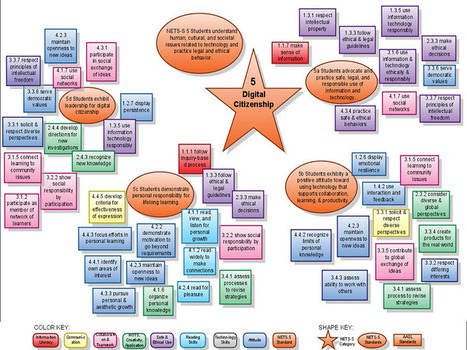
Standards For Digital Citizenship In Graphic Form | Eclectic Technology | Scoop.it

"ISTE has long had available technology standards to help promote informed use of technology by students.

These standards are broken down into 5 categories for students, teachers, administrators, coaches, and computer science educators."

Beth Dichter's insight:

For students whom are visual learners this graphical look at the ISTE standards for students and technology. Below are the six areas that are covered by ISTE :

* Creativity and Innovation

* Communication and Collaboration

* Research and Information Fluency

* Critical Thinking, Problem Solving & Decision Making

* Digital Citizenship

* Technology Operation and Concepts

As you design projects, consider how you might incorporate one or more of these skills for your students.

No comment yet.
Scooped by Beth Dichter
July 13, 2014 6:40 PM
Scoop.it!

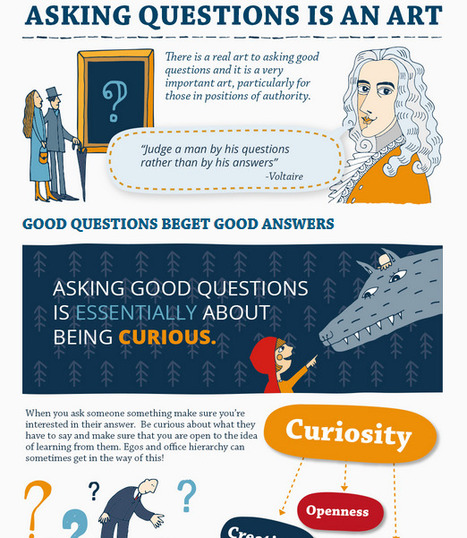
An Infographic that Explores the Art of Asking Questions

An Infographic that Explores the Art of Asking Questions | Eclectic Technology | Scoop.it
Asking the right question is more of an art form than you might imagine.
Beth Dichter's insight:

This lengthy infographic explores the The Art of Asking Questions. Areas of the infographic include:

* Wrong Question, Right Answer

* Good Questions Beget Good Answers

* The Golden Rule = No Closed Questions

* Rules were made to be Broken

   - Probe

   - Funneling

   - Specific to Broad OR Broad to Specific

* Leading Questions

There are also four images of "Thinkers on Asking Questions." You roll over the image and see what they have to say about asking questions

This is an infographic that could lead to a great classroom discussion on questioning.

No comment yet.
Scooped by Beth Dichter
July 11, 2014 9:38 PM
Scoop.it!

The Importance of Asking Questions to Promote Higher-Order Competencies

The Importance of Asking Questions to Promote Higher-Order Competencies | Eclectic Technology | Scoop.it
How to use open-ended, close-ended, and a double question technique to inspire deeper thinking in your students.
Beth Dichter's insight:

Teaching students to ask questions is not an easy task. This is the first in a series of two posts that will explore ways that teachers may ask questions to help their students "learn more from text and from the world around them." He is using the book Goldilocks and the Three Bears to model a number of strategies to use in the classroom

* Tell - Read the story or have them read the story. Ask questions that refer back to the text

* Suggest - Provide "children with choices about what might happen next or possible opinions they might have."

* Ask a closed question - "These questions generally elicit yes or no answers. They can bring students to different temporal areas or elaborations of details, but the extent of this is structured by the question."

* Ask an open ended question - questions that provide lots of options.

* The two-question rule - follow the first question with a second question allowing students to probe more deeply (and sometimes a third question).

Find examples of questions for each area listed above as well as the reasoning behind why the two-question rule is a good one to use.

No comment yet.
Scooped by Beth Dichter
July 10, 2014 8:51 PM
Scoop.it!

Best Apps and Websites Featured at ISTE

Best Apps and Websites Featured at ISTE | Eclectic Technology | Scoop.it
At the 2014 ISTE conference in Atlanta, Georgia, last week, Common Sense Media staff and Graphite Certified Educators presented a series of engaging, informative, and hands-on lightning-fast sessions. These 15-minute workshops showcased practical and engaging ways to use specific...
Beth Dichter's insight:

Are you looking for "practical and engaging ways to use specific technology tools to enhance student learning"? You might want to check out this link from graphinte (a part of Common Sense Media). There are 23 workshops that were each 15 minutes in length and covered 3 apps, games, websites or Common Sense Media resources. Below are some of the workshops.

* Best Elementary ELA Common Core Apps and Websites (also one on Math   and one on Science Apps and Websites as well as one for middle/high school in the same three areas).

* Ready for Research - Best Websites Across K-12

* Formative Assessment Tools to Rock Your World

* Digital Passport: Digital Safety Games for Kids (This is a free game from Common Sense Media that is great for students in grades 3 - 5.)

* Digital Citizenship + PBL = Cool Programs for Teens

You will find many great resources that may be of use to you during the next school year. Have fun exploring!

niftyjock's curator insight, July 15, 2014 6:07 PM

15 minute workshops, is that enough time or is it just the right amount. This review of the conference has some very good apps to try.

Scooped by Beth Dichter
July 10, 2014 3:39 PM
Scoop.it!

The Ultimate Directory Of Free Image Sources

The Ultimate Directory Of Free Image Sources | Eclectic Technology | Scoop.it
So, you need an image for your blog? We’ve spent some time categorizing our favorite sources for free images and organizing them in such a way as to help you find what you’re looking for. Here are ...
Beth Dichter's insight:

Finding great images that are free can take time. This post provides an amazing number of resources that will help you with this task. They have also included five pieces of information for each site:

* Subject - does it focus in a particular area or not

* Description

* High resolution - many images available today may be of low resolution

* License - Creative Commons, Public Domain, or specific attributions that may be required

* Safety - is this a site that is appropriate for students or may there be cause for concern

The post then splits the list into a variety of areas:
* Search Engines

* Large Crowdsourced Collections

* U.S. Government Collections

* Unique Collections, including

   -  Getty

   -  Pixabay

   - and approximately 20 more sites

* Specific Subjects

* Clip Art

You will find many great images as you explore these collections.

Gary Harwell's curator insight, July 11, 2014 12:35 AM

Well worth bookmarking.

Scooped by Beth Dichter
July 9, 2014 8:38 PM
Scoop.it!

Habits of Mind - Which Ones Should You Use?

Habits of Mind - Which Ones Should You Use? | Eclectic Technology | Scoop.it
Tools to help teachers and students apply the Habits of Mind and Thinking Routines
Beth Dichter's insight:

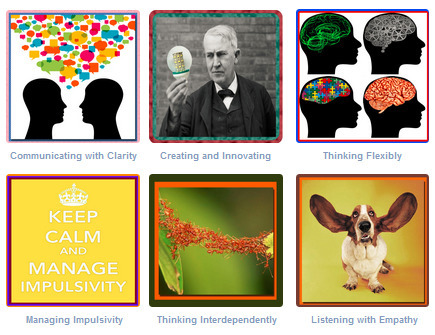
Are you using Costa and Kallick's Habits of Mind, or are you interested in learning more about them? This website provides an in-depth look at each of the sixteen habits of mind. It also looks Thinking Routines that are related to the Habits of Mind. The home page provides visuals for each of the sixteen habits of mind. When you click through to a page you will find the following sections:

* What does it mean?

* Why does it matter?

* When should you use it?

* A video that provides an example of the habit of mind

* 5 Top Strategies

* 5 Question to ask about your Thinking

* Thinking Routines

If you are new to the Habits of Mind five are listed below.

* Thinking Interdependently

* Thinking about your Thinking

* Creating and Innovating

* Using all your Senses

* Responding with Wonderment

Click through to the site to see the other habits of mind and to learn more about each.

Stacy Pickett's curator insight, August 11, 2014 2:29 PM

Interactive, linked with videos!  Students would enjoy exploring!

Scooped by Beth Dichter
July 8, 2014 9:02 PM
Scoop.it!

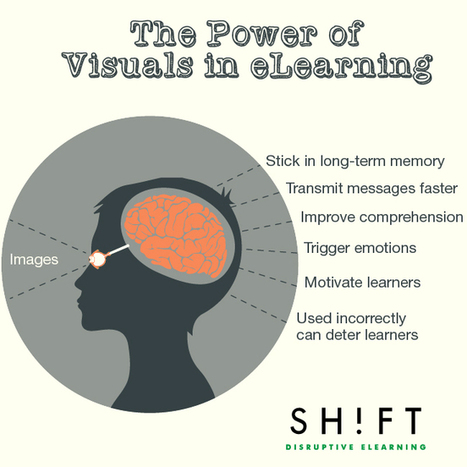
Studies Confirm the Power of Visuals in eLearning

Studies Confirm the Power of Visuals in eLearning | Eclectic Technology | Scoop.it

"We are now in the age of visual information where visual content plays a role in every part of life. As 65 percent of the population are visual learners, images are clearly key to engaging people in eLearning courses."

Beth Dichter's insight:

Visual learning is an important component of how our students learn today. Although this post focuses on eLearning, it is also an important tool to use effectively in a face2face environment. This post discusses six areas where visual make a difference, providing a number of statistics and facts.

What are the areas?

* Visuals stick in long-term memory

* Visuals transmit messages faster

* Visuals improve comprehension

* Visual cues trigger emotions

* Visuals motivate learners

* Incorrect use of visuals can also deter learners

Learn more about each of these areas by clicking through to the post.

Rosemary Tyrrell, Ed.D.'s curator insight, July 9, 2014 2:55 PM

Visual learning is an important part of learning in any platform. 

Pere Arcas's curator insight, July 14, 2014 3:55 AM

Now we need powerful visual creators of contents for education.

niftyjock's curator insight, July 15, 2014 6:19 PM

MULD

Scooped by Beth Dichter
July 7, 2014 9:32 PM
Scoop.it!

21st Century Work: Career-Readiness Isn't What It Used To Be

21st Century Work: Career-Readiness Isn't What It Used To Be | Eclectic Technology | Scoop.it

"

"The way we think about work is changing.

Thinking of jobs, careers, and pay is–by some–being replaced with the idea of work, relationships, and meaning. Technology and the resulting connectivity are a part of this. In the 21st century, we all have personal “brands”–digital footprints that precede and proceed us, leaving a record of our interactions and ideas for anyone to see."

Beth Dichter's insight:

How do we work today? What skills are needed? As we continue to move to a more global economy what are the skills that our students should have, and how do they differ from what we might call 20th century jobs?

This post begins to explore some of these questions, and provides access to a slideshare called Unlocking the Future of Work: Creating 21st Century Organizations that  are Innovative, Collaborative and Global. As you read through the slides you may find yourself questioning some of her ideas. You may also find new insights into how work is changing, which may lead you to make shifts in work you do with your students.

No comment yet.
Scooped by Beth Dichter
July 6, 2014 9:04 PM
Scoop.it!

7 Tenets of Creative Thinking

7 Tenets of Creative Thinking | Eclectic Technology | Scoop.it
Guest blogger Michael Michalko explains that everyone is an artist and that it takes belief and persistence to nurture this quality. He offers seven principles about creative thinking that he wishes he'd known as a student.
Beth Dichter's insight:

This post provides a look at seven principles of creative thinking. Each is described in some detail. Three of the principles are below (without explanations).

* You are creative

* Creative thinking is work

* You must go through the motions

If you would like to see a different version of the same seven principles you can head over to Sean Junkins twitter account and see an infographic that he put together that is based on the Edutopia article. As far as I can tell the shift he made was to create the infographic. It appears that all text is from the article (and the infographic gives credit to Sean Junkins).

Sue Alexander's curator insight, July 7, 2014 3:24 PM

Very down-to-earth approach: I like that in today's edu-buzzword cacophony.

Charlie Dare's curator insight, July 7, 2014 11:10 PM

Interesting comments by

Marshall BarnesFounder, Director of SuperScience for High School PhysicsSome of these I agree with in regard Edison and 1000 failures before finging a light filament and worthy of a read in his Paranovation blog~Especialy his claims to producing Video Rock early on~
Gary Harwell's curator insight, July 11, 2014 12:39 AM

It shoudl be our Mantra to teach Cretive Thinking skills to our students everyday.

Scooped by Beth Dichter
July 5, 2014 11:08 PM
Scoop.it!

Mocomi Offers Hundreds of Short Video Lessons for Kids

Mocomi Offers Hundreds of Short Video Lessons for Kids | Eclectic Technology | Scoop.it

"Mocomi is a nice website featuring educational and entertaining content for elementary and middle school students."

Beth Dichter's insight:

Mocomi is a website geared to elementary and middle school students. Along with videos they have a wide variety of activities in areas including the arts, civics, culture, English, environment, geography, history, science, and math. They also have an online magazine with a specific theme. The current one is called Under Water, and you can access 19 additional magazines online.

This might be a site you use with students, or one that they might explore during free time. Richard Byrne suggests that the videos "are a model of animated informational videos" and students in middle school and high school "could follow the model to create their own short videos to demonstrate their understanding of a topic."

No comment yet.