Your new post is loading...
Beth Dichter's insight:
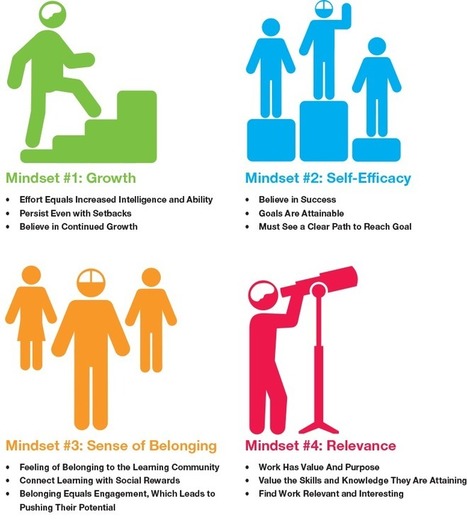
Who knew that the Growth Mindset is just one component of the Academic Mindsets? (My answer would be "not me.") Having stumbled on this post from mimio I knew I had to share it. Learn about three other mindsets that our students need to be aware of: * Self-Efficacy * Sense of Belonging * Relevance Are these mindsets you use in our classroom? How might you incorporate them? What will your students think about them? Click through to read more.
I am an adjunct faculty for several teacher education and educational technology programs. I have been so for a few decades. During that time I have noticed the changing nature of student behavio...
Beth Dichter's insight:
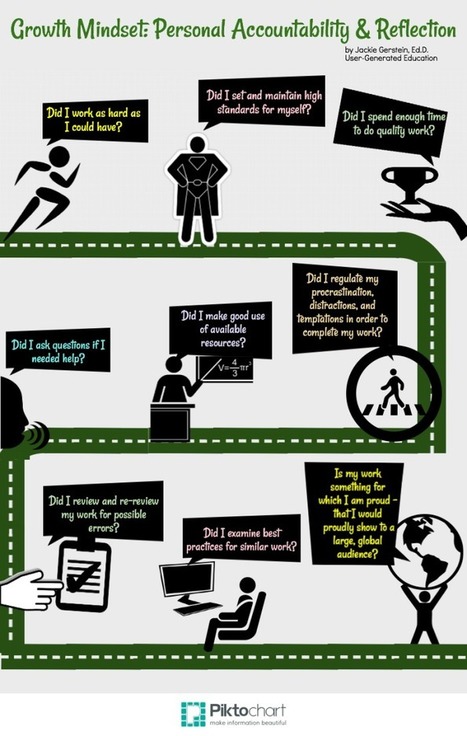
Do you discuss growth mindset with your students? Do you also discuss what a fixed mindset is? In this post Jackie Gerstein provides her insights into these areas, and also talks about the grwoth of what she defines as a "toxic mindset" where a students might think:
We are fortunate that she has also provided a "Personal Accountability and Reflection" series of questions, which is shown in the infographic above, and also listed in the post. Below are two of the questions.
These are great questions to use with your students. How do you think your students would answer them? Would they acknowledge how they are working accurately?
We've collected resources from Edutopia and the Web to help you navigate the possibilities of blended learning, an approach that combines face-to-face and technology-mediated learning, with some student control over time, path, place, or pace.
Beth Dichter's insight:
As more schools increase the number of computers available to students the possibility of blended learning is enhanced. This post will provide many great resources. They have divided blended learning into five areas: * What is Blended Learning? * Getting Started with Blended Learning * Tips. Tools and Strategies * Blended Learning in Practice * Additional Resources on the Web If you think you need to learn more about blended learning for the K-12 environment you may want to check out a course that will probably be offered through Coursera in 2015. Information about it available here. I took this course last spring and found it provided a solid base to help create a blended course. You can also check out a unit I designed on the Phases of the Moon.
"There are many reasons a student can lose focus in school. It can be bad grades that will discourage them to be inactive and to rebel. It can be the environment that can be stifling and suffocating for the students. It can be the fact that many of them don’t find it easy to the meaning in their struggles in school."
Beth Dichter's insight:
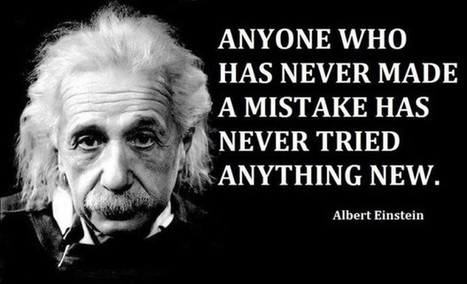
Do you have days when you wish you had a good quote to help a student who is struggling? This post provides 8 great quotes. One is above (in the image). Two more are below. Click through to the post to read an additional five quotes as well as a brief write-up that may provide you with some ideas on how to use them with students. * "I have not failed. I've just found 10,000 ways that won't work." - Thomas Edison * "Don't worry about your failures, worry about the chances you miss when you don't even try." - Jack Canfield
Sue Alexander's curator insight,
September 13, 2014 9:02 AM
It's a month into the school year, and our fresh starts are starting to fade. Time to revv up the positive vibes with these great quotes.
Beth Dichter's insight:
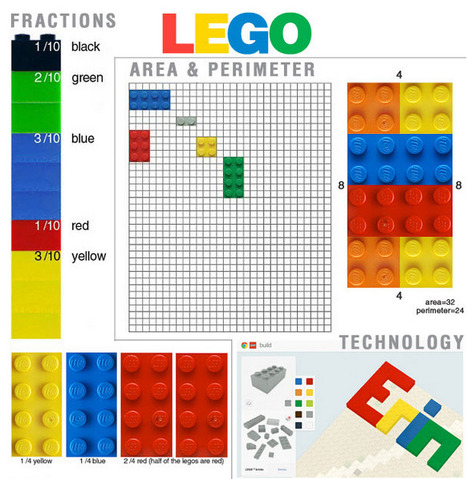
LEGOs. Math. Put the two together and you may have a winning combination. And to make it even easier check out this infographic that provides a range of ideas on how to use LEGOs in math. Make sure to scroll past the infographic. More detailed explanations are provides as well as a template to a LEGO stud dice (with additional ways to teach math with LEGOs).
Autism Daily Newscast's curator insight,
September 10, 2014 4:26 AM
Not an app but close enough - love it.
Elizabeth Bowden's curator insight,
September 12, 2014 7:52 PM
In addition to using Lego for maths, I've taken my sons (extensive) Lego collection into History and Society & Culture to have the students (high school) demonstrate their understanding of concepts such as globalisation, communism, nationalism, capitalism. Worked really well and classes sooo happy.
Having been broken up into groups and given a concept each, They created cities or environments demonstrating the concept then talked the rest of the class through.
Ness Crouch's curator insight,
September 13, 2014 4:06 PM
Fantastic ideas for using lego in mathematics. Simple hands on tasks.
Beth Dichter's insight:
Do you find yourself scratching your head wondering what some of the abbreviations your students use mean? If so, this post is for you. You will learn: * Some common abbreviations * How to read numbers and letters as words * An important abbreviation for responsible adults * Texting abbreviations for the older generation * When not to use IM speak You may find that some new information in this post, or learn that what you have been sending may not mean what you thought it did!
Maryalice Leister's curator insight,
September 9, 2014 12:22 PM
Admit it - you don't know what all the abbreviations mean, but the Field Guide is here to help!
Beth Dichter's insight:
Are you looking for ways to get your students more engaged in your classroom? This post includes some background information on student engagement including: * Five levels of student engagement that include authentic engagement and rebellion (with three in between) * Three ways to measure student engagement * Seven ways to increase student engagement (which includes a visual, part of which is shown above) This post provides a quick review on material that may be new to some, and this great visual to help you recall some ideas that you may want to try in your class.
Kathy Lynch's curator insight,
September 10, 2014 9:09 PM
Love it~ Using it tomorrow. Thx Beth Dichter
María Dolores Díaz Noguera's curator insight,
September 11, 2014 11:33 AM
Seven Ways to Increase Student Engagement in the Classroom
Mary Starry's curator insight,
September 13, 2014 9:38 PM
Great graphic that summarizes things we've all heard before, but helps keep them in mind so we really do utilize them with students.
Beth Dichter's insight:
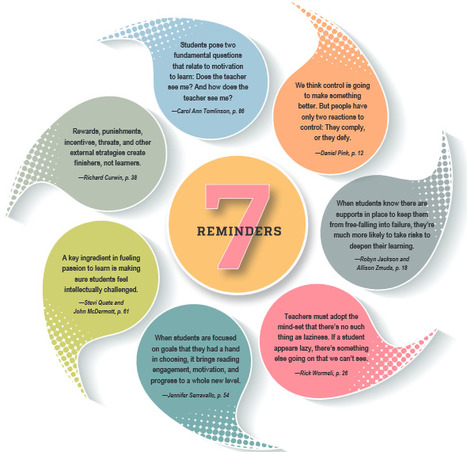
The September issue of Education Leadership focuses on motivation. The image above contains quotes from seven quotes from authors in this issue and all address motivation. There are many articles in this issue that are free to read. A few are listed below. * Motivated to Learn: A Conversation with Daniel Pink * Motivating Young Adolescents by Rick Wormeli * One to Grow On/Releasing the Will to Learn by Carol Ann Tomlinson I suspect we many of us would like to see more of our students motivated in our classes. These articles may provide some insights. Please be aware that the top link a is to the current issue. Once this has been updated a new link to the issue will posted here.
Nancy Jones's curator insight,
September 6, 2014 1:04 PM
In this edition of ASCD, I paid particular attention to Rick Wormeils article on "Motivating Young Adolescence as I begin my next 3 year relationship with 6th grade advisees. The first year in middle school is the toughest.
"Next gen tools provide meaningful ways teachers and students can explore, question, reflect and share–leading to Deeper Learning and blended and personalized opportunities for students. Here are 25 ideas for using next gen tools this year in your classroom."
Beth Dichter's insight:
Why would we want to use next gen tools in our classroom? One reason is they provide a richer experience for our students, richer content, potentially richer discussions, and more as well as the fact that these tools are often multi-disciplinary and multi-sensory. The 25 tools listed here address large parts of the curriculum as well as grade levels. Five are listed below. Click through to the post to learn more about them and twenty more. * PBS for Educators has many resources available. This post highlights three specifically: Point of View (which is geared to older students); SCI Girls (think STEM); and Daily News Story (as you probably guessed we are talking current events). * Big History Project goal is to develop a full curriculum for high school. At this point they have four key areas: the universe, or solar system and Earth, Life and Humans, with a total of seven "threshholds." * Do you want your students to publish work online? Consider checking out EduBlog, KidBlog and Blogger? Have fun exploring and teach your students (and yourself) some next gen tools!
Tony Guzman's curator insight,
September 4, 2014 9:43 AM
Some great tools to consider for your classroom.
Rosemary Tyrrell, Ed.D.'s curator insight,
September 4, 2014 4:20 PM
A useful list of top quality resources.
Due to the interest of my post The Other 21st Skills, I decided to individually discuss each of the skills or dispositions I proposed that are in addition to the seven survival skills as identified...
Beth Dichter's insight:
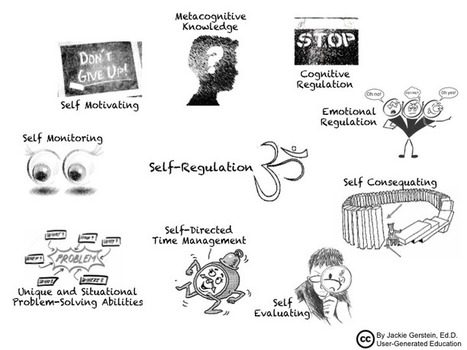
After a break Jackie Gerstein has returned with a new post that looks at self-regulation. What does Gersteing mean when she talks about self-regulation. She lists eight characteristics. Three are below. * Uses metacognitive processes * Regulates and controls emotional and cognitive processes * Manages time for one’s own benefit After providing the list of 8 characteristic she shares strategies to help students "build and expand their self-regulation skills. Providing students with "metacognitive reflective questions both pre and post activity to help students learn about self-regulation. Self-regulation has three phases, and she shares a visual about the three phases as well as clear descriptions. The post goes on to cover additional strategies and also has an excellent SlideShare on Teaching Children Self-Reguation. At the end of the post she discusses self-regulation as a 21st century skill and learning activities for young people. As always Gerstein's post are chock full of additional links. Educate yourself and teachers in your building by sharing this informative post.
"Earlier this week, Anil Dash wrote a smart piece unpacking the concept of “public.” He opens with some provocative questions about how we imagine the public, highlighting how new technologies that make heightened visibility possible. For example, Someone could make off with all your garbage that’s put out on the street, and carefully record how many used condoms or pregnancy tests or discarded pill bottles are in the trash, and then post that information up on the web along with your name and your address. There’s probably no law against it in your area. Trash on the curb is public."
Beth Dichter's insight:
Is your definition of privacy different from your students definition? Our world is changing quickly and the concept of privacy is also changing. This post by Danah Body explores this issue and will provide ideas that you may want to use with students in your classes. As this school year commences the need to understand the issue of privacy, esp. online where so much information is gathered about each of us, often without us being aware of it, is important for students to understand.
"Skoolbo – Common Core is a great new site for elementary children to help with reading and math. Skoolbo contains dedicated areas for children, parents and teachers. Children are immersed in an incredible learning world, and are highly motivated by the inbuilt reward mechanisms. Parents and teachers are equipped with an array of tools to help them achieve wonderful educational outcomes for their children."
Beth Dichter's insight:
Why should you check out Skoolbo? Because they are offering a "Forever Free" license to schools that register by Sept. 30, 2014. Skoobo is geared to elementary school (and states that they find the best results in students 8 and younger) that provides online games in the areas of numeracy and literacy. Some of the features that may be of interest include: * A "Spiral Learning Algorithm' - The first time a student uses Skoolbo they will take a test that will help place them a the appropriate level. After each game is completed the program will reassess, essentially differentiating work for each student. Teachers may also assign specific curriculum. * Students get immediate feedback and support through the program. * The program is cross platform and can be used on PC, Mac, iPad, Windows 8, Android and web browsers. * And remember, it is free (at least until Sept. 30, 2014)! So head over to Skoobo to check this out. Share it with other teachers you know in elementary school. And if you get it for your school make sure to let parents know.
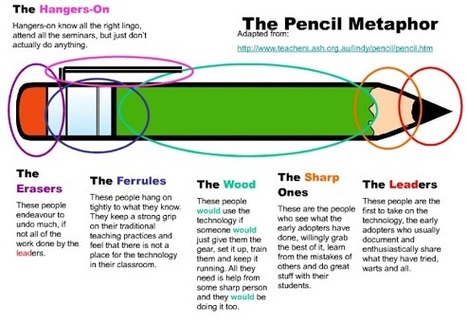
"For most educators, back-to-school decorations still include the proverbial apple, school bus, writing strips, and black and white composition notebooks... Looking back, we wanted to round up some of our favorite resources that highlight the pencil as a metaphor for leadership, work, and fun."
Beth Dichter's insight:
Perhaps you remember a few years back when the pencil became a viral hit on Twitter. Think back to the year 2011 and recall how tablets were becoming "the next best thing" in education. How was this technology going to be integrated into the school day? This post provides a number of resources that moves the pencil beyond that viral chat. You will find an image of the pencil with each component representing various groups of people often found in schools. The video, iPencil, takes a look at what actually goes into making a pencil, and will teach students about how one product impacts much of the world. And last, but not least,, is the Ode to #PencilChat, a short video that looks at technology integration in the classroom. Why look at the pencil? Here are the last two lines of this post. "Whether metaphor, symbol, or tool, the pencil is flexible, durable and timeless. We wish everyone a great school year."
Melissa Marshall's curator insight,
September 9, 2014 9:23 PM
The Pencil as a metaphor for educators and technology. I have yet to have a student ask, 'I won't do this because no-one's given me any PD.' |
Beth Dichter's insight:
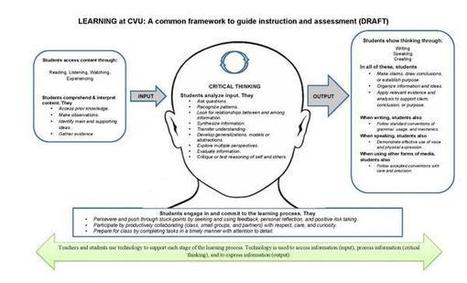
How do students learn? There are many concepts that look at this question, and the visual above in one way to view this. To the left you have a box that shows that students take in content by reading, writing, listening and experiencing, and that to comprehend and interpret content they must have prior knowledge, make observations, identify main and supporting ideas and gather evidence. In the midle section the student has to take the input and use critical thinking skills. To do this they must also be engaged in and committed to the learning process. And the final section looks at their output, how does the student show what they have learned. In all phases technology may play a role. This visual would be great to spark discussion amongst faculy.
Raquel Oliveira's curator insight,
September 23, 2014 7:21 PM
Aprendizagem requer mudanças no cérebro. Uma conversa interessante sobre pensamento critico.
Critical thinking is the study of clear and unclear thinking. A simple definition, maybe, but that's how it should be. The term was popularised long ago-
Beth Dichter's insight:
This post begins with a number of definitions for critical thinking, from the basic (as seen above) to more complex (as seen through the eyes of Common Core). It then goes on to look at: Where did the concept come from? The next section, "What does the term really mean?" provides two lists. The first list is "what we know critical thinking isn't. Below are two of the items on this list. * Simply mimicking others thinking. * Being biased towords (or against) one way of thinking. The second list, "what we know critical thinking is." This list includes: * Willingness to be wrong. * Questioning one's own thinking. The final section provides Three Rules of Thumb - one for Essays, one for Discussions and one for Tests. Below is one example from each of the Three Rules of Thumb. * Discuss the phrasing of prompts. * Highlight the mysterious. * Include the "how" and "why" in multiple choice questions. Each section of this post provides additional details.
Dyslexia affects up to 1 in 5 people, but the experience of dyslexia isn't always the same. This difficulty in processing language exists along a spectrum -- one that doesn't necessarily fit with labels like "normal" and "defective." Kelli Sandman-Hurley urges us to think again about dyslexic brain function and to celebrate the neurodiversity of the human brain.
Beth Dichter's insight:
Learn more about the brain and dyslexia in this five minute video from TED-Ed. Find out what type of teaching works best for students with dyslexia, and experience how it feels for students with dyslexia to decode words. You will also find questions you may use with students, additional resources and a forum for discussion.
"With an ever growing list of daily interactions occurring digitally, the result of small online decisions can have a huge and lasting impact. As educators, it is critical that we convey this impact to students and consider all elements of Digital Citizenship when working with them in the digital world."
Beth Dichter's insight:
Teaching students digital citizenship is not as easy as one might think.Tweens and teens often make decisions when posting online before they consider the consequences. Dr. Mike Ribble "coined the nine elements of digital citizenship" and many use it as a base to help teach these skills. The poster (shown above) may be printed out and six additional resources are provided in this post.
Nancy Jones's curator insight,
September 11, 2014 1:59 PM
This has not only an interesting graphic, but a number of links to additional resources for this very important topic.
Jo Blannin - The Know Tech Teacher's curator insight,
September 11, 2014 10:13 PM
This is a great tool for teachers. A small, printable reminder for students of their digital citizenship responsibilities. I've printed this for use at my school... what will you do with it?
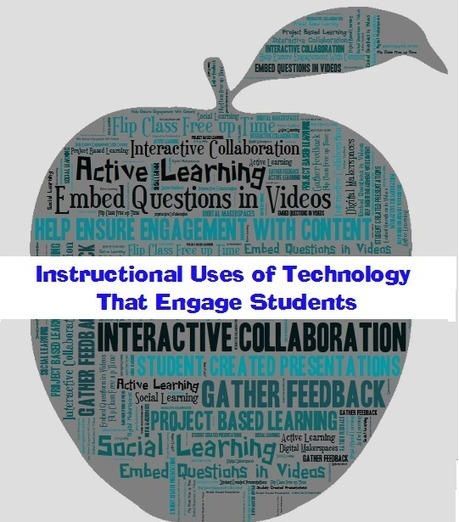
"Are you looking for ways to integration technology in your lesson plans and courses that provide for an engaging experience for you and your students? Fans of instructional technology know that it can be fun and inviting, and engaged students are far more likely to be learning."
Beth Dichter's insight:
What are the engaging techniques? Below are five. More are in the post and many have links to specific tools (many of which are free) that will help you. * Interactive Collaboration * Active Learning * Student Created Presentations * Embedding Questions in Videos * Digital Maker Spaces Learn much more by clicking though to the post.
"It just might be that in a society where information is abundant, thinking habits are more important than knowledge. Somewhere beneath wisdom and above the “things” a student knows. Laws of economics say that scarcity increases value. It’s no longer information that’s scarce, but rather meaningful response to that information. Thought. And thought has a source–a complex set of processes, background knowledge, and schema that we can, as educators think of as cognitive habits. And if they’re habits, well, that means they’re probably something we can practice at, doesn’t it?"
Beth Dichter's insight:
We want our students to demonstrate that they know how to think, to understand that they have the ability to ask questions and find answers, answers that may not be available through Google (esp. if we are asking them to research). In short, we want them to use metacognitive skills. But how do we teach them these skils? The image above, from teachthought, provides 15 questions that may help students create the habits that students need to learn. Below are three of the questions. Click through to the post for the entire list, as well as some great discussion. * Is this idea important to me? To others? Why or why not? * Is there a “part” of this new idea I can take and “pivot”? Create something new and fresh? * What real-world models–examples–relate to this that can help me understand this further? Consider posting these questions in your classroom and using them when appropriate with students.
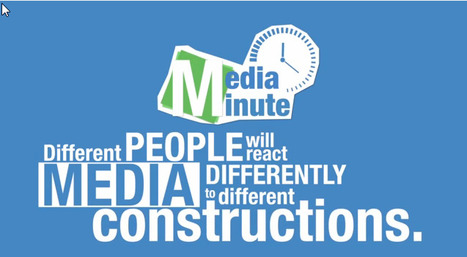
"Media educators base their teaching on key concepts of media literacy, which provide an effective foundation for examining mass media and popular culture. These key concepts act as filters that any media text has to go through in order for us to respond."
Beth Dichter's insight:
Do you teach media literacy? Do you think we should teach students in upper elementary and middle school the concepts of media literacy? Media Smarts (out of Canada) with the assistance of Companies Committed to Children, has launched a new website, Media Literacy 101. What will you find? Six short videos that will engage students as they learn about media literacy as well as lesson plans that include an overview, learning outcomes, preparation and materials, key concepts and an optional worksheet. The areas covered include: * What is media anyway * Media are constructions * Audiences negotiate media * Media have commercial impacts * Media have social and political implications * Each media has a unique aesthetic form These lessons are geared for students from about Grade 5 - 8, but make sure you review them to determine if they will work with your students. If you believe that your students need to become more media savvy this is website is worth exploring.
Antonio Andrade's curator insight,
September 6, 2014 11:54 AM
Muy buena interpretación de los contenidos sobre.....
Teacher feedback must be informative and encouraging for students to fully understand whether they're learning and what they can do to improve the learning process.
Beth Dichter's insight:
Do you know how to provide meaningful feedback to your students. This post in Edutopia provides five suggestions, all of which are included in the illustration above (located here). What are the suggestions? * Be as specific as possible * The sooner the better * Address the learner's advancement toward a goal * Present feedback carefully * Involve learners in the process Additional information on these five suggestions are in the post.
Mary Starry's curator insight,
September 14, 2014 7:38 PM
The role of immediate, meaningful feedback must also be incorporated into the active learning environment.
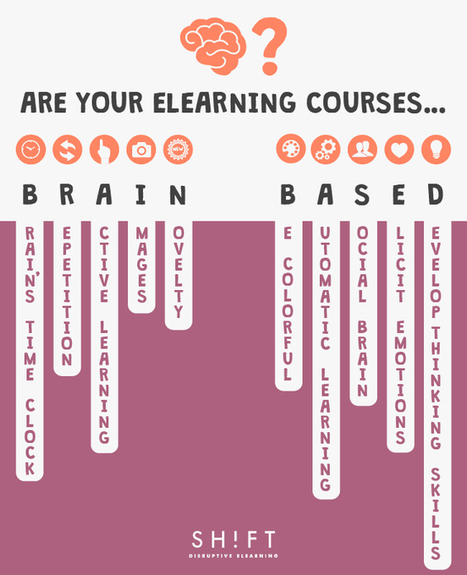
Creating brain-based eLearning courses is actually relatively easy, especially when following the acronym B.R.A.I.N. B.A.S.E.D.
Beth Dichter's insight:
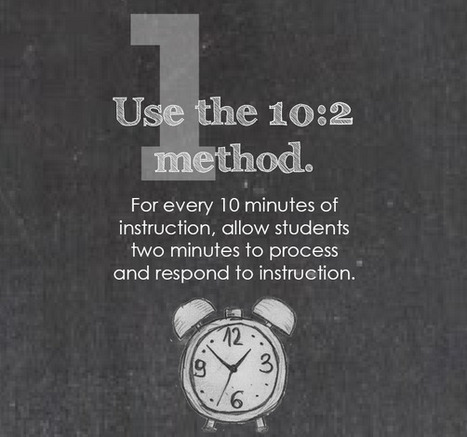
Perhaps with school starting up again, I am more aware of the number of posts that look at metacognition, and how our brains learn. This post from SH!FT provides the acronym B.R.A.I.N. B.A.S.E.D to help you remember key components of designing a course. Although the post is designed for eLearning the same concepts are also important in a face-2-face environment. Let's look at the B in brain. It stands for the "brain's time clock." How long can students engage in active learning vs. passive learning? How long can a student online stay engaged (or a student in your classroom)? For each letter there is an explanation and in most cases links to additional resources.
Rosemary Tyrrell, Ed.D.'s curator insight,
September 4, 2014 4:33 PM
Important things to think about whether designing an online or a face-to-face course.
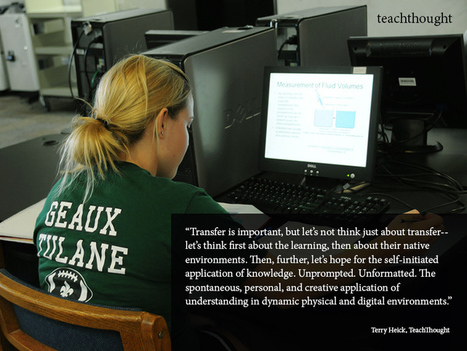
"Testing is a major challenge in education. Agreeing on what’s to be tested and how it’s to be administered is a matter of much debate. It’s also a big business... [Common Core testing may include] adaptive computer-based testing to the existing assessments forms, which in many states include short-written responses. While efforts like these continue, there remains a chasm between the progressive vision of a 21st century learning environment, and a decidedly 20th century assessment style.
Beth Dichter's insight:
If the goal in education is to graduate students whom are 21st century ready (a century we are already 14 years into) the question of appropriate testing comes up. This post explores this issue and shares what may be taking place in a classroom and how it is not necessarily testable with paper and pencil. Therefore as educators we need to "promote self-initiated transfer." The post is split into three sections. The first section looks at testing today. The second section provides "a picture of 21st century learning." The third section explores the challenge, the fact that in theory we are teaching one way and assessing a different way (and as they refer to it in the post, we may be teaching 21st century but we are using an assessment tool that is 20th century). The final section explores one possible solution. There is much to ponder on in this post which may lead you to think of ways to help students take ownership of learning how to effectively transfer knowlege.
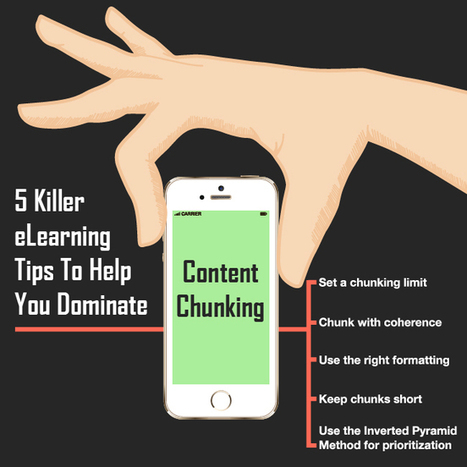
"Reading content on the Internet has changed the way people process information, and nowhere is this change more obvious than in fields where design must adapt to new technology such as in eLearning. eLearning course creators need to refine their content to suit learners’ behavior and accessibility to training. This is where chunking comes into play."
Beth Dichter's insight:
If you design a course, face2face or online, it is important to keep up with information on how people learn, and today we know that chunking information is critical. This post begins by describing what a chunk is and why they are important in learning. It them moves on to the five tips (quoted below): 1. Set a chunking limit 2. Chunk with coherance 3. Use the right formatting 4. Keep chunks short 5. Use the inverted pyramid method for for prioritization Each of these is described in detail and many addional resources are included in the post. You will also find a SlideShare on the Basics of Content Chunking. If this concept is new to you it will provide additional information. However be aware that the number of items that can be held in short term memory varies, and the rule they use is not accurate for all people. A recent course I took on Coursera, Learning How To Learn, suggested that the number of items most people can keep in short term memory is four.
Mel Riddile's curator insight,
September 2, 2014 10:16 AM
"Beth Dichter's insight: If you design a course, face2face or online, it is important to keep up with information on how people learn, and today we know that chunking information is critical. This post begins by describing what a chunk is and why they are important in learning. It them moves on to the five tips (quoted below): 1. Set a chunking limit 2. Chunk with coherance 3. Use the right formatting 4. Keep chunks short 5. Use the inverted pyramid method for for prioritization Each of these is described in detail and many addional resources are included in the post. You will also find a SlideShare on the Basics of Content Chunking. If this concept is new to you it will provide additional information. However be aware that the number of items that can be held in short term memory varies, and the rule they use is not accurate for all people. A recent course I took on Coursera, Learning How To Learn, suggested that the number of items most people can keep in short term memory is four."
There are so many different challenges that technology integration in the classroom presents teachers. From budgets to hesitant parents to broken devices and totally re-vamping your lesson plans and constantly tweaking with lots of trial and error. It can be fun, hugely rewarding, and a big giant headache, too. But just because it can be …
Beth Dichter's insight:
This post links to a video by Paul Hamilton, Technology in Education. In this 4 minute video Hamilton asks 8 questions that we may want to share with our community, be it our staff, our parents, or the broader community, to begin a dialogue that is lacking in many school districts. Three of the questions he raises are below. Take the time to click through to the post to read the other 5, and if possible find the time to watch this video. * What do we ant technology to do in schools? * Are we asking the right questions about technology, learning, and schools? * Is the way we are using technology now turning our students 'off' to the people and the world around them? |
Your new post is loading...
Thx Beth Dichter!