Eclectic Technology
230.9K views | +3 today
Eclectic Technology
Tech tools that assist all students to be independent learners & teachers to become better teachers
Curated by Beth Dichter
Your new post is loading...
Scooped by Beth Dichter
October 1, 2014 9:42 PM
Scoop.it!

Instruction That Sticks:Which Strategy Works Best?

Instruction That Sticks:Which Strategy Works Best? | Eclectic Technology | Scoop.it

"Which teaching strategy works best?" This is a question that many educators ask my colleagues at McREL. It's an earnest question, but it's a bit like walking into a gym full of workout equipment and asking a trainer, "So which exercise is best?" The answer, of course, depends on where you are in your fitness regime and what you're trying to accomplish."

Beth Dichter's insight:

Are you interested in learning more about how the brain works and how different teaching strategies may be best for specific situations? This post looks at:

* Short term memory

* Working memory

* Long term memory

The short version is that short term memory is what initially puts something in our memory, but it requires a hook of some sort. Research tells us that a positive learning environment and activities that bring on positive emotions help.

Working memory come next Information that is in short term memory must be moved quickly to working memory (or it tends to go poof!). When thinking of working memory you must also consider cognitive load.

Long term memory is the final step, but moving information from short term memory to long term memory takes time and repetition. It is best if the repetition is spaced out over time (so cramming the night before an exam is not the best way to remember information you will also need for a final exam weeks or months later).

This is great information not only for students but also for teachers (and families and friends).

No comment yet.
Scooped by Beth Dichter
September 30, 2014 10:07 PM
Scoop.it!

There's no app for good teaching

There's no app for good teaching | Eclectic Technology | Scoop.it

"Bringing technology into the classroom often winds up an awkward mash-up between the laws of Murphy and Moore: What can go wrong, will — only faster.

It’s a multi-headed challenge: Teachers need to connect with classrooms filled with distinct individuals. We all want learning to be intrinsically motivated and mindful, yet we want kids to test well and respond to bribes (er, extrinsic rewards). Meanwhile, there’s a multi-billion-dollar industry, in the US alone, hoping to sell apps and tech tools to school boards.

There’s no app for that."

Beth Dichter's insight:

There may not be apps for good teaching but there are ways to think about how you use technology that will improve the classroom. This post provides 8 recommendations. They are listed below but check out the post for additional information.

1. Keep learning goals ahead of the technology.

2. Opt for the open ended.

3. Don't let tech make learning easy.

4. Take feedback seriously.

5. Stay skeptical of individualized learning - for now.

6. Bring in students interests, authentically.

7. Start conversations

8. Make it open, make it better.

There is a lot of food for thought in this post.

Paul Nielsen's curator insight, September 30, 2014 11:03 PM

Great reminder that embedding learning in technology is not a 'revolutionary takeover' of the classroom. To my sceptical colleagues here in the UK, your jobs and traditional teaching methods are quite safe.

Scooped by Beth Dichter
September 28, 2014 5:23 PM
Scoop.it!

How Educators Can Assist Learners in Developing a Growth Mindset

How Educators Can Assist Learners in Developing a Growth Mindset | Eclectic Technology | Scoop.it
I have written, described, and presented about the growth mindset in education settings, see The Educator and the Growth Mindset The Educator with a Growth Mindset: A Staff Workshop Growth Mindset:...
Beth Dichter's insight:

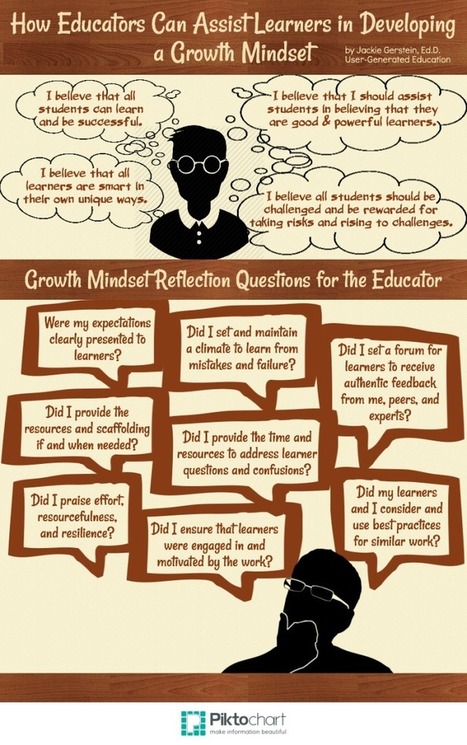
How can you, as an educator, help students develop a growth mindset? This infographic from Jackie Gerstein provides provides a  look at:

* "the common beliefs of an educator who promotes a growth mindset"

* "common beliefs of an educator who promotes a growth mindset"

She also discusses the need for a teacher to become a coach when we look at mindset, providing a link for additional information that you may find helpful, as well as links to some of here previous writings on mindset.

No comment yet.
Scooped by Beth Dichter
September 26, 2014 9:17 PM
Scoop.it!

Five Powerful Questions You Can Ask Students (Visual)

Five Powerful Questions You Can Ask Students (Visual) | Eclectic Technology | Scoop.it
Beth Dichter's insight:

This visual is based on an article published by Edutopia, 5 Powerful Questions Teachers Can Ask Students. You can access the article through the link which provides some additional information. If you read the comment section you will also find some additional resources related to questioning.

Kathy Lynch's curator insight, September 28, 2014 1:06 PM

Thx Beth Dichter!

Tony Guzman's curator insight, September 29, 2014 9:24 AM

Good list of questions to help get the student voice active in your classroom.

Frédéric Falisse's curator insight, October 10, 2014 6:51 AM

Sans questions pas de raisonnement. 

D'ailleurs, qu'est ce que la réflexion si ce n'est l'enchaînement de questions?

Et l'intelligence ne serait elle pas simplement l'enchaînement de bonne questions? 

Scooped by Beth Dichter
September 26, 2014 7:54 PM
Scoop.it!

The Daring Librarian: 10 Things to Think About Before You Post

The Daring Librarian: 10 Things to Think About Before You Post | Eclectic Technology | Scoop.it

"Over the last six years we've made some great friends with the cool people at the website Flocabulary and we love what they've been creating lately with super engaging rap songs & videos tied in with the CCSS! (Common Core State Standards)."

Beth Dichter's insight:

Flocabulary and Common Sense Media have teamed up and created a great rap that will help students understand why it is important to think about what you post and not to overshare information. If you have never explored vocabulary take the time to check out their website.

Within the post you will find a link to a page that shares the lyrics, challenge questions and a fill in the blanks form.

No comment yet.
Scooped by Beth Dichter
September 25, 2014 7:51 AM
Scoop.it!

Mazlow's needs for students using technology for learning

Mazlow's needs for students using technology for learning | Eclectic Technology | Scoop.it
Beth Dichter's insight:

Have you asked yourself how Mazlow's Hierarchy of Needs impacts your teaching of students? This table looks at the five areas and poses a question which is followed by a short answer and then shares ideas on how technology may be used to meet each need. For those whom may be new to Mazlow the five areas are below as well as the question being answered.

* Survival - What do I need to know/do to stay employed?

* Self-care - What I need to know or do to teach?

* Belonging - What do I need to know or do for students, parents and peers to think I am a good teacher?

* Esteem needs - What do I need to be a leader in technology use?

* Self-actualization - What do I need to know or do to change the world?

Mª Jesús García S.M.'s curator insight, September 26, 2014 2:01 AM

Teacher Needs

Armando's curator insight, September 26, 2014 4:59 AM

Mazlow's needs for students using technology for learning

Anna-Liisa Hayward's curator insight, September 26, 2014 5:22 AM

Interesting summary of the value of using technology in education from the point of view of learners

Scooped by Beth Dichter
September 22, 2014 10:29 PM
Scoop.it!

20 things every teacher should do | The Reflective Educator

20 things every teacher should do | The Reflective Educator | Eclectic Technology | Scoop.it
Beth Dichter's insight:

Have you considered creating a "core set of teacher practices" that you use and you think other teachers should use? David Wees had done this with this chart of 20 Things Every Teacher Should Do. Check it out and if you have items to add make sure to let him know. 

Kate JohnsonMcGregor's curator insight, September 24, 2014 3:59 PM

This is not a completely comprehensive list, however,  it is a good idea for trying to focus our priorities in a job that is so multifaceted that it is often overwhelming. I might consider reorganizing the list into action items and philosophical items, and choose one or two a week to focus on. 

Kathy Lynch's curator insight, September 26, 2014 12:23 PM

Thx Beth Dichter!

Scooped by Beth Dichter
September 21, 2014 9:51 PM
Scoop.it!

A Quick Comparison of Behaviorism, Cognitivism and Constructivism

A Quick Comparison of Behaviorism,  Cognitivism and Constructivism | Eclectic Technology | Scoop.it
Beth Dichter's insight:

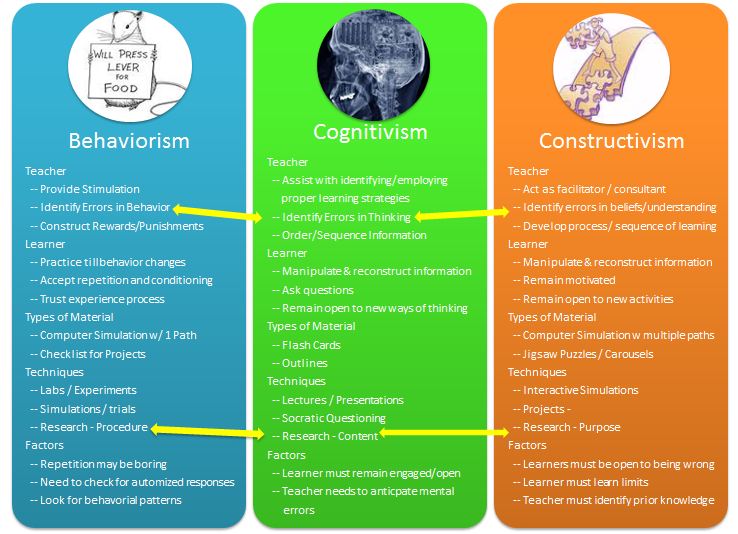
If you are interested in comparing some key components of behaviorism, cognitivism and constructivism side-by-side check out this visual. You will quickly find areas where components are similar as well as areas where ideas are more diverse.

Sharaya Baltimore's curator insight, September 20, 2016 12:29 PM

I like that it gives a comparison of behaviorism, cognitism and constructivism (even though we aren't looking at that school) and it also gives information about the teachers, learner and techniques, etc.


Susmita Dhungel's curator insight, September 14, 2017 12:03 PM

This article explains the differences between behaviorism, cognitivism, and constructivism. It shows differences in each school's teachers, learners, types of materials, techniques, and factors. 

Krystal Robles's curator insight, September 21, 2017 11:54 AM
I don't get as to why they all can share these things. The arrows indicate that the things relate to each other.
Scooped by Beth Dichter
September 20, 2014 10:02 PM
Scoop.it!

Expedition: Insects - An eBook from Smithsonian Science Education Center

Expedition: Insects - An eBook from Smithsonian Science Education Center | Eclectic Technology | Scoop.it
Beth Dichter's insight:

Check out this new eBook from the Smithsonian Science Education Center. You may download it for the iPad or Mac and it will be interactive. It is also available as a pdf. 

This book is designed for students in grades 3 - 5, introducing them to insects from a range of locations. In the interactive version you will find pictures, videos,  the sounds of the insects habitat and students may click or tap underlined words and hear definitions of the words. There is also an animated map in the interactive version. 

There is also a coloring book that you may download, and all are free!

Help students learn about why insects are beneficial, how they survive and how they impact their ecosystem.

Scooped by Beth Dichter
September 19, 2014 9:15 PM
Scoop.it!

Measuring Students’ Self-Control: A ‘Marshmallow Test’ for the Digital Age

Measuring Students’ Self-Control: A ‘Marshmallow Test’ for the Digital Age | Eclectic Technology | Scoop.it
Researchers hope that being able to accurately measure how well students resist digital temptations will help them learn about how "academic diligence" features in later life success.
Beth Dichter's insight:

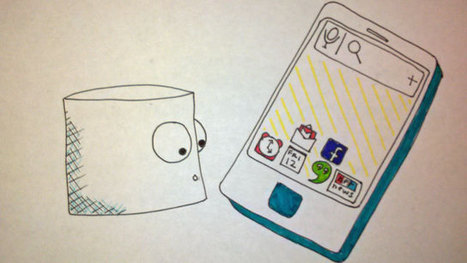
In the 1960s Stanford psychologist Walter Mischel and colleagues created an experiment, the "marshmellow test" to measure self-control in preschoolers. Would they eat one mini--marshmellow right away or would they wait 15 minutes to eat two mini-marshmellows?

Fast forward about 50 years and researchers have come up with a new "test that challenges the willpower of schoolkids to resist the brain-candy of today’s digital distractions — the YouTube videos, Instagram and mobile gaming apps like Angry Birds."

Why try to measure self-control. Researchers hope that it "will advance their studies of ways to improve academic perseverance in students."

Learn more about the original "marshmellow test" and this new test in the thought-provoking post. Additional areas that are discussed include:

* Road-testing the test

* Staying on task

* Different takes on willpower and grit

* A debate over drudgery

No comment yet.
Scooped by Beth Dichter
September 18, 2014 10:56 PM
Scoop.it!

25 Signs You Might Be A 21st Century Teacher

25 Signs You Might Be A 21st Century Teacher | Eclectic Technology | Scoop.it

"2015 is almost upon us, which means we’re somewhere between 1/6 and 1/7 of the way through the 21st century.

Which is an odd quantitative analysis, but does underscore that we’re past the point where “21st century” is an adequate label. These are odd times we live–and teach–in, the following 25 signs as proof that you’re teaching in 2015."

Beth Dichter's insight:

Check out this list of 25 ideas that might lead you to know if you are a 21st century teacher (or not). How many would you check off as a yes? What ideas do you think are missing from this list?

No comment yet.
Scooped by Beth Dichter
September 16, 2014 10:09 PM
Scoop.it!

Sesame Street: Power of Yet , Janelle Monae

"Are you thinking that maybe you want to be an astronaut, or an author, or a scientist or a doctor? That's great! And maybe you're not quite up to speed on the centrifugal force of the moon or how many bones are in your arms, but if you believe in yourself, you'll get there. That's the power of yet. You might not be ready for outer space yet, but just work hard and keep your eye on the prize and you'll get to where you want to be!"

Beth Dichter's insight:

I was not aware that Sesame Street had videos that looked at social-emotional learning until I stumbled on this one that looks at the power of the word yet. Although designed for younger children I suspect many middle and high school students would be engaged (since many watched Sesame Street as youngsters). This could be useful if you work with students on growth mindset and fixed mindset. 

No comment yet.
Scooped by Beth Dichter
September 15, 2014 10:18 PM
Scoop.it!

Power of Optics | auひかり - YouTube

Beth Dichter's insight:

I am fan of Rube Goldberg machines and this one is different than any I have seen online. It uses light to power the machine. It is short, only two minutes and it would be a great introduction to hook kids on optics.

No comment yet.
Scooped by Beth Dichter
September 30, 2014 10:30 PM
Scoop.it!

The Intersection of Growth Mindsets and Maker Education

The Intersection of Growth Mindsets and Maker Education | Eclectic Technology | Scoop.it
I have a recent interest in both Growth Mindsets and Maker Education; and have blogged and presented on both of these topics.  As such and because of my passion for both of these area, I have been ...
Beth Dichter's insight:

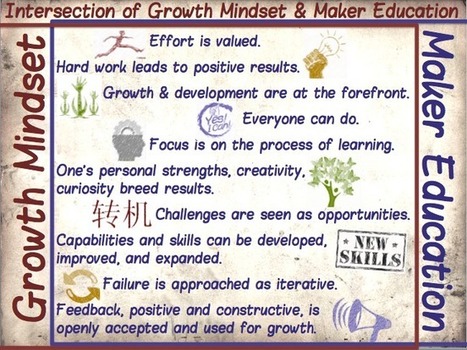
Where does growth mindset and maker education meet? Jackie Gerstein had created a great visual (see above) that looks at areas where both of these concepts come together.

Would you agree that valuing effort is a part of growth mindset and maker education? How about failure being approached as interactive?

Learn more about these intersections on two resources listed in this post and click through for a larger version of the image above or for a typed copy of the list.

ManufacturingStories's curator insight, October 4, 2014 3:44 PM

For more resources on STEM Education visit http://bit.ly/1640Tbl

Scooped by Beth Dichter
September 29, 2014 6:37 PM
Scoop.it!

Maslow and Student Motivation

Maslow and Student Motivation | Eclectic Technology | Scoop.it
There is no such thing as an unmotivated student. All students are motivated by something in school. The problem is that they might not be motivated by the things you'd like them to be motivated by...
Beth Dichter's insight:

Another question that has one looking at Maslow's Hierarchy of Needs, this time with the primary question geared to students: Why do students try in school?

Below are the five areas and what may be motivating the student.

* Survival - "I am in danger here or at home. I'm motivated by fear (intrinsic)."

* Self-care - "I'm motivated to stay afloat and avoid more work (extrinsic).

* Belonging - "I'm motivated by friends, family, and parents (extrinsic).

* Esteem - "I'm motivated because it makes me feel good about myself (both).

* Self-actualization - "I'm motivated in school because its important work (intrinsic)."

In each of the five areas you will find four to six statements that provide more depth to the statement.

Tony Meehan's curator insight, September 30, 2014 2:40 AM

Very interesting table linking Maslow to levels of student motivation

Scooped by Beth Dichter
September 27, 2014 7:50 PM
Scoop.it!

Can Project-Based Learning Close Gaps in Science Education?

Can Project-Based Learning Close Gaps in Science Education? | Eclectic Technology | Scoop.it
An encouraging new report describes preliminary, first-year outcomes from a study of 3,000 middle school students that shows kids can, in fact, learn more in science classrooms that adopt a well-designed, project-focused curriculum.
Beth Dichter's insight:

Would project-based learning be a more effective way for middle school students to learn science? According to this post the answer is ye, based on one year of data.

Project-based learning incorporates many of the "super skills" that we want students to have:

* The ability to communicate thoughts, ideas, questions and solutions.

* The ability to work together to reach a goal, using their talents, expertise, and more (collaboration).

* Looking at problems in new ways and linking learning across curriculum (critical thinking).

* Trying new approaches to get things done; innovating and inventing (creativity).

The post also explores some of the issues that may impact a schools ability to utilize project-based learning, including the cost of each unit and the training of teachers.


Kathy Lynch's curator insight, September 28, 2014 1:04 PM

Thx Beth Dichter! Great study on implementing Project- Based Learning 

Ruby Day's curator insight, September 28, 2014 4:40 PM

Interesting that in this study project based learning raised achievement across a diverse range of students. This approach seems to work for student groups with diverse backgrounds.

Scooped by Beth Dichter
September 26, 2014 8:44 PM
Scoop.it!

Differentiated Instruction & Adaptive Learning (Infographic)

Differentiated Instruction & Adaptive Learning (Infographic) | Eclectic Technology | Scoop.it

"Differentiated instruction, the tailoring of educational experiences to meet individual learner needs, is nothing new. Hardworking teachers have always recognized the diverse needs of students and adjusted their instruction to account for them..."

Beth Dichter's insight:

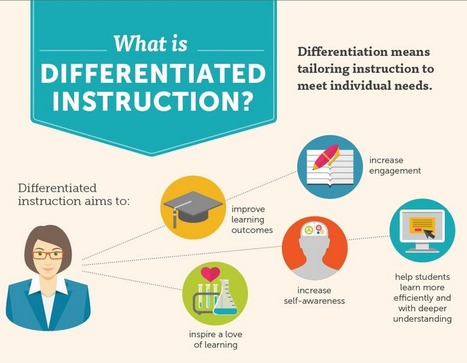
This infographic (from Knewton) provides an overview of differentiation. It is divided into the following sections.

* What is differentiated instruction?

* Why differentiated instruction?

* Differentiated instruction in schools

* Differentiated instruction at scale

Learning how to differentiate instruction effectively is not always easy, but it is a skill that we need to learn. This infographic provides an overview that may be helpful for you as a teacher, and it might be a good way to introduce parents to this concept if it is new to them.

Shradha Kanwar's curator insight, October 9, 2014 5:18 AM

differentiated instruction is an imperative to maximise the learning experience

Scooped by Beth Dichter
September 25, 2014 9:08 PM
Scoop.it!

Epic! presents a gift for educators: a free single subscription to its' iPad app

Epic! presents a gift for educators: a free single subscription to its' iPad app | Eclectic Technology | Scoop.it

"This week Epic! offered classroom teachers and school librarians in the U.S. and Canada free, forever, single subscription access to its iPad app, an “ever-growing library of high-quality children’s books from some of the world’s best publishers.” Epic! calls itself the first “All-You-Can-Read” eBook service for kids.  It currently offers thousands of digital titles from 40 publishing partners, including HarperCollins, Simon & Schuster, National Geographic, Kids Can Press, Blue Apple Books."

Beth Dichter's insight:

Check out this amazing offer from Epic!, a free single subscription for educators and librarians, to their library of great children's books.

In the post Joyce Valenza shares more information about the the books you may access, which include books for children 4 and under, up to age 12. She also shares the principle goal of the founders for their organization.

Lisa Norris's curator insight, September 26, 2014 10:30 PM

Don't miss this opportunity!

Scooped by Beth Dichter
September 23, 2014 10:44 PM
Scoop.it!

CK-12 Simulations

CK-12 Simulations | Eclectic Technology | Scoop.it
Beth Dichter's insight:

CK-12, a website that provides free materials for educators and students across grade levels. This link goes to a new series of physics simulations. However, if you work with students and are interested in finding great free resources that include video, text, audio, images, quizzes and interactives then it is worth your time to explore CK-12. 

No comment yet.
Scooped by Beth Dichter
September 22, 2014 10:22 PM
Scoop.it!

Animaker, Make Animated Explainers for free

Animaker, Make Animated Explainers for free | Eclectic Technology | Scoop.it
Animaker.com is a cloud-based do-it-yourself (#DIY) video making app that is bringing studio quality professional animation tools within reach of everyone.
Beth Dichter's insight:

Animaker is a new DIY video making tool that has many great features. You can check out their website and sign up to get an account (although it may take a few weeks). Compared to many of the other tools out that allow you to create animations, Animaker is more robust, providing more features for you to explore. Check it out and have fun creating animations for your students (or have your students create animations for you).

Kathy Lynch's curator insight, September 23, 2014 7:54 PM

Thx Beth Dichter! Sounds Like fun

Kathy Lynch's curator insight, September 26, 2014 1:30 PM

Thx Beth Dichter! 

AffiliateMarketHelp's curator insight, October 5, 2014 11:30 PM

Am anxiously awaiting for a response from them; I want this tool!  A cloud-based, easy to use animated video making app...drag 'n drop!  Although not out yet, I have signed up for it.....more exciting than Iphone 6!!!!!

Scooped by Beth Dichter
September 20, 2014 10:16 PM
Scoop.it!

Students As Creators: How To Drive Your Students To Be More Than Just Consumers

Students As Creators: How To Drive Your Students To Be More Than Just Consumers | Eclectic Technology | Scoop.it
One trend we are going to see in education that hasn't received much discussion yet is the shift from students as consumers to students as creators. This
Beth Dichter's insight:

Today many of our students are consumers, yet Common Core would like them to be more creative. What can we do as teachers to help our students become more creative? 

This post begins with an exploration of research that has taken place in this area. Below is one quote from the post.

“Understanding, identifying, and nurturing the creative potential is relevant in education if we want students able to solve academic and personal problems and challenges, to find innovative solutions and alternatives, and to have better tools and resources for success in a fast-changing world...”
The post provides 15 suggestions that you might want to incorporate into your classroom. Three are below. Click through to the post to find all fifteen plus additional information.

* Begin and end each class period with a creation. 

* Require students to create products for other students.

* Welcome mistakes

Lisa Norris's curator insight, September 21, 2014 8:26 PM

Love this one!

Affirmation-the inquiry process (which includes creativity and so many other HOT skills) is so important even for our youngest learners.  It's so important they work through the process and create something to show their learning at the end!  It may be a challenge, but the risk is worth it!


Let's not forget...Creativity=important leadership quality!

Scooped by Beth Dichter
September 19, 2014 9:40 PM
Scoop.it!

Brains Get a Performance Boost From Believing Effort Trumps Genetics

Brains Get a Performance Boost From Believing Effort Trumps Genetics | Eclectic Technology | Scoop.it

"How much of our intelligence is a genetic gift or the product of hard work is difficult, perhaps impossible, to know for sure. But for our brains to perform their best, new research suggests, it’s better to believe that effort trumps heredity."

Beth Dichter's insight:

As teachers many of believe it is important to teach students about growth mindset. This research provides additional information about the value of doing this. Quoting the last paragraph from this article in Time:

"The takeaway: How we’re predisposed to think about problems changes the way our brains handle them. Beyond the abilities we’ve inherited, the most important factor in achievement may be believing that it’s within reach."

If you are interested in more information on growth mindset search for the term in this Scoop.it. There are quite a few articles and videos that are appropriate to share with students.

Scooped by Beth Dichter
September 19, 2014 8:48 PM
Scoop.it!

Do Parents Know What Questions to Ask You (Don’t Forget Cognitive Skills!)

Do Parents Know What Questions to Ask You (Don’t Forget Cognitive Skills!) | Eclectic Technology | Scoop.it
How can you be sure that you are prepared to help your child get the most from this school year? Getting the answers to these questions can help.
Beth Dichter's insight:

What if you read this post and think of it as 10 answers you will provide to parents when they come in for a teacher conference? Parents may not know the best questions to ask, and this is one way to educate them. What are the questions. Three are below, The rest may be found in the post.

* Student Feedback & Support - How do you like to provide feedback to students? Are there any interventions to help children who need a little extra attention? When are you available if my child needs extra help? 

* Cognitive Skills – How would you say my child is doing, as compared to peers, in these areas: 

     Memory: How well does my child learn and remember new information? Does he or she require more or less support than peers? How easily is information retained?

No comment yet.
Scooped by Beth Dichter
September 18, 2014 10:37 PM
Scoop.it!

When Students Get Creative With Tech Tools, Teachers Focus on Skills

When Students Get Creative With Tech Tools, Teachers Focus on Skills | Eclectic Technology | Scoop.it
Teachers find the most success integrating technology into the classroom when they have clear instructional goals.
Beth Dichter's insight:

How many times have you watched a PowerPoint slide show that had lots of flash, but little content? All too often teachers may try to design a lesson around a specific tool, rather than focusing on the skills we want our students to gain, and then finding a tool that will provide the opportunity for the skills to come forth.

This post shares information:

* Look past the flash

* Present an objective, not a recipe

* Let them figure it out

* Encourage collaboration

Within the post you will also find suggestions from some teachers as well as some additional links.

No comment yet.
Scooped by Beth Dichter
September 16, 2014 8:30 PM
Scoop.it!

Inside the Brain of a Struggling Reader | Infographic | Scientific Learning

Inside the Brain of a Struggling Reader | Infographic | Scientific Learning | Eclectic Technology | Scoop.it
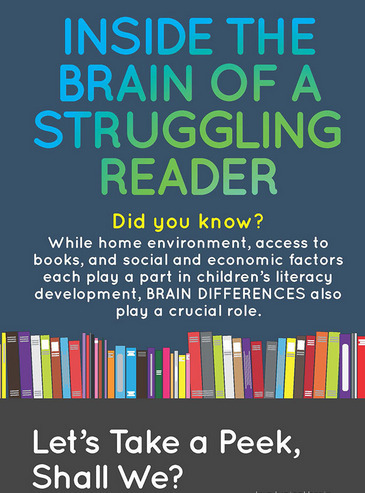
When a student struggles to read, we look to factors such as socioeconomic status or access to books. But brain differences are also part of the equation and should not be overlooked.
Beth Dichter's insight:

This infographic looks at the brain and how we learn. As more is learned about the brain it is clear that education is not a one-size-fits all.

* Learn how the occipital lobe, Wernicke's area, Broca's area and auditory processing impacts reading. 

* Read three examples that show brain plasticity (the ability of the brain to change over time).

* And find out how struggling readers can be helped at a neurological level.

Some additional resources are also included.

We have many students who struggle with reading. This infographic provides information that you may want to share with parents.