AbstractMassive Open Online Courses (MOOCs) allow students to study online courses without requiring previous experience or qualifications. This offers students the freedom to study a wide variety of topics, freed from the curriculum of a degree programme for example; however, it also poses a challenge for students in terms of making connections between individual courses. This paper examines the subjects which students at one MOOC platform (Coursera) choose to study. It uses a social network analysis based approach to create a network graph of co-studied subjects. The resulting network demonstrates a good deal of overlap between different disciplinary areas. Communities are identified within the graph and characterised. The results suggests that MOOC students may not be seeking to replicate degree-style courses in one specialist area, which may have implications for the future moves toward ‘MOOCs for credit’.
Teaching and learning excellence did not exist, because no one measured it.
Thankfully, the epoch of unconscious teaching and learning has passed, and Teaching and Learning is now established as a bona fide hyperarticulated discipline with its own floor space, Web presence, and vigilantly guarded photocopier. We at the CTL spread excellence by steering faculty away from their focus on content (who, after all, needs to know the dates of the Civil War?) toward a more universal design model, in which knowledge-delivery systems are systematically delivered.
"Crystal Renfro and Mary Axford, co-authors of the blog Academic PKM (http://academicpkm.org) presented a panel at the 2014 Computers in Libraries conference on how their interest in personal knowledge management and productivity helped in their outreach services to faculty and students."
Via Profdoc
This resource focuses on how schools can use open source to continue to offer great lessons to students without the high price tag of similar proprietary products..
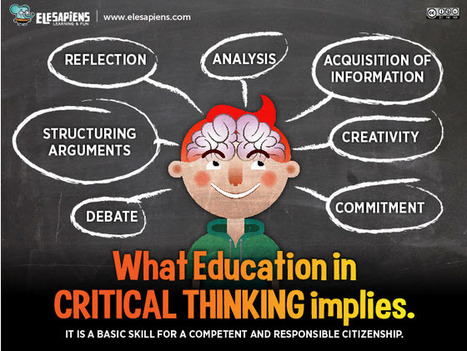
"Critical thought is a cognitive process that proposes the systematic analysis of information, opinion and statements that we accept in our daily life as valid or true. It is a basic skill for a competent, free and responsible citizen."
I would add: Trans-disciplinary thinking; systems thinking for sustainability. Most people can not see the forest through the trees so miss the larger connections of the impacts that action, goods & services have on both environmental systems and human systems.
Have you ever wondered about motivation and what motivates us to learn? Kathleen Cushman presented in our Personalize Learning Webinar Series on Tues. January 21st by explaining that you start by drawing a straight line between...
> what young people tell us about their learning experiences;
> your own practice as educators and;
> compelling scientific research into mind, brain, and education.
It is important to hear from the learners how they are stimulated to absorb information. The earlier this is encouraged the greater the brain power, audrey@homeschoolsource.co.uk
Learn How To Make Students Better Online Researchers. Getting kids to really focus on what exactly they are searching for, and then be able to further distill idea into a few key specific search terms is a skill that we must teach students.
Planning the map inside your head is the most important task of a man. Without a plan a person is just a clueless wanderer. And into the vast oceans of information a wanderer is just bound to be lost. Map in your mind, what is research all about, what are the key points and what you hope to achieve as the conclusion of this research and does your information smoothly flows proving towards your conclusion? This makes the job of searching easier.
A website to support Reflection in Education K-16 The following technologies can support reflection: web logs (‘blogs’) as reflective journals, wikis as collaborative websites, digital storytelling/podcasting, Twitter and social networks.
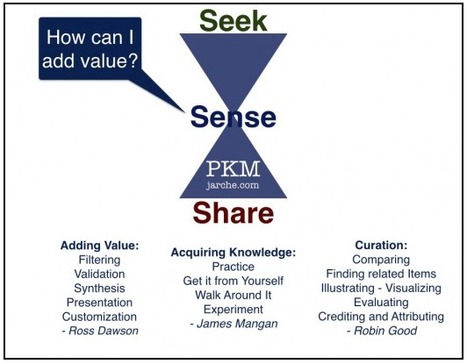
SyReach Notes now offers a full coverage of personal KM needs: Seek with integrated watch module and search engines, Sense with note and article edition, linking and knowledge building. Share by email or publish to Scoop.it selected resources linked to your articles!
"Education sprouts in many forms depending on how you look at it. Our views of what it should look like and how it should materialize depend on our value of it and our experience with it...
Take a tour of 50 different views of education that somehow find a similar note: Education must change."
The views of education are diverse and this post presents 50 views. So what are they? Below are five of the fifty. You may find it necessary to head over to the post to learn just what the name means.
* From the Ground Up (think Sir Ken Robinson)
* Talking Education (think TedEd and YouTube)
* School in the Clouds
* Competency Based Education
* Disrupting Innovation
Click through to learn more about these five plus 45 more. Each entry provides a link for additional information.
Codecademy is an education company. But not one in the way you might think. We're committed to building the best learning experience inside and out, making Codecademy the best place for our team to learn, teach, and create the online learning experience of the future.
Education is old. The current public school system in the US dates back to the 19th century and wasn't designed to scale the way it has. Lots of companies are working to "disrupt" education by changing the way things work in the classroom and by bringing the classroom online.
We're not one of those companies. We are rethinking education from the bottom up. The web has rethought nearly everything - commerce, social networking, healthcare, and more. We are building the education the world needs - the first truly net native education. We take more cues from Facebook and Zynga in creating an engaging educational experience than we do from the classroom.
We do not want to open up universities. We want to open up knowledge. Everyone knows something they can teach someone else and we want to help them do it. Our community has created tens of thousands of courses and taken millions of courses. At this point, more than a billion lines of code have been submitted to Codecademy.
Education is broken. Come help us build the education the world deserves.
In this module, The IRIS Center walks you through the five steps to create a learning environment that challenges and engages all learners.
"This module examines the three principles of Universal Design for Learning (UDL) and discusses how to apply these principles to the four curricular components (i.e., goals, instructional materials, instructional methods, and assessments)."
What are the best websites that help children learn? This list covers a variety of tools and resources geared toward preparing your child for greatness.
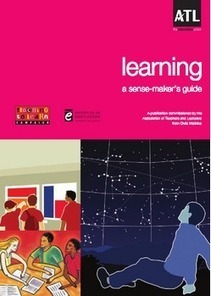
Learning can make sense and is similar to how we make sense of other things. This post is about a free article from Chris Watkins, a reader at The Institute of Education in London wrote "Learning: a sense-makers guide" that provides four teaching practices that help learners make sense of their learning.
In this fourth post in a series about comprehensive student assessment, I’m taking on the subject of resilience and how it is we can both teach and assess students in this area. I’ve been arguing
At the beginning of this month, I decided that I was going to take a different approach to New Years Resolutions. After much consideration, it simply started to make more sense to plan on taking specific actions that would lead to achieving objectives, rather than to plan open-endedly on reaching vague goals.
Muy de acuerdo con los puntos que aporta Ally Greer para una "aproximación" positiva a los buenos deseos y resoluciones que a finales o principio de año se suelen hacer, desarrollar (adquirir) nuevos hábitos y facilitar las acciones necesarias hasta integrarlos.
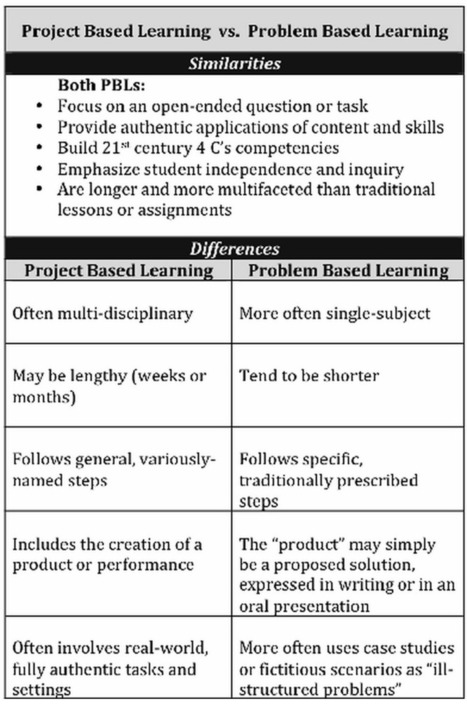
Project based learning and problem based learning are two didactic approaches to learning that are often used interchangeably to refer to the same thing: engaging students in authentic learning activities. This truism does not always hold true. In a learning task that is problem based, the focus is on finding solutions to the problem posed through applying learned strategies and in so doing the process of arriving at the solution is, in and of itself, an integral part of the overall learning taking place . Whether a learning activity is authentic or not does not really matter from a problem based learning perspective because often times 'fictitious scenarios' are purposefully designed to provide learners with a contrived environment to work on their ill-structured problems.
2014 is the year for Personalized Learning to take center stage in national and international discussions. The buzz is out. Yet, the information around personalized learning is still confusing. This new year will be the year that defines the term where we focus on the learner first.
What personalized learning is and how it can be optimized. Now that learning is available to "the masses", what is preventing "the masses" from taking advantage of learning opportunities?
"Education sprouts in many forms depending on how you look at it. Our views of what it should look like and how it should materialize depend on our value of it and our experience with it."
It took a life-threatening condition to jolt chemistry teacher Ramsey Musallam out of ten years of "pseudo-teaching" to understand the true role of the educa...
“What does achievement look like?” The question lingers as does the pedagogical implications of how to create it in my classroom and because of the weight of this question constantly pressuring my consciousness, the need to excel as an educator continuous bubbles forcing me to reflect further on my part in that process.
Codecademy is an education company. But not one in the way you might think. We're committed to building the best learning experience inside and out, making Codecademy the best place for our team to learn, teach, and create the online learning experience of the future.
Education is old. The current public school system in the US dates back to the 19th century and wasn't designed to scale the way it has. Lots of companies are working to "disrupt" education by changing the way things work in the classroom and by bringing the classroom online.
We're not one of those companies. We are rethinking education from the bottom up. The web has rethought nearly everything - commerce, social networking, healthcare, and more. We are building the education the world needs - the first truly net native education. We take more cues from Facebook and Zynga in creating an engaging educational experience than we do from the classroom.
We do not want to open up universities. We want to open up knowledge. Everyone knows something they can teach someone else and we want to help them do it. Our community has created tens of thousands of courses and taken millions of courses. At this point, more than a billion lines of code have been submitted to Codecademy.
Education is broken. Come help us build the education the world deserves.
To get content containing either thought or leadership enter:
To get content containing both thought and leadership enter:
To get content containing the expression thought leadership enter:
You can enter several keywords and you can refine them whenever you want. Our suggestion engine uses more signals but entering a few keywords here will rapidly give you great content to curate.


 Your new post is loading...