Your new post is loading...

|
Scooped by
Beeyond
December 17, 8:21 AM
|
We are trying to operate technology companies using ideas formed decades ago. Decision-making is optimized for control planning and predictability, and incentives are optimized for avoiding error. Those ideas once protected critical infrastructure, but in 2025, they slowed learning and blocked accountability.
I am increasingly convinced that no technical fix will work unless culture changes first. New platforms, new vendors, new architectures all fail when the underlying behavior stays the same. Culture is not a side issue; It is the constraint that shapes every outcome.
|
|
Scooped by
Beeyond
December 16, 10:41 AM
|
5G was always a strange creature. Not because the technology itself was weak, but because the story told to the market and the standard's structure evolved in opposite directions. On stage, 5G was presented as a civilizational leap. Driverless cars coordinating at intersections. Surgeons operating remotely with haptic feedback. Smart cities orchestrating traffic, energy, and safety in real time. Factories running lights out with autonomous robots connected wirelessly. The message conveyed in 2019 was existential: the promise was not faster mobile internet but a new system for society.
|
|
Scooped by
Beeyond
December 12, 12:53 AM
|
For the last twenty years, the Telco industry behaved like a controlled ecosystem in which one species dominated most of the investment, energy, and attention: radio. The G cycles were our Triassic, Jurassic, and Cretaceous. 3G, then 4G, then 5G—each presented as a new epoch, each delivering meaningful improvements, but none altering the underlying organism. More antennas, more mid-band, higher-order MIMO, better silicon, better spectral efficiency, yet the same radio architecture adapting within the same ecological niche. Approximately 70% of operator capex was allocated to radio networks, and approximately 60% of operator opex was related to radio performance, energy, and maintenance. What sustained dinosaurs' dominance for so long were stable environmental conditions. In telecom, the equivalent was data traffic.
|
|
Scooped by
Beeyond
December 10, 7:31 AM
|
- Orange et Bouygues Telecom conservent les tarifs les plus élevés du marché, avec des prix moyens supérieurs à 21 €, misant sur la qualité de service et la fidélisation de leurs abonnés
- SFR reste dans une gamme similaire, autour de 20,28 €, tandis que Free et Sosh se positionnent légèrement en dessous, autour de 16 €, pour conserver leur attractivité sans basculer dans le low-cost
- À l’inverse, les MVNO comme Lebara, YouPrice, NRJ Mobile ou Prixtel affichent des prix très compétitifs, souvent sous la barre des 10 €. Ces acteurs misent sur la simplicité et l’absence de services superflus pour proposer les forfaits les plus abordables du marché, tout en s’appuyant sur les réseaux des grands opérateurs.
|
|
Scooped by
Beeyond
December 7, 1:47 PM
|
In a mobile ad hoc network (MANET), communication is wireless and nodes can move independently. Properly analyzing the functional correctness, performance, and security of MANET protocols is a challenging task. A wide range of formal specification and analysis techniques have been employed in the analysis of MANET protocols. This survey presents an overview of rigorous formal analysis techniques and their applications, with a focus on MANET routing protocols. Next to functional correctness, also real-time properties and security are considered. Moreover, an overview is given of formal frameworks that target MANETs specifically, as well as mobility models that underlie performance analyses of MANET protocols. The aim is to give a comprehensive and coherent overview of this rather scattered field, in which a variety of rigorous formal methods have been applied to analyze different aspects of a wide range of MANET protocols.
|
|
Scooped by
Beeyond
December 6, 11:31 AM
|
The next decade forces telecom to abandon human centric assumptions and design a network that can support continuous inference, real time robotics and machine generated traffic at global scale.
|
|
Scooped by
Beeyond
December 6, 10:53 AM
|
L’économie collaborative a révolutionné le modèle économique actuel. En quoi consiste-t-elle et quels sont ses avantages pour notre société ? Zoom sur quelques exemples de plateformes collaboratives.
|
|
Scooped by
Beeyond
December 4, 5:00 AM
|
Why Telcos Are Spending Billions on Transformation, Only to Feed the Ghost of Yesterday... The industry is not just underperforming; it is actively using its massive capital expenditure to service the maintenance and complexity of its own past, leading to a permanent state of diminishing returns. The key challenge we are facing is that the problem is not the telco’s technology stack; it is the telco’s DNA.
|
|
Scooped by
Beeyond
November 30, 4:20 PM
|
Flying ad-hoc networks (FANETs) consist of multiple unmanned aerial vehicles (UAVs) that rely on multi-hop routes for communication. These routes are particularly susceptible to grey hole attacks, necessitating swift and accurate defence to preserve the network’s quality of service. Grey hole attacks are a type of denial-of-service attack where malicious nodes selectively drop packets, disrupting the normal flow of data in the network. This paper introduces and motivates a novel dataset, FAN-GHETS24, designed for the fast classification of various grey hole attacks.
|
|
Scooped by
Beeyond
November 30, 8:46 AM
|
A direct look at the hidden assumptions shaping telco strategy and the truths buried beneath them
|
|
Scooped by
Beeyond
November 24, 8:09 AM
|
Chaque mois, plus de 56 millions de Français se connectent. Mais quels sites dominent vraiment nos journées ? Et surtout : comment notre usage change-t-il avec la montée des applis, de la santé en ligne et de l’IA ? Voici la radiographie complète du web français en octobre 2025.
|
|
Scooped by
Beeyond
November 23, 7:27 AM
|
Most analysts don’t understand Nokia and Ericsson. That’s because they’ve never had to. These two companies are not just vendors; they’re survivors. One started as a telegraph repair shop, the other as a paper mill. A century and a half later, they’re still here, writing the code, engineering the chips, and building the networks that keep the world connected.
They’ve outlasted wars, pandemics, economic collapses, and political extremes such as communism, socialism, capitalism, and fascism. Fads came and went. These two didn’t. They evolved. Quietly, relentlessly, in labs and field trials. Through thousands of patents, research breakthroughs, and engineering standards. They’re not just part of the telecom industry; they are its foundation. You’re reading this on a device that almost certainly relies on its IP.
|
|
Scooped by
Beeyond
November 18, 11:26 AM
|
Every week, I collect private confessions from telco CXOs. This time, I pulled together fifteen short stories. Small moments that expose the truths our industry keeps quiet. Real voices. Real pressure. Real mistakes. Real opportunities. A clearer picture of telco emerges one confession at a time. A collection of honest reflections from the people who actually run networks and see the industry from the inside every day.
|
|
|
Scooped by
Beeyond
December 17, 5:38 AM
|
Une étude de l’Ifop pour l’association Cop1 montre que de nombreux étudiants peinent à boucler leur budget et renoncent parfois à se chauffer, faute de moyens.
|
|
Scooped by
Beeyond
December 15, 8:06 AM
|
The historical telecom model assumes one SIM per person, one plan per device, and a user-initiated data flow. That assumption is collapsing. The next generation of network consumers will not be humans, but machines with agency: AI agents, humanoid robots, driverless vehicles, autonomous drones, synthetic software agents, and transactional copilots.
This is not IoT. These are not static “dumb” sensors or telemetry endpoints. They are intelligent systems, hardware-based or software-based, that make decisions, initiate interactions, and consume services on behalf of a human or an enterprise. They operate continuously, transact in real time, and function independently of human attention.
|
|
Scooped by
Beeyond
December 11, 4:27 PM
|
On se jette, allô ? S’il est impossible de trouver un téléphone portable 100% écologique et éthique, certains produits sont meilleurs que d’autres. Éco-conception, réparabilité, reconditionnement… Vert vous aide à faire le tri pour choisir le smartphone le moins problématique, écologiquement et socialement.
|
|
Scooped by
Beeyond
December 9, 1:10 PM
|
In Star Wars, Order 66 erased the Jedi from within. In telecom, the legacy operator model is being decommissioned by its own internal logic. Between 2025 and 2030, telcos will streamline operations, retire legacy systems, reduce headcount, and refactor their digital and physical stacks. This is not a cost-cutting exercise but a structural reset.
|
|
Scooped by
Beeyond
December 7, 1:41 PM
|
OpenMANET is an open-source project for building Raspberry Pi–based MANET radios on Wi-Fi HaLow (915 MHz) using Morse Micro chipsets. A MANET (Mobile Ad-Hoc Network) is a self-forming wireless mesh where each node connects directly without centralized infrastructure. This technology is especially useful in the civilian space for search and rescue, disaster response, airsoft events, and any disconnected communications scenario. Designed to be budget-friendly with excellent long-range performance. The build is designed to integrate with ATAK over multicast, but works equally well over standard IP and internet links.
|
|
Scooped by
Beeyond
December 6, 10:59 AM
|
La consommation collaborative ou participative se définit communément comme la manière traditionnelle de partager, d'échanger, de prêter, de louer et d'offrir, repensée à la faveur de la technologie moderne et des communautés.
|
|
Scooped by
Beeyond
December 5, 7:12 AM
|
Many operators today support 500-2,000 plan variants in billing and provisioning. I have seen Telcos with more than 2,000. The visible retail catalogue may show 50 options. Still, the internal configuration space is an uncontrolled forest of legacy plans, micro bundles, expired promotions, seasonal offers, roaming packs, device finance combinations, and regional conditions.
The internal narrative is always the same: We have a plan for every need. That is the wrong story. If you have one thousand plans, you do not understand your segments. You are shooting in the dark. Quantity replaces insight.
|
|
Scooped by
Beeyond
December 4, 4:35 AM
|
Elf Labs has signed a $3.5 million development deal with CompaxDigital to launch Elf Mobile—the first wireless service built around iconic character IP and immersive family entertainment. Powered by T-Mobile’s network, the service will blend 5G connectivity with immersive original content and branded experiences inspired by beloved classics like Snow White, Pinocchio, and Peter Pan.
|
|
Scooped by
Beeyond
November 30, 4:18 PM
|
The project uses LoRa, a long-range, low-power radio technology, to create a mobile ad hoc network, or MANET. These radios connect directly to each other without relying on cell towers or Wi-Fi. The researchers built a smartphone app that links to the radios through Bluetooth, allowing civilians to send messages and share location data using familiar tools on their phones.
|
|
Scooped by
Beeyond
November 30, 8:44 AM
|
Americans are hanging onto their smartphones for much longer than they did a decade ago, but new releases like Apple’s iPhone 17 can entice consumers to upgrade. Businesses tend to hang onto their devices even longer than individual consumers, especially overseas. While it may seem to be a smart money move, it can result in a costly productivity and innovation lag for the economy.
|
|
Scooped by
Beeyond
November 23, 9:12 AM
|
Les nouvelles conditions d’utilisation mettent en évidence l’instauration d’une nouvelle licence beaucoup plus restrictive. Celle-ci introduit une licence perpétuelle et irrévocable sur tous les éléments proposés par les utilisateurs sur la plateforme. Chaque bout de code uploadé chez Arduino devient non pas Open Source mais propriété de Qualcomm. Une surveillance complète de toutes les fonctions employées avec l’IA, ce qui signifie que tout élément intéressant pour Qualcomm pourra être récupéré par leurs soins.
|
|
Scooped by
Beeyond
November 20, 8:11 AM
|
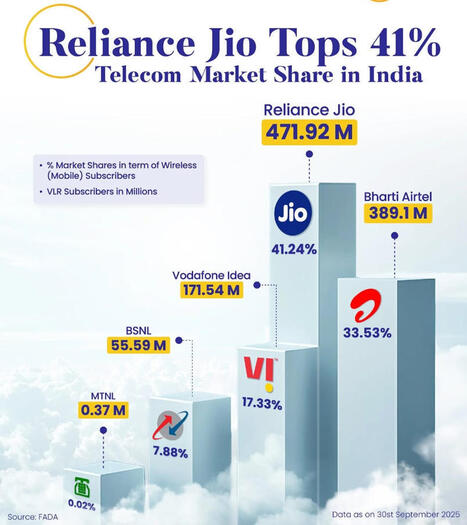
India’s telecom market behaves like a digital continent. It carries volumes that rival entire regions, yet it runs on the lowest revenue per user among major economies. Two operators deliver world-class network performance at a national scale, one operator remains structurally distressed, and a state player anchors policy goals. This mix of extreme usage, thin margins, and relentless investment pressure creates a system that is both remarkable and unstable.
|