Your new post is loading...

|
Scooped by
Beeyond
February 20, 9:01 AM
|
Telco network exposure is the right move. Aduna shows what that looks like in practice. Structured as a joint venture between Ericsson and a group of leading global operators, and built on CAMARA standards, it aggregates network APIs so developers can integrate once and reach multiple networks. In the US, AT&T, Verizon, and T-Mobile are aligned. In recent interviews, Vonage CEO Niklas Heuveldop has been candid: authentication and fraud APIs such as SIM Swap and Number Verification are now generating revenues in the tens of millions.
That proves demand is real, even if it remains marginal at telco scale. The industry narrative has matured from headline projections to a more grounded ambition: building the first $100 billion over time.
|
|
Scooped by
Beeyond
February 18, 8:14 AM
|
I love Barcelona, and I love MWC. The people, the energy, the late dinners after Hall 3, the chance to meet half the industry in four days. It is the one week where telecom feels like the center of the world. But like any great city, there are tourist traps. And in 2026, many of them will have AI written in big bold letters. Some will be real innovations. Many will be light integrations, LLM wrappers, and marketing upgrades. I wrote this guide so you can skip the noise, avoid wasting time, and focus on the AI that actually moves cost curves, energy profiles, and revenue.
|
|
Scooped by
Beeyond
February 16, 10:49 AM
|
In early February, more than $285 billion in software market value was lost in a single session following the release of enterprise agents by Anthropic and OpenAI. Within days, cumulative losses across SaaS names crossed $1 trillion. The IGV Software Index fell roughly 30% from its late September peak. Forward earnings multiples compressed from around 39x to near 21x in a matter of months. Short sellers reportedly generated more than $20 billion in profits in 2026 positioning against legacy SaaS.
|
|
Scooped by
Beeyond
February 14, 12:07 PM
|
Quantum internet is approaching faster than many expected. At the same time, the world still runs on classical encryption that quantum computers are projected to break within the next decade.
Enterprises, governments, and consumer networks rely on cryptographic foundations that will not withstand a quantum computer with cryptographic relevance. Post-quantum standards were finalized in 2024, and regulators have begun setting migration timelines. The transition is an infrastructure upgrade that must start now.
Telcos sit at the center of this shift.
They move the world’s data and operate the physical networks where quantum security will be deployed. According to STL Partners, 35 operators are already active across 75 quantum-related projects, from pilots to commercial launches.
Telco Momentum is building, and yet the risk is familiar: Telcos can either shape the quantum internet and own the trust layer, or remain passive transport providers while others capture the value. As quantum capabilities move closer to the network, the strategic choice cannot be deferred.
|
|
Scooped by
Beeyond
February 13, 7:42 AM
|
Then in February 2026, T-Mobile US launched something unexpectedly bold: Live Translation, a network-integrated, real-time voice translation service available to postpaid customers in beta. During a live call, you dial a short code and translation activates instantly across more than 50 languages. No app, no special device. It works on VoLTE, VoNR, and VoWiFi, even when calling a landline, and only one party needs to be on T-Mobile. Speech flows, AI translates, the conversation continues.
Simple, Useful, and technically elegant.
But translation is the tip of the iceberg for Telcos. AI is now integrated directly into the carrier's voice path within the network. That means the call is no longer just transport; it becomes programmable. Once intelligence sits in the media stream, fraud detection, voice biometrics, compliance monitoring, contextual agents, and transaction controls become possible at scale. This is the beginning of something much larger, and now the question is whether operators will have the courage to build on it.
|
|
Scooped by
Beeyond
February 12, 9:59 AM
|
#dotdot - Frictionless Wireless Connectivity for Incremental Revenue Generation. Extend network reach, enable opportunistic connectivity, and unlock new revenue streams — without deploying new infrastructure.
|
|
Scooped by
Beeyond
February 11, 9:01 AM
|
If spectrum, coverage, and throughput have become hygiene factors in mature markets, the overlooked variable is latency. It is rarely marketed, rarely priced directly, and often summarized as an average statistic. Yet it is the only performance dimension tightly constrained by physics and physical topology. That constraint creates a structural advantage.
Latency is determined by three elements that cannot be abstracted away by software alone: signal propagation distance, radio scheduling delay, and queuing under load. Optical fiber introduces roughly 5 microseconds per kilometer. A 150 km round trip adds around 1.5 milliseconds before switching and processing. Radio access introduces additional delay based on scheduling intervals, retransmissions, and contention. Under congestion, queuing increases tail latency and jitter even if average throughput remains high.
|
|
Scooped by
Beeyond
February 10, 5:13 AM
|
Six years ago, edge computing reached peak hype. The 5G architecture allowed telcos to decouple the user plane and place traffic breakout close to enterprises, improving the performance of mission-critical applications. Hyperscaler partnerships spread fast, pilots multiplied, and edge was framed as the next monetization layer beyond connectivity.
By 2022, the momentum collapsed. Only about 7% of operators had deployed edge, revenues stayed marginal, and value flowed elsewhere. But the economics are shifting. AI inference volumes are growing fast, data movement costs are rising, and regulations are hardening. These forces began redefining both the role of edge and the role of telcos within it.
|
|
Scooped by
Beeyond
February 9, 8:12 AM
|
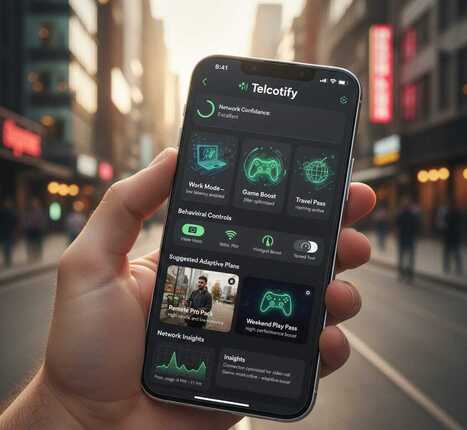
ARPU is central to telco management. It signals the perceived strength of the subscriber base and drives a long chain of decisions, segmentation, plan design, pricing, promotions, and value-added services. In many operators, target ARPU effectively becomes the strategy. The flaw sits in causality: ARPU aggregates past behavior into a single number. It explains what has already happened and offers limited insight into why users behave as they do.
There is an alternative way to operate a consumer-scale platform. Spotify measures ARPU, but does not manage the business around it. Global Premium ARPU remains around 4.5 USD per month, while engagement and margins expanded. Spotify uses behavior-driven control metrics, including time spent in the app, sessions per day, algorithmic discovery share, skip rates, and playlist reuse. More than 30% of listening comes from recommendations, and average daily usage exceeds two hours.
Monetization follows habit, but Telcos often invert that logic.
|
|
Scooped by
Beeyond
February 6, 11:14 AM
|
While selling private LTE and 5G networks, I visited an automotive manufacturing plant. The COO stopped the line and told me that one minute of downtime costs US$30,000 to US$40,000. Their production depends on synchronized robotics, AGVs, and real-time quality inspection running over an on-site private network. When connectivity is lost, even briefly, the line desynchronizes, and restarting can take minutes. The business impact is immediate and measurable.
That is why selling private networks was easy; The ROI conversation was trivial, but the problem was the economics. In 2026, the market counted 6,500 private networks globally with a total value of only US$2.5 billion, or roughly US$350,000 per network per year. For infrastructure that protects tens of millions in industrial value, telecom connectivity captures almost nothing. Private networks clearly work. Telecom business models do not.
|
|
Scooped by
Beeyond
February 5, 1:36 PM
|
The tech world rarely does “middle ground,” and this week’s clash over the future of the cloud is no exception. Following SpaceX’s massive FCC filing to deploy up to one million satellites as orbital AI data centers, AWS CEO Matt Garman immediately countered, labeling the plan “far from reality” and economically unfeasible. The internet has since fractured into two camps: those convinced we are witnessing a Kardashev-scale breakthrough and those certain it’s a multi-billion-dollar engineering hallucination.
Stripping away the fanboy rhetoric and corporate posturing, we need to examine the cold variables that remain: physics, economics, and infrastructure bottlenecks. This debate isn’t actually about whether space is “better” than Earth; it’s about whether the terrestrial grid is finally reaching its breaking point and if the vacuum of space offers a viable, albeit brutal, escape hatch for the next phase of AI.
|
|
Scooped by
Beeyond
February 3, 12:45 PM
|
On January 30, 2026, SpaceX filed with the Federal Communications Commission for authorization to operate up to one million satellites described as orbital AI data centers. The number dominated coverage, but the underlying driver received less attention.
Global data centers consumed about 460 terawatt hours of electricity in 2024. Multiple forecasts from IEA and industry analysts converge between 1,200 and 1,700 terawatt hours by the mid-2030s, driven primarily by AI workloads. In Northern Virginia, the world's largest data center market, grid interconnection queues exceed 40 months. In Ireland and the Netherlands, permission for new campuses has already been frozen or delayed due to power and water constraints. Cooling now represents a larger share of capital expenditure growth than servers.
|
|
Scooped by
Beeyond
February 1, 5:06 PM
|
Fixed Mobile Convergence was supposed to be the big unlock a decade ago. One bill, one box, one operator for everything: mobile, broadband, TV, Wi-Fi. It looked clean on paper: quad-play bundles, shared devices, and seamless handoffs from mobile to home Wi-Fi. But it didn’t work. The networks weren’t ready. OSS and billing systems couldn’t talk to each other. Routers were dumb. The phone might drop your call the moment you step out the front door. And the commercial pitch? Mostly discounts. Operators traded ARPU for volume and still experienced churn. By 2015, FMC had disappeared from most boardroom decks.
That’s changed.
In 2026, FMC is back, and this time it’s not about packaging but all about ambient connectivity, churn reduction, escaping saturation, and focus on ARPA.
Mobile growth is flat. Everyone already has a phone. What carriers want now is to own the household. If you take the U.S. as a clear example, there are 130 million broadband-connected homes, each with three to five mobile devices, TVs, speakers, tablets, and laptops. Whoever controls the fixed line controls the entire digital stack inside the house.
|
|
|
Scooped by
Beeyond
February 19, 10:19 AM
|
AI has forced a fundamental question inside the Radio Access Network: what kind of compute should power 6G? For decades, the answer was obvious: Purpose-built silicon optimized for deterministic signal processing wins on power, cost, and reliability. Now that assumption is under direct scrutiny. NVIDIA class-accelerated compute is entering the baseband conversation, and two European vendors with more than a century of survival behind them are taking opposite paths.
Ericsson is doubling down on custom ASIC and energy-efficient Layer 1 acceleration. Nokia is aligning its future baseband roadmap with Nvidia accelerated platforms and positioning RAN as a distributed AI compute fabric. This is not a minor branding disagreement; RAN accounts for roughly 60% of Ericsson's revenue and about 40% of Nokia's. A wrong architectural bet in the 6G cycle could be fatal. But also, the final RAN Vision will also shape margins, market share, and long-term relevance.
|
|
Scooped by
Beeyond
February 17, 11:01 AM
|
Between 2010 and 2020, IoT was positioned as telecom’s next growth engine. Forecasts projected tens of billions of devices, recurring revenues, and deep enterprise integration. The volume materialized, but the value did not.
By the end of 2025, global IoT connections reached roughly 21 billion, according to IoT Analytics. Cellular IoT alone accounts for approximately 4.5 billion connections and is projected to reach 8 billion by 2031, according to the Ericsson Mobility Report. On paper, scale exists. IoT connections are projected to double by 2031, but most growth comes from short-range technologies rather than cellular.
However, the economics of this business tell a different story. Cellular IoT ARPU in many markets ranges from $1 to $5 per device per month for NB-IoT and LTE-M deployments. Even broadband IoT modules, such as LTE Cat 1, operate at narrow connectivity margins. Compare that to satellite IoT, where legacy plans often range from 40 to 70 dollars per device per month. Volume versus premium.
|
|
Scooped by
Beeyond
February 15, 11:21 AM
|
If you follow the US telecom market closely, there is little need for scripted drama elsewhere. In Q3, the three kings were still marching in different directions. Verizon was focused on yield discipline and cultural reset. AT&T was executing a fiber-led convergence model with almost mechanical consistency. T-Mobile was scaling fixed wireless and pushing growth into every open flank. Three doctrines, three tempos, three interpretations of where value would come from next.
By Q4 and full year 2025, something shifted. The divergence narrowed.
All three are now targeting the same asset: the American home. Not as a side product, but as the strategic control point of the account. Home broadband increases wallet share per household, reduces mobile churn through bundling, and raises switching costs by embedding connectivity deeper into daily life. Fiber passings, fixed wireless scale, and even satellite backstop coverage are now tools for the same objective: own the household relationship, and the rest of the revenue stack follows.
|
|
Scooped by
Beeyond
February 13, 7:43 AM
|
Le lancement commercial des services 5G, amorcé dans certaines régions dès octobre 2022, a rapidement pris de l’ampleur. Les opérateurs majeurs – Bharti Airtel et Reliance Jio – se sont lancés dans une course effrénée, chacun revendiquant déjà 50 millions d’abonnés après seulement douze mois. La concurrence s’est ensuite intensifiée avec l’arrivée progressive de Vodafone Idea, notamment dans plusieurs grandes villes dès 2025.
|
|
Scooped by
Beeyond
February 12, 2:16 PM
|
Le groupe français, dont le siège social est basé dans les Bouches-du-Rhône, veut contribuer à faire émerger ces start-up à forte croissance, absentes du secteur de la construction.
|
|
Scooped by
Beeyond
February 12, 7:59 AM
|
A massive shift is unfolding in consumer behavior. Children grow up speaking to machines as naturally as to parents. Young adults outsource decisions to AI systems that summarize, compare, and recommend in seconds. Attention no longer flows in long sessions but in rapid microbursts shaped by short-form media. Identity is fluid, fragmented across platforms and contexts. Trust is no longer assumed; it is verified, questioned, filtered. These trends are converging into a new cognitive baseline.
From that baseline, a new telco consumer is emerging. Not an iteration of the early smartphone user, but a different behavioral archetype. The previous generation adapted to apps and digital interfaces; this next generation expects frictionless voice interaction, machine-mediated choices, instant activation, and continuous connectivity as invisible infrastructure. Generation Alpha will enter the market already shaped by AI, not discovering it. The industry still designs for a browsing, plan-comparing customer, and that customer is disappearing.
|
|
Scooped by
Beeyond
February 11, 5:54 AM
|
Sur le front de l’internet fixe, l’évolution des tarifs continue de susciter l’attention. D’après les données du baromètre de février de Ariase, le prix moyen d’une box fibre d’entrée de gamme atteint désormais 27,27 € par mois en France. Ce montant témoigne d’un équilibre fragile : si la baisse sur un an (-0,4 %) est marginale, la hausse mensuelle récente (+1,9 %) illustre une tendance inflationniste certes discrète mais persistante. En toile de fond, chaque opérateur ajuste prudemment ses tarifs sans provoquer de rupture brutale sur le marché.
|
|
Scooped by
Beeyond
February 9, 8:13 AM
|
6–7, matcha latte, two-second attention span, Ramen lovers, five hours a day inside mobile apps, visual-first communication, loyal but always ready to change, perfectly fine consuming and creating AI-generated content.
That is the generation telcos are struggling to understand. This is Gen Z. Born roughly between the late 1990s and the late 2000s, they are the first generation to have grown up entirely within algorithmic systems. No memory of life before smartphones. No novelty around connectivity. Always on, always available, always assumed. Their expectations were shaped by feeds that adapt in real time, services that anticipate intent, and tools that integrate creation, consumption, and monetization into a single flow. They experience technology as an environment. And that difference is what makes them so hard for telcos to read, price, and serve using models designed for an earlier era.
|
|
Scooped by
Beeyond
February 9, 4:34 AM
|
Super Bowl LX is not just the biggest sporting event in the world. It is the most extreme connectivity experiment ever deployed in a single venue. More than 35 terabytes of in-venue traffic are expected to be generated by roughly 70,000 spectators, each acting as a live content producer. This load is not driven by messaging or browsing, but by uplink-intensive behavior: high-definition video uploads, multi-angle replays, immersive applications, real-time social sharing, and continuous background streaming.
To meet that demand, Levi’s Stadium is running the most ultra-dense stack that combines mmWave, mid-band 5G, Wi-Fi 7, private 5G networks, network slicing, satellite-backed mobile cells, and real-time AI-driven optimization. That is why Super Bowl LX has become the place where Verizon, AT&T, T-Mobile, Ericsson, and Nokia show everything they have. It is a full-stack stress test of the future network. Let us break it down layer by layer.
|
|
Scooped by
Beeyond
February 5, 1:40 PM
|
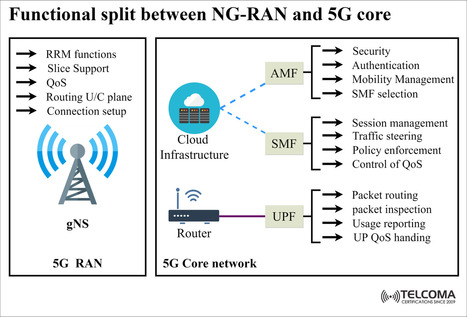
The functional split between NG-RAN and 5G Core is a dramatic difference over prior generations. With the decoupling of the radio access function from the core network functions, 5G provides unlimited flexibility, operational efficiency, and service agility in the deployment of various services.
This separation plays the critical role in low-latency (URLLC) applications, massive IoT applications, and high speed eMBB applications.
|
|
Scooped by
Beeyond
February 4, 8:55 AM
|
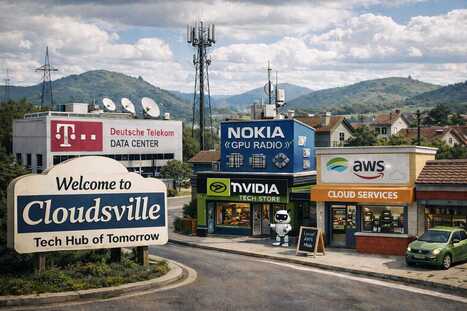
Deutsche Telekom announced that its sovereign public cloud inside Germany will match core hyperscaler features by 2026, backed by a €1 billion NVIDIA-powered AI data center designed to host industrial and regulated workloads. In parallel, Nokia is integrating GPU-based AI inference directly into the radio access network, pushing compute from centralized data centers into live mobile networks. At the same time, hyperscalers are expanding across multiple regions, zones, metro deployments, and sovereign stacks, bringing cloud execution closer to enterprises and machines rather than keeping everything centralized.
Against that backdrop, global AI spending is approaching $2.52 trillion, with roughly 60% directed to infrastructure. Power, data centers, cooling, fiber, and silicon dominate the spend, not models or applications. This resembles previous infrastructure cycles in which capacity was built before demand clarity. Cloud is not reversing direction; it is expanding with the use of AI. As execution becomes more local and physical, local networks and infrastructure operations move back to the center of the AI economy.
|
|
Scooped by
Beeyond
February 2, 9:42 AM
|
The AI value chain economics at this stage is focused on infrastructure. AI value creation is concentrated upstream, where capital intensity is highest and scale advantages compound most rapidly. The market rewards balance sheets, not clever prompts. Training and inference workloads demand dense compute, high-bandwidth memory, optical interconnects, and ample power. Those inputs scale poorly for small players and extremely well for incumbents.
Gartner frames 2026 as the Trough of Disillusionment. Enterprises prioritize predictable ROI over experimentation. AI gets sold by incumbent vendors and bundled into existing contracts rather than procured as standalone moonshots. That behavior reinforces concentration. Buyers choose suppliers already embedded in their infrastructure stack.
|