Companies like Wirepas are creating new ways for people to find practical applications for IoT technology. Gartner Research has projected that there will be 14.2 billion connected things by the end of this year. It expects that number to reach 25 billion by 2021. As more things are connected to IoT, the issue becomes how to use – and process – the data. Wirepas Mesh is already helping companies put IoT to practical use. Springwise has spotted other innovators delivering practical benefits for IoT, like startup Ripe.io's use of blockchain and IoT to improve food transparency.
Vehicular ad hoc networks (VANETs) have been quite a hot research area in the last few years. Due to their unique characteristics such as high dynamic topology and predictable mobility, VANETs attract so much attention to both academia and industry. In this survey paper, I provide an overview of the credential management of VANETs from my perspective. This paper starts with introducing what is VANET, its architecture, some of its features and uses. It also introduces the basics of security and access management in VANET. But mainly it focuses on the credential management for vehicular ad-hoc networks. The challenges and issues faced by it and lastly my thoughts on how it can be interpreted with respect to our course.
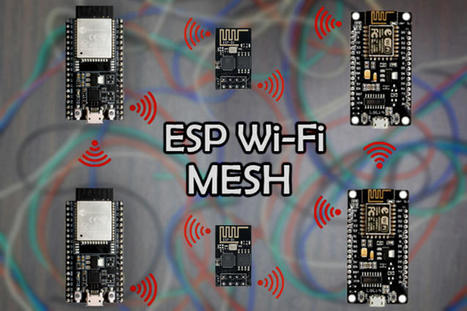
In this video, we are going to make a simple ESP Mesh network setup that consists of four ESP devices that will communicate with each other with the help of a Wi-Fi Mesh Network. And finally, we are going to connect a single esp to our laptop in order to get data from all the four sensors on the network. Note that we will be using both the ESP32 and ESP8266 boards in this tutorial so that you can create an ESP8266 Mesh network or ESP32 Mesh network using the same method.
During the event, Viasat showed its NetAgility Virtual and Mobile Software Defined Networking (SDN) bonding router delivering advanced multi-path networking transmission and management capabilities over a variety of tactical communication links in a number of U.S. Army Medical Command (MEDCOM) and Operational Virtual Health (OVH) situations. Tactical communication technologies leveraged included SATCOM, LTE and multiple Line of Sight tactical radios. Viasat’s technology supported Situational Awareness (SA) and Intelligence, Surveillance and Reconnaissance (ISR) applications with optimized network video capture to:
Connected Autonomous Vehicles (CAVs) share a high volume of data and specific information by accessing a digital infrastructure that includes public internet access. With different devices, vehicles can connect and share data from onboard sensors and road infrastructure. This sharing of data, inclusive of personal data, ends up making vehicles more vulnerable to cyber attacks.
Mobile Ad Hoc Network or MANET is a group of mobile devices, e.g., laptops, mobile phones, radios, or sensors that communicate with each other wirelessly — standard Wi-Fi, cellular, local RF network, etc.—and provides the needed network functionality without an existing fixed structure. They can change locations and reconfigure themselves while doing so. MANETs can be restricted to a local group of wireless devices or they can be connected to the Internet. A VANET (Vehicular Ad Hoc Network) is a MANET that lets vehicles communicate with roadside equipment. Even if the vehicles do not have an Internet connection, the wireless roadside equipment may be connected to the Internet, therefore allowing the vehicles' data to be conveyed over the Internet.
In this paper, we quantitatively investigate the impacts of node selfishness caused by energy depletion in MANETs in terms of packet loss rate, round-trip delay, and throughput. We conducted extensive measurements on a proper simulation platform incorporating an OMNeT++ and INET Framework. Our experimental results quantitatively indicate the impact of node selfishness on the network performance in MANETs. The results also imply that it is important to evaluate the impact of node selfishness by jointly considering selfish nodes’ mobility models, densities, proportions, and combinations.
An Electronic Control Unit (ECU) is an embedded system that controls electrical subsystems in a transport vehicle. Modern motor vehicles have up to 80 ECUs. The various types of ECUs include Electronic/engine Control Module (ECM), Powertrain Control Module (PCM), Transmission Control Module (TCM), Brake Control Module (BCM or EBCM), Central Control Module (CCM), Central Timing Module (CTM), General Electronic Module (GEM), Body Control Module (BCM), Suspension Control Module (SCM), control unit or control module among others.
The infrastructure-based architecture segment held the largest share of around 75% of the market in 2019 due to rising popularity of infrastructure-based architecture for providing seamless peer-to-peer network access. This architecture leverages access points-based technology, which also serves as routers, reducing the need for cabling and decreasing installation costs.
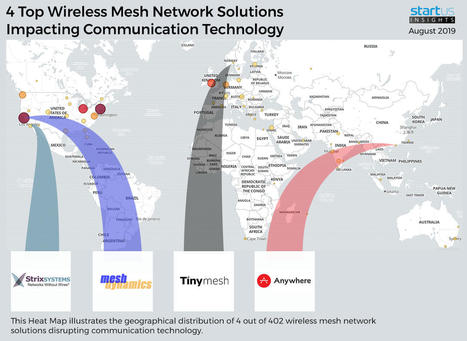
Our Innovation Analysts recently looked into emerging technologies and up-and-coming startups working on communication technologies. As there is a large number of startups working on a wide variety of solutions, we decided to share our insights with you. This time, we are taking a look at 4 promising Wireless Mesh Network Startups.
Avec la famille de microcontrôleurs référencée STM32U5, STMicroelectronics met franchement l’accent sur la sobriété extrême de ce type de circuit intégré fabriqué dans un procédé de gravure 40 nm. La consommation affichée des puces STM32U5 est de 19 µA/MHz en fonctionnement dynamique, de 110 nA à 300 nA en sommeil profond avec l'horloge temps réel en marche et 24 lignes d'E/S actives, et de 4 µA pour un réveil rapide en 5 µs avec le code stocké en mémoire SRam.
Internet of Things (IoT) has seen exponential growth over the past couple of years. A new study from International Data Corporation (IDC) estimates that there will be almost 42 billion connected devices within the year 2025, generating over 80 zettabytes (ZB) of data. As the number of IoT devices grows; the amount of data grows, along with that, grows the need for superior network instruments; which can support this load. However, if we consider a common host (like a generic router), it can connect to a limited number of nodes, less than 32 to be exact. And with an increasing number of IoT devices that could be in our home or industry, this is not sufficient. Currently, there are two solutions to this problem: The first one is to use a Mesh Router that can handle a lot more connections compared to a generic one, or we can use a network protocol known as Mesh Network.
RightMesh, a connectivity company developing a decentralized mobile mesh network has announced a new integration partnership with Tenta, a private and secure crypto browser. Their mission is to get more people online, especially in areas that are underserved or lacking proper infrastructure.
Mobile Ad Hoc Network or MANET is a group of mobile devices, e.g., laptops, mobile phones, radios, or sensors that communicate with each other wirelessly — standard Wi-Fi, cellular, local RF network, etc.—and provides the needed network functionality without an existing fixed structure. They can change locations and reconfigure themselves while doing so. MANETs can be restricted to a local group of wireless devices or they can be connected to the Internet. A VANET (Vehicular Ad Hoc Network) is a MANET that lets vehicles communicate with roadside equipment. Even if the vehicles do not have an Internet connection, the wireless roadside equipment may be connected to the Internet, therefore allowing the vehicles' data to be conveyed over the Internet.
For our 4 top picks, we used a data-driven startup scouting approach to identify the most relevant solutions globally. The Global Startup Heat Map below highlights 4 interesting examples out of 402 relevant solutions. Depending on your specific needs, your top picks might look entirely different.
Internet of Things (IoT) has seen exponential growth over the past couple of years. A new study from International Data Corporation (IDC) estimates that there will be almost 42 billion connected devices within the year 2025, generating over 80 zettabytes (ZB) of data. As the number of IoT devices grows; the amount of data grows, along with that, grows the need for superior network instruments; which can support this load.
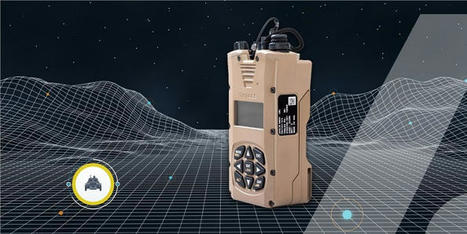
Thales has introduced the Javelin Combat Net Radio to its family of tactical communications products in response to evolving Warfighter needs. This new, rugged, single-channel, small form factor, Mobile Ad-Hoc Network (MANET) radio provides tactical command and control communications into the formations to further enable mission-essential capabilities at the tactical edge.
The military is one of the largest users of MANET. The military must perform a variety of missions, often in a hostile environment. The Army, Navy, Marines, Air Force, and Coast Guard require an information network between soldiers, vehicles, ships, planes, and headquarters—and this network must be safe from hacking, jamming, and targeting by adversaries. The need to transfer more and more information over greater distances with greater numbers of end points presents a challenging and complex mix of transceivers, amplifiers, and antenna equipment.
VANET have particular features like distributed processing, managing network, variable length of nodes, high node speed, but network topology is highly variable, and frequently partitioned network. In a research and industry communities, vehicular ad-hoc network have been recently attracting an increasing attention. VANET is a key topology for improving road safety and comfort through (ITS). A strong interaction is needed between the network protocol and vehicular mobility. Different routing scheme of VANET is given in this paper.
Cet appel à manifestation d’intérêt vise des projets innovants d’envergure significative, à tout stade de maturité, partenariaux ou non, permettant de la création de valeur à l’échelle française et / ou européenne. L’objectif est de recueillir les propositions de projets pouvant être menés dans le cadre de la stratégie d’accélération sur la 5G et les futures technologies de réseaux de télécommunications par les acteurs concernés sur le territoire français.
The global automotive electronic control unit market size was estimated at USD 63.6 billion in 2018 and is projected to expand at a CAGR of 4.4% from 2019 to 2025. The sales of automotive electronic control units (ECUs) are expected to reach 3.29 billion units by 2025. Increasing adoption of autonomous driving technology in the form of driver-assisted technologies, such as Adaptive Cruise Control (ACC), Automatic Emergency Braking (AEB), blind-spot detection, park assist, and Lane Departure Warning (LSW) systems, has been propelling the market growth. Growing consumer preference for fuel-efficient Electric Vehicles (EVs), self-driving cars, and vehicle-to-vehicle communication technology is also expected to boost market growth over the forecast period.
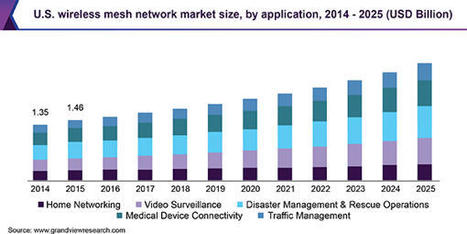
The disaster management & rescue operation segment is expected to lead the market over the forecast years. With the increasing proportion of climatic disasters due to rise in temperatures, rescue operations need to be improved with the aid of mesh networks. These networks are also used in military applications for enhancing communication between the team. The video surveillance segment is expected to witness the highest CAGR as video surveillance offers a human-friendly interface and thus is a preferred security solution over others.
Top companies for Mesh Networks at VentureRadar with Innovation Scores, Core Health Signals and more. Including Fondazione Istituto Italiano di Tecnologia etc
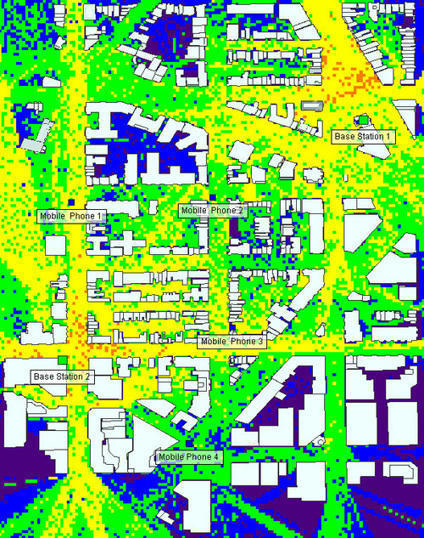
Ad hoc peer-to-peer networks can provide reliable communications in emergency situations where fixed infrastructures, like base stations, may not be available. A mobile ad hoc network (MANET) is a self-configuring network of mobile devices connected without infrastructures or wires. These networks operate independently and can be comprised of one or many transceivers. Remcom’s introduction of transceivers provides a quick way to set up and model ad hoc networks where nodes can act as both a transmitter and receiver. The scenario described here is loosely based on that described in the AT&T article, Scalable Ad Hoc Wireless Geocast.
The mesh is a mass expansive, robust, self-forming and self-healing resilient network created through multi-hop routing. Importantly, real-time messages and notifications can be sent to everyone on site with the app to meet social distancing objectives and provide up-to-date advice and guidance, as well as delivering live fan and community-based social content and retail offers.
To get content containing either thought or leadership enter:
To get content containing both thought and leadership enter:
To get content containing the expression thought leadership enter:
You can enter several keywords and you can refine them whenever you want. Our suggestion engine uses more signals but entering a few keywords here will rapidly give you great content to curate.


 Your new post is loading...