Your new post is loading...

|
Scooped by
Beeyond
Today, 9:17 AM
|
The traditional boundary between how we pay and how we connect has officially dissolved. As of early 2026, the global telecommunications landscape is being aggressively remapped not by legacy carriers, but by financial powerhouses like Revolut, Nubank, and Klarna. By leveraging "Telecom-as-a-Service" (TaaS) platforms to embed full-stack mobile connectivity directly into their apps, these fintechs have transformed the SIM card from a standalone utility into a high-frequency financial "feature."
This is no longer a pilot phase of superficial marketing tie-ins; it is an early, but irreversible shift in control points, in which the mobile plan serves as the ultimate engine for doubling ARPU, reducing churn, and generating high-fidelity data for credit underwriting. For the modern fintech, owning the internet connection is the final step in the "Super App" evolution, turning every smartphone into a locked-in gateway for a lifetime of financial services.
|
|
Scooped by
Beeyond
January 9, 7:39 AM
|
Over the past weeks, I have had long private conversations with five senior telecom analysts. The reason is because I was a dissapointed about many of the latest reports I saw regarding 2026. trends They felt just corporate talk or even sponsored reports. So I wanted to have a honest discussion. What came out of those discussions has very little to do with the trend reports filling our inboxes right now. Those documents are written to keep ecosystems stable, relationships smooth, and marketing budgets justified. This was different. This is where the industry is structurally weak and where 2026 will prompt uncomfortable discussions.
This is not a future-looking hype piece and not a technology wish list. It is a confession-style assessment of what actually matters next year, based on what people say when they stop selling and start thinking.
|
|
Scooped by
Beeyond
January 7, 8:05 AM
|
In the near future, you will not be able to tell whether you are talking to a human or an AI. That statement is no longer speculation; it is the direct outcome of how generative systems are evolving and how rapidly the underlying economics are collapsing. Voice, video, and interactive presence are already at the point where human perception is an unreliable security control, and the remaining gaps are closing quickly.
|
|
Scooped by
Beeyond
January 6, 2:55 AM
|
Mature assets, strong incumbents, high technical competence, and slow decision cycles. In that environment, advantage no longer comes from owning better infrastructure. It comes from how effectively the organization coordinates what it already owns. Analysts consistently find that, after asset normalization, operating model and decision velocity account for roughly 30-40% of performance variance. Network quality explains survival but does not explain outperformance. Once technical parity is reached, internal friction becomes the dominant tax. Culture here is not about kindness or slogans. It concerns incentives, permissions, ways of working, and coherence.
|
|
Scooped by
Beeyond
January 2, 12:04 PM
|
The telecom industry operates the most distributed, synchronized, and permanently powered infrastructure on the planet. Eight million radio sites span cities, roads, ports, factories, and borders.
Telecom can expose not just connectivity but structured awareness: object motion, crowd flow, anomalies, risks, and environmental state. In real time, across every continent. The infrastructure already exists. What’s missing is the architecture and the will to build the sensing layer on top of it.
|
|
Scooped by
Beeyond
December 31, 2025 9:45 AM
|
The more realistic role of 6G is to enable an AI-driven economy without collapsing network economics. AI traffic is not primarily about terabytes but about transactions, latency variance, trust, and coordination. Supporting that efficiently requires lower control density, tighter timing, integrated compute placement, and autonomous operation. Those capabilities protect margins first and create optionality second.
Standards strategy reflects this shift. The emphasis is moving from feature accumulation to architectural coherence, AI-native operation, and system-level efficiency. Success will be measured less by headline speeds and more by reduced cost per delivered service, lower energy per transaction, and fewer human interventions per network element.
6G therefore carries a narrower but more complex value proposition. It does not promise revenue miracles, but it aims to stop economic deterioration while preparing networks for continuous machine interaction and AI-driven workloads. The ROI case is defensive and makes it less exciting, but far more grounded than the narratives that accompanied 5G.
|
|
Scooped by
Beeyond
December 30, 2025 7:33 AM
|
Revolut’s decision to launch a full in-app mobile service in the UK does not look dramatic at first glance: a competitively priced plan, unlimited domestic usage, and roaming bundled across Europe and the US. Activation is completed within an app that millions already use. Nothing about the surface offer suggests a shock to the telecom system, but this understatement explains why the move matters. There is a strong B2B2C movement in the Telecom space.
|
|
Scooped by
Beeyond
December 27, 2025 10:38 AM
|
Telecom is rarely associated with startup innovation. Software, fintech, and consumer AI dominate venture narratives, while telecommunications is viewed as slow, regulated, and capital-heavy. Despite structural barriers, a non-trivial startup ecosystem has formed around telecom. Analysts identify roughly 7,000 active telecom startups globally, spanning RAN software, AI-driven operations, security, satellite systems, private networks, and connectivity platforms. This is small relative to SaaS or fintech, but large enough to bring disruption.
The backdrop for this new wave of telecom startups is a mix of necessity and disruption. Operator revenues are flat, while complexity continues to rise across multi-generation networks.
|
|
Scooped by
Beeyond
December 25, 2025 9:38 AM
|
In most industries, heavy usage correlates with high value. Airlines reward frequent flyers. Banks price transaction volume. Cloud providers charge per compute cycle. Telecom does the opposite.
Mobile data usage follows a power law. Operator and regulator datasets consistently indicate that approximately the top 10% of users account for 40–60% of total traffic, particularly during peak hours. Under flat or unlimited pricing, users pay approximately the average price rather than a premium.
This outcome is not really accidental. Usage-based pricing increases bill shock, which is a major churn trigger. To stabilize retention, operators removed usage signals entirely, accepting margin dilution in exchange for lower churn risk.
In telecommunications, the customer who relies most on the network is often the one the network least wants to serve.
|
|
Scooped by
Beeyond
December 23, 2025 5:08 AM
|
Selon l’indice des dépenses contraintes des ménages publié par LesFurets et CSA Research, un foyer français débourse en moyenne 1143 € chaque mois en charges fixes en 2025. C’est 10 euros de plus qu’en 2024. Un écart en apparence minime, mais qui cache de fortes disparités, surtout chez les familles avec enfants.
|
|
Scooped by
Beeyond
December 23, 2025 4:33 AM
|
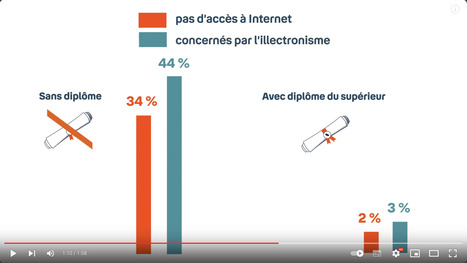
L’étude révèle que 45% des Français se sont déjà sentis en situation de précarité numérique. Pire encore, 1 Français sur 10 considère ne pas disposer d’un équipement suffisant ou assez performant pour accomplir certaines tâches au quotidien, qu’il s’agisse de tâches administratives, de devoirs scolaires ou liées à son activité professionnelle. Parmi les populations les plus concernées par ce manque d’équipement, les jeunes sont les premières victimes.
|
|
Scooped by
Beeyond
December 22, 2025 8:57 AM
|
Europe built modern telecommunications. Companies such as Ericsson, Nokia, and Marconi shaped fixed telephony, radio transmission, mobile systems, and global standards. GSM became the de facto mobile standard worldwide. For decades, Europe exported technology, engineering capability, and regulatory models.
Roughly 150 years later, the economic position of the European telecom service provider industry is weak by any objective measure. Since the early 2000s, listed European telecom operators have lost approximately 70-80% of their equity value. Morningstar data indicate that European communications equities required more than 25 years to recover from their dotcom peak, despite substantial growth in mobile and broadband penetration and sustained traffic growth. This performance gap is not explained by demand. It is described by structure.
|
|
Scooped by
Beeyond
December 21, 2025 10:01 AM
|
Airspace activity has crossed the threshold where ignoring it becomes a strategic mistake. In 2024, commercial aviation operated approximately 40 million flights worldwide, carrying nearly 9 billion passengers. At the same time, tens of millions of drones are already active worldwide, with commercial fleets scaling at double-digit growth. Urban air mobility programs and military aviation introduce an additional layer of permanent airborne traffic. These systems require deterministic, high-availability connectivity. This could be a new trillion-dollar control-and-connectivity opportunity for Telcos.
|
|
|
Scooped by
Beeyond
January 10, 9:24 AM
|
Artificial intelligence now sits at the top of every telecom CEO's agenda. It is an operating reality that touches cost, growth, capital allocation, regulation, and network design. In the last twelve months alone, AI has moved from side initiatives into the center of earnings calls, investor days, workforce plans, and capex debates across the industry.
At this stage, there doesn't seem to be a single formula. For some CEOs, AI is a blunt instrument for compressing opex and protecting cash flow. For others, it is a lever for growth to defend customer momentum. In parallel, a smaller group is treating AI as infrastructure gravity, reshaping networks, data centers, and national digital policy. One outlier is betting on AI as a new core business altogether.
|
|
Scooped by
Beeyond
January 8, 9:20 AM
|
Since 2000, telecommunications operators have paid approximately $1 trillion for spectrum access. Not equipment. Not fiber. Not radios. Just permission to transmit. Roughly $400–450B upfront in primary license awards, $50–100B in clearing and refarming, and hundreds of billions more in recurring spectrum fees paid every year. This is the largest capital and rent extraction in telecom history.
|
|
Scooped by
Beeyond
January 6, 8:20 AM
|
In the early 2010s, many telecom operators convinced themselves that data centers were a natural extension of the network. The logic sounded solid at the time: Telcos owned fiber, central offices, land, power contracts, and enterprise relationships. Hosting and private cloud looked adjacent to connectivity, and margins in traditional telecom were already compressing. Between 2008 and 2014, dozens of operators in Europe, North America, and Asia built or acquired data center assets, often branded as strategic cloud platforms.
The outcome was essentially a fast commoditization. As workloads standardized on x86 virtualization, pricing collapsed toward a cost-plus power model. Utilization, not reliability, became the profit driver. Hyperscalers scaled faster than telcos could justify on their balance sheets, while specialist colocation providers optimized yield through financial discipline that telecom organizations rarely applied to non-network assets. By the mid-2010s, most telco-owned data centers were either sold, carved out, or relegated to side businesses with single-digit returns on invested capital.
|
|
Scooped by
Beeyond
January 5, 3:50 PM
|
Over the last 24 months, Deutsche Telekom has not been experimenting with AI. It has been reallocating capital. Venture investments through T.Capital, large-scale compute commitments, and targeted acquisitions are converging into a single objective: control where AI becomes operational. In an industry with flat revenues and rising network complexity, this is a defensive move against margin erosion and an offensive attempt to turn distribution, compute, and execution into an AI advantage. This is not a technology story. It is a balance sheet story.
|
|
Scooped by
Beeyond
January 1, 12:13 PM
|
The killer app is one of the most persistent myths in technology. It promises salvation through brilliance. One product so compelling that customers flood in, competitors fall behind, and monetization somehow takes care of itself. History shows the opposite: killer apps are excellent at creating demand but poor at protecting value.
The iPhone is the cleanest way to expose the myth, precisely because it is so often misused as proof. People talk about it as if the device itself were the business, and it never was. A smartphone is a standardized object the moment it succeeds: glass, battery, radios, silicon, and software. Once adoption explodes, expectations harden, and competitors converge. That is what killer products do: they define the reference design that others copy.
What prevented the iPhone from becoming a commodity phone business was not the phone itself. It was everything built around it. App distribution, payments, identity, accessories, defaults, services. Remove those layers, and Apple would have faced the same fate as every other hardware success story. Indispensable product, shrinking margins.
|
|
Scooped by
Beeyond
December 30, 2025 8:14 AM
|
From pipes to machine governance: how 5G and 6G turn the telco stack into deterministic coordination, trusted identity, and real time control for billions of robots
|
|
Scooped by
Beeyond
December 29, 2025 7:26 AM
|
On Dec 19, 2025, the White House issued a national security presidential memorandum ordering federal users to begin relocating from 7.125 to 7.4 GHz to free the band for full-power, licensed commercial 6G. Agencies have 12 months to submit relocation plans with costs and timelines, while protecting national security missions and critical infrastructure operations. The memorandum also triggers immediate studies on 2.69 to 2.9 GHz and 4.4 to 4.94 GHz for potential additional full-power 6G capacity. It directs the State Department to advance US 6G positions through international engagement ahead of the next set of standards and spectrum cycles.
|
|
Scooped by
Beeyond
December 26, 2025 11:18 AM
|
As of today, GPUs remain appropriate for co-located edge inference where workloads are heterogeneous, and utilization can be amortized. In a commoditized, energy-constrained RAN, inline radio inference follows a different economic and physical logic. Architectures optimized for deterministic execution, integration, and cost per decision outperform throughput-oriented designs. As learned functions move deeper into the radio processing chain, hardware selection will increasingly be driven by these constraints rather than by data-center inference defaults.
|
|
Scooped by
Beeyond
December 23, 2025 1:32 PM
|
Telcos did not misunderstand the internet; instead, for many years, they treated it as an add-on rather than as a new organizing principle. They optimized existing processes rather than redesigning decision-making, pricing, and product creation to substantially reduce coordination costs.
AI sits in the same category today. It reduces the cost of prediction, pattern recognition, and decision making by orders of magnitude. According to recent studies by McKinsey and Analysys Mason, more than 70% of telco AI spending between 2022 and 2024 has gone into customer care automation and network operations, with primary success metrics tied to opex reductions of 5-15%. Fewer than 20% of initiatives target pricing, revenue optimization, or new product creation, and even fewer have the authority to execute changes autonomously. AI is treated as an efficiency layer rather than an operating model.
|
|
Scooped by
Beeyond
December 23, 2025 5:06 AM
|
Les Français consacrent 49 € par mois en abonnements numériques, mais estiment en dépenser seulement 31. Une sous-évaluation révélatrice d’un angle mort budgétaire, dans un modèle où l’accumulation de services devient aussi diffuse que coûteuse.
|
|
Scooped by
Beeyond
December 23, 2025 4:32 AM
|
Avec un taux de pauvreté de 15,4 % en 2023 représentant près de 10 millions de personnes, la France a atteint en effet un sommet depuis 30 ans. Sans la redistribution et les prestations sociales, la pauvreté grimperait à 21,7 % de la population, selon la Cour des Comptes. Même si ce taux se situe dans la moyenne européenne, la tendance est inquiétante : + 650 000 personnes pauvres en un an, là aussi, la plus forte hausse annuelle depuis 30 ans.
|
|
Scooped by
Beeyond
December 21, 2025 1:18 PM
|
Network operations represent 25–35% of total opex for integrated operators. Within that, field operations, NOC staffing, and incident management are the fastest-growing cost lines. CEOs are backing AI where it directly compresses these cost curves.
Deutsche Telekom’s RAN Guardian is a representative case. The system uses AI agents to detect anomalies, correlate root causes across the RAN and transport layers, and trigger corrective actions. DT reports mean time-to-repair reductions from hours to minutes in specific domains, directly reducing escalations and truck rolls. This is not sold as innovation but as protection against rising operational headcount.
|