Digital Literacy in the Library
47.1K views | +1 today
Your new post is loading...
Scooped by Mary Reilley Clark
January 10, 2015 1:40 PM
Scoop.it!

I Know Where Your Cat Lives

I Know Where Your Cat Lives | Digital Literacy in the Library | Scoop.it

What a great example of the importance of privacy settings! Although your students might see nothing wrong with this, what they think they're sharing with friends on social media can easily be found by others. Most of my students would ask why not get as many views for your photos as you can? I imagine adults would see this differently.

This would be a good discussion starter. Be prepared for your computers to be taken over, though, as students immediately head there to look for their cats....
Mary Reilley Clark's insight:

Here's a great conversation starter from the website:  "The images are less likely to explain where all the cats in the world exist than they are to describe how many photos of cats have been uploaded from each of these places. So the maps are perhaps a better representation of globalism, access to smart phones, and relaxed consideration for individual privacy." (Emphasis added.) 


No comment yet.
Scooped by Mary Reilley Clark
December 29, 2014 11:57 AM
Scoop.it!

High schoolers wise up about social media when applying for colleges

High schoolers wise up about social media when applying for colleges | Digital Literacy in the Library | Scoop.it

"Colleges are increasingly considering social media posts in the application process, and students are getting smarter about it."


Photo via JEShoots/Pixabay

Mary Reilley Clark's insight:

Students have been savvy enough to create fake Facebook profiles for years. What I'd love to see is students developing an honest online presence that highlights their passions. If they're creating, they should be sharing their work on YouTube, Deviant Art, Tumblr, etc. Encourage students to curate their interests, too. I have students who have Polyvore or Pinterest collections of fashion. Another decided to start 2015 by using Vingle to create a collection of book reviews for every book he reads. When or if colleges look a prospective student up online, they should get an understanding of that student's interests, not a slick marketing campaign.  

No comment yet.
Scooped by Mary Reilley Clark
November 28, 2014 10:51 AM
Scoop.it!

@HistoryInPics, or Does Copyright Count?

@HistoryInPics, or Does Copyright Count? | Digital Literacy in the Library | Scoop.it
Meet Xavier Di Petta and Kyle Cameron, ages 17 and 19, whose ability to build a massive audience from nothing may be unparalleled in media today.
Mary Reilley Clark's insight:

I'm sure if I share this with my students, their response will be, "Then why should we bother searching for images that are free to use or share? We're not even going to be making money on our projects!" Interesting point, and one that would make a great research or debate topic. 

GwynethJones's curator insight, November 30, 2014 9:59 AM

Great convo starter!

Scooped by Mary Reilley Clark
October 13, 2014 12:53 PM
Scoop.it!

Today's Teens Can Be Adept Multitaskers, Study Suggests

Today's Teens Can Be Adept Multitaskers, Study Suggests | Digital Literacy in the Library | Scoop.it
Some kids do just fine juggling multiple forms of media throughout the day, research shows
Mary Reilley Clark's insight:

I'm a big media multi-tasker, so I'm pleased to see it's not that detrimental to my work!

No comment yet.
Scooped by Mary Reilley Clark
October 1, 2014 1:59 PM
Scoop.it!

9 ways to use Hyperlapse for your school's videos

9 ways to use Hyperlapse for your school's videos | Digital Literacy in the Library | Scoop.it

Cassie Dull writes: "See how to use Hyperlapse for school videos to create engaging content for social media."

Mary Reilley Clark's insight:

I just started using Hyperlapse last week, mostly showing students coming and going in the library. I am going to use some of Cassie's suggestions!


Update: Since I gave up my iPhone to join the rest of the family with Samsung devices, I've been using the TimeMovie Android app. I did make some great videos to showcase how much the library is used! 

GwynethJones's curator insight, October 5, 2014 11:10 AM

Sweet! Thanks, Mary!

Scooped by Mary Reilley Clark
September 27, 2014 5:46 PM
Scoop.it!

10 Ways To Use Instagram In Your Classroom | Edudemic

10 Ways To Use Instagram In Your Classroom | Edudemic | Digital Literacy in the Library | Scoop.it

Katie Lepi writes: "Instagram is a hugely popular social network for photo sharing. Though the use of social media in the classroom may have skyrocketed, Twitter and Facebook definitely reign supreme as the key social media tools for schools and teachers. Somehow, despite the widespread popularity of Instagram, few teachers are employing it in the classroom."  

Mary Reilley Clark's insight:

Katie's list would be very helpful for teachers just starting to dip their toes into social media. I love the idea of using photos for writing prompts! I haven't used my library Instagram account often enough--I'd love to ask students to share photos of creative reading spots, or photos that could be alternative covers for their favorite books.  Another idea for the to do list!

Kim Borghouts's curator insight, September 28, 2014 6:17 PM

A nice ice breaker.

Scooped by Mary Reilley Clark
September 21, 2014 9:11 PM
Scoop.it!

What We're Missing with Digital Footprint

What We're Missing with Digital Footprint | Digital Literacy in the Library | Scoop.it

John Spencer writes: "I've noticed a trend toward educating students on the notion of a permanent digital footprint. Often, this leads to a conversation about personal branding. Do this and don't do that. Craft this image to make yourself look great for an employer. Don't get caught saying or doing anything dumb at sixteen."

Mary Reilley Clark's insight:

 This is an interesting take on how we teach about digital footprints or tattoos. John Spencer wonders if we're encouraging students to be less than authentic online by focusing on the impact of their digital teen life on their future education or employment prospects.


I usually couch my digital tattoo talks with comments about how glad I am that camera phones weren't around when I was a teen, but John's article will make me shift my emphasis a bit away from the fear, and more toward  the questions John poses.

No comment yet.
Scooped by Mary Reilley Clark
August 20, 2014 1:32 PM
Scoop.it!

Are We All Narcissists? Viral Social Media Campaigns

Are We All Narcissists? Viral Social Media Campaigns | Digital Literacy in the Library | Scoop.it
Following the pattern here would make an intriguing assignment for secondary students. Campaign goes viral, campaign gets criticized, campaign gets forgotten or breaks down horribly? Are those always the steps? I know we saw it with Kony 2012 and Invisible Children. I doubt we'll see that kind of public flame-out from the good people at the ALS Association, but it's certainly worth studying viral campaigns.

Is this slacktivism at its best, and does it matter, since money is allegedly being ...
Mary Reilley Clark's insight:

I'm going to spend more time focusing on social media with students this year. This is a great example that they can all relate to! Digger deeper with critical thinking is key.

No comment yet.
Scooped by Mary Reilley Clark
July 14, 2014 5:18 PM
Scoop.it!

Using Social Media to Teach Visual Literacy

Using Social Media to Teach Visual Literacy | Digital Literacy in the Library | Scoop.it
With all the "sky is falling" cries about American students reading less, I often wonder why we don't track how much reading and writing students do daily on social media. Bring social media into your lessons is crucial to helping students develop critical thinking about the media many of them consume and create in large amounts every day.

In this article from Edudemic, Dave Guymon suggests that pairing visual or non-linguistic ideas with text-based ones can help students recall or interpret...
Mary Reilley Clark's insight:

I've started using Vingle to do more reflection on topics that interest me. Here are my comments on Dave Guymon's article on visual literacy.

No comment yet.
Scooped by Mary Reilley Clark
June 24, 2014 9:31 AM
Scoop.it!

How a Raccoon Became an Aardvark

How a Raccoon Became an Aardvark | Digital Literacy in the Library | Scoop.it

Eric Randal posted: "Wikipedia is an experiment in crowdsourcing as much human knowledge as possible, and the logical outcome of that process is that the wisdom of the crowd often rules—as insensible as the crowd can be."

Mary Reilley Clark's insight:

Great article to share with students when teaching about credible sources.

Ann Ewel's curator insight, July 27, 2014 12:20 AM

Great article to share about credible information and why we all need to be alert and careful. 

Scooped by Mary Reilley Clark
June 17, 2014 10:32 AM
Scoop.it!

Curation as Digital Literacy Practice

Curation as Digital Literacy Practice | Digital Literacy in the Library | Scoop.it

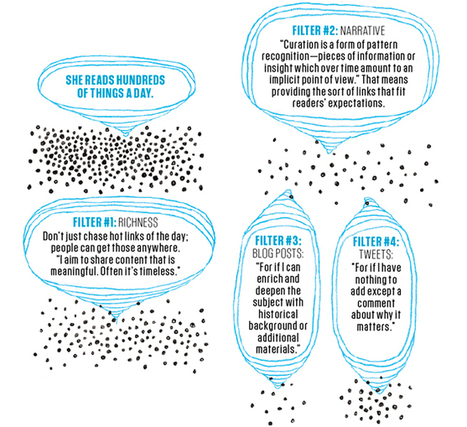
Ibrar Bhatt writes: "Digital curation therefore is not just about finding relevant material, although that is a significant part of it, but is also about creating a specific and unique experience by utilising the resulting materials which then become contextualised within a new space. A curator, therefore, whether she is a journalist-by-proxy such as Popova or a student completing an assignment in a classroom, not only collects and interprets, but also creates a new experience with it. In this respect, curation is a process of problem solving, re-assembling,re-creating, and stewardship of other people’s writing." 

Mary Reilley Clark's insight:

So much to digest here! This article is definitely worth reading, and then re-reading, for a new insight into curation.

Gilbert C FAURE's curator insight, July 25, 2014 3:40 AM

was not aware that curation.... definition was born in 1990

lynnegibb's curator insight, July 25, 2014 7:53 PM

This gave me plenty of food for thought and some new insights into the art of and purposes of curation

Bodil Hernesvold's curator insight, August 25, 2014 5:05 AM

More on curation. Creating new content from old. When should you blog about it, and when should you tweet?

Scooped by Mary Reilley Clark
June 13, 2014 1:03 PM
Scoop.it!

Reading Writing Responding: What's So Digital About Literacy Anyway?

Reading Writing Responding: What's So Digital About Literacy Anyway? | Digital Literacy in the Library | Scoop.it

Aaron Davis writes: "In a post titled, 'The Importance of Modeling Positive Use of Social Media', +Chris Wejr suggested that schools need to do more to both model the appropriate use of social media, as well as promote more positive stories. This got me thinking about some of the other things that we may do personally online , but not necessarily model all the time in school. One such practise is that of reading and responding online. So often students are told to use tracks and be active readers, to write regular journal reflections, but this usually starts and stops at the physical book. When are students getting the same opportunity to read and respond online?"

Mary Reilley Clark's insight:

Lots of great stuff in here to ponder.  The blog post itself is a great answer to how reading digital content is a different skill than reading print--do you wander off to the embedded links as you're reading? Do you read the entire post, then go back and visit the links? I find myself down a rabbit hole too often, clicking links, reading, clicking more links.  That works fine for me, but would that work for a student trying to gather information for a research project? Online reading definitely feels more scattered to me, as I am easily distracted. Does that matter to students researching? Do we need to highlight the differences for them? I think at least making students aware by modeling online reading would be helpful, as they can reflect on how they  interact with print and digital information.

No comment yet.
Scooped by Mary Reilley Clark
June 10, 2014 10:31 AM
Scoop.it!

10 Proactive Steps for Schools to Limit Student Issues With Social Media

10 Proactive Steps for Schools to Limit Student Issues With Social Media | Digital Literacy in the Library | Scoop.it

Kelly Walsh writes: " Combining what I learned with suggestions from the great staff at Kinry Road Elementary School, and my own personal perspective as a parent, I developed this list of approaches to help parents and educators limit incidents and issues by tackling the problem head on."

Mary Reilley Clark's insight:

Hmm.  Some good points here, but that graphic? I'd rather start with the positives!  I do like the idea of a peer mediation program, which would work with our PALS program. 

No comment yet.
Scooped by Mary Reilley Clark
December 30, 2014 5:47 PM
Scoop.it!

Best ads of 2014 are strong storytellers

Best ads of 2014 are strong storytellers | Digital Literacy in the Library | Scoop.it
The best ads of 2014 share one common trait: they all tell stories -- beautifully. Sometimes they grab you from the get-go, and never let go. Sometimes the stories are visual -- or audio -- picnics.
Mary Reilley Clark's insight:

I am going to work these commercials into a lesson when we discuss book trailers, or, well, anything! Telling stories is such  critical skill, and telling them with powerful visuals is a skill we need to help students develop.  I'd also like to explore how these commercials influence behavior, and get students to question how much influence commercials have on them.

No comment yet.
Scooped by Mary Reilley Clark
December 19, 2014 11:35 AM
Scoop.it!

14 of the Best Media Literacy Resources for 2014 | Edudemic

14 of the Best Media Literacy Resources for 2014 | Edudemic | Digital Literacy in the Library | Scoop.it

"The American Academy of Pediatrics (AAP) reports that children spend an average of seven hours a day consuming various types of media. This data illustrates that society’s voracious appetite for media makes media literacy more important than ever.

How can you teach your students to interact responsibly with the media? The following resources can help you plan thought-provoking lessons on the subject."

Mary Reilley Clark's insight:

It's well worth spending some time exploring these resources collected by Edudemic. I found several things I'll be incorporating in lessons for next year.

No comment yet.
Scooped by Mary Reilley Clark
November 21, 2014 11:10 AM
Scoop.it!

How to Turn a Classroom Research Project into an Infographic | Edudemic

How to Turn a Classroom Research Project into an Infographic | Edudemic | Digital Literacy in the Library | Scoop.it

Ann Elliott writes: "Conveying information in a striking, concise way has never been more important, and infographics are the perfect pedagogical tool with which to do so. Below, you’ll find my experience with designing an infographic-friendly classroom research project, explained in a step-by-step process you can implement in your own classroom."

Mary Reilley Clark's insight:

After making several suggestions to a teacher yesterday who wanted to assign a "more interesting" book project, I found Ann Elliott's article timely and useful.  Our students love viewing infographics, but need instruction on creating them, on design basics, etc.  Ann's article will be very helpful to a teacher who wants to jump into infographics, but is learning along with her students.

No comment yet.
Scooped by Mary Reilley Clark
October 10, 2014 5:28 PM
Scoop.it!

Links to Photos Said to Be Stolen From Snapchat Users Flood Message Boards

Links to Photos Said to Be Stolen From Snapchat Users Flood Message Boards | Digital Literacy in the Library | Scoop.it
Just weeks after a celebrity hacking scandal, members of an anonymous online message board claimed to have accessed hundreds of thousands of photographs of noncelebrities.
Mary Reilley Clark's insight:

I love the last quote, in which the creator of an app that allows you to save Snapchats to your phone says, "...your average Snapchat user isn't very tech savvy."  Another teachable moment to add to my long list of examples for digital literacy. Even just reading about the mystery of Snapsaved is a lesson!

No comment yet.
Rescooped by Mary Reilley Clark from Catchy headings
September 29, 2014 10:39 AM
Scoop.it!

How to Write Better Headlines [Infographic]

How to Write Better Headlines [Infographic] | Digital Literacy in the Library | Scoop.it

Here are some tips for writing more compelling headlines...

The infographic by Neil Patel from Quick Sprout will give you a simple formula for enticing headlines. Though there's no one-size-fits-all headline trope that guarantees a crazy influx of traffic, the tactics below should help you tweak your headlines to get your posts the attention they deserve.


Via Lauren Moss, Kim Borghouts
Mary Reilley Clark's insight:

There are some great tips here. Our 7th grades write newspaper front pages for an historical fiction project, and last year we talked about good headlines and captions. I'll share this with them this year. 

Smartwords's curator insight, September 4, 2014 12:13 PM

Le titre est le produit d'appel de votre contenu. Rendez-le le plus attractif possible !

Kamian's curator insight, October 1, 2014 12:31 PM

(ENG) Excelente infografía con Tips para redactar titulares efectivos.

GwynethJones's curator insight, October 5, 2014 11:49 AM

Writing kicky headlines are the THING!

Scooped by Mary Reilley Clark
September 26, 2014 2:34 PM
Scoop.it!

A Straightforward Guide To Creative Commons | Edudemic

A Straightforward Guide To Creative Commons | Edudemic | Digital Literacy in the Library | Scoop.it

Katie Lepi writes: " The Creative Commons licenses allow any internet user to easily understand how they can (and can not) share what they find on the web. The licenses are visual, and if you aren’t sure of what you see on the work you’d like to use, you can refer back to the CC website to see. The handy infographic below gives a pretty thorough overview of the licenses and what they mean. Whether you have a personal blog, a class blog, or your students want to use a photo they’ve found in a presentation, this guide will be super handy!"

Mary Reilley Clark's insight:

I love this infographic from Foter! My next presentation to 8th grade students is on Creative Commons, so this information is timely. I think the infographic will make a longer lasting impression than anything I tell them.

No comment yet.
Scooped by Mary Reilley Clark
September 16, 2014 12:09 PM
Scoop.it!

NFL protests include flyover, model with black eye along with #GoodellMustGo

NFL protests include flyover, model with black eye along with #GoodellMustGo | Digital Literacy in the Library | Scoop.it

Cindy Boren writes: "It isn’t clear exactly where NFL Commissioner Roger Goodell is, but, if he’d chosen to attend at game Sunday at MetLife Stadium, he’d have seen a plane fly over  the place, trailing a banner calling for him to go in a larger #GoodellMustGo protest over the weekend."

Mary Reilley Clark's insight:

Another example of using social media to pressure public figures for action.  This would certainly generate discussion among students.--football AND make-up!

No comment yet.
Scooped by Mary Reilley Clark
August 15, 2014 4:41 PM
Scoop.it!

Web Trolls Winning as Incivility Increases

Web Trolls Winning as Incivility Increases | Digital Literacy in the Library | Scoop.it
Emotionally abusive comments are becoming more common online, and the consequences could include scaring away from the web those subject to attacks.
Mary Reilley Clark's insight:

This article would be great for a discussion about online.rights and responsibilities. Just because you can comment on everything online, should you? Can students come up with a civility code that they think we should adhere to online (or anywhere)? 


Lots to think about here.

GwynethJones's curator insight, August 16, 2014 10:50 AM

A current exploration of hating online and negative trolling 

Rescooped by Mary Reilley Clark from Googly
June 28, 2014 8:46 PM
Scoop.it!

Staying Organized Using Google Apps for Education in the Classroom

Staying Organized Using Google Apps for Education in the Classroom | Digital Literacy in the Library | Scoop.it
(Scroll to the bottom to skip to the video) I was recently asked (twice in the same week) to share how I organize student work shared with me via Google Apps for Education. At nErDcamp Northern New...

Via AdinaSullivan
Mary Reilley Clark's insight:

I think we should establish a consistent policy for this at school!

No comment yet.
Scooped by Mary Reilley Clark
June 20, 2014 2:40 PM
Scoop.it!

What Is The Ideal Length Of A Tweet (And Other Communications?)

What Is The Ideal Length Of A Tweet (And Other Communications?) | Digital Literacy in the Library | Scoop.it

There are so many ways that teachers are using social media –  both in the classroom and for their own professional development. From Instagram and Facebook in the classroom to Twitter lists and hashtags for their PLN, there are so many social networks and so much content to choose from when you’re looking.

Mary Reilley Clark's insight:

So now we know!

Ann Ewel's curator insight, July 27, 2014 12:16 AM

Good things to remember and to share about engaging in social media. 

Rescooped by Mary Reilley Clark from Into the Driver's Seat
June 15, 2014 11:07 AM
Scoop.it!

The 7 characteristics of a digitally competent teacher

The 7 characteristics of a digitally competent teacher | Digital Literacy in the Library | Scoop.it

“Being a proper digitally competent teacher is not as simple as picking up an iPhone and tweeting. You need to be a good digital citizen, understand privacy, and more.”


Via Jenny Smith, Jim Lerman
Mary Reilley Clark's insight:

This will be good to share at the beginning of the year. I think it will reassure some teachers, and light a fire under others:)

GwynethJones's curator insight, June 15, 2014 11:55 AM

Like my friend Mary Clark said (She's a great follow!)  This is a really great graphic to share with teachers at the start of school! 


I'm also gonna share this on my New Teacher Survival Guide wikipage!

Rachel Gutzler's curator insight, August 13, 2014 11:25 AM

Curating with ScoopIt.  #pasummit

Scooped by Mary Reilley Clark
June 13, 2014 12:50 PM
Scoop.it!

Developing Digital Literacy Through Content Curation

Developing Digital Literacy Through Content Curation | Digital Literacy in the Library | Scoop.it
With the vast amount of content that is shared on the Internet, content curation is becoming an essential digital literacy skill for teachers and students.
Mary Reilley Clark's insight:

Good article to share with teachers new to content curation, as it gives a good summary of several curation tools.

Ann Ewel's curator insight, July 27, 2014 12:18 AM

As Mary said this is a great list for teachers new to content curation.  Very helpful.