 Your new post is loading...

|
Scooped by
Mary Reilley Clark
October 4, 2015 7:45 PM
|
"The Martian stars Matt Damon as a stranded astronaut — and Mars as the red planet of doom. Can our hero survive life on Mars? Can NASA find a way to bring him home? To help you better understand the film — and the scifi novel that came first — we’ve picked 5 TED-Ed Lessons that explore some key Martian life skills."
|
|
Scooped by
Mary Reilley Clark
September 24, 2015 1:26 PM
|
I updated my digital citizenship presentation, based on Craig Badura's digital citizenship kit found here. I used this last year, and found that the students could recall the images and what they represented four or five months later. I am trying to use more images and less text (and less me talking!) in all of my presentations.
|
|
Scooped by
Mary Reilley Clark
August 18, 2015 2:16 PM
|
Joe Pinsker, quoting James Heilman, writes: "Many people do not consider other people to be intelligent enough to use Wikipedia with a grain of salt, yet they consider themselves to be intelligent enough to use Wikipedia properly,” Heilman observes. To rely on Wikipedia without any skepticism is to act as though every editor is as relentless, principled, and stubborn as he is.
|
|
Scooped by
Mary Reilley Clark
June 16, 2015 12:08 PM
|
Dian Shaffhause writes: "American millennials may be the first generation that grew up with computers and Internet access, but all that time spent glued to a small screen hasn't translated to technology competence, according to a research project that analyzed data from an assessment of adult competencies that tests cognitive and workplace skills."
|
|
Scooped by
Mary Reilley Clark
May 22, 2015 12:23 PM
|
From Global Digital Citizen: "Creating great infographics need not be a chore, no matter if you’re a teacher or a student. Taking information and presenting it in an artful and visually appealing way has never been easier, thanks to Web 2.0 tools. Before you dive in, here are some quick tips: - Collect your data. If you have been collecting data, compile it all in a spreadsheet.
- Decide the best way to present your data (flyer-style, bar charts, line charts, Venn diagrams, histogram, scatter plot charts, flow charts, timelines, etc.).
- Design a rough sketch so you don’t end up flying blind.
- Pick your app and get to work!"
|
|
Scooped by
Mary Reilley Clark
May 22, 2015 11:24 AM
|
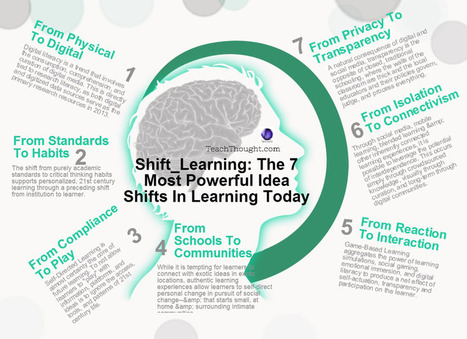
Terry Heick writes: "The good news is, many of the elements of a progressive learning environment—e.g., digital literacy, connectivism, and play—conveniently, and not coincidentally, work together. And better yet, collectively they can reduce the burden on those managing the learning because they place the learner at the center."
|
|
Scooped by
Mary Reilley Clark
May 13, 2015 3:32 PM
|
Marshall Honoroff writes: "Compromising children's safety online doesn't take a hacker -- just a savvy individual and some information that parents already provide."
|
|
Scooped by
Mary Reilley Clark
April 20, 2015 2:05 PM
|
Wikipedia editors are finding more hoaxes on the site every month. How many are there, really? No one actually knows.
|
|
Scooped by
Mary Reilley Clark
April 14, 2015 11:41 AM
|
In this section we outline how skills and competencies for digital literacy and media literacy intersect and provide us with essential skills for playing, learning and working as citizens of the digital world.
|
|
Scooped by
Mary Reilley Clark
March 16, 2015 2:31 PM
|
Alice Chen writes: "We all know that our digital natives are very at ease with technology. In fact, they’re in love with technology, but does that automatically make them digital proficient?
When I originally pondered this question, I began to realize that the 5 C's often discussed in education today - communication, collaboration, creativity, critical thinking, and citizenship - needed to be expanded to include these other areas as well: curation, copyright, character and connectedness."
|
|
Scooped by
Mary Reilley Clark
February 16, 2015 12:25 PM
|
Mary Beth Hertz writes: "Responsible digital citizens emerge from schools where students are taught about the rules, risks, and trust involved in the safe, respectful use of social media."
|
|
Scooped by
Mary Reilley Clark
February 16, 2015 11:54 AM
|
Stephen Marche, in this opinion piece about abuse on social media, writes: "The challenge of our moment is that the face has been at the root of justice and ethics for 2,000 years. The right to face an accuser is one of the very first principles of the law, described in the “confrontation clause” of the Sixth Amendment of the United States Constitution, but reaching back through English common law to ancient Rome. In Roman courts no man could be sentenced to death without first seeing his accuser."
|
|
Scooped by
Mary Reilley Clark
January 15, 2015 9:34 AM
|
A satirical Web site's response to an ultra-Orthodox newspaper.
|
|
|
Scooped by
Mary Reilley Clark
October 3, 2015 10:55 AM
|
It's about living mindfully on social media because—let's be real—the internet can be the best. It's this amazing thing that connects us all to one other...
|
|
Scooped by
Mary Reilley Clark
September 3, 2015 11:01 AM
|
Nick Kristof writes: "So think of armchair activism as a gateway drug. It exposes people to causes and sometimes gets them hooked. And while it doesn’t always solve problems, it tends to build awareness of crises — a necessary but not sufficient step to getting them resolved."
|
|
Scooped by
Mary Reilley Clark
July 31, 2015 12:02 PM
|
Alice Chen writes: "Why do students plagiarize? Most of the time it's probably due to two reasons: they don't know how to properly cite their sources or they don't know what to write.
In my English Language Arts class, my students are constantly writing. It may be blog posts, essays, or speeches. We don't use services like Turnitin so how do I know that they are truly the authors of the work they call their own?
First, my students start and complete most of their writing in class. When given time to write, there is less inclination to cheat."
|
|
Scooped by
Mary Reilley Clark
May 26, 2015 2:28 PM
|
Jessica Contrera writes: " The Internet is the place where nothing goes to die. Those embarrassing photos of your high school dance you marked “private” on Facebook? The drunk Instagram posts? The NSFW snapchats? If you use social media, you’ve probably heard a warning akin to “don’t post anything you wouldn’t want your employer (or future employer) to see.” We agree, and are adding this caveat: Don’t post anything you wouldn’t want hanging in an art gallery."
|
|
Scooped by
Mary Reilley Clark
May 22, 2015 11:40 AM
|
Lisa Johnson writes: "I have spent most of educational technology career supporting secondary students. Projects and Presentations are always a plenty… but what I noticed is typically students have great presentations and poor content or great content and poor presentations."
|
|
Scooped by
Mary Reilley Clark
May 18, 2015 11:56 AM
|
In C. M. Rubin's interview, Howard Rheingold states: "When I decided to write a book about the essential literacies necessary today—with the aim of using the book as a text for a Stanford course—I decided that the essential literacies are attention, crap detection, participation, collaboration, and network awareness."
|
|
Scooped by
Mary Reilley Clark
April 24, 2015 11:26 PM
|
Based on lessons from Common Sense Education's K-12 Digital Literacy and Citizenship Curriculum, Digital Compass addresses cyberbullying, privacy and security, creative credit and copyright, information literacy, Internet safety, digital footprint...
|
|
Scooped by
Mary Reilley Clark
April 14, 2015 12:36 PM
|
Saga Briggs writes: "Teaching digital literacy is about more than just integrating technology into lesson plans; it’s about using technology to understand and enhance modern communication, to locate oneself in digital space, to manage knowledge and experience in the Age of Information. Digital literacy isn’t about knowing computers inside and out; it’s about using technology to change the way you think. If critical thinking skills haven’t yet become a part of your students’ digital citizenship, it’s time to rethink your teaching strategy."
|
|
Scooped by
Mary Reilley Clark
April 5, 2015 3:23 PM
|
The Internet offers an abundance of online citation tools, from the extremely easy to use, to ones that require more research on the part of the user.
|
|
Scooped by
Mary Reilley Clark
February 18, 2015 11:17 AM
|
Today’s students may be skilled at texting and social media, but many are unable to perform online research and distinguish accurate information on the web, according to a new study."
|
|
Rescooped by
Mary Reilley Clark
from Media Literacy
February 16, 2015 12:10 PM
|
Anna Blow writes: " When we comment on news stories, most of us hope to say something about the topic at hand — even (or maybe especially) if it’s that the author got it all wrong. But what do the comments we leave say about us — about our beliefs, our biases and how we act when the ordinary rules don’t apply? And how do our comments affect the beliefs of others?
|
|
Rescooped by
Mary Reilley Clark
from Media Literacy
January 19, 2015 4:55 PM
|
Explosive confrontations are nothing new for Israel and Lebanon, but the latest spat between the longtime foes is perhaps the first to have been caused by an alleged photo-bomb.
|


















I know a lot of my students went to see the movie this weekend. We just got back, and I thought the movie was great! It will be fun to share these videos during the week with classes.