More detail here https://daveowhite.com/phantom-premise/
|
|
Scooped by
Ana Cristina Pratas
onto Digital Delights Today, 11:11 AM
|
|
|
Scooped by
Ana Cristina Pratas
onto Digital Delights Today, 11:11 AM
|
Your new post is loading...

Ana Cristina Pratas's insight:
Nabila bruno's curator insight,
April 26, 2023 2:20 AM
acquista subutex online acquista subutex online
From
daveowhite
This is an expanded version of a talk I gave at the Postdigital backlash conference in Zagreb in June 2026. My proposal is that while the backlash (refusal or resistance) to Gen AI is commonly base…
Part 2 of an interview with Kirsten Davis
"Thoughtful legal educators are hungry for a set of best practices, and for ideas on how to avoid the problem of AI interfering with their students’ education. That’s really worrisome for folks; that AI use will get in the way of learning. Studies suggest our ability to learn requires effort, and AI can take away from that effort, so it can be dangerous to a legal education in that way. And my colleagues are hungry for conversation; somewhere to talk about this without feeling stigmatized, or that they’ll reveal they don’t know something or are doing the wrong thing.
The idea of AI “stigma” is real. I find people are still reluctant to talk about how they use AIthemselves, because.they think it’ll be perceived as the wrong thing to do. I just had a conversation with colleagues planning a presentation, and it was interesting to hear how varied our personal ethical boundaries were on AI use. One says, “I never use it for writing, only editing”; another, “I only use it for research”; another, “I use it for all the things.” That’s a lot of variation; how do we make consistent ethical boundaries in this context?? That’s what we’re all struggling with: to do the right thing by our students, by our scholarship, and by the law. That’s what faculty are hungry for guidance about."
AI literacy, metacognitive frameworks, and reflection apparati have limited efficacy in the absence of systemic change, instructional redesign, disciplinary scaffolding, and ongoing measurement.
Discover how purpose-first learning in higher education builds student ownership, intrinsic motivation, and deeper engagement by starting with meaning, not modality.
What Claude's newly discovered "conscious access" means for the classroom
Some collective resources (& a free event!) to help make sense of AI in Higher Ed
This piece initiates a search for the connectors between two conversations happening at different altitudes.
Cognitive sovereignty is this week's throughline. A UN report on who controls AI, a reading-fluency crisis with a paper trail, and the wealthy quietly opting out.
How AI fakes expose a crisis in critical thinking that predates them
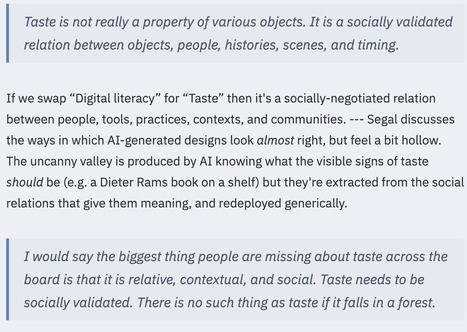
I found I had so much to say about Emily Segal's latest Nemesis Memos post, that I not only transferred it from Thought Shrapnel to here, but I think this is going to have to be a couple of posts. Segal is talking about the world of aesthetics as it relates to AI, but it's absolutely relevant to... |
Discover how storytelling in teaching can transform your course syllabus into a guide that engages students, builds context, and creates a more meaningful learning experience.
Preparing a syllabus to tell a story implies that:
The course description must set the tone for the overview of the story of your course.
As well as expose the solution that your students must overcome with the knowledge they will receive.
Learn why AI literacy matters and how faculty can help students use generative AI responsibly while protecting critical thinking skills.
Like nineteenth-century scholars who wrote about the world without deeply engaging with it, academics who lean too heavily on AI risk becoming paper-thin
Thoughts on Christopher Nolan's hypothesis about Gen Z AI rejection
(...)
This brings us to a vital realization: this tendency to blindly offload thinking is not an inevitable failing of Gen Z or Gen Alpha. Rather, it is fundamentally an educational design problem. Traditional “snapshot assessments” actively reward students for falling into the efficiency trap. To fix this, we must shift our focus from evaluating the final output to evaluating the messy process of learning itself."
The ongoing fight over a shrinking, increasingly valuable resource. People who still think in full sentences.
Discover practical assessment strategies that promote academic integrity and meaningful learning in the age of AI and generative technology.
Learn practical strategies for managing technology change in higher education, reducing change fatigue, and partnering with IT to support teaching success.
Last modified: August 25, 2025 Under the Duke Community Standard, unauthorized use of generative AI is treated as cheating. This means you have the discretion to define how, if, an
A response to "The Epistemology of Cognitive Uploading," written — as requested — by the kind of machine it describes.
What Humanizers Do to the Text We Ask Students to Submit |
Your new post is loading...