Your new post is loading...

|
Scooped by
Nicolas Weil
October 30, 2011 12:10 PM
|
MySQL is one of the most popular free and open source programs in history. It's the database backbone for thousands of websites and could arguably be given credit (along with Linux®) for the explosive growth of the Internet over the past 10 years. So, if MySQL is so important, why is increasing amount of high profile off-shoots of the core MySQL product? Because MySQL is free and open source, developers have always been able to take the code, modify it as they see fit, and distribute it on their own. For a long time, there weren't any branches of MySQL that a developer would trust in their own production environment. However, that's changing rapidly. Several branches are getting a lot of attention. This article will discuss three popular branches of MySQL that are gaining attention: Drizzle, MariaDB, and Percona Server, including the XtraDB engine. This article will talk briefly about the reasons for each branch and their goals, and whether to use them in your own production environment. By the time you finish this article, you should be able to answer the question "Are these MySQL branch products a good solution for my environment?"
|
|
Scooped by
Nicolas Weil
October 30, 2011 12:03 PM
|
When we say an application is modular, we generally mean it's composed of a set of highly decoupled, distinct pieces of functionality stored in modules. As you probably know, loose coupling facilitates easier maintainability of apps by removing dependencies where possible. When this is implemented efficiently, its quite easy to see how changes to one part of a system may affect another. Unlike some more traditional programming languages however, the current iteration of JavaScript (ECMA-262) doesn't provide developers with the means to import such modules of code in a clean, organized manner. It's one of the concerns with specifications that haven't required great thought until more recent years where the need for more organized JavaScript applications became apparent. Instead, developers at present are left to fall back on variations of the module or object literal patterns. With many of these, module scripts are strung together in the DOM with namespaces being described by a single global object where it's still possible to incur naming collisions in your architecture. There's also no clean way to handle dependency management without some manual effort or third party tools. Whilst native solutions to these problems will be arriving in ES Harmony, the good news is that writing modular JavaScript has never been easier and you can start doing it today. In this article, we're going to look at three formats for writing modular JavaScript: AMD, CommonJS and proposals for the next version of JavaScript, Harmony.
|
|
Scooped by
Nicolas Weil
October 30, 2011 11:31 AM
|
It’s time again for a new version of iOS for iPhone and iPad and a bunch of news about mobile web development. I’ve analyzed every new feature I could found in Safari on iOS5, including what’s the final resolution with expected features as WebGL (3d) on Safari.
|
|
Scooped by
Nicolas Weil
October 30, 2011 10:38 AM
|
iGenApps is the easiest, fastest, most affordable way to create your own mobile Apps without programming and straight from your mobile device.
|
|
Scooped by
Nicolas Weil
October 30, 2011 7:55 AM
|
On Tuesday I did a presentation for the Pittsburgh JavaScript Developers Meetup group about using Node.js with NoSQL – or document based – databases. I chose MongoDB because it’s got great traction and there’s a Node module for it named Mongoose. Unfortunately, I was on vacation the week before the presentation, so I didn’t get to cover absolutely everything that I wanted to, but I was able to show some great highlights of what can be done with Mongoose. When I first started to look in to it, I was immediately attracted to its syntax and API being very JavaScript friendly. First things first, though. You can install Mongoose easily by using npm – npm install mongoose.
|
|
Scooped by
Nicolas Weil
October 30, 2011 4:13 AM
|
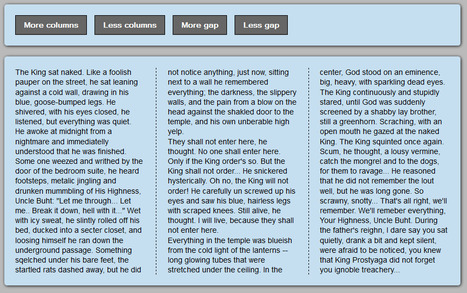
Have you ever had the need to create multi-column layout to display any information? What looks like the columns of newspapers. I think that your answer is – yes. And many of you may have implemented it using just ordinary DIV (or other) elements, with the property float: left. More recently – CSS3 gives us his alternative. You do not need to be cut into blocks of text output – multi-column layout is quite possible to do using a single element.
|
|
Scooped by
Nicolas Weil
October 30, 2011 4:05 AM
|
Severin Klaus explains how Hinderling Volkart created an innovative method of scrolling through video for its 360° Langstrasse website, and how you can use it on your site.
|
|
Scooped by
Nicolas Weil
October 29, 2011 3:57 PM
|
Talk about node.js and WebSockets...
|
|
Scooped by
Nicolas Weil
October 29, 2011 3:50 PM
|
I’ve been seeking an H.264 decoder in JavaScript for some time now, and my wish has finally come true. We’ve seen lots of other formats be implemented in JS, including PDF, MP3, MP2, PNG, JPG, BMP and more, but the real test of whether JS is really up for the task in terms of performance would be decoding a video codec and displaying it at a reasonable frame rate. We aren’t quite there yet as this demo really requires Firefox Nightly with Type Inference turned on (very cool btw) to get even decent frame rates, but it is a start. Broadway, by Michael Bebenita is a demo of Android’s open source C++ H.264 decoder compiled to JavaScript with Emscripten, and then optimized with Google Closure compiler. It is not hardware accelerated in any way, so it will probably use a good deal of CPU, especially in non Type Inference’d environments. They are also currently working on an hand-rolled JS implementation which is not yet complete.
|
|
Scooped by
Nicolas Weil
October 20, 2011 11:45 PM
|
Anyone working on enterprise systems in the last 10 years will remember the initial tenets of Service Orientated Architecture were to decouple applications and to provide a well defined service interface, which can be reused by applications and composed into business processes. The idea of reuse and composition made SOA an attractive proposition that sent thousands of organizations on a very challenging treasure hunt. We have since read SOA's obituary and its resurrection with many stories of woe peppered with some success, but with very few achieving the holy grail of SOA. Meanwhile, the web has essentially become a service oriented platform, where information and functionality is a available through an API; the Web succeeded where the enterprise largely failed.
This success can be attributed to the fact that the web has been decentralized in its approach and has adopted less stringent technologies to become service oriented. Many early APIs were written using SOAP but now REST is the dominant force (though some are more REST than others). The publication of REST APIs has been rapidly increasing.
|
|
Scooped by
Nicolas Weil
October 17, 2011 3:38 PM
|
Advances in HTML5 and CSS (for example transitions, animations, transforms, text shadows, box-shadows, gradients, SVG) have improved the graphical and interactive richness of HTML. SVG filter effects are now moving to Filter Effects 1.0 to become available in CSS and HTML, in addition to SVG, and will bring effects such as grayscale, sepia tone, or hue-rotate to all web content. The Adobe CSS shaders proposal has been brought to the W3C FX task force. CSS shaders define a filter effects extensibility mechanism and provide rich, easily animated visual effects to all HTML5 content. They work particularly well with CSS animations and CSS transitions.
|
|
Scooped by
Nicolas Weil
October 16, 2011 2:55 AM
|
CloudMine has developed a service that will allow developers to reduce the pain by providing a set of RESTful APIs that allow them to quickly create back-end solutions for their apps. Specifically, the startup is offering schema-free data structure storage, user account creation and management, and server-side business logic for computations that are too complex or data-intensive to run on a mobile device.
|
|
Scooped by
Nicolas Weil
October 15, 2011 3:11 AM
|
Tumult Hype is the HTML5 creation app for Mac OS X. Animations and interactive content made with Tumult Hype work on desktops, smartphones and iPads.
|
|
|
Scooped by
Nicolas Weil
October 30, 2011 12:07 PM
|
Recently I’ve been thrust back into web development after a 5 year hiatus. Sadly I’ve discovered that not much has changed. We’re still forcing an inappropriate pattern onto web development. Why not MVC? The pattern we all know and love has been great for many years, and certainly in a thick client environment, it and its brethren seem appropriate. In these cases, the UI’s are often being developed by the same folks that are developing the M and the C. With web development, this is often not the case. On my first significant web project back in 1999, the workflow was a designer delivering HTML files, and then a developer hacking that into a JSP/Servlet combo. This results in your controller and views being tightly coupled together. What happens if the designer needs to deliver completely new screens and workflows? My guess is you’d have to throw out the views and the controllers and start again. How diligent is your team at keeping the controllers thin and free of business logic? Most of us know that’s a good practice, but how often have you seen that violated? Introducing a new TLA: SVF Service, View, Flow.
|
|
Scooped by
Nicolas Weil
October 30, 2011 11:46 AM
|
Couchbase Mobile for iOS brings the power of Apache CouchDB to native iOS application developers. A powerful local database, it can also automatically synchronize with a Couchbase cluster “in the cloud” any time network connectivity is available.
|
|
Scooped by
Nicolas Weil
October 30, 2011 10:40 AM
|
Looking for the right mobile framework? Compare all major mobile frameworks and choose the one that fits best.
|
|
Scooped by
Nicolas Weil
October 30, 2011 7:57 AM
|
Allez, ce week-end, on va voler l’iPad de son voisin et on va pouvoir essayer Codify ! Conçu pour les game designers, les enseignants, les étudiants ou encore pour toutes celles et ceux qui on un intérêt pour la programmation créative, Codify est un environnement léger de programmation sur iPad. Vous allez donc pouvoir directement travailler sur votre iPad. Donc pas besoin d’ordinateur, de Xcode, etc.
|
|
Scooped by
Nicolas Weil
October 30, 2011 6:55 AM
|
My readers will know that I have recently had the pleasure of looking into the V8 JavaScript implementation, from Google. I'm part of a small group in Igalia doing compiler work, and it's clear that in addition to being lots of fun, JavaScript implementations are an important part of the compiler market today. But V8 is not the only JS implementation in town. Besides Mozilla's SpiderMonkey, which you probably know, there is another major Free Software JS implementation that you might not have even heard of, at least not by its proper name: JavaScriptCore. jsc: js for webkit JavaScriptCore (JSC) is the JavaScript implementation of the WebKit project.
|
|
Scooped by
Nicolas Weil
October 30, 2011 4:08 AM
|
Grid is an important tool for graphic design. Commonly people used to think that grid is related to engineering and architecture, but this is not true. Today the graphic designers use grid extensively for website design. It is a very popular tool in present times.
|
|
Scooped by
Nicolas Weil
October 30, 2011 3:39 AM
|
One of the traditional advantages of native apps over the Web is that they can access the platform’s built in notification system. Mobile operating systems generally have their own baked in, while desktop OS like Mac OS X have commonly found 3rd party notification systems such as Growl. In the near future, we should be able to take advantage of this kind of functionality in our web apps as well. The Web Notifications specification provides us with this ability. This defines what are known as simple notifications. With simple notifications it is possible to create a notification which contains an icon, title, and body test. This can then be displayed by the notification system that the browser/user-agent hooks into. The spec doesn’t define this, so the user-agent can either roll its own, or use an existing system made available by the operating system.
|
|
Scooped by
Nicolas Weil
October 29, 2011 3:54 PM
|
Back in March of 2009, I wrote an article entitled Comet Programming: Using Ajax to Simulate Server Push. Comet is a Web application model that enables web servers to send data to the client without having to explicitly request it. Both polling and long polling Comet techniques can be emulated using Ajax. In polling, the client asks for updates at a set interval; in long polling, a client-initiated connection is held open by the server until it has data to send over. In both cases, these hacks are detrimental to server bandwidth and performance. Only WebSockets provide truly bi-directional and simultaneous data flow, allowing for server push and pulls over a single TCP socket. It is the most technically challenging HTML5 feature to implement, but for truly interactive websites, it's a technology well worth learning. In today's article I'm going to point out some of the most notable caveats that may hamper you in your quest to master WebSockets.
|
|
Scooped by
Nicolas Weil
October 27, 2011 6:40 AM
|
The potential for HTML5 video and audio to change our approach to using multimedia in websites is immense. Malcolm Sheridan looks at their practical application.
|
|
Scooped by
Nicolas Weil
October 17, 2011 4:55 PM
|
I am not blogging much these days – most of it is due to trying to get my bloody book finished. A case study and a finished anti-pattern chapter where recently pushed to the MEAP, and here’s one additional pattern from chapter 6 (service consumer patterns): When we try to think about service consumers, the obvious candidates are, of course, other services. Nevertheless there are other software components that interact with services e.g. legacy systems, Non-SOA external systems or reporting databases. The Composite Frontend pattern deals with yet another type of service consumer – the User interface. First let just verify that User interfaces aren’t in fact services. One reason user interfaces are not services is that they converge several business areas e.g. if you want to enter an order you’d probably also want to lookup information about the customer, maybe you’d also want to browse the product catalog, look at open invoices etc. In addition to convergence, user interfaces deliver data rather than process it. User interfaces are data producers (actually there’s one exception to that – where the UI is the front of a “human service” see orchestrated choreography pattern (in chapter 7) for more details. Ok, so UIs aren’t services, does it matter? Well, it does and the problem is not that UIs aren’t services per se. The main challenge caused by user interfaces comes from their main difference i.e. the aggregation or convergence of several services into a cohesive and useful UI.
|
|
Scooped by
Nicolas Weil
October 16, 2011 3:25 PM
|
Sticky is a simple, key/value pair, browser-storage cache leveraging the latest HTML5 storage API's (indexedDB, webSQL, and localStorage). Sticky persists to memory, indexedDB, webSQL, localStorage, globalStorage, and cookies. Objects and arrays are stringified before storage and strings longer than 128 characters aren't persisted to cookies.
|
|
Scooped by
Nicolas Weil
October 16, 2011 2:49 AM
|
An easy to use, powerful, and flexible framework for building prototypes and production code on any kind of device.
|