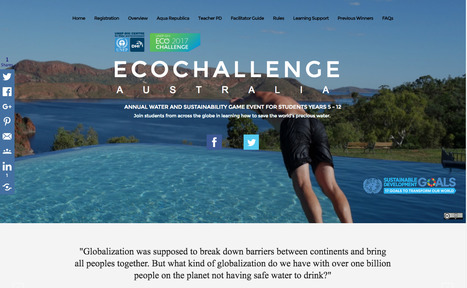
Curtin University embarks upon organising and supporting global challenges - beginning with the UNEP-DHI Eco Challenge 2015. The links connected here should not be seen as endorsements but rather suggested starting points for critical discussions. http://ecochallengeaustralia.com.au
World Water Day, on 22 March every year, is about taking action to tackle the water crisis. Today, there are over 663 million people living without a safe water supply close to home, spending countless hours queuing or trekking to distant sources, and coping with the health impacts of using contaminated water.
Tempers have flared once again over the long-term plan to return water to the Murray-Darling River and improve its health.
The Murray-Darling Basin Authority has released its report into the northern basin (in Queensland and New South Wales). The report finds that the plan, agreed in 2012, has already affected communities. It recommends that less water be returned to the river.
The plan aims to recover 2,750 gigalitres of water from human uses for the environment, but also allows for an extra 450GL to be recovered.
Federal Agriculture Minister Barnaby Joyce has signalled that returning the extra 450GL would be extremely difficult – which has outraged South Australian politicians at state and federal level. In response, Prime Minister Malcolm Turnbull has promised extra monitoring.
While it may seem like a political bunfight, the current argument sheds light on serious flaws in the management of the river.
Dr. Edgar Morin, an eminent sociologist and philosopher, discusses his work on Seven Complex Lessons in Education for the Future, addressing themes related to knowledge, identity and shared global challenges.
AdaptNRM is a national initiative that aims to support NRM groups in updating their NRM plans to include climate adaptation planning. It is part of Stream 2 of the National Resource Management (NRM) Planning for Climate Change Fund administered by the Department of Environment. CSIRO and NCCARF are providing NRM groups with materials and data products about key individual topics that are regionally and nationally relevant.
Adaptation information is delivered at a national level in scale, but are designed to suit regions in order to complement other NRM Fund projects and existing NRM activities that incorporate locally-specific issues and solutions.
Deepika Kurup has been determined to solve the global water crisis since when she was 14 years old, after she saw kids outside her grandparents' house in India drinking water that looked too dirty even to touch. Her research began in her family kitchen — and eventually led to a major science prize. Hear how this teenage scientist developed a cost-effective, eco-friendly way to purify water.
Deepika has done something that many teenagers would not have done. Despite her young age, she is courageous and not afraid to pursue her dream of solving the global water crisis. She integrated her love for science as well as her determination to find a solution to the crisis. After about 4years of research, Deepika has set up a social enterprise to tackle the global water crisis. I am grateful for her courage and determination that has led her on this journey to improve other people's life.
Call-invitation from the Brazilian Amazon! Project greetings Rivers Meeting in afroindígena community, Dry Hair, in Maraba, Para, between the Rivers Itacaiúnas and Tocantins. We belong to the Brazilian Network of Arteducators ( ABRA Network ). Together, we are making Creativity Rivers : cultural action for life . We invite you to collaborate, at home or here in the Amazon! Our goal is to create a world of solidarity pororoca ( know why ), stimulating cultural activities with publication of a minute clips on Facebook and You Tube, between December 20 to January 1, 2017 with the hashtag #RiosDeCriatividade . We will have a second wave on 30 May to 01 June 2017 , ahead of the three - day forum on art education for a sustainable planet, which will take place in Maraba, northern Brazil.
Use these resources to teach your students about the world without leaving your school.
Well into the 21st century, educators, politicians, and industry leaders are still debating the exact meaning of "21st century skills." Although most of us believe today's learners should be able to apply what they have learned in authentic contexts, such contexts are rapidly changing, reflecting a "flat" world with few trade barriers and an expanding global economy (Friedman, 2005). Constant technological advancements provide innovative opportunities for connecting people and sharing information at record speed beyond geographic boundaries.
The International Society for Technology in Education (ISTE) explains that students should "use digital media and environments to communicate and work collaboratively" and "develop cultural understanding and global awareness by engaging with learners of other cultures" (ISTE, 2007). The Common Core State Standards also emphasize the importance of preparing all students for success in our global economy and society. Similarly, the Partnership for 21st Century Learning (2014) argues that students need academic proficiency, as well as an ability to solve problems, think critically, communicate, create, collaborate, and innovate. Further, to gain "21st century citizenship," students must develop global competencies and international understanding (p. 1).
Serious gaming is growing in appeal across the education sector. This article explores gaming as a tool for learning, using the Aqua Republica Eco Challenge 2016 as an example.
Serious gaming is growing in appeal across the education sector. This article explores gaming as a tool for learning, using the Aqua Republica Eco Challenge 2016 as an example.
Gaming as a tool for learning
Games have long been used for developing both skills and knowledge. As digital technologies continue to develop, the range of digital learning games also continues to grow, driving an area of learning called game-based learning. It’s not new, but it is using new digital tools and platforms – and there is an accompanying pedagogical shift from using games to motivate and engage students in learning to using ‘serious games’ as the basis for knowledge and skill development. ‘Gamification’ describes the process of applying game rules to a learning process.
A popular Curtin University science outreach program which tracks fireball trajectories in space has won a prestigious 2016 Australian Museum Eureka Prize.
Fireballs in the Sky won the 2016 Department of Industry, Innovation and Science Eureka Prize for Innovation in Citizen Science category — its second major win in the past two weeks, after taking out the Chevron Science Engagement Initiative of the Year category at the WA Premier’s Science Awards on 18 August.
The Eureka prizes were awarded at a special ceremony in Sydney last night.
The global water crisis has many causes, requiring many different solutions. As 1.2 billion people live in areas of water scarcity, these solutions must span policy, technology, and behaviour change to make a real difference.
A number of technological innovations address the crisis in novel ways. We asked two water experts – Vincent Casey, senior water and sanitation adviser at WaterAid, and Hannah Safford, an energy and environmental policy analyst – to assess some of the most creative approaches.
Recording of the UNEP-DHI Webinar #3 from Webinar Series "Supporting SDG6 monitoring and reporting with Earth Observation"
Water Innovation Webinar #3: Supporting SDG6 monitoring and reporting with Earth Observation (Recorded on September 14th, 2016, 15:00 CEST)
Presenters:
1. Peter Koefoed Bjørnsen (Director of UNEP-DHI Partnership): The global indicator framework for monitoring progress towards achieving SDG6 and data gaps 2. Dr. Benjamin Koetz (European Space Agency Earth Observation Programme): Supporting SDG monitoring with Earth Observation 3. Dr. Christian Tottrup (Senior project manager, DHI GRAS): Earth Observation examples for water resource management and monitoring of SDG on Water and Sanitation
The climate crisis is impacting weather patterns and the water cycle in dangerous ways. Some of these impacts can be hard to understand. Why does climate change increase our risk of both heavy rains and extreme droughts? Aren’t the two contradictory?
Nope! But don’t just take our word for it. Download our Climate Change and the Water Cycle: Four Big Questions Answered e-book and get the answers to these complicated questions and much more.
You already know the basics, now take your climate knowledge to the next level.
Curtin University is proud to announce that it is once again the Australian organiser for participation in the UNEP-DHI EcoChallenge.
Water is essential for all life as we know it. A simple fact that sometimes feels forgotten as political and commercial interests take priority.
UNEP-DHI Eco Challenge Australia provides an exciting and authentic learning experience for students through the online strategic game “Aqua Republica”. Addressing national curriculum priority dimensions of Sustainability and Asia and Australia’s engagement with Asia the experience provides many learning opportunities across social studies, science, humanities, health and physical education, english, geography, and more.
Melbourne’s transport uses 311bn litres of water each year – equivalent to flooding the city’s centre 8 metres deep. That’s just one of the findings of our study looking at how much water different modes of transport use.
We found that cars are the most water-intensive mode of transport, using on average 6.4 litres of water per passenger, per kilometre. Diesel trains use 5.2L per passenger-kilometre (pkm) and electric trains use the least, at 3.4L per pkm.
UNEP-DHI EcoChallenge Australia 2017 kicks off for Term 1. http://ecochallengeaustralia.com.au - Water and Sustainability game for schools - prizes and recognition for achievement.
Well-heeled Peppermint Grove has retained its title as Perth’s biggest water guzzling suburb, with the typical household increasing its use despite shrinking consumption across the city.
Figures from the Water Corporation show that in the 12 months to June 30 last year, the average Peppermint Grove household used 433,000 litres of drinking water, up from 429,000 in the 2014-15 financial year.
The figure was significantly higher than the next placed suburb, Gooseberry Hill, where residents used 372,000 litres of scheme water on average in 2015-16.
Rounding out the top three was Dalkeith, where average consumption for the year was 369,000 litres.
Other suburbs to feature in the top10 were those with big blocks and leafy gardens in the Hills, such as Bedfordale, or in the city’s affluent west, such as Swanbourne and City Beach.
The global conservation movement has reached a turning point. We have documented the fast pace of habitat loss, the growing number of endangered and extinct species, and the increasing speed of global climate change. Yet while the seriousness of these threats cannot be denied, there are a growing number of examples of improvements in the health of species and ecosystems, along with benefits to human well-being, thanks to our conservation actions. Earth Optimism celebrates a change in focus from problem to solution, from a sense of loss to one of hope, in the dialogue about conservation and sustainability.
Bolivia has declared a state of emergency as climate impacts shrink glaciers and leave cities without water.
SÃO PAOLO, 26 November, 2016 − The government of Bolivia, a landlocked country in the heart of South America, has been forced to declare a state of emergency as it faces its worst drought for at least 25 years.
Much of the water supply to La Paz, the highest capital city in the world, and the neighbouring El Alto, Bolivia’s second largest city, comes from the glaciers in the surrounding Andean mountains.
But the glaciers are now shrinking rapidly, illustrating how climate change is already affecting one of the poorest countries in Latin America.
The three main dams that supply La Paz and El Alto are no longer fed by runoff from glaciers and have almost run dry. Water rationing has been introduced in La Paz, and the poor of El Alto − where many are not yet even connected to the mains water supply − have staged protests.
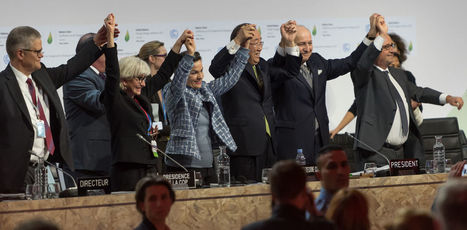
The Paris climate agreement comes into legal force today, just 11 months after it was concluded and 30 days after it met its ratification threshold of 55 parties accounting for at least 55% of global greenhouse gas emissions.
By contrast, the Kyoto Protocol, which this treaty now replaces, took more than 8 years to come into force, slowed by the United States’ persistent and erosive opposition.
At the time of writing, the Agreement has been ratified by 94 parties, including the world’s four largest emitters: China, the United States, the European Union and India. As Climate Analytics reports, these nations account for 66% of greenhouse emissions. Even if the United States were to withdraw its support under a Trump presidency, the Paris Agreement will remain in force.
Water and sanitation: Two everyday necessities many people take for granted. Yet millions still struggle to access clean water and good sanitation on a daily basis.
Photographer Dusan Stojancevic has a unique technique for photographing the world. Rather than aiming his camera at the subject, Stojancevic turns his lens toward its reflection in teensy water droplets.
The product is a gorgeous array of globules containing scenic destinations like Sagrada Familia, the Brooklyn Bridge, Belgrade’s National Assembly, and many more. Stojancevic calls these droplets “microcosmos.”
To get content containing either thought or leadership enter:
To get content containing both thought and leadership enter:
To get content containing the expression thought leadership enter:
You can enter several keywords and you can refine them whenever you want. Our suggestion engine uses more signals but entering a few keywords here will rapidly give you great content to curate.


 Your new post is loading...