Curtin University embarks upon organising and supporting global challenges - beginning with the UNEP-DHI Eco Challenge 2015. The links connected here should not be seen as endorsements but rather suggested starting points for critical discussions. http://ecochallengeaustralia.com.au
THE TIPPING POINT CRISIS is based on the research of Professor Tim Lenton at the University of Exeter, who has identified 12 dangerous "Tipping Points".These have the potential to dramatically affect the performance of the climate system and take us from a stable climate system, to an unstable system with unpredictable weather patterns around the globe.A TIPPING POINT is a critical threshold at which a tiny change can dramatically alter the state of development of a system tipping past a point of no return.
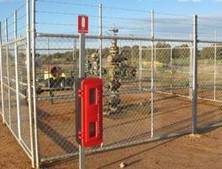
Aquifers earmarked for drinking water between Geraldton and Busselton could be compromised if companies are allowed to drill for gas through them, the Water Corporation has warned.
The State-owned utility also raised questions about why hydraulic fracturing, or fracking, would be permitted in protected water areas when providing drinking supplies was of "paramount importance".
Fracking is still a very contentious mining practice and has raised concerns the world over. Now those concerns are are being raised here in Western Australia.
Scientists have found an elusive mineral pointing to the existence of a vast reservoir deep in the Earth's mantle, 400 to 600 kilometres beneath our feet.
Could this offer some hope in finding a solution to the Global Water Crisis - are we ironically sitting on a vast water supply? The full article is in Nature.
Very good current science to introduce into lessons around water management. Could we possibly crowdsource a solution via citizen science?
Raise awareness of the inter-linkages between water and energy
Contribute to a policy dialogue that focuses on the broad range of issues related to the nexus of water and energy
Demonstrate, through case studies, to decision makers in the energy sector and the water domain that integrated approaches and solutions to water-energy issues can achieve greater economic and social impacts
Identify policy formulation and capacity development issues in which the UN system, in particular UN-Water and UN-Energy, can offer significant contributions
Identify key stakeholders in the water-energy nexus and actively engaging them in further developing the water-energy linkages
Contribute as relevant to the post-2015 discussions in relation to the water-energy nexus.
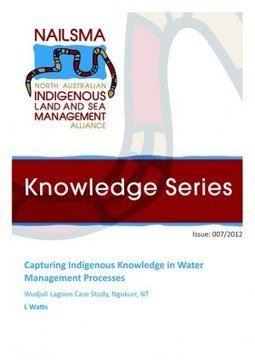
NAILSMA delivered five projects under the NAWFA Cultural and Social Program under the guidance and advice of the NAILSMA Indigenous Water Policy Group (IWPG).
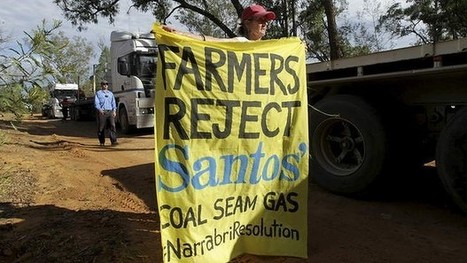
A coal seam gas project operated by energy company Santos in north-western NSW has contaminated a nearby aquifer, with uranium at levels 20 times higher than safe drinking water guidelines, an official investigation has found.
Another issue that raises the importance of knowing how to manage and protect a water supply. Help students learn to take control of their water future at Eco Challenge 2.0 online game event: http://curtin.edu.au/ecochallenge
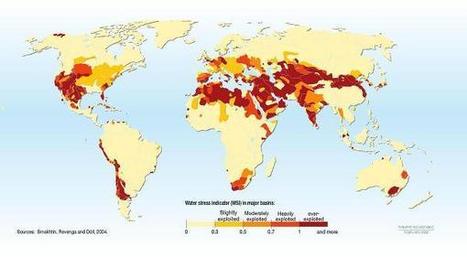
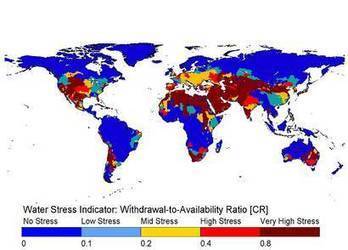
Water overuse is damaging the environment in many major basins. High overuse tends to occur in regions heavily dependent on irrigated agriculture, such as the Indo-Gangetic Plain in south Asia, the North China Plain and the High Plains of North America, and in areas undergoing rapid urbanization and industrial development. An estimated 1.4 billion people now live in river basin areas that are ‘closed’ (in that water use exceeds minimum recharge levels) or near closure. As millions of people in water-stressed areas are discovering, the environment is foreclosing on unsustainable water debts on an extensive scale. For example, farmers near Sana’a in Yemen have deepened their wells by 50 meters over the past 12 years, while the amount of water they can extract has dropped by two-thirds. Some people in water-stressed areas have the economic resources, skills and opportunities to leave their water problem behind. Many millions, such as small farmers, agricultural laborers and pastoralists in poor countries, do not (Human Development Report 2006).
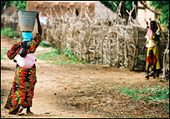
Water is an essential resource for life and good health. A lack of water to meet daily needs is a reality today for one in three people around the world.
Globally, the problem is getting worse as cities and populations grow, and the needs for water increase in agriculture, industry and households.
This fact file highlights the health consequences of water scarcity, its impact on daily life and how it could impede international development. It urges everyone to be part of efforts to conserve and protect the resource.
In this interdisciplinary lesson, we explore ways in which humanity is learning to cope with shortages or threats to water, a vital element of life. We also consider ways in which water enriches our life or helps define our interactions.
In the water, sanitation and hygiene (WASH) sector, Australia’s aid program provides support for development outcomes that are captured under three key pillars identified in the WASH Thematic Strategy. These pillars are:
increased access to safe water and basic sanitation
increased knowledge of hygiene practices
creating sustainable services.
Australia works with a range of multilateral organisations, other governments and the private sector to improve access to clean water, basic sanitation and improved hygiene behaviours in urban, peri-urban and rural areas. We also support improved water security through protection of freshwater sources.
Exploring Community Priorities for Water Use and Supply Options
Water is central to our survival. Ensuring the sustainable supply of water in our state is challenging, and as Western Australia’s climate dries, it is important to consider all current and future water resource opportunities.
Researchers from the School of Psychology and Speech Pathology want to hear from you about your priorities for water use and supply options and we invite you to participate in our online survey. Your participation is entirely voluntary and you can withdraw from the research at any time without consequence. The online survey takes no more than 30 minutes.
By completing the survey you will be entered into the draw to win a 16GB Apple iPad Mini. Entries close at 11.59pm on Sunday 7 September 2014. The prize draw will be held at 10:00am on Monday 8 September 2014.
The ultimate origin of water in the Earth/'s hydrosphere is in the deep Earth[mdash]the mantle. Theory and experiments have shown that although the water storage capacity of olivine-dominated shallow mantle is limited, the Earth/'s transition zone, at depths between 410 and 660[thinsp]kilometres, could be a major repository for water, owing to the ability of the higher-pressure polymorphs of olivine[mdash]wadsleyite and ringwoodite[mdash]to host enough water to comprise up to around 2.5 per cent of their weight. A hydrous transition zone may have a key role in terrestrial magmatism and plate tectonics, yet despite experimental demonstration of the water-bearing capacity of these phases, geophysical probes such as electrical conductivity have provided conflicting results, and the issue of whether the transition zone contains abundant water remains highly controversial. Here we report X-ray diffraction, Raman and infrared spectroscopic data that provide, to our knowledge, the first evidence for the terrestrial occurrence of any higher-pressure polymorph of olivine: we find ringwoodite included in a diamond from Juina, Brazil. The water-rich nature of this inclusion, indicated by infrared absorption, along with the preservation of the ringwoodite, is direct evidence that, at least locally, the transition zone is hydrous, to about 1 weight per cent. The finding also indicates that some kimberlites must have their primary sources in this deep mantle region.
Climate change and other factors external to water management (such as demography, technology, politics, societal values, governance and law) are demonstrating accelerating trends or disruptions. Yet in spite of these challenges and the increasing complexity of dealing with them, we know less and less about water resources and how they are being used. This creates new risks and uncertainties for water managers and for those who determine the direction of water actions
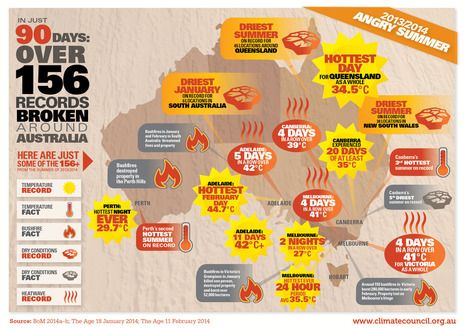
Continuing hot on the heels of the ‘Angry Summer’ of 2012/2013, Australians again endured record breaking extreme events this summer.
Five Key Findings
Heatwaves and hot days, drought and rainfall deficiency, and bushfires dominated the 2013/2014 summer.
Climate change is already increasing the intensity and frequency of extreme weather events in Australia.
Many of our largest population centres stand out as being at increased risk from extreme weather events, including heatwaves, drought and bushfires.
The impacts of extreme weather events on people, property, communities and the environment are serious and costly.
Limiting the increase in extreme weather activity requires urgent and deep reductions in the emissions of greenhouse gases. The decisions we make this decade will largely determine the severity of climate change and its influence on extreme events for our grandchildren. This is the critical decade.
Our Water Our Country An information manual for Aboriginal people and communities about the water reform process
The Aboriginal Water Initiative program aims to improve Aboriginal involvement and representation in water planning and management within NSW. The program allows the NSW Office of Water to monitor the success of water sharing plans in meeting their statutory requirements for Aboriginal specific performance indicators including:
providing water for Native Title rights
recognising spiritual, social, customary and economic values of water to Aboriginal people
Indigenous perspectives are very often overlooked in water management strategies - In some cases in Australia Indigenous communities do have pathways to be heard.
Indigenous perspectives are very often overlooked in water management strategies - In some cases in Australia Indigenous communities do have pathways to be heard.
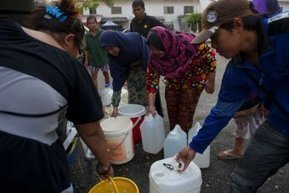
Malaysia will expand water rationing in and around its capital Kuala Lumpur, as a drought continues to affect millions.
The hot spell has also contributed to more cases of dengue fever, as it speeds up the life cycle of the aedes mosquito that carries the virus and enhances replication of the pathogen.
Presentation of the Water Crisis. Overview, concepts, key figures and solutions for the future.
"There is a water crisis today. But the crisis is not about having too little water to satisfy our needs. It is a crisis of managing water so badly that billions of people - and the environment - suffer badly." World Water Vision Report
The National Water Commission is responsible for driving national water reform under the National Water Initiative. We provide independent and public advice to the Council of Australian Governments (COAG) and the Australian Government by assessing, auditing and monitoring water reform progress.
Australia is at the forefront of a global water crisis. Some of the management lessons learned there could help bail out California and other parched regions before they meet the same fate
The New York Times documents a global picture of the water crisis. The US is currently facing challenges to water supplies across the country highlighting that this isn't just a problem for the developing world.
Let your students develop their understanding of the situation:
To get content containing either thought or leadership enter:
To get content containing both thought and leadership enter:
To get content containing the expression thought leadership enter:
You can enter several keywords and you can refine them whenever you want. Our suggestion engine uses more signals but entering a few keywords here will rapidly give you great content to curate.


 Your new post is loading...





















Eco Challenge 2.0
http://curtin.edu.au/ecochallenge