Robin Good: Here is the official presentation that Beth Kanter delivered yesterday, accompanied by a curated bundle of user contributions (mostly tweets) and relevant resources (stats, some visuals and other resources) outlining the key benefits that content curation can bring.
To do so, she used Storify.com which allowed her to pull in the most relevant and interesting tweets that had been posted during her webinar, as well as other relevant resources on the topics she covered.
My three picks from this Storify bundle:
- Mindless sharing is not content curation (Dara Goldberg)
- RT @ntenorg: Good content curators don't just share or collect links, they explain & make sense of a particular topic for others. (Steve Heye)
- ...@hjarche Seek-Sense-Share (PKM) model, he offers an online workshop bit.ly/HPV07M
Robin thanks so much for highlighting the storify summary - I did that right after the session because I wanted to do a quick content analysis of the tweets and see what resonated. I also did the same for the chat logs so I could gather up the questions and make sure they were answered. The session was based on an article I wrote recently on why content curation - real content curation as you describe it - can benefit nonprofits. How it can enhance staff expertise and reduce information overload. Here's a blog post that wrote sharing some of the other resources, including many of yours. http://www.bethkanter.org/?p=5690
"Do you suffer from information overload? Do you find it difficult to organise and process the things you find online so that you can apply them productively in your day-to-day working life?"
An interesting and personal account of curation for learning. According to the author, curation tools are used to facilitate the core practical tasks which anyone working on an information rich environment does: collecting, sorting, evaluating, and sharing information.
Robin Good: ROCKZi is a new social news discovery and sharing service launched by the human curated search engine Blekko.
The service intelligently leverages the great work done by its own human curators to generate a thematic news board that is an hybrid between the experience of Pinterest and the one of Flipboard.
From GigaOM: "...taking a cue from from other popular curation sites, ROCKzi was built to bring curation to a wider set of users through low-touch, passive curation tools.
The site surfaces fresh content from news sources curated by power blekko users and displays articles in topic-specific, searchable “news boards,” from “Geekery” and “Glitterati” to “SportZ” and “Red State.”
As of now, there are 33 boards but, over the next few weeks and months, it plans to expand to hundreds and then thousands more."
N.B.: Not only you can browse and discover news through the existing boards, but if you scroll below them, you will find a search box that allows you to dive and find news on ANY topic you want. Examples:
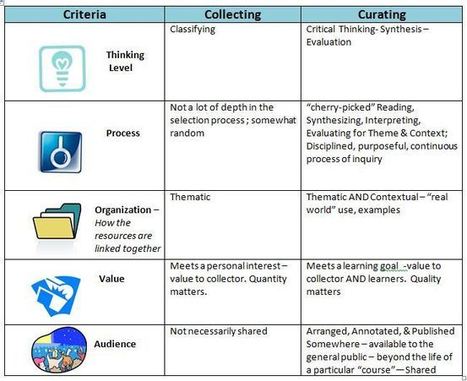
Robin Good: What does curation mean from an educational viewpoint? And what is the key difference between "collecting" and "curating".
Nancy White (@NancyW), a 21st Century Learning & Innovation Specialist and the author of Innovations in Education blog, has written an excellent article, dissecting the key characterizing traits of curation, as a valuable resource to create and share knowledge.
She truly distills some key traits of curation in a way that is clear and comprehensible to anyone.
She writes: "The first thing I realized is that in order to have value-added benefits to curating information, the collector needs to move beyond just classifying the objects under a certain theme to deeper thinking through a) synthesis and b) evaluation of the collected items.
How are they connected?"
Excellent definition.
And then she also frames perfectly the relevance of "context" for any meaningful curation project by writing: "I believe when we curate, organization moves beyond thematic to contextual – as we start to build knowledge and understanding with each new resource that we curate.
Themes have a common unifying element – but don’t necessarily explain the “why.”
Theme supports a central idea – Context allows the learner to determine why that idea (or in this case, resource) is important.
So, as collecting progresses into curating, context becomes essential to determine what to keep, and what to discard."
But there's a lot more insight distilled in this article as Nancy captures with elegance the difference between collecting for a personal interest and curating for a specific audience.
She finally steals my full endorsement for this article by discretely inquirying how great a value it would be to allow students to "curate" the domains of interest they need to master.
Robin Good: I agree. Curation is an autonomous process of collective intelligence, where you and me, and all the others who sift and select from the ocean of information passing through them, unconsciouly help our global brain, to make sense of the information we have ourselves created.
Even those who simply like, share or retweet, contribute to this process, by gradually filtering and marking what is most interesting and relevant to them.
Evolver.fm writes on Wired: "There’s too much stuff. We can help each other find it. This is what the age of curation is about.
Yes, it’s amusing to make fun of people who seem to retweet other people’s links all day, but that’s giving all of those retweeters and Likers too little credit by far.
What they’re really doing is strengthening connections in the global brain, in much the same way the axons and dendrites in our brain grow and lose connections to shape our minds."
"Content curation is the natural evolution of our globally networked consciousness.
This sounds like a bunch of hippie drivel, but we really are creating a global brain, of sorts, by encoding human knowledge and tracking human activity.
Using the human nodes of this network to strengthen some of these connections while weakening others (by choosing either to pass along i.e., ‘curate’ information or not to pass it along) helps this global brain function better as a system, which in turn increases its power whenever any of us need to tap into it.
...
When we curate, for whatever reason and in whatever form, we are enhancing a connection in the global neural network we are inadvertently creating."
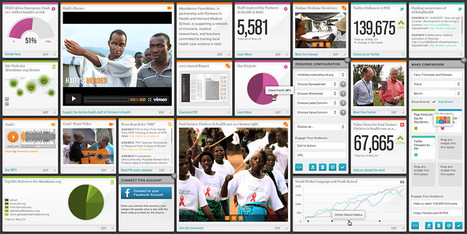
Robin Good: Sparkwise is a new, open-source free web service which allows you to assemble and curate beautiful looking data-dashboards containing the most relevant info and data about a person, a company or an issue. You choose.
How does it work.
You simply connect your social accounts to Sparkwise and then you start to drag and configure the widget buttons representing different data types onto your page. For example you can drag a Twitter Fan Count widget and specify for which Twitter account you want that widget to display the data. There are widgets for just about anything from Twitter, Facebook, YouTube and Google Analytics statistical counters to any data, image or video coming from other sources. You can even type in your own data.
You can create as many dashboard/pages as you like, and publish only the one you want, while keeping control of which widhets and data everyone gets to see.
If you want to create visual engaging story-pages with lots of data to support your focus, this is really a great tool to explore.
I just had an epiphany reading this article that explains how curation is the shaping out of a global brain for mankind. I've used this analogy in the past (such as recently in this TechCoktail interview) and I've always thought I was maybe sounding a bit crazy.
Well, good to see I'm not the only one. Thanks Eliot van Buskirk: you just made my day!
And as I said in the comments on this post, the other important point that's happening is that human curators are not just passing the information: they enrich it. With context and meaning to a particular audience. So yes, this global brain we're building will be smart.
Firstly, I must apologize for not reading the links in the post, however, I am not sure that I need to to understand the gravity of the epiphany. We are all curators of our own minds, and as an extension of our mind, we curate similarly online and in person. A properly cultivated idea can grow into a sort of "universal mind", or even a "universal mankind". These are not original ideas. I do not believe in original thought. What I do see is that social media has had the communicative effect on human beings that has been unrivaled since the development of the alphabet.
@Scott - The idea in the article is that curators pass ideas in a similar manner to neurons and synapses in the human brain, forming a global brain. An idea which isn't new but which could be taking shape with the Internet, social media and... curation.
Once installed in your browser, Markerly lets you grab text from any website and add it to your books. When you mark from a website, we automatically grab the source link so we can credit the original creator.
Schoox is an Academy for Self-Learners where members can teach, learn and certify their knowledge online. Users can create private or public online courses by using files or web resources incredibly easy and in seconds.
KF: This approach blends together curation, OER and independent learning. In conjunction with a good badge system there is making of an informal alternative to any educational sector.
1 -What is Pinterest 2- How does Pinteres work ? 3- Pinterest Tips 4- Some suggestions on teachers can use Pinterest 5- Pinterest for professional development 6- Some prominent educational Pinner to follow 7 Pinterest tutorials 8- Webliography ( links for further reading )
"My top three preferred platforms for sourcing and sorting through qualified curators and their content are Twitter, Scoop.it and Google Plus" says Debra Askanase on the Socialbrite blog.
It's interesting to read how she explains her daily routine with Scoop.it which involved both publishing and following topics she has a professional interest in. "If you have only 30 minutes each day to read the latest news in your industry, start with Scoop.it; it serves up the newest information in a very readable format."
Check out her topics, including Facebook research and best practices.
"Evernote is a great web service and software application that we can use in education. A lot of ink has been shed on this topic and just one click in a search engine is enough to get hundreds of links to guides and tutorials about Evernote. I have been going through so many of these resources and have collected ideas, videos, notes and many more. If you are a loyal reader to my blog ( I am glad most of you are ) you would clearly notice that guides I write here are different in that they are simple. to the point, address teachers and students direct need, and most of all written in an easy and simple language. In this regard, I am working on an ebook that will contain all the guides I have posted here so far but will be available for free only to my subscribers. Without any further ado, let us get back to our guide."
KF: Another collection/curation tool in the style of Pinterest. This one is created for the Edcuation sector and focuses on collecting and sharing educational resources.
Sherry Stones is presenting the workshop: “A Flipped Classroom: Students as Curators with Storify”.
Storify will be used to demonstrate design multimodal/multimedia research-based assignments, due to its features such as Hashtag specific Tweets, Flicker and Instagram images, Soundcloud audios and Youtube videos.
Most of the expected outcomes of the workshop can be associated to teaching and learning in general.
Important ideas:
a) Storify has a great educational potential;
b) You can organize Storify content based on theme or topic;
c) You can easily embed Hashtag specific Tweets, Flicker and Instagram images, Soundcloud audios and Youtube videos;
d) It helps students develop research, synthesis and presentation skills;
f) It helps students to evaluate the credibility and relevance of web sources;
g) It enables teachers to set assignments and rubric;
h) You can embed a Storify page into a Blog;
i) Other types of Open Access Content are great for embedding on Storify, such as: Xtranormal, Goanimate, Animoto animations; Infographics and Flicker images; Google Docs; Vimeo, Big Think, and Academic Earth videos; Webcomics; Prezi and Google Slideshows; Learning Objects.
Great pick by Jan Gordon and a vribrant defense of Twitter as way to do research, mutual curation and smart... cocktail parties!
Nigel Cameron says in this post he doesn't like "the thought of “one great inter-connected world brain,” language proposed by the editors of a National Science Foundation volume a decade back." But reading him (and as he also admits), I couldn't help but think about this previous post on how curation might be shaping the global brain.
gdecugis
Great minds think alike, I liked the 24/7 cocktail party too:) yes it was great chatting with you at the #140 last year, I missed you this year:)
Robin Good: Many content curation tools promise to make your content publishing job easier, faster and better. But is it really so? Does less work and more automated aggregation/filtering guarantee a higher quality result?
Christa Carone writes on Fast Company: "New content curation tools make automating the job easier--but easy may not always be as effective.
It would be a mistake to let algorithms do the entire job for you. No one knows your audience like you do.
And, keeping the human touch in the process is more real, which is really important to today's info-overloaded consumer."
Yes, the human touch. Not the human click to rapidly share, repost or reblog. The human touch as in the act of adding value in ways that go beyond being someone who passes on interesting items.
And to achieve that, someone needs to manually stop, research, read, check and contribute something of value. it doesn't happen automatically.
"The companies that are truly winning over audiences and driving consumers are the ones that are experimenting with a balance of automated aggregation and human-directed curation.
It's a process of out-sourcing and in-sourcing.
I've been following Intel's approach. It recently launched iQ, an employee-curated digital magazine created to connect with a younger audience and share with them the bigger, living brand story.
Not only does the site provide original stories about tech, it also aggregates top tech stories from other sites that Intel's audience will find interesting... all closely watched by editor-in-chief Bryan Rhoades, who spurs conversations by judiciously placing some stories on the iQ homepage.
NASCAR, too, is experimenting in this space. A partnership with Twitter includes a site that compiles #NASCAR-related tweets from popular drivers, who send 140-character blasts from the track or wherever they may be-- along with those from sports writers and other industry folks.
They pull it off by using a search algorithm and human editors who understand narrative---and appropriate content."
Robin Good: Next Tuesday, July 10th I will be running a live online workshop on "content curation for education and learning" as part of the e/merge 2012 web conference.
My session (90 mins.) will focus on defining curation within an educational/learning context and analyzing the factors that will rapidly make curation a major new interest area. I will look at the key benefits that content curation may bring, as well as at the types of content curation that are possible and the key tools available to do it.
I will finally showcase a few interesting examples of curation at work, before diving into a "live" collaborative session in which I will be joined by participants in the creation of a collection of great examples of curated content for education/learning.
A follow-up Q&A session is sheduled for the following week on Tue 17 at 12:15 GMT+2
e/merge 2012 is the fourth virtual conference on educational technology in Africa and builds on the e/merge conferences in 2004, 2006 and 2008.
e/merge 2012 which takes place online from 9 – 20 July 2012, is primarily designed to share good practice and knowledge about educational technology innovation within the further and higher education sectors in the region, as well as to strengthen communities of researchers and practitioners.
The e/merge 2012 conference is organised by Tony Carr and the Centre for Educational Technology at the University of Cape Town.
Robin Good: Everytime I see a new post or article claiming to list the best content curation tools I know I am in for some disappointment.
Most of these lists just pick up names from other lists without even bothering to check, test or verify what these tools actually do, whether they are still available. Unfortunately the rush to put out "curated" list of tools and services has created more misinformation than useful lists.
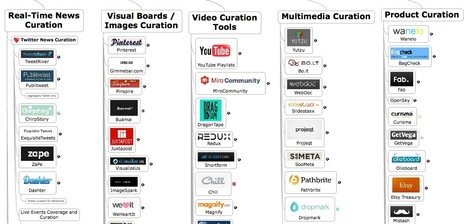
But if you, like me, are on the lookout for new and effective tools to curate your own content or the one of your customers, I have created a comprehensive map of all the curation tools available online and I keep it fresh and updated almost on a daily basis.
The map presently lists over 250 content curation tools which you can navigate much more easily than it was possible on my earlier versions of this map.
On the right side of the map you will find all of the news and content curation tools available online today. On the left side, you can find bookmarking, link lists builders, clippers and lots of tools to operate with RSS feeds (which are still at the heart of a curator's job).
Hello there, You have done an incredible job. I will definitely digg it and personally suggest to my friends. I am sure they’ll be benefited from this web site.<a href="http://downjustforme.com/"; rel="dofollow">is this site down</a>
Robin Good: Mural.ly is an infinite visual canvas that can be used to create visual maps, digital posters, collections of information resources, images and video clips.
Mural.ly makes it particularly easy to search the web and to import any image, video or content clip you decide to use.
"Often, I come across websites that re-publish or link to my articles here on MakeUseOf. This is how I discovered Scoop.it!"
This is how Bakari Chavanu introduces a very complete review of Scoop.it on MakeUseOf.com. We always like to see awareness for the platform grow virally as well as site publishers embrace it and write about us. And we also feel great reading "the setup was easy and there are a few easy-to-use features that enable you to populate your page very quickly."
"You find a link to an article about Route 66 and aspire to plan a road trip. You watch a video about cliff diving and wonder if you have what it takes. You uncover a photo of your grandma and decide to explore your family tree. You hear about a cool event and want to invite friends to join in the festivities.
So you create a Mightybell space.
You invite friends to bring their ideas.
You explore the possibilities together.
Your curiosity grows into a passion.
Repeat often to bring more color to life."
KF: An extension of the current trend of curation tools that actively engages group interaction as part of the process.
AcademicPub provides real-time copyright clearance and an ever-expanding content library along with the ability to add your own materials and articles from t...
<- seemingly a way to curate a textbook for academics... Needs further exploration. #curation
To get content containing either thought or leadership enter:
To get content containing both thought and leadership enter:
To get content containing the expression thought leadership enter:
You can enter several keywords and you can refine them whenever you want. Our suggestion engine uses more signals but entering a few keywords here will rapidly give you great content to curate.


 Your new post is loading...