Robin Good: Databib is a collaborative, annotated "bibliography of primary research data repositories" which allows anyone to easily find, access and download records from open research data repositories.
"Users and bibliographers create and curate records that describe data repositories that users can search."
Databib has been developed with support from the Institute of Museum and Library Services.
Robin Good: If you want to question your well-established assumptions about how we may want to satisfy our insatiable craving for news in the age of filters, algorithms and personalization, this is an article I highly recommend you to read.
Jonathan Stray, on NiemanLab, looks into a tough question: assuming we really need to keep ourselves updated via the news, in this age of superabundance of information, "who should see, what, when?".
In his effort, he does an excellent job of clarifying two very critical points, that both journalists and media tend to easily overlook when they try to look at the future of news journalism and its business models:
1) There is more than one audience. The internet is not about broadcasting to a mass audience, but rather a medium to precisely intercept a group of people characterized by a common interest or by an issue that affects them.
2) The news isn't just what's new.
"...journalism came to believe that only new events deserved attention, and that consuming small, daily, incremental updates is the best way to stay informed about the world.
It’s not.
Piecemeal updates don’t work for complex stories.
Wikipedia rapidly filled the explanatory gap, and the journalism profession is now rediscovering the explainer and figuring out how to give people the context they need to understand the news."
Indeed the context and the level of personalization does determine the usefulness and value of any news service to its end users. Thus,
as he rightly writes, "Journalism could be a reference guide to the present, not just a stream of real-time events." and it is hard not to agree with such a vision.
Mr Stray suggests then the use of three specific criteria to identify which news we should be exposed to. He writes: "Three key words should determine who gets served what: Interest, effects, and agency" and then provides a detailed explanation of the "why" behind these.
Finally, he goes on to suggest that: "...we’ll need a combination of human curators, social media, and sophisticated filtering algorithms to make personalized feeds possible for everyone.
Yet the people working on news personalization systems have mostly been technologists who have viewed story selection as a sort of clickthrough-optimization problem.
If we believe that news has a civic role — that it is something at least somewhat distinct from entertainment and has purposes other than making money — then we need more principled answers to the question of who should see what when."
A collaborative map of great examples of content curation at work in education.
KF: This Mindomo presentation is worth seeing siomply for the way that it represents its topic. The tool itself can be used fro curation and live presentation; the examples offered are quality examples of curation on a variety of platforms.
Robin Good: Here is a good example of video curation at work. CoFounder.tv is a video web site curating only the best and most inspiring entrepreneurship video clips. From startuppers, to investors and VCs, the growing collection strives to bring together a variety of viewpoints from those who have been there.
The curated video site is maintained by Rony El-Nashar, a VC at Dubai based SeedStartup, a startup accelerator and seed venture fund that invests in early-stage startups from all around the world.
He writes: "My goal with Cofounder TV is to build a resource that educates and inspires entrepreneurs globally."
Right on track. A pioneering example of what you are going to see in place of blogs soon. 9/10
Images like the following ones, visualize for me the urgency for all of us to become information literate to wade through the incredible, ever increasing, amount of information being created and shared with the world.
A community resource guide to data curation in the digital humanities...
This is the first stop on your way to mastering the essentials of data curation for the humanities. The Guide offers concise, expert introductions to key topics, including annotated links to important standards, articles, projects, and other resources.
The DH Curation Guide grew out of a needs analysis study of data curation at digital humanities centers conducted by the Data Curation Education Program for the Humanities (DCEP-H) at the Graduate School of Library and Information Science (GSLIS), University of Illinois, Urbana-Champaign, which has been generously funded by a grant from the Institute of Museum and Library Services (RE-05-08-0062-08). In the course of interviewing directors and senior-level staff of centers engaged in digital research in the humanities, project team members identified a clear need for a collection of reviewed, trusted resources for basic information on issues related to data curation. The DH Curation Guide is an initial contribution toward meeting that need.
KF: This is an interesting academic document about curation. I can see the next big step will be for it to reflect the shift in digital curation technologies and look at the crowdsourcing approaches that are evolving.
Robin Good: Start this video clip at 1':42" (up to 3':30") and you can get a pretty good idea of what a content curator does and why what he does has so much to do with sense-making, making things understandable for others and ultimately extracting contextualized "meaning" from information "as is".
Must-see. Excellent. 9/10
P.S.: Thanks to Howard Rheingold for spotting this clip and sharing it.
Excellente vidéo sur le concept mapping avec un exemple sur le cheminement de l'information à l'action (début à 1'42). Merci à Robin Good et Howard Rheingold pour le partage.
Robin Good: Steve Buttry, who has already written several articles on content curation (see the end of his original article), just published this in-depth essay celebrating the launch of a new curation team at Digital First Media and pointing to many of the critical factors neeeded for a content / news curator to be effective.
He covers a lot ground while giving a particular emphasis to the importance of linking and attribution. He writes: "Where you can’t learn much about the source of content you’re curating, consider crowdsourcing the question: Note the name and organization, tell readers what you’ve found and that you’re continuing research and ask them what they know about the source.
Where the source of online content is unclear, you should be clear about what you know and where you found the material."
and...
"Sometimes the name of a person or organization is not sufficient attribution.
If the person or organization is not well-known, do a little research (Google will provide quick answers in many cases; sometimes an “about us” page will help).
Especially in political content, you want to note whether you are linking to partisan sources. A liberal or conservative think tank or political action committee is an entirely different kind of source from a professional media outlet or an independent fact-checking site."
Steve Buttry also includes some valuable key guidelines on "how to add value" when curating content and suggests several types of curation approaches that can be used in the newsroom.
Using Scoop.it as your search field is a handy way to search a large number of curated articles. Since the articles are selected by individual 'experts' you tend to get a better set of initial results than you might find with a Google or Bing search. ~ Dennis
It seems as though when one technology tool for the classroom is introduced, another one is waiting to make its debut! We’ve shared several 21st century tools with our readers; however, we have not acquainted you with a recent tool, Pinterest.
Pinterest is an electronic bulletin board where users can “pin” images from around the web. These images are then categorized into various boards on the users’ profile. Pins are also shared and searchable, which makes Pinterest a wonderful resource for visual information. So what are these pin boards good for with regards to integrating them into the classroom?
Robin Good: Clipix is a Pinterest-like clipping and collection app which allows you to capture images and content from any web page and to organize it in custom visual boards.
One key feature that differentiates Clipix from Pinterest (though it is likely that Pinterest will add this feature soon as well) is the ability to organize together multiple sets into a "multiboard".
Other key features include a "Price Drop Alert" which emails you when the price of one of the commercial products you have clipped drops and
"...For example you might have a multiboard that you call “Recipe Ideas” and inside you’d have 3 clipboards: Baking Recipes, Soup Recipes, and Health Recipes.
The easiest way to create a multiboard is by dragging one clipboard from the icon in the lower right-hand corner into another clipboard."
Thank you Lelapin. The world is beautiful because it is varied. Pinterest will soon lose its "mojo" to many of these more specialized clones, which will provide more immediate value to those specifically interested in that specific area or application. I may be wrong but this is what I expect to happen.
Robin Good: PKM or Personal Knowledge Management may be indeed a very close relative to Content Curation. But while Content Curation, is done with a specific audience in mind, PKM is done for one's own learning.
Harold Jarche, looks at the relationship between the two and writes:
"The most important part of personal knowledge management (PKM), in my opinion, is the need for active sense-making.
Merely seeking and sharing information does little other than create more noise online.
Sense-making takes time, discipline, and effort.
-> One strength of PKM is the “manual” nature of sense-making activities. The act of writing a blog post, a tweet, or an annotation on a social bookmark all force you to think a bit more than clicking once and filing it to an automated system.
-> Sense-making, or placing information into context, is where the real personal value of PKM lies.
-> The knowledge gained from PKM is an emergent property of all its activities.
Merely tagging an article does not create knowledge. ...
The difference between PKM and Curation is that the former is personal, while the latter is for an intended audience."
I have been using his framework for the past year and a half to teach curation to nonprofits. Linking curation to nonprofit staffer work flow is a great way to get people to use curation!
Robin Good: Springpad is both a web and a mobile app that you can use to curate visual collections on any topic.
Unlike Pinterest and similar visual boards, Springpad allows you to add just about any type of content to a collection while it auto-enriches it everytime possible with additional contextual information.
For example if you include a book or a movie into a collection Springpad will gather and display relevant information next to it (author, description, reviews, where to buy it, etc.).
Springpad boards are called "notebooks" and they can be personalized in their look, and made private or public. You can also invite additional contributors and offer a customized providing different views of your collection.
Content can be added to a "notebook" via standard bookmarklet or by using an internal search feature which gathers all types of relevant content.
Works right in your browser and in your favorite smartphone or tablet (iOS and Android).
This post, by Nancy White, highlights some of the most important reasons why learners should embrace curation to facilitate sense-making and knowledge creation.
We live in a 24/7 InfoWhelm world. We have access to more information than we will ever need. This video will tell you just how much information there is out there. It requires a different set of skills than the ones we leave school with today.
Robin Good: If you are looking for new RSS feeds of quality news sources to curate your own newsradar, the RSS Search Engine by Digital Inspiration may come to the rescue.
This free and easy to use RSS search engine, makes it very easy to search for your preferred keywords-keyphrases and it spits out instantly a selection of ten RSS feeds covering, at least in part, that very topic.
From the official site: "The RSS search engine will help you discover the most popular feeds on the web around your favorite topics. You may find blogs, news websites, podcasts, Twitter accounts and more."
Digital curation has grown rapidly on the Internet and there has been strong uptake in all fields of education. Many academics see curation of their subject matter expertise as a passion to be shared with their students and similarly interested people via the Internet. This newsletter will introduce the concept of academic digital curation and explain how to use one of the available tools to start your curation collection.
In interview Robin Good, that master of new media (http://masternewmedia.org) about curation -- what it is, what it requires, why it's important, how to do it.
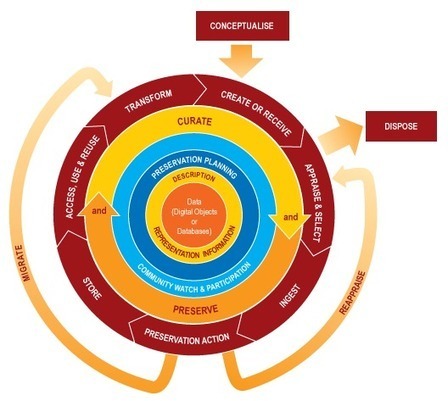
Robin Good: Data (or Digital) Curation, is an academic/scientific discipline dedicated to preserve, organize and collect digital documents and other electronic artifacts for archival, re-use and repurposing objectives.
The importance of Data Curation can be easily underestimated as it may appear, to the casual viewer, as an arid, tedious document archival job.
In reality, Digital Curation efforts are of great value to the preservation of important cultural documents and data for future researchers who will want to access, in some organized way, the data-information-artifacts of our time. In addition, the data curation practices and guidelines developed by academic and research institutions can also be of value and inspiration to other types of curation work, that may adopt, emulate or innovate upon them.
If you are interested in learning more about Data/Digital Curation and in identifying the key organizations in this space, here is a good shortlist for you, thanks to the kind work of Kevin "the Librarian" Read:
University of Arizona – Digital Information Management University of Illinois – Data Curation Education Program University of North Carolina – DigCCurr University of Virginia – Scientific Data Consulting
Digital Curation Centre Digital Curation Exchange International Journal of Digital Curation Purdue-UIUC Data Curation Profiles Project
Author: Audrey Williams of Pellissippi State Community College Everybody collects something and we all organize our collections in our own way. “Growing up” on the web means that most of us...
Robin Good: Must-read article on ClutterMuseum.com by Leslie M-B, exploring in depth the opportunity to have students master their selected topics by "curating" them, rather than by reading and memorizing facts about them.
"Critical and creative thinking should be prioritized over remembering content"
"That students should learn to think for themselves may seem like a no-brainer to many readers, but if you look at the textbook packages put out by publishers, you’ll find that the texts and accompanying materials (for both teachers and students) assume students are expected to read and retain content—and then be tested on it.
Instead, between middle school (if not earlier) and college graduation, students should practice—if not master—how to question, critique, research, and construct an argument like an historian."
This is indeed the critical point. Moving education from an effort to memorize things on which then to be tested, to a collaborative exercise in creating new knowledge and value by pulling and editing together individual pieces of content, resources and tools that allow the explanation/illustration of a topic from a specific viewpoint/for a specific need.
And I can't avoid to rejoice and second her next proposition: "What if we shifted the standards’ primary emphasis from content, and not to just the development of traditional skills—basic knowledge recall, document interpretation, research, and essay-writing—but to the cultivation of skills that challenge students to make unconventional connections, skills that are essential for thriving in the 21st century?"
We often ask our students to create annotated bibliographies, and this focuses on their capacity to evaluate and make decisions about the validity, reliability and relevance of sources they have found. using Scoop.it, we can ask them to do much the same thing, but they will publish their ideas for an audience, and will also be able to provide and use peer feedback to enhance and tighten up their thinking. This is relevant to any curriculum area. Of course it is dependent on schools being able to access any social media, but rather than thinking about what is impossible, perhaps we could start thinking about what is possible and lobbying for change.
We often ask our students to create annotated bibliographies, and this focuses on their capacity to evaluate and make decisions about the validity, reliability and relevance of sources they have found. Using Scoop.it, we can ask them to do much the same thing. But they will publish their ideas for an audience, and will also be able to provide and use peer feedback to enhance and tighten up their thinking. This is relevant to any age, and any curriculum area. Of course it is dependent on schools being able to access social media. But rather than thinking about what is impossible, perhaps we should start thinking about what is possible, and lobbying for change. Could you use a Scoop.it collection as an assessment task?
Robin Good: I believe that content curation will play a very important role in the future of education and learning and this presentation-map focuses on this topic.
Robin Good: Good video with Margot Bloomenstein, brand and content strategist, being interviewed and explaining, in very simple terms what "is" and what "it is not".
This is a good introduction to what content curation is, and how it is done as it would be explained to someone who knows nothing or very little about it.
Good material to show to top management, executives and to those who may be a bit skeptical about the benefits of doing it as well as for those who are just starting to explore this activity.
"It’s not about hoarding content indiscriminately, says Bloomstein. You have to have goals in mind from the outset.
Not every bit of content you come across will be relevant to your audience, either.
The content curation process is intended to determine what is and isn’t important, in addition to what your readers want to see. Then, it’s your job to get that content in front of them."
KF: Many of these principles carry across into the education sector. Staff collecting resources for their students will find this an insightful guide, and it will also provide some useful guidelines when asking students to curate a collection.
Robin Good: I believe that content curation will play a very important role in the future of education and learning and this presentation-map focuses on this topic.
I have identified at least ten reasons that are transforming and weakening the education-certification system as it is now, and may rapidly give way to new ways of teaching, learning and getting certified which will likely involve a great deal of curation (both for those who teach/guide and those who want to learn).
In this presentation-map I am introducing the concept of curation for education, the key factors that I see are transforming traditional academic institutions and the learning industry in general, and the tools, resources and examples that are relevant to those working in these fields and wanting to find out more.
As part of my workshop session during the emerge2012 conference in which I have first presented these ideas, I have also created an "open", collaborative wiki-map where, you are welcome to contribute inspiring curated collections. You will find instructions on how to contribute to it at the end of this presentation.
"What is content curation in the context of education and why it is going to be so relevant in the near future. Benefits of content curation, examples and tools."
To get content containing either thought or leadership enter:
To get content containing both thought and leadership enter:
To get content containing the expression thought leadership enter:
You can enter several keywords and you can refine them whenever you want. Our suggestion engine uses more signals but entering a few keywords here will rapidly give you great content to curate.


 Your new post is loading...