 Your new post is loading...

|
Scooped by
Philippe J DEWOST
April 25, 2019 1:11 AM
|
Getaround, the peer-to-peer car-sharing startup that launched at TC Disrupt back in 2011, is making moves to become a global car rental service. Today, the SoftBank-backed startup announced its acquisition of Drivy, a Paris-headquartered car-sharing startup that operates in 170 European cities. “We were obviously looking at what our European strategy was and how we would expand out of the U.S. and into other parts of the world,” Getaround CEO Sam Zaid told TechCrunch. “When we started looking at Europe, it became clear Drivy was the market leader. They also shared the same vision.” This marks Getaround’s first expansion out of the U.S. As part of the deal, Drivy founder and CEO Paulin Dementhon will run the company’s operations in Europe as CEO for the continent. “Getaround is an ideal partner for us because our companies are aligned in so many ways while being complementary on key aspects of our business, like geography or fleet acquisition,” Dementhon said in a statement. “I look forward to seeing what we can accomplish together.” Combined with Drivy, Getaround now has more than five million users. Moving forward, Getaround has its eyes set on becoming a truly global company.
|
|
Scooped by
Philippe J DEWOST
April 19, 2019 7:54 AM
|
AI can generate storyboard animations from scripts, spot potholes and cracks in roads, and teach four-legged robots to recover when they fall. But what about adapting one person’s singing style to that of another? Yep — it’s got that down pat, too. In a paper published on the preprint server Arxiv.org (“Unsupervised Singing Voice Conversion“), scientists at Facebook AI Research and Tel Aviv University describe a system that directly converts audio of one singer to the voice of another. All the more impressive, it’s unsupervised, meaning it’s able to perform the conversion from unclassified, unannotated data it hasn’t previously encountered. The team claims that their model was able to learn to convert between singers from just 5-30 minutes of their singing voices, thanks in part to an innovative training scheme and data augmentation technique. “[Our approach] could lead, for example, to the ability to free oneself from some of the limitations of one’s own voice,” the paper’s authors wrote. “The proposed network is not conditioned on the text or on the notes [and doesn’t] require parallel training data between the various singers, nor [does it] employ a transcript of the audio to either text … or to musical notes … While existing pitch correction methods … correct local pitch shifts, our work offers flexibility along the other voice
|
|
Scooped by
Philippe J DEWOST
April 18, 2019 5:52 AM
|
Interesting bit found in Tesla's latest blog update (highlights are mine) : "Last quarter, we introduced two new Model 3 variants with more competitive pricing than ever before – Standard and Standard Plus. Since then, Standard Plus has sold at more than six times the rate of Standard, far exceeding our expectations. Given the popularity of the Standard Plus relative to the Standard, we have made the decision to simplify our production operations to better optimize cost, minimize complexity and streamline operations. As a result, Model 3 Standard will now be a software-limited version of the Standard Plus, and we are taking it off the online ordering menu, which just means that to get it, customers will need to call us or visit any one of the several hundred Tesla stores. Deliveries of Model 3 Standard will begin this weekend. Its range will be limited by 10%, and several features will be disabled via software (including our onboard music streaming service, navigation with live traffic visualization, and heated seats). Similar to other software-limited vehicles produced in the past, Standard customers will have the option to upgrade to a Standard Plus at any time. Similarly, anyone who has already bought Standard Plus and wants to convert to Standard is welcome to do so, and we will provide a refund for the difference in cost."
|
|
Scooped by
Philippe J DEWOST
April 15, 2019 2:15 AM
|
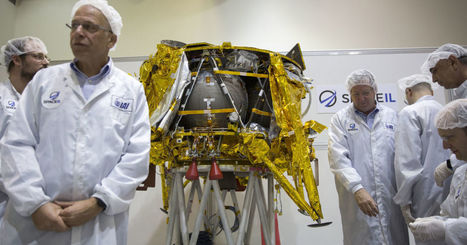
SpaceIL's first attempt at a private Moon landing didn't go according to plan. However, that isn't deterring the team from giving it another shot. Founder Morris Khan has announced that the team will build another Beresheet lander and "complete the mission." The task force behind the new lander will start its work "first thing" on April 14th, he said.
|
|
Scooped by
Philippe J DEWOST
April 11, 2019 8:47 AM
|
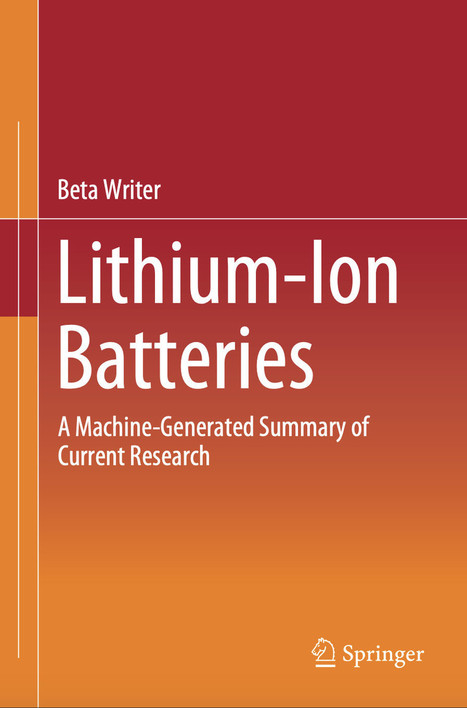
Academic publisher Springer Nature has unveiled what it claims is the first research book generated using machine learning. The book, titled Lithium-Ion Batteries: A Machine-Generated Summary of Current Research, isn’t exactly a snappy read. Instead, as the name suggests, it’s a summary of peer-reviewed papers published on the topic in question. It includes quotations, hyperlinks to the work cited, and automatically generated references contents. It’s also available to download and read for free if you have any trouble getting to sleep at night. “a new era in scientific publishing” While the book’s contents are soporific, the fact that it exists at all is exciting. Writing in the introduction, Springer Nature’s Henning Schoenenberger (a human) says books like this have the potential to start “a new era in scientific publishing” by automating drudgery. Schoenenberger points out that, in the last three years alone, more than 53,000 research papers on lithium-ion batteries have been published. This represents a huge challenge for scientists who are trying to keep abreast of the field. But by using AI to automatically scan and summarize this output, scientists could save time and get on with important research. “This method allows for readers to speed up the literature digestion process of a given field of research instead of reading through hundreds of published articles,” writes Schoenenberger. “At the same time, if needed, readers are always able to identify and click through to the underlying original source in order to dig deeper and further explore the subject.” Although the recent boom in machine learning has greatly improved computers’ capacity to generate the written word, the output of these bots is still severely limited. They can’t contend with the long-term coherence and structure that human writers generate, and so endeavors like AI-generated fiction or poetry tend to be more about playing with formatting than creating compelling reading that’s enjoyed on its own merits.
|
|
Scooped by
Philippe J DEWOST
April 5, 2019 12:18 AM
|
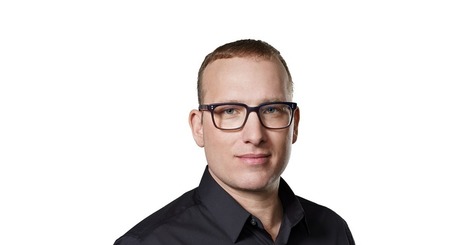
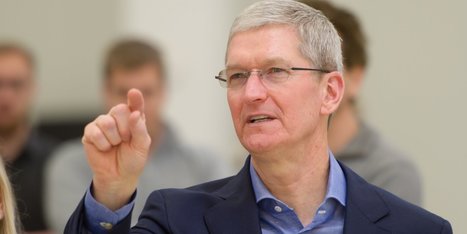
As noticed by Bloomberg, " Apple Inc. on Wednesday added mergers and acquisitions head Adrian Perica to its executive leadership page online, a promotion that suggests the technology giant is more focused on deals. Perica joined Apple in 2009 and was instrumental in deals such as the 2014 purchase of Beats and the investment in China-based ride hailing service Didi Chuxing. He’s an under-the-radar operator who oversees the acquisition and integration of companies that Apple acquires as well as strategic investments. Apple’s website describes Perica as the vice president of corporate development and lists him as reporting directly to Chief Executive Officer Tim Cook. That title is old, but reporting to the CEO is a move up in the company’s hierarchy. Previously, Chief Financial Officer Luca Maestri oversaw M&A. The change comes as some Wall Street analysts are calling for Apple to consider larger acquisitions than it has in the past. Apple bought 18 companies in 2018, with none of them crossing the billion-dollar threshold. "Cook knows it is time to get the deal engine ready," said Dan Ives, an analyst at Wedbush Securities, who has predicted that Apple will do a major media acquisition this year. "They have to accelerate non-existent M&A going forward as we believe they can spend up to $100 billion on M&A over the next few years," Ives added. "Cook is taking much more oversight of deals and retail, and this is just another tea leaf." An Apple spokesperson didn’t respond to a request for comment. Perica is now one of fewer than 20 executives who report directly to the CEO. That group includes Chief Operating Officer Jeff Williams, Chief Design Officer Jony Ive and Maestri. Mike Fenger and Doug Beck, sales vice presidents, report to Cook despite not being featured on Apple’s executive leadership website." -- https://www.bloomberg.com/news/articles/2019-04-03/apple-m-a-chief-now-reporting-to-cook-as-calls-grow-for-big-deal
|
|
Scooped by
Philippe J DEWOST
March 28, 2019 1:34 AM
|
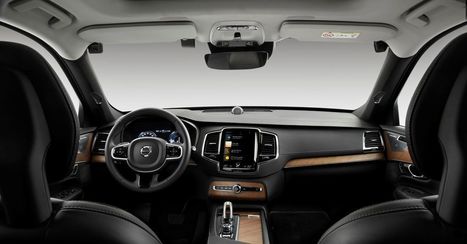
Volvo said on Wednesday it will use cameras installed inside its vehicles to monitor driver behavior and intervene if the driver appears to be drunk or distracted. It’s a risky move by an automaker, even one with a reputation for safety like Volvo, which could raise concerns among privacy advocates.
|
|
Scooped by
Philippe J DEWOST
February 4, 2019 4:46 AM
|
Apple shut down Google’s ability to distribute its internal iOS apps earlier today. A person familiar with the situation told The Verge that early versions of Google Maps, Hangouts, Gmail, and other pre-release beta apps stopped working alongside employee-only apps like a Gbus app for transportation and Google’s internal cafe app. The block came after Google was found to be in violation of Apple’s app distribution policy, and followed a similar shutdown that was issued to Facebook earlier this week.
TechCrunch and Bloomberg’s Mark Bergen reported late Thursday that the apps’ functionality had been restored; Apple appears to have worked more closely with Google to fix this situation. “We are working together with Google to help them reinstate their enterprise certificates very quickly,” an Apple spokesperson earlier told BuzzFeed.
APPLE BLOCKED FACEBOOK AND THEN GOOGLE
Apple’s move to block Google’s developer certificate comes just a day after Google disabled its Screenwise Meter app following press coverage. Google’s private app was designed to monitor how people use their iPhones, similar to Facebook’s research app. Google’s app also relied on Apple’s enterprise program, which enables the distribution of internal apps within a company.
In an earlier statement over Facebook’s certificate removal, Apple did warn that “any developer using their enterprise certificates to distribute apps to consumers will have their certificates revoked.” Facebook’s internal iOS apps have since resumed functioning, as the social network said this afternoon that Apple had restored its enterprise certificate.
Apple is clearly sticking to its rules and applying them equally to Facebook, Google, and likely many other companies that get caught breaking Apple’s rules in the future.
There’s growing evidence that a number of companies are using Apple’s enterprise program to distribute apps to consumers. iOS developer Alex Fajkowski has discovered that Amazon, DoorDash, and Sonos all distribute beta versions of their apps to non-employees. Apple may be forced to take action against these apps, or to even revamp its entire enterprise program in the future.
Update 1/31, 5:45PM ET: Article updated with comment from Google, Apple, and details on other companies using Apple’s enterprise program to distribute apps.
Update 1/31: 6:18PM ET: Updated with the news that Apple has resumed letting Facebook use internal iOS apps.
Update 1/31: 10:30PM ET: Updated with the news that Apple has restored functionality to Google’s apps.
|
|
Scooped by
Philippe J DEWOST
January 8, 2019 9:09 AM
|
Janrain, one of the companies that helped usher in Portland’s technology renaissance a decade ago, sold Monday to a Massachusetts online services company called Akamai Technologies. Privately held Janrain mines information from social networks to help its clients, large retailers and others learn about the people visiting its website. Visitors can use their logins from other sites, like Google or Facebook, to log in to a retailer’s site – and the retailer can then analyze that shared information. Akamai said it will use Janrain’s technology to help its own clients improve their online security by identifying automated bots and limiting their access to online registration features. Akamai said that will help the sites reduce fraud. Financial terms of Monday’s deal weren’t disclosed, but Akamai said it was an all-cash transaction that would reduce its profits by as much as $10 million this year, then add to profitability in future years. Akamai is a publicly traded company that reported $2.5 billion in sales last year, and profits of $218 million. Janrain, which once employed more than 150, now employs 127 -- 92 of them in the Portland office. Akamai said it will retain the Portland site and integrate a small group of its employees already here into Janrain’s office. The companies didn’t immediately say what Akamai will do with Janrain’s Portland office, which once employed more than 150. Founded in 2005, Janrain had raised at least $79 million, most recently in a $27 million round three years ago. The Portland company says it has more than 3,400 clients, including Coca-Cola, NPR and Philips. As social media gained popularity in the years after the Great Recession, Janrain was among Portland’s most promising young technology companies and helped lead the Silicon Forest’s transition from its roots in hardware manufacturing to a new generation of startup providing software and online services. Janrain’s profile was somewhat diminished in recent years, however, as the company refocused amid the changing social media landscape and diminished investor enthusiasm for social networking startups. Monday’s sale followed a string of deals for Oregon technology companies in 2018, including young tech businesses such as Cozy, Exterro, Mirador Financial and Electro Scientific Industries – Oregon’s oldest tech company. The spate of deals reflect the strong national economy and the continued low cost of borrowing, which has helped spur acquisitions and investments in many industries. Additionally, Oregon tech companies – like Janrain – tend to operate in market niches, which make them more likely to be consolidated into larger organizations than to do the consolidating themselves.
|
|
Scooped by
Philippe J DEWOST
January 8, 2019 2:01 AM
|
Japan’s SoftBank has radically scaled back plans for fresh investment in WeWork, the loss-making, shared-office provider, following the recent tech stock rout and concerns among investors in its $100 billion Vision Fund. SoftBank is in detailed negotiations to inject $2bn into WeWork this year, according to two people briefed on the deal, a much lower amount than the $16 billion that had been discussed towards the end of last year. And the deal will now not include the participation of Softbank’s Vision Fund, which had been a major backer of Softbank’s existing investment of more than $8 billion in WeWork. The funding could be announced as soon as this week, according to one of the people, who added that the deal had not yet been agreed and could still fall apart. The scaling-back of the planned $16bn investment, which would have been the largest ever in a tech start-up, underlines the rapid shift in investor enthusiasm for technology shares that is now spilling into even the best-known privately held groups. SoftBank has been instrumental in propping up private market valuations, investing billions of dollars in start-ups from ride-hailing group Uber to dog-walking app Wag. WeWork has been one of the company’s largest bets, garnering billions from SoftBank as the group sought to dominate the fast-growing market for shared office space in cities such as New York and London even as its own losses have ballooned. The negotiations over fresh funding have taken place against a backdrop of a sharp sell-off in equity markets that saw some of the world’s largest technology companies particularly hard hit in recent months. Shares in SoftBank itself have fallen by 33 per cent in the past three months. The company also suffered an embarrassing start to trading for its newly-listed Japanese mobile phone business in late December after raising $23 billion from investors. SoftBank will not gain a majority stake in the shared-office provider, which has become known for specialist coffees and fruit-infused water in its canteens and Instagram-ready art on its walls. WeWork and SoftBank declined to comment. If a deal is finalised, SoftBank will still have pumped more than $10bn into the company, marking one of the biggest bets on a start-up by SoftBank founder Masayoshi Son.
|
|
Scooped by
Philippe J DEWOST
December 19, 2018 12:46 PM
|
Elon Musk has unveiled a prototype underground tunnel in Los Angeles which is designed to transport cars at high speed around the city. The tunnel is only a mile (1.6km) long at the moment but the goal is a network to ease chronic traffic congestion. Modified electric cars would be lowered into the tunnel and travel at speeds up to 150mph (240km/h), Mr Musk says. The tunnel has been built by Mr Musk's Boring Company, which boasts state-of-the-art engineering techniques. Mr Musk, best known as the head of Tesla electric cars and the commercial SpaceX programme, arrived at the launch on Tuesday in a Tesla car modified to work on the "loop" system. He was cheered by a small crowd as he emerged from the car at one end of the tunnel bathed in green and blue interior lights. The plan envisages modified cars being lowered into the tunnel network by lifts and then slotted into tracks on the "loop". "The profound breakthrough is very simple: it's the ability to turn a normal car into a passively stable vehicle by adding the deployable tracking wheels, stabilising wheels, so that it can travel at high speed through a small tunnel," Mr Musk said. .../... Alana Semuels, of The Atlantic, told the BBC World Service that Mr Musk had yet to unveil the technology that would allow vehicles to travel at such high speeds through the system. "At first he said we're going have these tunnels and transport people in pods, now he's saying we're going to transport them in cars, so I'm not sure even he knows how it works," she said.
|
|
Scooped by
Philippe J DEWOST
December 17, 2018 12:15 AM
|
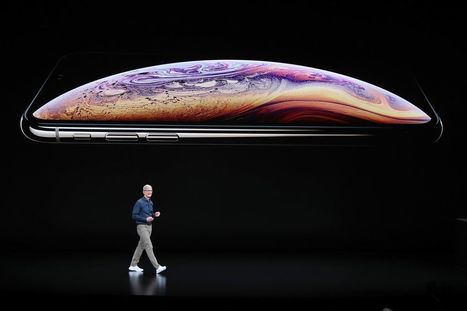
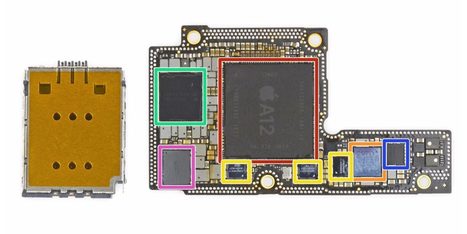
Apple has been expanding its development and use of custom chips over the last few years. Last month we first heard that Apple was looking to poach employees from Qualcomm on its home turf of San Diego to potentially create custom radio chips. Today, a new report from The Information says that Apple is indeed …
|
|
Scooped by
Philippe J DEWOST
December 13, 2018 8:13 AM
|
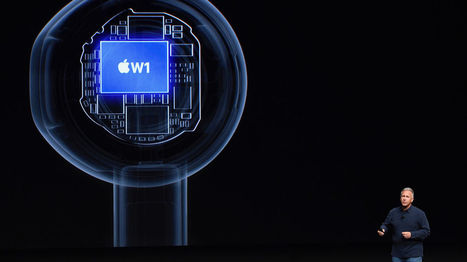
For some time, Apple has been serious about building more wireless components for its own devices, putting its own Bluetooth and Wi-Fi chips into the latest Apple Watches and AirPod earbuds. Now Apple has provided the clearest evidence yet that it is working on one of the most complicated and expensive hardware ingredients in its devices: a cellular modem. In a job listing posted a week ago, which hasn’t previously been reported, the company said it is looking for a cellular modem systems architect to work in its San Diego office. And a person briefed on Apple’s plans confirmed that the company, indeed, has an an active project to build its own cellular modem chip, which connects Apple’s phones to the networks of wireless carriers. Due to the complexity of the chip, it could take Apple as long as three years to ship iPhones with them, analysts said.
|
|
|
Scooped by
Philippe J DEWOST
April 24, 2019 5:24 AM
|
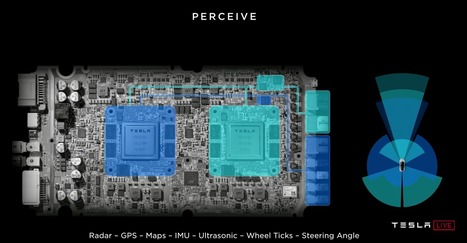
Cleantechnica has compiled the event video plus tons of liveblogging highlights from the event : there is a trove of insight about where Tesla is going and how they are going there. They have designed their own FSD (Full Self Driving system) that doesn't need a LIDAR and "learns" from shadow mode driving of the whole deployed Tesla fleet. This is how they will be able to deploy Robotaxi mode with just a software update. For instance, “Early testing of new FSD hardware shows a 21× improvement in image processing capability with fully redundant computing capability. “This is all done at a modest cost while delivering a fully redundant computing platform to all of Tesla’s vehicles currently in production.” General summary from Kyle: “Our shit is really, really fast and we built it better than anyone else.” Elon notes that Tesla finished this design 1½–2 years ago and then started on the next system design. They are not talking about the next design now, but they’re about halfway through it. Some additional technical notes from Chanan Bos: “An enthusiast Intel desktop i7 processor with 8 cores has 3 billion transistors, Tesla’s new chip has 6 billion. But that is till less than some crazy 18 core Intel ships like Skylake-X which has 8.33 billion transistors. An iPhone has about 2 billion. “So SRAM is much faster but is more expensive and has less storage compared to DRAM. “Nvidia Xavier (available early 2018) had 30 TOPS (Tera Operations Per Second). Tesla’s FSD chip has 144 TOPS.”
|
|
Scooped by
Philippe J DEWOST
April 19, 2019 5:41 AM
|
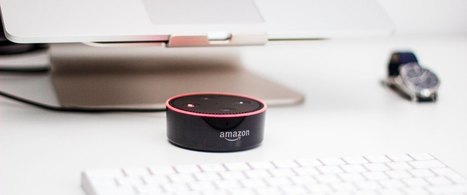
How do assistants like Alexa discern sound? The answer lies in two Amazon research papers scheduled to be presented at this year’s International Conference on Acoustics, Speech, and Signal Processing in Aachen, Germany. Ming Sun, a senior speech scientist in the Alexa Speech group, detailed them this morning in a blog post. “We develop[ed] a way to better characterize media audio by examining longer-duration audio streams versus merely classifying short audio snippets,” he said, “[and] we used semisupervised learning to train a system developed from an external dataset to do audio event detection.” The first paper addresses the problem of media detection — that is, recognizing when voices captured from an assistant originate from a TV or radio rather than a human speaker. To tackle this, Sun and colleagues devised a machine learning model that identifies certain characteristics common to media sound, regardless of content, to delineate it from speech.
|
|
Scooped by
Philippe J DEWOST
April 17, 2019 12:02 AM
|
A new highway in China is being built that will have dedicated lanes for autonomous vehicles. The lanes reserved for self-driving cars will be built on a new freeway connecting Beijing and the Xiongan New Area in Hebei province. The area is located about 60 miles southwest of Beijing. The 100-kilometer (62 mile) freeway will be open to two-way traffic, with two of the eight lanes specially designed for autonomous vehicles, according to the Beijing Capital Highway Development Group Co. Construction on the project will begin this year. The speed limit on the highway will range from 62 to 74 mph. The stretch of highway will also include intelligent road infrastructure and smart-toll facilities. This intelligent infrastructure system can acquire vehicle data and road information through wireless communication and internet technology, improving traffic flow and safety. "It will be the most convenient freeway between Beijing and Xiongan," Zhou Xiaohong, deputy head of the group's department of technology and planning, was quoted as saying by Beijing Daily. When the Beijing-Xiongan freeway is complete, travel time from the capital city of Beijing to Xiongan will be cut to one hour from the current two and a half hours, according to the outline. The highway is one of several planned for the region. An outline for the Xiongan New Area lists four north-south freeways and three east-west expressways which will be built linking Xiongan with surrounding cities, including Beijing, Tianjin and cities in Hebei.
|
|
Scooped by
Philippe J DEWOST
April 11, 2019 1:00 PM
|
Google just announced that it’s adding native support for Microsoft’s Word, Excel, and PowerPoint formats — like .docx, .xls, and .ppt — which will let you do real-time collaboration in Google Docs, Sheets, and Slides. Editing Microsoft Office files in Google Docs is a pain. You can view them there, but you’ve previously had to convert them to Google’s format before you could edit, comment, and collaborate inside Docs. That’s about to change: Google just announced that it’s adding native support for Microsoft’s Word, Excel, and PowerPoint formats — like .docx, .xls, and .ppt — which will let you do real-time collaboration in Google Docs, Sheets, and Slides. This morning, Google announced support would be coming to the commercial versions of those apps right now, namely G Suite, but the company now tells The Verge they’re coming to regular users too, as soon as this month. G Suite customers should see support start to roll out in April or May, depending on which release schedule your company prefers.
|
|
Scooped by
Philippe J DEWOST
April 5, 2019 2:11 AM
|
"In new research published today in NPJ Digital Medicine, scientists at Cornell University trained an off-the-shelf Google deep learning algorithm to identify IVF embryos as either good, fair, or poor, based on the likelihood each would successfully implant. This type of AI—the same neural network that identifies faces, animals, and objects in pictures uploaded to Google’s online services—has proven adept in medical settings. It has learned to diagnose diabetic blindness and identify the genetic mutations fueling cancerous tumor growth. IVF clinics could be where it’s headed next."
|
|
Scooped by
Philippe J DEWOST
March 28, 2019 3:23 AM
|
“We believe that machines and humans excel at detecting fundamentally different aspects of generated text,” Sebastian Gehrmann, a Ph.D. candidate in Computer Science at Harvard, told Digital Trends. “Machine learning algorithms are great at picking up statistical patterns such as the ones we see in GLTR. However, at the moment machines do not actually understand the content of a text. That means that algorithms could be fooled by completely nonsensical text, as long as the patterns match the detection. Humans, on the other hand, can easily tell when a text does not make any sense, but cannot detect the same patterns we show in GLTR.”
|
|
Scooped by
Philippe J DEWOST
February 14, 2019 5:28 AM
|
Google’s payment to Apple could be worth as much as 23% of Apple's services business.
|
|
Scooped by
Philippe J DEWOST
January 22, 2019 6:37 AM
|
Facebook last year grounded its ambitious plan to develop a solar-powered drone to beam internet across the world, but the company isn’t done with the concept, it seems. The social media giant is working with aeronautics giant Airbus to test drones in Australia, according to a new report from Germany’s NetzPolitik. Using a request under Australia’s Freedom of Information Act, NetzPolitik got hold of a document that shows the two companies spent last year in talks over a collaboration with test flights scheduled for November and December 2018. The duo have collaborated before on communication systems for satellite drones. Those trials — and it isn’t clear if they took place — involved the use of Airbus’ Zephyr drone, a model that is designed for “defence, humanitarian and environmental missions.” The Zephyr is much like Facebook’s now-deceased Aquila drone blueprint; it is a HAPS — “High Altitude Pseudo Satellite” — that uses solar power and can fly for “months.”
|
|
Scooped by
Philippe J DEWOST
January 8, 2019 4:48 AM
|
Ce ne sont pas moins de 381 start-up françaises qui ont traversé l'océan pour venir présenter leurs produits au CES cette année. 334 d'entre elles exposent dans l'Eureka Park, la partie du Salon dédiée aux jeunes pousses, ce qui fait de la délégation française la plus importante de cet espace. Selon les calculs d'Olivier Ezratty, l'Hexagone représente 26 % des jeunes entreprises présentes, contre 25 % pour les Etats-Unis. Alors que la France pointait depuis plusieurs années au deuxième rang, c'est la première fois qu'elle se place devant ses homologues locaux.
|
|
Scooped by
Philippe J DEWOST
December 23, 2018 1:21 PM
|
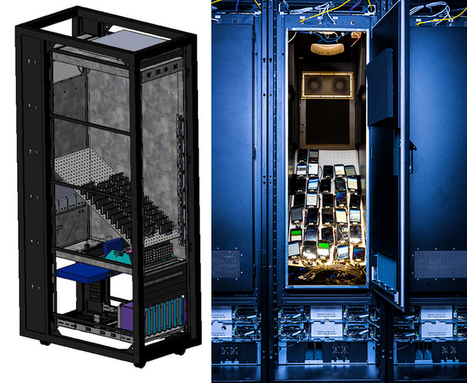
"Last year we developed CT-Scan, a service that helped us understand the performance implications of code changes and decrease the number of software regressions. When a commit lands in a repository, CT-Scan performs a build and runs performance tests, such as cold and warm start, feed scroll performance, and battery consumption. The results are plotted and engineers can learn whether they're causing an issue with a new build. Initially, engineers tested code by running CT-Scan on a single device that they had at their desks. This didn't scale — we needed to be able to run tests on more than 2,000 mobile devices to account for all the combinations of device hardware, operating systems, and network connections that people use to connect on Facebook. Today, in our Prineville data center, we have a mobile device lab — outfitted with a custom-built rack — that allows us to run tests on thousands of phones. The process of building a lab in our data center wasn't a direct path, and we learned a lot along the way as we worked to scale out the promise of CT-Scan."
It was a perfect sunny summer afternoon in Copenhagen when the world’s largest shipping conglomerate began to lose its mind. The headquarters of A.P. Møller-Maersk sits beside the breezy, cobblestoned esplanade of Copenhagen’s harbor. A ship’s mast carrying the Danish flag is planted by the building’s northeastern corner, and six stories of blue-tinted windows look out over the water, facing a dock where the Danish royal family parks its yacht. In the building’s basement, employees can browse a corporate gift shop, stocked with Maersk-branded bags and ties, and even a rare Lego model of the company’s gargantuan Triple-E container ship, a vessel roughly as large as the Empire State Building laid on its side, capable of carrying another Empire State Building–sized load of cargo stacked on top of it. That gift shop also houses a technology help center, a single desk manned by IT troubleshooters next to the shop’s cashier. And on the afternoon of June 27, 2017, confused Maersk staffers began to gather at that help desk in twos and threes, almost all of them carrying laptops. On the machines’ screens were messages in red and black lettering. Some read “repairing file system on C:” with a stark warning not to turn off the computer. Others, more surreally, read “oops, your important files are encrypted” and demanded a payment of $300 worth of bitcoin to decrypt them. Across the street, an IT administrator named Henrik Jensen was working in another part of the Maersk compound, an ornate white-stone building that in previous centuries had served as the royal archive of maritime maps and charts. (Henrik Jensen is not his real name. Like almost every Maersk employee, customer, or partner I interviewed, Jensen feared the consequences of speaking publicly for this story.) Jensen was busy preparing a software update for Maersk’s nearly 80,000 employees when his computer spontaneously restarted. He quietly swore under his breath. Jensen assumed the unplanned reboot was a typically brusque move by Maersk’s central IT department, a little-loved entity in England that oversaw most of the corporate empire, whose eight business units ranged from ports to logistics to oil drilling, in 574 offices in 130 countries around the globe. Jensen looked up to ask if anyone else in his open-plan office of IT staffers had been so rudely interrupted. And as he craned his head, he watched every other computer screen around the room blink out in rapid succession. “I saw a wave of screens turning black. Black, black, black. Black black black black black,” he says. The PCs, Jensen and his neighbors quickly discovered, were irreversibly locked. Restarting only returned them to the same black screen. All across Maersk headquarters, the full scale of the crisis was starting to become clear. Within half an hour, Maersk employees were running down hallways, yelling to their colleagues to turn off computers or disconnect them from Maersk’s network before the malicious software could infect them, as it dawned on them that every minute could mean dozens or hundreds more corrupted PCs. Tech workers ran into conference rooms and unplugged machines in the middle of meetings. Soon staffers were hurdling over locked key-card gates, which had been paralyzed by the still-mysterious malware, to spread the warning to other sections of the building. Disconnecting Maersk’s entire global network took the company’s IT staff more than two panicky hours. By the end of that process, every employee had been ordered to turn off their computer and leave it at their desk. The digital phones at every cubicle, too, had been rendered useless in the emergency network shutdown. Around 3 pm, a Maersk executive walked into the room where Jensen and a dozen or so of his colleagues were anxiously awaiting news and told them to go home. Maersk’s network was so deeply corrupted that even IT staffers were helpless. A few of the company’s more old-school managers told their teams to remain at the office. But many employees—rendered entirely idle without computers, servers, routers, or desk phones—simply left. Jensen walked out of the building and into the warm air of a late June afternoon. Like the vast majority of Maersk staffers, he had no idea when he might return to work. The maritime giant that employed him, responsible for 76 ports on all sides of the earth and nearly 800 seafaring vessels, including container ships carrying tens of millions of tons of cargo, representing close to a fifth of the entire world’s shipping capacity, was dead in the water. On the edge of the trendy Podil neighborhood in the Ukrainian capital of Kiev, coffee shops and parks abruptly evaporate, replaced by a grim industrial landscape. Under a highway overpass, across some trash-strewn railroad tracks, and through a concrete gate stands the four-story headquarters of Linkos Group, a small, family-run Ukrainian software business. Up three flights of stairs in that building is a server room, where a rack of pizza-box-sized computers is connected by a tangle of wires and marked with handwritten, numbered labels. On a normal day, these servers push out routine updates—bug fixes, security patches, new features—to a piece of accounting software called M.E.Doc, which is more or less Ukraine’s equivalent of TurboTax or Quicken. It’s used by nearly anyone who files taxes or does business in the country. But for a moment in 2017, those machines served as ground zero for the most devastating cyberattack since the invention of the internet—an attack that began, at least, as an assault on one nation by another. For the past four and a half years, Ukraine has been locked in a grinding, undeclared war with Russia that has killed more than 10,000 Ukrainians and displaced millions more. The conflict has also seen Ukraine become a scorched-earth testing ground for Russian cyberwar tactics. In 2015 and 2016, while the Kremlin-linked hackers known as Fancy Bear were busy breaking into the US Democratic National Committee’s servers, another group of agents known as Sandworm was hacking into dozens of Ukrainian governmental organizations and companies. They penetrated the networks of victims ranging from media outlets to railway firms, detonating logic bombs that destroyed terabytes of data. The attacks followed a sadistic seasonal cadence. In the winters of both years, the saboteurs capped off their destructive sprees by causing widespread power outages—the first confirmed blackouts induced by hackers. But those attacks still weren’t Sandworm’s grand finale. In the spring of 2017, unbeknownst to anyone at Linkos Group, Russian military hackers hijacked the company’s update servers to allow them a hidden back door into the thousands of PCs around the country and the world that have M.E.Doc installed. Then, in June 2017, the saboteurs used that back door to release a piece of malware called NotPetya, their most vicious cyberweapon yet. The code that the hackers pushed out was honed to spread automatically, rapidly, and indiscriminately. “To date, it was simply the fastest-propagating piece of malware we’ve ever seen,” says Craig Williams, director of outreach at Cisco’s Talos division, one of the first security companies to reverse engineer and analyze NotPetya. “By the second you saw it, your data center was already gone.” NotPetya was propelled by two powerful hacker exploits working in tandem: One was a penetration tool known as EternalBlue, created by the US National Security Agency but leaked in a disastrous breach of the agency’s ultrasecret files earlier in 2017. EternalBlue takes advantage of a vulnerability in a particular Windows protocol, allowing hackers free rein to remotely run their own code on any unpatched machine. NotPetya’s architects combined that digital skeleton key with an older invention known as Mimikatz, created as a proof of concept by French security researcher Benjamin Delpy in 2011. Delpy had originally released Mimikatz to demonstrate that Windows left users’ passwords lingering in computers’ memory. Once hackers gained initial access to a computer, Mimikatz could pull those passwords out of RAM and use them to hack into other machines accessible with the same credentials. On networks with multiuser computers, it could even allow an automated attack to hopscotch from one machine to the next. Before NotPetya’s launch, Microsoft had released a patch for its EternalBlue vulnerability. But EternalBlue and Mimikatz together nonetheless made a virulent combination. “You can infect computers that aren’t patched, and then you can grab the passwords from those computers to infect other computers that are patched,” Delpy says. NotPetya took its name from its resemblance to the ransomware Petya, a piece of criminal code that surfaced in early 2016 and extorted victims to pay for a key to unlock their files. But NotPetya’s ransom messages were only a ruse: The malware’s goal was purely destructive. It irreversibly encrypted computers’ master boot records, the deep-seated part of a machine that tells it where to find its own operating system. Any ransom payment that victims tried to make was futile. No key even existed to reorder the scrambled noise of their computer’s contents. The weapon’s target was Ukraine. But its blast radius was the entire world. “It was the equivalent of using a nuclear bomb to achieve a small tactical victory,” Bossert says. The release of NotPetya was an act of cyberwar by almost any definition—one that was likely more explosive than even its creators intended. Within hours of its first appearance, the worm raced beyond Ukraine and out to countless machines around the world, from hospitals in Pennsylvania to a chocolate factory in Tasmania. It crippled multinational companies including Maersk, pharmaceutical giant Merck, FedEx’s European subsidiary TNT Express, French construction company Saint-Gobain, food producer Mondelēz, and manufacturer Reckitt Benckiser. In each case, it inflicted nine-figure costs. It even spread back to Russia, striking the state oil company Rosneft. The result was more than $10 billion in total damages, according to a White House assessment confirmed to WIRED by former Homeland Security adviser Tom Bossert, who at the time of the attack was President Trump’s most senior cybersecurity-focused official. Bossert and US intelligence agencies also confirmed in February that Russia’s military—the prime suspect in any cyberwar attack targeting Ukraine—was responsible for launching the malicious code. (The Russian foreign ministry declined to answer repeated requests for comment.) To get a sense of the scale of NotPetya’s damage, consider the nightmarish but more typical ransomware attack that paralyzed the city government of Atlanta this past March: It cost up to $10 million, a tenth of a percent of NotPetya’s price. Even WannaCry, the more notorious worm that spread a month before NotPetya in May 2017, is estimated to have cost between $4 billion and $8 billion. Nothing since has come close. “While there was no loss of life, it was the equivalent of using a nuclear bomb to achieve a small tactical victory,” Bossert says. “That’s a degree of recklessness we can’t tolerate on the world stage.” In the year since NotPetya shook the world, WIRED has delved into the experience of one corporate goliath brought to its knees by Russia’s worm: Maersk, whose malware fiasco uniquely demonstrates the danger that cyberwar now poses to the infrastructure of the modern world. The executives of the shipping behemoth, like every other non-Ukrainian victim WIRED approached to speak about NotPetya, declined to comment in any official capacity for this story. WIRED’s account is instead assembled from current and former Maersk sources, many of whom chose to remain anonymous. But the story of NotPetya isn’t truly about Maersk, or even about Ukraine. It’s the story of a nation-state’s weapon of war released in a medium where national borders have no meaning, and where collateral damage travels via a cruel and unexpected logic: Where an attack aimed at Ukraine strikes Maersk, and an attack on Maersk strikes everywhere at once.
|
|
Scooped by
Philippe J DEWOST
December 15, 2018 3:22 AM
|
Samsung's folding display device, possibly called the Galaxy Fold, will cost $1.8k before carrier subsidies, according to analysts at CCS-CIMB Research; the gadget reportedly will contain a battery pack in each side for a total 5,000 to 6,000 mAh; will run the Exynos 9820 CPU in Korea and the Snapdragon 8150 in the US; CCS-CIMB indicates suppliers have confirmed the 74 pages report.
|




















Not a Unicorn, more than a Pony : nice exit for a French Tech startup. Congrats to Paulin and all the team !