Your new post is loading...

|
Scooped by
Philippe J DEWOST
November 30, 2012 4:33 AM
|
Numenta is a startup with a cloud-based prediction engine for streaming data. The company launched in 2005 and went into beta earlier this year. It is ready enough now to start making a difference that the New York Times profiled its founder, Jeff Hawkins, this week and called his company a brainy big data company--a play on Hawkins' theories on neuroscience.
In fact, Numenta's core technology, the Grok prediction engine, was developed based on a theory of the neocortex. Hawkins' approach may upset the big data applecart, according to the Times, because it focuses on real-time streaming sensor data and goes against the grain of mass storage that is driving much of the development on databases such as Hadoop.
Hawkins told the Times that "much of this will be a relic within a few years." He said Hadoop won't go away, but it will manage a lot less stuff and that querying databases won't matter as much. "It only makes sense to look at old data if you think the world doesn't change," Hawkins said.
|
|
Scooped by
Philippe J DEWOST
November 29, 2012 6:15 AM
|
It’s the scourge of stores everywhere: “showrooming,” the act of going to a store to see and touch a product, then using your phone to find and order the same item for a lower price online.
Some retailers have taken drastic measures to curb the practice, such as blocking barcodes. While likely futile, the effort to stop showrooming is an understandable if sometimes unsubtle reaction to fears of death by a billion clicks.
But the world’s largest retailer hasn’t tried to build a fence to block showrooming. Instead, in an act of digital judo, Walmart is urging shoppers to get out their smartphones when they come into a store.
“You’ve got to go where the customer wants you to go. We live in the age of the customer,” Walmart.com President and CEO Joel Anderson told Wired in an interview this week. “We’re embracing showrooming.”
|
|
Scooped by
Philippe J DEWOST
November 29, 2012 5:17 AM
|
Remember when you couldn't send video or audio files because of attachment size limits? That's history.
If you're a Gmail user, there's good news: You can now send files as large as 10 gigabytes.
If you're a Dropbox investor or employee, though, that's bad news.
The Web-based email service now integrates with Google's Drive storage system, according to ReadWrite's Jon Mitchell.
Users don't have to do anything to take advantage of this new feature. When you attach a file, Gmail will double-check that your recipients have permission to view the files in Google Drive.
|
|
Scooped by
Philippe J DEWOST
November 28, 2012 3:15 AM
|
For the last couple of years, sales of Android-based smartphones have been smoking every other kind of smartphone, including the iPhone. Android phones now account for nearly 75% of the global smartphone market. The next closest competitor is iPhones, which have about 15% of the market.
In the U.S., Android is clubbing iPhone 53% to 34%. Given such a disparity in phone sales and usage, you would think that things people do with smartphones--smartphone-based activities--would be equally dominated by Android.
But they aren't. They're not even equal.
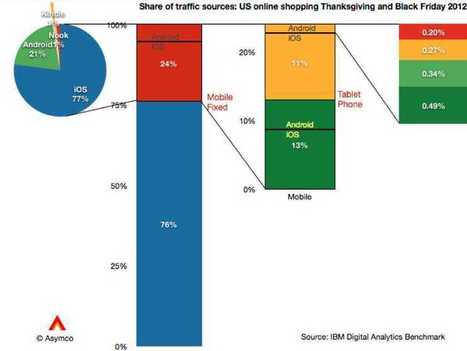
In fact, iPhone users completely dominate Internet-based smartphone activities. A recent survey of mobile web usage found that a staggering 60% of mobile web visits came from iOS devices, while only 20% came from Android. A study IBM did of Black Friday online sales showed much the same thing--except that it was even more skewed. iOS (iPads and iPhones) accounted for nearly 20% of Black Friday sales. Android devices, meanwhile, accounted for only 5.5%.
|
|
Scooped by
Philippe J DEWOST
November 26, 2012 12:29 PM
|
Resto Flash est le premier émetteur de titres restaurants numériques sur mobile en France. Créée en avril 2011, la société est en plein déploiement commercial, pour l'instant en Ile-de-France.
|
|
Scooped by
Philippe J DEWOST
November 24, 2012 11:27 AM
|
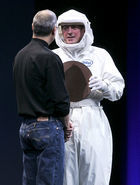
Proud to be part of this speakers roster 10 days ago; you need to view Carsten Schloter (SwissCom CEO - photo) keynote as it is a lesson both on content and on speaking engagement.
|
|
Scooped by
Philippe J DEWOST
November 20, 2012 10:11 AM
|
Cisco bought a wifi startup called Meraki for $1.2 billion.
Here's the blog post everyone is passing around to explain how that happened.
It's from Doug Leone, who got his VC firm, Sequoia Capital, to invest in Meraki:
Quick: when was the last time you plugged in an Ethernet cable? If you have trouble answering that question, you’re one of the reasons why Cisco has agreed to acquire Meraki.
|
|
Scooped by
Philippe J DEWOST
November 14, 2012 10:37 AM
|
We've known for a while that Samsung is readying phones with flexible screens. Now, though, the Wall Street Journal is reporting that it's pushing forward with the concept more quickly than ever, in order to avoid being beaten to the finish line by other firms.
The new phones simply swap plastic for glass in the screen. The OLEDs you find in plenty of other displays can be put on flexible materials—like metal foil—which then makes it possible to create a device which is both unbreakable and bendable.
Samsung hasn't told the Journal how much it's invested in the new bendy phones. However, it points out that it has been spurred along by growing innovation in the display market, from the likes of LG and Sharp. Seems that's enough to rush out a bendy phone as soon as possible.
Which is just what it plans to do. The Journal reports that a "person familiar with the situation" told it that devices will be released in the first half of 2013. Bendy phones for all!
|
|
Scooped by
Philippe J DEWOST
November 13, 2012 6:18 PM
|
Text messaging and text messaging revenue has fallen for the first time in the U.S., according to mobile analyst Chetan Sharma's latest report.
He tells us, "the dip in volume coincided with revenue dip as well which didn't happen previously. Typically, when this happens, it is an indication that the peak might have been reached and the curves will decline from here on out."
The reason text messaging and revenue is down is that more people have smartphones, which have apps that help users avoid carriers texting services.
|
|
Scooped by
Philippe J DEWOST
November 7, 2012 8:42 AM
|
Not content with synchronizing your phones to make one giant speaker? Researchers at the Tokyo University of Technology have developed "Pinch," an interface that lets you connect multiple devices together to form a giant disjointed display. Although the technology behind the interface remains a mystery — described only as a Wi-Fi based system — a video posted by DigInfo TV shows Pinch in action. To connect two devices, a user simply needs to pinch two adjacent screens together. The screens can be linked together in whatever alignment you choose, as the position and screen size of each display is communicated on a successful pinch. It's not the first time developers have managed to link together multiple smartphone displays, but this is definitely the slickest interface we've seen.
Takashi Ohta, Associate Professor at Tokyo University of Technology, envisions the Pinch interface being used for a variety of apps. "People probably own just one of these devices each. I think people could communicate in fun ways by getting together with friends and putting their devices next to each other." Potential uses include music, advertising, and photo sharing — although depending on how fast the tech is we'd love to see some games take advantage of the interface. The research team is offering Pinch to interested developers and says that several have already taken them up on the offer.
|
|
Scooped by
Philippe J DEWOST
November 5, 2012 5:33 PM
|
While Apple is now committed to Intel in computers and is unlikely to switch in the next few years, some engineers say a shift to its own designs is inevitable as the features of mobile devices and PCs become more similar, two people said. Any change would be a blow to Intel, the world’s largest processor maker, which has already been hurt by a stagnating market for computers running Microsoft Corp. (MSFT)’s Windows software and its failure to gain a foothold in mobile gadgets.
As handheld devices increasingly function like PCs, the engineers working on this project within Apple envision machines that use a common chip design. If Apple Chief Executive Officer Tim Cook wants to offer the consumer of 2017 and beyond a seamless experience on laptops, phones, tablets and televisions, it will be easier to build if all the devices have a consistent underlying chip architecture, according to one of the people.
|
|
Scooped by
Philippe J DEWOST
October 31, 2012 6:17 PM
|
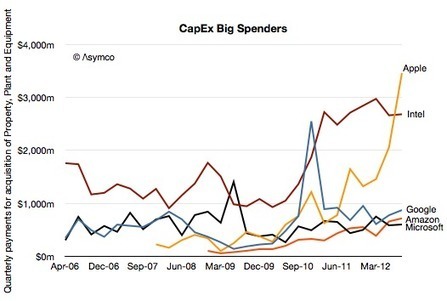
Apple's capital expenditures for the last year were $8.3 billion, which is significantly above its rivals, as this chart from Horace Dediu at Asymco shows.
Dediu believes Apple's capex is significantly above its peers because Apple is investing in data centers like Google, and process equipment like Intel. As a result, its quarterly spending is closer to Google plus Intel.
|
|
Scooped by
Philippe J DEWOST
October 20, 2012 6:31 AM
|
l'histoire d'imsense et de son rachat par Apple racontée pour la première fois in extenso et en video dans "On refait le Mac" ...
|
|
|
Scooped by
Philippe J DEWOST
November 29, 2012 11:53 AM
|
Suneet Tuli, CEO of Datawind, maker of the world’s least expensive functional 7″ tablet computer, recently stopped by the offices of Quartz to show off the device. The Aakash 2, which we’ve covered at length, is the size of a Google Nexus 7 tablet and, surprisingly, almost as capable, despite costing just one fifth as much. (Datawind sells the tablets to the Indian government for around $40, and the government either gives them away or re-sells them to students for $20.)
“It’s a pretty stock, straightforward entry-level device,” Tuli said during our interview. “As far as the hardware goes, it’s nothing too extraordinary and it’s not intended to be. The key focus is breaking that price barrier.”
|
|
Scooped by
Philippe J DEWOST
November 29, 2012 5:31 AM
|
The numbers guiding policymakers and experts are subject to revisions as "advance" estimates are based on incomplete source data. Until recently, most economists thought that data revisions were likely to be small and inconsequential. But the size of data revisions over the past few years have made a convincing case that data revisions may be large and have important implications for both policies (as exemplified by role of revisions in the debate about shifts in the Beveridge curve) and the variables we choose to measure output growth (GDP vs. GDI).
According to the BEA, the average revision in either direction is 0.5 points between the first and second estimate, 0.6 between the first and third, and 1.3 between the first and last. That’s a huge amount of error.
|
|
Scooped by
Philippe J DEWOST
November 28, 2012 11:53 AM
|
It seems not too long ago that the storage industry was fragmented in terms of the "compute" layer in their storage systems. PowerPC, MIPS, Sparc and other platforms dominated the "pie chart" with x86 occupying a small share. Then something happened - all suppliers moved to x86 as a premise for commoditization of the storage platform. With vendors like Dell now testing low-powered ARM based servers and ARM releasing a 64-bit architecture, the question is how long before ARM becomes the platform of choice for storage vendors?
|
|
Scooped by
Philippe J DEWOST
November 27, 2012 12:32 AM
|
Une autre application vient de voir le jour : Resto Flash. L’idée est très simple : le salarié reçoit ses titres sur son mobile via une application dédiée. Au moment de payer, l’application génère un QR code qui est scanné par le smartphone du restaurateur. C’est tout. L’opération aura duré quelques secondes. “La solution coûte 7,50 euros par mois au restaurateur, qui reçoit son argent 48 heures après la transaction, sans commission supplémentaires, explique Emmanuel Rodriguez-Maroto, co-fondateur de Resto-Flash. Quant à l’entreprise, elle paye un forfait annuel par salarié, dont le montant dépend du nombre d’employés”.
|
|
Scooped by
Philippe J DEWOST
November 26, 2012 12:38 AM
|
Here is the introduction speech I gave for the "Platforms & Shovels for the next Gold Rush" plenary session panel I ran on Nov 15th in Montpellier during IDATE DigiWorld Summit 2012. Available in both video & text.
|
|
Scooped by
Philippe J DEWOST
November 22, 2012 5:15 PM
|
In 1984, the New York Times ran an article slamming the concept of windows-based operating systems.
Nicholas Carlson just pointed it out as an example of why you shouldn't listen to gadget reviewers. He's right about that as far as it goes: You shouldn't listen to gadget reviewers. It only leads to heartbreak.
But the New York Times article is actually amazingly prescient, if you think about the future of computing today.
What's magnificent about Apple's iPad and Microsoft's new Surface? They let you focus on a single task, by design.
|
|
Scooped by
Philippe J DEWOST
November 14, 2012 5:34 PM
|
Samsung Makes Much More Money On Mobile Than Google Makes Overall
Pretty insane chart from Horace Dediu at Asymco. He compares Samsung's mobile operating income to Google's overall operating income.
As you can see, Samsung's mobile operating income will soon be twice as much as Google's overall operating income. Samsung's operating income is almost entirely because of Google's Android.
|
|
Scooped by
Philippe J DEWOST
November 14, 2012 10:30 AM
|
The clickwheel of the first iPod worked by measuring electric field disturbances in one dimension. The first iPhone touch screen functioned similarly, but in two dimensions.
This week, Microchip Technology, a large U.S. semiconductor manufacturer, says it is releasing the first controller that uses electrical fields to make 3D measurements.
The low-power chip makes it possible to interact with mobile devices and a host of other consumer electronics using hand gesture recognition, which today is usually accomplished with camera-based sensors. A key limitation is that it only recognizes motions, such as a hand flick or circular movement, within a six-inch range.
|
|
Scooped by
Philippe J DEWOST
November 8, 2012 1:29 AM
|
With gas shortages rampant following Hurricane Sandy, FEMA and the White House turned to crowd-sourced navigation app Waze to gather data on where to send gasoline fueling trucks.
|
|
Scooped by
Philippe J DEWOST
November 6, 2012 10:14 AM
|
UI design is about maintaining consistency while expanding possibilities. Looks like Facebook's latest iOS update does the opposite... Today facebook changed (once again) the gestures that everybody knew by now (given the high usage rate of the app), which will induce latency, friction and frustration from single handed, zero attention span millions of users. But maybe one can see some wisdom in such choices, that over time may be progressively forgotten. More frustrating are some feature reductions, namely in the photo area of the app that now longer allows posting pictures that are not in the camera roll. For instance, it is no longer possible to enrich a post with a photo picked in an existing album, including the photostream. This is a big restriction in terms of features and UI, with no understandable reason. Please voice your comments and reactions.
|
|
Scooped by
Philippe J DEWOST
November 1, 2012 6:17 PM
|
Powering cellular base stations around the world will cost $36 billion this year—chewing through nearly 1 percent of all global electricity production. Much of this is wasted by a grossly inefficient piece of hardware: the power amplifier, a gadget that turns electricity into radio signals.
The versions of amplifiers within smartphones suffer similar problems. If you’ve noticed your phone getting warm and rapidly draining the battery when streaming video or sending large files, blame the power amplifiers. As with the versions in base stations, these chips waste more than 65 percent of their energy—and that’s why you sometimes need to charge your phone twice a day.
Now an MIT spinout company called Eta Devices, based in Cambridge, Massachusetts, cofounded by two MIT electrical engineering professors, Joel Dawson and David Perreault, say they have cracked the efficiency problem with a new amplifier design.
It’s currently a lab-bench technology, but if it proves itself in commercialization, which is expected to start in 2013—first targeting LTE base stations—the technology could slash base station energy use by half. Likewise, a chip-scale version of the technology, still in development, could double the battery life of smartphones.
“There really has been no significant advance in this area for years,” says Vanu Bose, founder of Vanu, a wireless technology startup. “If you get 30 to 35 percent efficiency with today’s amplifiers, you are doing really well. But they can more than double that.”
|
|
Scooped by
Philippe J DEWOST
October 31, 2012 3:03 PM
|
Carrier IQ, the market leader in delivering Mobile Intelligence, today announced the appointment of Ben Bergeret to the role of Vice President and General Manager of Devices. Mr. Bergeret joins Carrier IQ having founded and grown two successful start-ups – Realeyes3D and Qipit – that benefited from his significant experience managing company operations globally, and his proven ability to identify the fastest paths to market. Prior to this, as head of EMEA Sales for Lucent Technologies' Software Products Group, he developed in-depth knowledge of mobile operators' operations and challenges in the areas of billing and care.
|