


Rude Baguette - France's Startup Blog - 2013 will certainly be the year of the war between Deezer & Spotify - figures show it will be a tight race.

 Your new post is loading...
 Scoop.it! Rude Baguette - France's Startup Blog - 2013 will certainly be the year of the war between Deezer & Spotify - figures show it will be a tight race. 
No comment yet.
Sign up to comment
Scoop.it!

"a tiny San Francisco startup, Adamant Technologies, is trying to give your iPhone the senses of smell and taste, too. The company has created a computer chip that works with a bunch of tiny sensors that "can take the sense of smell and taste and digitize them," explains Sam Khamis, Adamant's founder and CEO. This is not about turning your smartphone into some kind of scratch-and-sniff thing that emits scent. It's about letting your phone or computer or other medical devices smell for themselves. This was a pretty tricky problem to solve. A computer can easily identify a chemical in the air, but put a bunch of them together and it's stumped. For instance, humans can tell when there's pizza and chocolate chip cookies in the same room. Computers have a harder time with that."
Philippe J DEWOST's insight:
This may stink IMHO
Scoop.it!
There can be no doubt that one of the hottest startups of the last couple of years has been social sat-nav smartphone app Waze. Not surprising in an era when – largely due to Apple initially dumping Google Maps in iOS 6 – everyone woke up, as if from some slumber, about the importance of decent mobile maps. Something many had taken for granted was thrown into sharp relief, especially when it became clear that even the mighty Apple was capable of royally screwing up its own maps product. So it comes as almost no surprise to us that there are rumours flying around that Apple is sniffing around Waze with a view to a possible acquisition. After all, Waze is already a data partner for Apple’s Maps app and wasthe only app to gain meaningful marketshare after the Apple Maps fail. We have reached out to both. An apple spokesperson said: “We don’t comment on rumors or speculation.” We got a “we never comment on rumors” from Waze. [UPDATE: Another source confirms that negotiations are advanced, but Waze wants $750M and Apple is willing to do $400M plus $100m in incentives. Waze had less than $1M in revenues last year (primarily from ads). Negotiations may take awhile.]
Philippe J DEWOST's insight:
Paving the way vs. the road ahead :-)

Philippe J DEWOST's comment,
January 4, 2013 1:30 PM
Course change : seems that acquisition of Waze is not this certain...http://www.businessinsider.com/apple-not-buying-mapping-startup-waze-2013-1
Scoop.it!
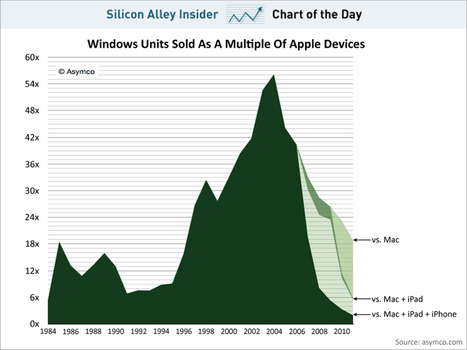
For years, people have been predicting the death of Microsoft's Windows dominance. And in the last two years, it's finally happened. The rise of iOS and Android have made Microsoft's operating system significantly less important.
Philippe J DEWOST's insight:
Uncharted territories
Scoop.it!
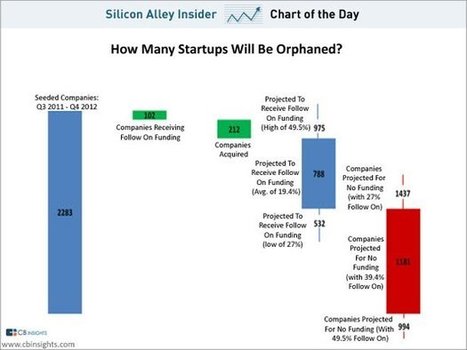
The so-called Series A crunch isn't the problem.
Scoop.it!

A year ago RIM bought NewBay, presumably to join Apple and Google in the cloud storage and synch arena. Now it's selling NewBay at a steep discount to Synchronoss.
Philippe J DEWOST's insight:
How Synchronoss will integrate NewBay, Miyowa and FusionOne is also a mystery...
Scoop.it!

Mike Butcher at TechCrunch has done a remarkable work of spotting very well known as well as emerging and promising conferences with a focus on Europe, but also the unmissable suspects in SF Bay Area or Austin
Scoop.it!
Philippe J DEWOST's insight:
In 2005, Google bought a small, almost unheard of operating system provider called Android. Now, 250 million Android products are activated annually, and there as almost as many Android devices activated than Big Mac sold every second ...
Scoop.it!

Google’s maps app for the iPhone offers smooth navigation and intelligent directions for driving, walking and public transportation.
Scoop.it!

Facebook's top executive in Europe, Joanna Shields, is leaving to spearhead the government's scheme to create a 'Silicon Valley' cluster of technology businesses in East London. Shields, who is vice-president and managing director of Facebook EMEA, is to become chief executive of the Tech City Investment Organisation in January. The social network, which is also looking for its first UK managing director, does not have a replacement for her lined up yet.
At TCIO Shields will replace Eric van der Kleij, who did not renew his contract when it ended this summer. She will also take up a position with the government as ambassador for the Digital Industries.
Shields joined Facebook in 2010, after a brief period working at Elisabeth Murdoch's digital media media venture ShineVu. She made her name at the social network Bebo, where she was president. She oversaw the sale of the business to AOL for $850m (£417m), later becoming president of its social media divison. Prior to her role at Bebo, Shields was managing director at Google, where she was responsible for building and managing the company's advertising and syndication network across Europe, Russia, the Middle East and Africa.
The Tech City Investment Organisation (TCIO) was set up by the government department of UK Trade and Investment in April last year, to support the growth of technology businesses in East London and make it the location of choice for tech and digital businesses. Businesses that have set up offices in Tech City include Amazon, Google, Intel and Cisco. Shields’ role will involve helping to promote the area, raising its profile internationally, and attracting investment.

Laurent Charreyron's curator insight,
December 18, 2012 5:22 PM
Pendant ce temps, dans un petit village gaulois.....
Scoop.it!

I had never imagined, when writing http://blog.dewost.com/delighting-views-on-the-ipad , such growth for a product that defined and invented a market ahead of any predictions. Who would have actually?
Still puzzled by the fact, however, that Apple achieved this with a personal device that could be (and is used) in family contexts.
Scoop.it!

Hppy bthdy txt msng! The text turns twenty today: Text messaging, or txt msng, if you like, turns 20 today. Inte...
Scoop.it!

According to Asymco's Horace Dediu, Samsung is blowing all the companies away in advertising.
But advertising isn't Samsung's only marketing expense. It also has big, crazy launch parties and promotional discounts.
If you look at Samsung's full marketing expenses, you get a better idea about the incredible amount it cost Samsung to become the world's biggest smartphone company.

Peixin hu's comment,
August 17, 2013 5:03 AM
I think the reason why Samsung's success in recent years partly because they establish a good brand image. First of all, Samsung have Stylish appearance compare with other brands also attracting the attention of young people. Second, we can see Samsung show up in a variety of activities, newspapers even all kinds of ball games, so that the different age’s group and different interests of the people can concern them.

's comment August 22, 2013 3:58 AM
From this chart, we could see that the tendency of Samsung’s budget increases greatly year by year, now Samsung has been the largest company of investing in marketing advertising. Despite its successful advertising, Samsung also spend a lot of money on promotional campaign to attract customers. As for Samsung, it is an admirable company, its products are popular in Asia and Europe countries. In my personal opinion, advertising is like a dialogue between the company and the consumers, and it can be a good method for communicating the features of a product or service in a way that will motivate customers to purchase it. In the intensely competitive market, to be closer to the consumers to figure out their desires and interests are critical for the smartphone company. This is one of the reasons for Samsung’s big success. Thanks.

Abbey 's curator insight,
April 7, 2014 5:36 PM
As shown in the digram Samsung's Marketing expenses are far, far higher than any of the of the other brands shown. Considering Samsung is one of the largest smart phone companies in the world, large marketing campaigns and promotional parties etc contribute immensely to the success and impression of the brand received by consumers. Considering Coca Cola is such a huge brand and marketed hugely worldwide, yet is still way behind what Samsung is spending, really shows in comparison to other developed brands how huge Samsung's Marketing really is.
I am quite surprised at how large the gap is between Apple and Samsung as i always considered them reasonably close competitors in the smart phone industry. |
Scoop.it!

"According to Ovum, 60% of the $2 trillion-plus revenues generated last year went to mobile operators. In addition, the analyst firm identified mobile broadband as the "single largest opportunity for telcos to claw back revenue," predicting that the sector will grow by 19.2% annually and generate $122.9 billion in incremental revenue between 2013 and 2016. There is some good news for the fixed-line firms though. Other segments reporting double-digit revenue growth over the next five years will include public cloud, Ethernet, IPTV and managed/hosted IP voice, Ovum predicts. Infrastructure vendors, meanwhile, will have to position themselves carefully to generate revenue increases of their own. With service provider revenues overall experiencing low single-digit growth, capex is likely to be constrained."
Scoop.it!
Philippe J DEWOST's insight:
This is definitely big...
Scoop.it!

How do you improve the mobile experience when all you have is a visibility over a carrier’s network?
That is the question that started carrier IQ (CiQ) in 2005. They set out to open up a window on the devices. To show what was happening inside what was until then a closed ‘black box’ after it left the factory. Seven years later, the company now has a tremendous technology foundation, from a unique agent software which gathers system data on smartphones (180 million rolled out so far), to an incredible analytics big data platform that’s able to deliver real-time drill-down information on technical parameters of a phone as well as trends and statistics. Last ime I checked CiQ was processing over 7 terabytes of smartphone system data each month…
They have a great business team, too, and managed to develop solid relationships with major mobile carriers in the US and abroad. And weathered an incredible storm in late 2011 — more on this at the bottom of this post.
Philippe J DEWOST's insight:
CarrierIQ's new GM Devices explains it all, one device at a time
Scoop.it!

Scoop.it!

Facebook has vaulted past its competitors to control 18.4 percent of U.S. mobile display ad revenues.
According to eMarketer, that means Facebook will end the year as the top U.S. publisher in mobile display, with roughly $340 million in revenue for all of 2012. The chart below presents a visualization of Facebook remarkable performance. The social network wasn't in the picture in 2011. One year later, it has seized a fatter share of U.S. mobile display revenues than heavyweights such as Google, Pandora, and Apple's iAd platform. In the process, a greater share of revenue has accrued to the top six publishers. However, Facebook's accomplishment needs to be placed in context. First, mobile remains a blip in the total advertising landscape. And within mobile, display still accounts for less spend than search ads— 46 percent to 49 percent of U.S. mobile ad spending. (In other countries the picture is even more lopsided in favor of search.) Finally, it's early days yet for Facebook's mobile ads, and there are no guarantees the company's mobile ad formats will continue to succeed indefinitely.
Philippe J DEWOST's insight:
Still haven't clicked on any of these ads...
Scoop.it!

Every VC firm has its own way of evaluating potential investments. Remmy Oxley, an anonymous VC, says that Moneyball-style methods are the next step, and reveals his firm's algorithm for screening candidates.
Scoop.it!

Ce projet correspond aux anomalies ou aux demandes d'évolutions logicielles pour le Freebox Server. .../...
Philippe J DEWOST's insight:
Le WDS (Wireless Distribution System) est un protocole de la norme WiFi qui permet à des bornes de travailler ensemble et d'étendre un réseau sans fil unique. Par exemple d'ajouter des Airport Express et autres Time Capsules à un réseau Freebox existant plutôt que d'en créer un deuxième ou de bidouiller avec du CPL
Or pour une raison incompréhensible, et très peu commentée, Free n'a toujours pas activé cette fonctionnalité dans le firmware de sa Freebox alors qu'apparemment sa carte WiFi Marvell le supporte parfaitement ?
Philippe J DEWOST's curator insight,
December 19, 2012 5:12 PM
Le WDS (Wireless Distribution System) est un protocole de la norme WiFi qui permet à des bornes de travailler ensemble et d'étendre un réseau sans fil unique. Par exemple d'ajouter des Airport Express et autres Time Capsules à un réseau Freebox existant plutôt que d'en créer un deuxième ou de bidouiller avec du CPL
Or pour une raison incompréhensible, et très peu commentée, Free n'a toujours pas activé cette fonctionnalité dans le firmware de sa Freebox alors qu'apparemment sa carte WiFi Marvell le supporte parfaitement ?
Scoop.it!

Android's share of the Chinese smartphone market ended the third quarter at 90 percent.
According to Analysys International, Android's share is up from 83 percent a quarter prior and 58 percent a year ago. With the Chinese market now accounting for a quarter of global smartphone shipments, Android's dominance there is driving its widening lead in global smartphone platform market share. In China, Android's gain has mostly come at the expense of Symbian, Nokia's antiquated platform that will eventually disappear as Nokia shifts its product offerings on to Windows Phone. Interestingly, despite its dominance, Google only offers limited support for Google Play in China and Android apps are usually downloaded in third-party app markets. Apple, meanwhile, has never really gained traction after a weak market entry on only one of the country's major providers. The iPhone 5 will be available on two carriers, but as of now will not be distributed by the largest carrier, China Mobile. Additionally, while many Chinese consumers may fawn over iPhones, they are simply out of reach financially for a substantial part of the market.
Scoop.it!
Microsoft and Apple are currently locked in something of a Cold War over the future of SkyDrive in the iOS App Store.
Sources close to Microsoft have detailed to TNW a difficult, and perhaps unresolvable situation between the two companies that underscores the difficulty with certain Apple rules concerning its app marketplace, and how far the company is willing to go to protect its vaunted 30% cut of in-app revenues. The difficulty began when Microsoft rolled out the ability for SkyDrive users to purchase more storage space on the service. From that point, the company was not permitted to update its application in the iOS App Store. The reason? It doesn’t pay Apple a 30% cut of subscription revenue generated by the application through the paid, additional storage. Microsoft, TNW has learned, has a new version of the application ready to go, including a key bug fix that would rectify a crashing bug, but cannot get it through. Microsoft does not appear keen to pay Apple the 30% cut, as it lasts in perpetuity, regardless of whether a user continues to use an iOS device or not, as the billing is through their Apple account. Therefore, if a user signed up for a few additional gigabytes on their iOS device, and then moved to Android or Windows Phone or not phone at all, for the length of their account, Apple would collect 30% of their fee for storage. This hasn’t sat well with Microsoft. Microsoft has persisted in trying to work out a compromise with Apple, but has thus far failed to come to an agreement. The company offered to remove all subscription options from its application, leaving it a non-revenue generating experience on iOS. The offer was rebuffed. If a service has a subscription option, it seems, and it is not listed in the iOS store, the application cannot, and will not be allowed. That is, unless you are small enough that Apple doesn’t bothers to check. I assume that smaller companies could slip under the radar.
Philippe J DEWOST's insight:
This is getting somewhat ugly
Scoop.it!

Cool chart from mobile analytics firm, Flurry. It says people are spending 127 minutes per day with their smartphones, up from 66 minutes per day in 2010. This means we spend more time with mobile phones and apps than we do on the web. This time spent is rapidly approaching the time we spend watching TV.
Scoop.it!

FORTUNE -- Kleiner Perkins' Mary ("Queen of the Net") Meeker gave her annual Internet Trends presentation at Stanford University Monday night, and as always her slide deck is a trove of cleverly presented data.
The chart above builds on the work of Asymco's Horace Dediu to show the rise and fall of what for decades seemed the unassailable duopoly of computing: Microsoft (MSFT) Windows running on Intel (INTC) chips. Now it's being rapidly overtaken by mobile devices running Apple's (AAPL) iOS or Google's (GOOG) Android.
Scoop.it!

Whatsapp, the multiplatform mobile messaging app that has been one of the runaway success stories for ad-free, paid services, has been in talks to be acquired by Facebook, according to sources close to the matter.
We’re still digging around on potential price and other details about how advanced the deal is. But as mobile becomes the most bloody battleground in the Internet’s game of thrones, you can see how such a deal could make sense.
For starters, it would be another way for Facebook to continue extending its touchpoints with mobile consumer. Mark Zuckerberg asserted, on the occasion of reaching 1 billion monthly active users on Facebook, that mobile would be crucial to Facebook reaching the “next billion.”
“The big thing is obviously going to be mobile,” Zuckerberg told BusinessWeek. “There are 5 billion people in the world who have phones.”
Whatsapp also has a footprint that fits with Facebook’s focus on international/emerging markets: The messaging app has users in over a hundred countries covering 750 mobile networks, on the iOS, Android, BlackBerry, Nokia S40, Symbian and Windows Phone platforms.
The startup also has demonstrable scale. We’ve heard the company has something like tens of millions of daily active users globally and these users utilize Whatsapp to send messages to family and friends. Every minute a user spends on Whatsapp is likely at the expense of a minute spent on Facebook.
At the end of October 2011, when the last time Whatsapp updated its usage numbers, it announced that it was serving 1 billion messages per day — “Just how much is 1 billion messages? That is 41,666,667 messages an hour, 694,444 messages a minute, and 11,574 messages a second,” the company wrote then. In August 2012, that number had grown ten-fold to 10 billion messages per day, 4 billion inbound and 6 billion outbound (because they go to more than one recipient). The app, which is built on Erlang, has the potential and ambition to grow more and wants to provide “a great mobile messaging system for a global market, regardless of your handset.”
|





