Your new post is loading...

|
Scooped by
Philippe J DEWOST
October 27, 2015 4:03 AM
|
Last week, Ginni Rometty, the chairman and CEO of IBM, stood on stage in front of a packed room and announced that she was going to make "a bold prediction.""In the future, every decision that mankind makes is going to be informed by a cognitive system like Watson," she said, "and our lives will be better for it."Listening in were the crowds of engineers, designers, doctors, bankers, researchers, and reporters that IBM had ferried over to a massive glass-and-steel structure on the banks of the East River in Brooklyn.The occasion was a new event, World of Watson, designed to showcase the "ecosystem" of innovation happening around Watson, IBM's signature artificial-intelligence system.
|
|
Scooped by
Philippe J DEWOST
October 16, 2015 2:58 AM
|
THERANOS, A COMPANY that makes low-cost blood tests, has been celebrated as the inventor of the next major medical breakthrough, and its founder, Elizabeth Holmes, has been hailed as the next Steve Jobs. But in an expose published today, The Wall Street Journal portrays Theranos as a company that is not only grossly under-delivering on its promise, but is also working hard to hide its problems. http://www.wsj.com/articles/theranos-has-struggled-with-blood-tests-1444881901A months-long investigation by the Journal found that, for the bulk of its blood tests, Theranos has not actually been using its own technology, which the company has claimed are capable of running tests with only a few drops of blood. Instead, it’s been relying on traditional machines from companies like Siemens. What’s more, the article alleges that in proficiency tests, Theranos’s own Edison machines have produced radically different results than traditional machines have, and internal emails reveal the company may have tried to prevent those inconsistencies from seeing the light of day.The Journal‘s claims, many of which Theranos has contested, are damning, portraying Theranos as an Oz-like company that looms large in public consciousness but turns out to have little going on behind the facade. At the same time, the story also exposes a deeper problem with the way Silicon Valley tries to spin hype into startup gold.It’s hardly unusual for a startup to over-hype its potential in its early days. Mark Zuckerberg was crowing about connecting every person in the world long before that claim seemed plausible. Uber executives have been talking about taking over the taxi industry for years. Even Tinder sometimes bills itself as a global social network, not just a dating app. These grandiose promises are table stakes in the tech industry, a requirement for luring both investors and early users. And typically, they’re harmless. After all, who really gets hurt when, say, Ello fails to catch on?But Theranos is a cautionary tale of what happens when that mentality creeps into sectors other than software, such as medicine. As one Theranos patient quoted by the Journal put it, “trial and error on people, that’s not OK.” It’s not that any of this is done maliciously. It’s just that the tech industry wants its heroes. It wants to find the next Steve Jobs. It wants to be responsible for discovering not just the next big chat app, but the next big idea that will change the world. Once the industry finds a protagonist who seems to fit that narrative, the story can take on a life of its own, separate from the more mundane reality.Moving Too FastHolmes started Theranos in her dorm room, and, as the oft-told story goes, she kept the company in stealth mode for 10 years, refusing to say much about its methodology or publish its findings in peer-reviewed journals. And yet, throughout that time, tech investors like Draper Fisher Jurvetson and Larry Ellison continued pouring money into the company. To date, the company has raised $400 million at a $9 billion valuation, making Holmes a celebrity in tech circles and on the conference circuit (WIRED featured Holmes in its March 2014 issue).Fast growth and overexposure can be tricky for any young company to navigate. But when that company dictates people’s health decisions, it can be downright dangerous. So much more is at stake. That’s why these medical tech and biotech companies are among the toughest to start. Instead of raising the money to prove the concept, as so often happens in the frothy tech industry, inventors of medical technology are tasked with proving their worth first. “In the mainstream medical diagnostics industry, there’s a pretty high standard in terms of investment,” says Dr. Muneesh Tewari, an associate professor in the University of Michigan’s department of hematology and oncology. “It’s very uncommon to reach the size of Theranos without substantial disclosure and validation of results of the diagnostic performance.”There’s an argument to be made, of course, that this process isn’t perfect, either. It means breakthrough treatments can take far too long to reach the mainstream and that large pharmaceutical companies with money to spend get to dictate which technologies are worth the investment. That the tech world would want to apply the “move fast and break things” motto to medicine as well as software makes sense. But there’s an equal and opposite argument to be made: not every industry can or should move fast.Caught in the CycleTheranos isn’t the first scientific company get caught up in the tech hype cycle long before it was ready. The DNA-testing-by-mail service 23andMe was celebrated in tech circles, before the FDA ordered it to stop marketing its health-related gene analyses. The FDA argued that 23andMe’s technology hadn’t gone through the proper approvals, and, as a result, couldn’t advertise its tests to customers as indicators of health issues.The good news for 23andMe, and perhaps even for Theranos, is that 23andMe seems to have survived the backlash. Unable to market its tests for health purposes, the company began using them for research, all while appealing to the FDA to reconsider. Now, 23andMe has announced a new $115 million round of funding, and at least one of its health tests has received FDA approval.Theranos, no doubt, will use its substantial backing to fight the claims made by The Wall Street Journal, and work to convince the public and regulators that its technology, while still in its infancy, is more than just vaporware.That’s the good thing about raising $400 million. It can buy you a heckuva legal team. http://www.wired.com/2015/10/theranos-scandal-exposes-the-problem-with-techs-hype-cycle
|
|
Scooped by
Philippe J DEWOST
October 15, 2015 8:18 AM
|
There are more than 1,200 active satellites orbiting earth right now, taking pictures, relaying communications, broadcasting locations, spying on you, and even housing humans. Thanks to a database compiled by the Union of Concerned Scientists, we can show you each one, as of August 21, 2014. The satellites are sized according to their launch mass and are colored by their country.
|
|
Scooped by
Philippe J DEWOST
October 12, 2015 1:25 PM
|
"Selon nos informations, elle devrait prendre dans les prochains jours la direction du projet la Halle Freyssinet, l’incubateur au 30 000 mètres carrés, présenté comme «le plus grand du monde», et financé par Xavier Niel. 1 000 start-up seront hébergées dès 2016."
|
|
Scooped by
Philippe J DEWOST
October 6, 2015 3:26 PM
|
Tech City UK is no longer needed according to the cofounder of one of the startups that the taxpayer-funded organisation is trying to support. The quango, funded by the Department of Business, Innovation and Skills with over £4 million every year, was set up in 2010 by Prime Minister David Cameron in a bid to help London compete more directly with Silicon Valley. Tech City UK has since expanded its remit to the whole of the UK but the organisation has had mixed success. For example, a freedom of information request made by Techworld revealed that it gave out just seven of a possible 200 visas for exceptionally talented overseas technologists, while several of the companies Tech City UK is trying to support have criticised it for failing to provide anything of real value to them. Now Alistair Mitchell, cofounder and president of London-based enterprise collaboration firm Huddle, which has raised $89.2 million in venture capital funding, has gone one step further and revealed that he thinks the organisation should be shut down.
|
|
Rescooped by
Philippe J DEWOST
from pixels and pictures
October 6, 2015 10:52 AM
|
To process a transaction, you need first to make sure the sender owns the asset he wants to transfer, and make sure he will not trade it twice.
In the blockchain, information is stored in blocks that record all transactions ever done through the network. Hence, it allows validating both the existence of assets to be traded and ownership.
To avoid double spending, the technology requests several nodes to agree on a transaction to process it. A validation is also artificially difficult to achieve: miners leverage computer power to solve complex cryptographic problems (the proof-of-work). Every time a problem is cracked, a block is added to the chain, and all the transactions it includes are thus validated. The updated chain, including the new block, is shared with other nodes and becomes the new reference; this process leverages cryptography to prevent duplicate transactions.
|
|
Scooped by
Philippe J DEWOST
October 2, 2015 6:32 AM
|
Robots are poor at many activities that humans find simple. Now roboticists are making progress on a task that exemplifies them all: the automated assembly of an IKEA chair.Humans have long feared that robots are taking over the world. The truth, however, is more prosaic. It’s certainly the case that robots have revolutionized certain tasks such as car manufacturing, for example.But in many real world tasks, robots come a poor second to humans. They find it impossible to work in the messy, cluttered environment that humans cope with easily. They have difficulty locating and picking up small objects and they lack the fine control to assemble components.All these problems are exemplified in a single task—the assembly of an IKEA chair. This is an activity that many humans will have performed with varying degrees of success but one that robots simply cannot complete. At least not yet.
|
|
Scooped by
Philippe J DEWOST
September 25, 2015 1:14 AM
|
Le Conseil des Ministres du 23 septembre 2015 a nommé Henri Verdier directeur interministériel du numérique et du système d'information et de communication de l'État, adjoint à la secrétaire générale pour la modernisation de l'action publique. La mesure était attendue et ne surprend donc personne : Henri Verdier vient d'être nommé en Conseil des Ministres, ce 23 septembre 2015, à la tête de la DINSIC (Direction interministérielle du numérique et du système d'information et de communication de l'État), la « DSI groupe » de l'Etat. Il est de ce seul fait adjoint à la secrétaire générale pour la modernisation de l'action publique (SGMAP). En provenance d'Etalab, absorbée par la DINSIC, il succède donc à Jacques Marzin, directeur de la DISIC. La mission Etalab était en charge de la politique d'open-data et d'open-gouvernement de la France. Henri Verdier avait donc été qualifié de « Premier CDO » d'un gouvernement européen.
|
|
Scooped by
Philippe J DEWOST
September 21, 2015 4:21 AM
|
Tens, if not hundreds of thousands of non-jailbroken devices are believed infected after a Trojan compiler malware struck in China.
It involves a maliciously modified version of the XCode integrated development environment (IDE) -- a nasty trick that places it among a family of malware known as "compiler malware". While not a wholly new strategy, this is the first time that we've seen proof of such a strategy being used to target the iOS crowd. It's also remarkable in its ability not only to threaten users of non-jailbroken devices but every version of iOS, as well.
And by the looks of it, it's a very succesful indeed as it in effect transforms Apple's walled garden and singular source -- an approach that for so long helped to secure Apple's userbase -- into a digital weapon to attack users. After all developers trust XCode -- they have to because they have no other choice. But if they get their copy of Apple's software from a third party (as many even in the U.S. do) they may find their apps secretly Trojanized.
And to make matters worst, in this case Apple is the Trojan dealer, not some sketchy piracy site. iOS users trust the App Store -- because they have to. Officially, Apple contends any other source of apps for the iPhone is illegal. But in this recent breach Apple was very cleverly -- and some would say alarmingly easily -- tricked into distributing malware to 25,000+ iPhone owners.
Une question revient souvent dans les débats sur le bitcoin : « quelle est l’autorité centrale qui le gère ? » La réponse, connue même si elle n’est pas toujours bien comprise, est : « il n’y en a pas, c’est un réseau pair à pair décentralisé et les règles de gestion sont inscrites dans le code ». Pour beaucoup, cette réponse ne fait que déplacer le problème : « quelle est alors l’autorité centrale qui gère le code ? » demandent-ils. La réponse à cette deuxième question est beaucoup moins connue : « Il n’y en a pas non plus, les règles d’évolution du code sont elles aussi inscrites dans le code ». L’explication nécessite un assez long détour par la technique, notamment par le protocole de construction de la « blockchain », qui est très mal connu bien qu’il forme le véritable cœur du système. Pour beaucoup, cette opération se résume à la constitution des « blocs » de transactions, alors que la phase suivante d’assemblage des blocs, qui est encore plus vitale pour la sécurité du système, est largement ignorée. Comme si on réduisait la construction de la Tour Eiffel à la fabrication de ses éléments dans les ateliers de Levallois, en ignorant son montage sur le Champ de Mars. C’est donc à cette deuxième phase que le présent article est consacré.
Via CHECy
|
|
Scooped by
Philippe J DEWOST
September 17, 2015 1:59 AM
|
.../...As Lambert point out, building and running such a system requires not only know-how but enormous amounts of computing power. Piper spans about 85 terabytes of data (aka 85,000 gigabytes), and Google’s 25,000 engineers make about 45,000 commits (changes) to the repository each day. That’s some serious activity. While the Linux open source operating spans 15 million lines of code across 40,000 software files, Google engineers modify 15 million lines of code across 250,000 files each week.
At the same time, Piper must work to remove much of the burden from human coders. It must ensure that humans can wrap their heads around all that code; that they don’t step on each other’s toes with code changes; that they can readily remove bugs and unused code from the repository. And because all of this is so difficult, it must actually take some of that work away from the humans. Now that Google has switched to Piper from its previous version control system—a tool called Perforce—automated ‘bots handle a majority of the commits.
This doesn’t mean ‘bots are writing code. But they are generating a lot of the data and configuration files needed to run the company’s software. “You need to make a concerted effort to maintain code health,” Potvin says. “And this is not just humans maintaining code health, but robots too.”
|
|
Scooped by
Philippe J DEWOST
September 15, 2015 5:14 AM
|
In fact, the true measure of a CDO’s success is when the role becomes unnecessary: by its very nature, a high-functioning digital company does not need a CDO (however, it may want its former CDO to be the CEO). Of course, the vast majority of organizations are not yet at that point. And while there are numerous actions companies can and should take to help these executives work themselves out of a job—such as providing sufficient resources and active CEO support—this article focuses on five areas CDOs themselves must get right if their organizations are to successfully transition to digital.
|
|
Scooped by
Philippe J DEWOST
September 10, 2015 1:47 PM
|
There’s the fast way and the slow way,” said Musk, who called Mars “a fixer upper of a planet.” The fast way, according to Musk, would be to drop thermonuclear weapons on the poles of Mars, which would warm the planet and would trigger a chain reaction that releases carbon dioxide into the Martian atmosphere, and then continues to warm the planet.
|
|
|
Scooped by
Philippe J DEWOST
October 21, 2015 7:33 AM
|
While Tesla’s new hands-free driving is drawing a lot of interest this week, it’s the technology behind-the-scenes of the company’s newly-enabled autopilot service that should be getting more attention.
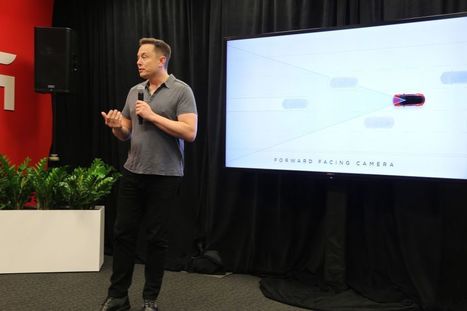
At an event on Wednesday Tesla’s CEO Elon Musk explained that the company’s new autopilot service is constantly learning and improving thanks to machine learning algorithms, the car’s wireless connection, and detailed mapping and sensor data that Tesla collects.
Tesla’s cars in general have long been using data, and over-the-air software updates, to improve the way they operate. Machine learning algorithms are the latest in computer science where computers can take a large data set, analyze it and use it to make increasingly accurate predictions. In short, they are learning. Companies like Google , Facebook and now Tesla are using machine learning as a way to train software to help customers or sell them new services. Machine learning is the way that computers can become artificially intelligent, and the technology is a form of AI. While Musk has taken a sort of alarmist stance against the dangers of AI, he clarified during the event on Wednesday that he’s only concerned with artificial intelligence that is meant for nefarious purposes.
When a reporter asked Musk during the media Q&A what made his company’s autopilot service different than other computer-based driving assistance features that competing big auto makers are working on, Musk emphasized learning.
“The whole Tesla fleet operates as a network. When one car learns something, they all learn it. That is beyond what other car companies are doing,” said Musk. When it comes to the autopilot software, Musk explained that each driver using the autopilot system essentially becomes an “expert trainer for how the autopilot should work.”
|
|
Scooped by
Philippe J DEWOST
October 15, 2015 1:39 PM
|
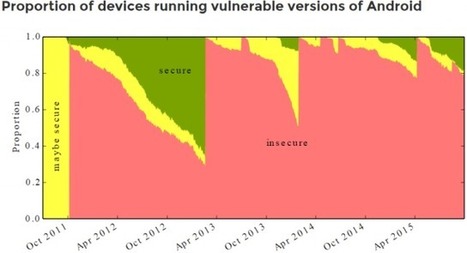
It's easy to see that the Android ecosystem currently has a rather lax policy toward security, but a recent study from the University of Cambridge put some hard numbers to Android's security failings. The conclusion finds that "on average 87.7% of Android devices are exposed to at least one of 11 known critical vulnerabilities." Data for the study was collected through the group's "Device Analyzer" app, which has been available for free on the Play Store since May 2011. After the participants opted into the survey, the University says it collected daily Android version and build number information from over 20,400 devices. The study then compared this version information against 13 critical vulnerabilities (including the Stagefright vulnerabilities) dating back to 2010. Each individual device was then labeled "secure" or "insecure" based on whether or not its OS version was patched against these vulnerabilities or placed in a special "maybe secure" category if it could have gotten a specialized, backported fix.
|
|
Scooped by
Philippe J DEWOST
October 15, 2015 2:20 AM
|
With one over-the-air update Wednesday night, Tesla Motors has brought a new breed of self-driving car to American roads.Tens of thousands of Tesla's all-electric sedan, the Model S, bought in the U.S. over the last year have already started downloading or installing "Autopilot" mode, one of the first great breakthroughs for making the kind of driverless magic seen mostly in Google-car demos.With "Autopilot," the Tesla S can steer, change lanes and drive at highway speeds with little to no help from the human behind the wheel. It can parallel park, using its banks of cameras and sensors, and slow to a stop if the driver happens to drift asleep. In the next update, it may even be able to rouse itself from its parking space and pick the driver up.
|
|
Scooped by
Philippe J DEWOST
October 8, 2015 11:45 AM
|
Last year, MIT computer scientists and Adobe engineers came together to try to solve a major problem that many companies face: bit-rot.
A good example is Adobe’s successful Photoshop photo editor, which just celebrated its 25th birthday. Over the years Photoshop had accumulated heaps of code that had been optimized for what is now old hardware.
“For high-performance code used for image-processing, you have to optimize the heck out of the software,” says Saman Amarasinghe, a professor at MIT and researcher at the Computer Science and Artificial Intelligence Laboratory (CSAIL). “The downside is that the code becomes much less effective and much more difficult to understand.”
This results in what Amarasinghe describes as “a billion-dollar problem”: companies like Adobe having to devote massive manpower to going back into the code every few years and, by hand, testing out a bunch of different strategies to try to patch it.
But what if there were a computer program that could automatically fix old code so that engineers can focus on more important tasks, such as actually dreaming up new software?
Enter Helium, a CSAIL system that revamps and fine-tunes code without ever needing the original source, in a matter of hours or even minutes.
|
|
Scooped by
Philippe J DEWOST
October 6, 2015 12:54 PM
|
Quand on parle des projets pour connecter la planète, on pense généralement aux ballons dirigeables (Project Loon) ou bien aux drones que les géants du Web tentent depuis quelques années de mettre sur orbite . Mais il y a finalement plus simple lorsqu’on cherche à offrir un accès Internet aux régions les plus reculées du monde : le satellite. La solution est certes moins sexy que les drones, mais elle pourrait s’avérer très efficace. C’est en tout cas ce que semble croire Facebook. Le réseau social vient de signer un partenariat avec l’opérateur de satellites Eutelsat, dont le siège est basé à Paris, pour favoriser le déploiement d’Internet en Afrique. Le « deal » s’inscrit dans l’initiative Internet.org de Facebook, qui vise à accélérer l’accès à la connectivité, là où il est restreint. Les deux sociétés ont conclu un accord pluriannuel avec le groupe Spacecom, qui va lancer un satellite géostationnaire (AMOS-6) au premier trimestre 2016, pour couvrir une grande part de l’Afrique sub-saharienne. Selon le contrat, Eutelsat et Facebook pourront utiliser la totalité de la charge utile haut débit de l'appareil pour proposer des services Internet dans quatorze pays, dont le Sénégal, la Côte d’Ivoire, le Kenya, le Nigeria et l’Afrique du Sud.
|
|
Scooped by
Philippe J DEWOST
October 2, 2015 11:35 AM
|
In the semiconductor business, it is called the “red brick wall” — the limit of the industry’s ability to shrink transistors beyond a certain size.On Thursday, however, IBM scientists reported that they now believe they see a path around the wall. Writing in the journal Science, a team at the company’s Thomas J. Watson Research Center said it has found a new way to make transistors from parallel rows of carbon nanotubes.The advance is based on a new way to connect ultrathin metal wires to the nanotubes that will make it possible to continue shrinking the width of the wires without increasing electrical resistance.One of the principal challenges facing chip makers is that resistance and heat increase as wires become smaller, and that limits the speed of chips, which contain transistors.Carbon nanotubes are composed of a one-atom thick matrix of carbon atoms rolled into an infinitesimally small tube.
|
|
Scooped by
Philippe J DEWOST
September 30, 2015 5:07 PM
|
Elon Musk believes Tesla cars will be fully autonomous by 2018, and have an all-electric range of more than 1,000km, double what it is today. He also predicts that by 2035 all new cars will not require a driver. A renowned futurist and CEO of Tesla and SpaceX, Musk predicts that the range of the Model S can be increased by between 5% and 10% every year, as battery technology improves. He also claims the AutoPilot self-driving feature currently being beta tested by Tesla will be rolled-out to all compatible Model S vehicles by the end of October. AutoPilot provides automatic steering, accelerating and braking on motorways, but only in countries which have updated their road laws to allow it. In an interview on Dutch television, Musk said: "My guess is that we could probably break 1,000km within a year or two. I'd say 2017 for sure...in 2020 I guess we could probably make a car go 1,200km. I think maybe 5-10% a year [improvement], something like that." A Model S was recently driven 452 miles (723km) on a single charge, but drove at an average speed of just 24mph. Musk says his predictions account for driving at a more realistic speed.
|
|
Scooped by
Philippe J DEWOST
September 22, 2015 10:50 AM
|
Volkswagen's CEO Martin Winterkorn has been ousted. His last day is Sept. 25 according to German press reports in Der Tagespiegel, and he will be replaced by Porsche CEO Matthias Muller. Winterkorn lost the support of the supervisory board, which meets on Wednesday. The press reports cite sources close to the car company's 20-person supervisory board. A spokeswoman for VW told Business Insider: "In this moment, we cannot say anything. For the moment we have to wait." Winterkorn is being ousted after news broke that VW used software to cheat emissions standards testing. Since that story first hit, VW's shares have been clobbered. They're down by as much as 20% as of 12 p.m. UK time (7 a.m. ET) after losing more than 20% in trading on Monday — more than a third of the company's market value has been wiped away in just 2 days. Investors are seriously concerned about the company after US regulators found that software the carmaker designed for diesel cars gave false emissions data. VW faces fines of up to $18 billion (£11.6 billion), the Environmental Protection Agency said on Friday. The company said Tuesday that up to 11 million cars worldwide are affected by the scandal. The group issued a profit warning setting aside €6.5 billion (£4.70 billion, $7.27 billion) to "cover the necessary service measures and other efforts to win back the trust of our customers." They add: "discrepancies relate to vehicles with Type EA 189 engines, involving some eleven million vehicles worldwide."
|
|
Scooped by
Philippe J DEWOST
September 19, 2015 4:32 AM
|
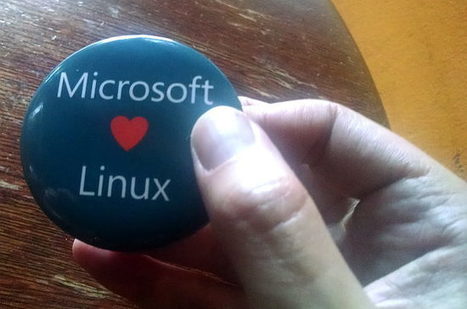
Microsoft has developed its own Linux distribution. And Azure runs it to do networking.
Redmond's revealed that it's built something called Azure Cloud Switch (ACS), describing it as “a cross-platform modular operating system for data center networking built on Linux” and “our foray into building our own software for running network devices like switches.”
Kamala Subramanian, Redmond's principal architect for Azure Networking, writes that: “At Microsoft, we believe there are many excellent switch hardware platforms available on the market, with healthy competition between many vendors driving innovation, speed increases, and cost reductions.”
(Translation: Microsoft partners, we mean you no harm.)
“However, what the cloud and enterprise networks find challenging is integrating the radically different software running on each different type of switch into a cloud-wide network management platform. Ideally, we would like all the benefits of the features we have implemented and the bugs we have fixed to stay with us, even as we ride the tide of newer switch hardware innovation.”
(Translation: Software-defined networking (SDN) is a very fine idea.)
But it appears Redmond couldn't find SDN code to fits its particular needs, as it says ACS “... focuses on feature development based on Microsoft priorities” and “allows us to debug, fix, and test software bugs much faster. It also allows us the flexibility to scale down the software and develop features that are required for our datacenter and our networking needs.”
ACS is designed to use the Switch Abstraction Interface (SAI), an OpenCompute effort that offers an API to program ASICs inside network devices.
|
|
Scooped by
Philippe J DEWOST
September 17, 2015 3:25 AM
|
Ride-sharing service BlaBlaCar raises $200 million and joins the Unicorn List with a valuation of $1.6 billion.
|
|
Scooped by
Philippe J DEWOST
September 16, 2015 12:17 PM
|
Apple's iOS 9 is expected to cause a boom in the use of IPv6, which could speed up service provider networks but create a lot of work for mobile developers. The new Apple mobile OS, coming out on Wednesday, will treat the new Internet Protocol as an equal to IPv4 instead of favoring the older system. That will cause iOS devices to use IPv6 much more, as long as apps, websites and carrier networks support it, according Facebook engineer Paul Saab. He led a panel discussion on IPv6 at Facebook's @Scale conference on Monday. Even when all the pieces are in place for IPv6, iOS 8 only makes an IPv6 connection about half the time or less because of the way it treats the new protocol. With iOS 9, and IPv6 connection will happen 99 percent of the time, Saab predicts. IPv4 is running out of unused Internet addresses, while IPv6 is expected to have more than enough for all uses long into the future. Adoption has been slow since its completion in 1998 but is starting to accelerate. The release of iOS 9 may give a big boost to that trend. "Immediately, starting on the 16th, I'm expecting to see a lot more v6 traffic show up," said Samir Vaidya, director of device technology at Verizon Wireless. About 50 percent of Verizon Wireless traffic uses IPv6, and Vaidya thinks it may be 70 percent by this time next year as subscribers flock to the iPhone 6s.
|
|
Scooped by
Philippe J DEWOST
September 15, 2015 4:52 AM
|
It’s been almost 20 years since IBM’s Deep Blue supercomputer beat the reigning world chess champion, Gary Kasparov, for the first time under standard tournament rules. Since then, chess-playing computers have become significantly stronger, leaving the best humans little chance even against a modern chess engine running on a smartphone. But while computers have become faster, the way chess engines work has not changed. Their power relies on brute force, the process of searching through all possible future moves to find the best next one. Of course, no human can match that or come anywhere close. While Deep Blue was searching some 200 million positions per second, Kasparov was probably searching no more than five a second. And yet he played at essentially the same level. Clearly, humans have a trick up their sleeve that computers have yet to master. This trick is in evaluating chess positions and narrowing down the most profitable avenues of search. That dramatically simplifies the computational task because it prunes the tree of all possible moves to just a few branches. Computers have never been good at this, but today that changes thanks to the work of Matthew Lai at Imperial College London. Lai has created an artificial intelligence machine called Giraffe that has taught itself to play chess by evaluating positions much more like humans and in an entirely different way to conventional chess engines. Straight out of the box, the new machine plays at the same level as the best conventional chess engines, many of which have been fine-tuned over many years. On a human level, it is equivalent to FIDE International Master status, placing it within the top 2.2 percent of tournament chess players. The technology behind Lai’s new machine is a neural network. This is a way of processing information inspired by the human brain. It consists of several layers of nodes that are connected in a way that change as the system is trained. This training process uses lots of examples to fine-tune the connections so that the network produces a specific output given a certain input, to recognize the presence of face in a picture, for example.
|