SIGFOX, the world’s leading provider of dedicated Internet of Things (IoT) connectivity, and VT Networks today announced they will roll out the SIGFOX network across Ireland, allowing nationwide low-power and cost-effective connectivity for the first time in the country.As a SIGFOX Network Operator, VT Networks will extend SIGFOX’s coverage and provide its seamless connectivity, clear subscription-based pricing and guaranteed service-level agreement to Irish customers. VT Networks will also work with SIGFOX to accelerate the development of IoT applications in Ireland and will connect over 1 million devices by 2017.
Before Endaga’s cell network in a box arrived in Shimshal, Pakistan, villagers had to drive three hours along the Shimshal Valley Road — one of the most dangerous roads in the world — to reach the nearest town with a telephone. When people were injured, it took hours for the nearest doctor to arrive because someone had to drive to the nearest town with a phone to call for a doctor.Without phones, villagers in Shimshal (and the thousands of villages like it) are isolated from their neighbors a few miles down the road and their relatives in other towns, and are cut off from anything that does not occur in their village.More than a billion people do not have access to cellular networks, three billion people live without phones and five billion people do without Internet access. While billions became connected to phone and Internet networks over the past decade, huge numbers of people are still underserved by these networks. The existing telecom and Internet infrastructure faces a tremendous challenge in linking many of these unconnected and under-connected people with the rest of the world.
A traditional base station costs around $250k. This article highlights the potential for solutions like RuggedPod + Amarisoft that divide such cost by 10x ...
Horizon teamed up with Amarisoft to deliver the first small cell 4G LTE system based on x86 industry standard microprocessor.
Amarisoft software does support eNodeB functions including PHY Layer, Protocol layer, and network interface layer including IPv6, as well as core network features to manage users access and interoperability with existing installation making it an highly flexible 4G LTE implementation. Associated with the power and flexibility of linux it does bring endless possibilities to its end user to implement new services or business model, to expand 4G and Internet access deployment.
Currently targeting developers, small telco companies and people who are willing to deploy Internet access around the world, this first development POD comes with:
An integrated SDR solution directly connected to the x86 motherboard through a PCIe connection. This solution covers frequencies from 70Mhz to 6Ghz and doesn’t require any external hardware to implement a 4G network. The signal can be either amplified to build up a production based station or use outdoor antennas connected through sealed SMA connectors.
Enough computing power to drive this SDR solutions and many IP services on top of it.
The solution provides a 10m signal range through a 10mW max power antenna solution (with 4 antennas 2×2 MIMO). Multiples POD can be synced using GPS clock signal available through a fith antenna.
Amarisoft and Horizon are working with AW2S on stronger signal support which can deliver dual 20W amplifier signals allowing to expand coverage to proprietary cell tower class. Please get in touch with us as to get more informations on this solution.
The dual socket Xeon E5 v3 motherboard included within this developer kit is providing enough computing power as to support with a single Xeon E5 2618Lv3 up to 3 Antennas as to emulate a full cell tower, leaving up to 2 full core for additionnal features.
The motherboard includes high resiliency hardware functions like ECC memory support to lower system failure and improve stability.
The ASPEED IPMI controller provides full features remote management function, and simplify remote operation.
Relying on industry standard hardware the solution lower OPEX by a 3 digit percentage as it doesn’t requires any specific training, and can be easily upgraded.
Associated with Amarisoft 4G/LTE 100 software stack, RuggedPOD is becoming one of the most cost efficient solution to deploy 4G/LTE network in harsh environments, disaster recovery situation or white zone where traditionnal telco’s do not want operate.
Apple had the highest annual profit of any company in history for its fiscal year, which ended September 30. Can anybody else catch up?
Probably not anytime soon. This chart from Statista shows how far ahead Apple is compared with the rest of the tech industry. Apple's quarterly profit was more than the combined profits of Microsoft and Alphabet (Google). No other tech company came close.
Careful study of cryptocurrency systems such as Bitcoin showed that under certain security assumptions, it is possible to verify and authenticate when financial information has been transferred and updated. Due to how it was configured, the specific applications of Bitcoin's blockchain itself resulted in a niche set of use cases, namely pseudonymous interactions that needed censorship resistance on a public network.What happens if you reconfigure those same elements or substitute those elements with other cogs and software libraries? Different types of utility and applications arise from this mix-and-match process, all of which have pros and cons depending on the operating environment. One set of gears includes a family of tools used to enhance privacy of participants and is found in projects such as Enigma, zk-SNARKs, confidential transactions and a handful of others. Each of these has trade-offs depending on how they are integrated with the host network. And in some cases, the resulting system itself caters to use cases that are gated and not censorship-resistant.Some Bitcoin enthusiasts assert that non-Bitcoin blockchains are all the same and that "permissioned" blockchains – or blockchains that gate transaction validation – are not much different than relational databases mixed with snake oil.The problem with this broad generalization is that it does not distinguish between what each project, startup and effort in the overall space is trying to do. It lumps them all together without bothering to distinguish the potential customers and problem sets these projects are addressing.
Facebook has done a better job of capitalizing on the move to mobile than any other major internet company.When it went public in May 2012, it had just launched a mobile advertising business. Now, mobile advertising makes up the vast majority of its revenue — 78% in the quarter ended September 30.As this chart from Statista shows, the number of mobile-only Facebook users has grown 7x since the beginning of 2012, and last quarter it surpassed the number of mobile-and-desktop users for the first time. A lot of that growth comes from developing countries where people are using their mobile phones as their only computers, and Facebook has done a lot over the last couple years to make sure the site works well over slow mobile connections.
A new kind of concrete from the UK building materials company Lafarge Tarmac instantly soaks up litres and litres of H20 — simultaneously preventing flood conditions while also conserving water by cycling it directly back into the ground.
It’s called Tarmac Topmix Permeable, and it’s a super-porous concrete pavement designed to remove storm and floodwater from parking lots, driveways, footpaths, and other surfaces. It was designed by Britain’s LaFarge Tarmac, who call the idea part of a “sustainable urban drainage system.” Water enters the permeable concrete top layer, and then passes through pebbles beneath to become groundwater in the soil.
The company says that the concrete could be installed anywhere to mitigate flood risk, but anyone who uses it should carry out a survey first to scope out any sinkholes or other possible pitfalls, literal and figurative, in the area.
The one big caveat? If the concrete is installed someplace cold, the water could freeze, which would ruin the whole system. So the company’s next challenge is figuring out a way to build a version of the porous concrete that can adapt to cold climates.
There has been some frenzy around the intelligent road recently. We shall not forget that the smart road will also need to deal with severe conditions and that safety also proceeds from maintaining the pavement physical behaviour as constant as possible. Tarmac's Topmix approach, though currently restricted to limited areas and climate conditions, "paves the way" in an interesting manner.
During the press conference for the release of the Autopilot, Tesla CEO Elon Musk referred to each Model S owners as an “expert trainer” – meaning that each driver will train the autonomous features of the system to feed the collective network intelligence of the fleet by simply driving the electric vehicle on Autopilot.
He said that the system should improve every day, but that improvements might only become noticeable every week or so by adding up. Just a few weeks after the release, Model S owners are already taking to the Tesla Motors Club forum to describe how the Autopilot is improving…
A common problem with the early version of the system was that it had a tendency to try to take exits on the highway when it wasn’t supposed to, but after a few tugs on the Autopilot’s leash, trainers have corrected the issue.
Pierre-Étienne Franc, Pascal MateoPréface de Pascal Lamy L’hydrogène peut et doit jouer un rôle important dans la transition énergétique : cette molécule sans carbone peut permettre, avec une aide technologique pour maîtriser sa production et son usage, de basculer dans un monde “propre”, régi par une économie sans carbone. L’hydrogène a la faculté de stocker l’énergie primaire, en particulier les énergies renouvelables. Combiné à une pile à combustible, il peut en outre restituer cette énergie sous forme d’électricité dans un grand nombre d’applications, relevant notamment du domaine de la mobilité. Mais si les difficultés techniques sont aujourd’hui en passe d’être résolues, les défis économiques (déploiement industriel et commercial des premières expériences menées, collaboration entre acteurs privés et publics) sont encore prédominants pour faire décoller la transition énergétique.
The Ethereum project and ConsenSys, the company created by one of the project’s co-creators, have received a huge vote of approval from one of the world’s biggest enterprise software providers — Microsoft. The company will be working with ConsenSys to provide developmenttools for Microsoft’s enterprise customers on the Azure platform.
Focusing on financial services we saw a lot of potential for a framework and platform like Ethereum to go across the platform of financial institutions and modernize a lot of processes that were stuck in the past,” says Marley Gray, Director of Technology Strategy, US Financial Services at Microsoft. “We thought that Ethereum was a really good platform for building distributed ledger applications.”
Unlike bitcoin-based blockchain applications (and companies like Chain that are developing projects on top of bitcoin) Ethereum uses a different token called the Ether.
“Bitcoin offers one functionality which is the monetary functionality. Because it’s a very narrow protocol… it’s difficult to build arbitrarily difficult functionality into the program,” says Joseph Lubin, the founder of ConsenSys, and a major supporter of the Ethereum Foundation.
With Ethereum, there’s a complete computational machine running within every node of the network, Lubin says.
Fragmentation or evolution ? Microsoft's move is interesting anyway and confirms the advent of decentralized consensus as a generic and scalable disruption factor.
You may have heard that Europe is in a state of crisis. This has nothing to do with an influx of refugees, or Greek debt, or even the future of the European Union. The crisis we speak of has even more severe consequences for Europe’s global competitiveness. In our research on the state and pace of digital evolution worldwide, we have found that the old continent is in the midst of a “digital recession.”Of the 50 countries we studied in our Digital Evolution Index, 23 were European (not counting Turkey). Of these, only three, Switzerland, Ireland, and Estonia, made it to a commendable “Stand Out” category – which means that their high levels of digital development are attractive to global businesses and investors and that their digital ecosystems are positioned to nurture start ups and internet businesses that can compete globally.Fifteen European countries have been losing momentum since 2008 in terms of their state of digital evolution – this is what we mean by a digital recession – with the Netherlands coming in dead last in our momentum rankings. European countries occupy the nine bottom spots in our list of 50. Plus, the digitally receding countries include large economies like Germany, the UK, and France, as well as Finland and Sweden, Scandinavian tech powerhouses that were the early leaders of mobile telephony. Across the rest of Europe, the state of digital evolution has been mediocre and the pace of improvement, tepid.This dismal performance points to a glaring – and growing — digital gap as Europeans watch the U.S. and China take the lead in tech innovation. President Obama said it plainly in a recent interview: “We have owned the Internet. Our companies have created it, expanded it, perfected it in ways that they can’t compete,” referring to the Europeans. And a recently released report suggests that Europe’s digital divide problem extends way beyond the Atlantic; Europe is a distant third behind North America and Asia for $100 million plus financing for VC backed companies.
Fred Wilson says blockchain technology will create the next Google or Facebook. But in the end, the disruption could be to our entire economic system.
He wonders in not-so vague terms if the blockchain technology which underlies bitcoin, might actually mean an end to “network effects” that let bigger companies create better value for their customers, and more.
“Lately, we’ve been wondering if there is an end to this pattern on the Internet and mobile,” wrote Wilson, who in addition to being an investor in bitcoin exchange Coinbase, was an early investor in Twitter and Tumblr.
“We think it is possible that an open-data platform, in which users ultimately control their data and the networks they choose to participate in, could be the thing that undoes this pattern of winner takes most,” he writes.
We’re obviously looking at 21st-century technology of building segmental bridges, and as far as we can tell, this video was shot in China. Watching this buddy at work will most likely scare the hell out of those people who believe the end of humanity is the rise of artificial intelligence, but there’s a lot of superior engineering to it that is quite appealing.
First of all, building a bridge in short sections as opposed to traditional methods that make them in huge sections is a rather novel practice. As a matter of fact, the first segmental concrete bridge, built in 1950, was cast-in-place across the Lahn River in Balduinstein, Germany. The first precast segmental concrete bridge, created 12 years later, crossed the Seine River in France.
However, this method still wasn’t fast enough for China’s massive development pace, which is probably the reason they started using launching machines. These bad boys come in all sorts of shapes and sizes and are regularly personalized to suit the specific bridge design, construction conditions, and structural dimensions of beams.
Technically speaking, SLJ900/32 is a "segmental bridge launching" machine. The launching part looks scary to me, and the video is properly insane when you focus on the worker's relative height...
The future of construction is here! All thanks to China, not always something you hear everyday but yes China has created a bridge section setting machine. This machine goes from pillar to pillar and sets each piece of bridge on to it and then moves to the next. Diffusion of this idea could quickly move from China to other countries and this would allow countries that are not China to be able to build bridge just as quickly. Now, it looks very scary when watching the video but if the job gets done any quicker I would be all for the machine, as long as it is safe. Other countries may not be willing to share the idea with others, but may sell it to other countries and make some money on it and just maybe boost their own economy.
Nokia Networks announced that it has joined Open Compute Project (OCP) as a Gold member, and will work with the OCP Foundation to help drive greater efficiencies, flexibility, and scale in the data center with their AirFrame solution.We're thrilled to see continued momentum in the OCP community and Nokia's new membership introduces a breakthrough layer of collaboration and innovation in data center technology. As a traditional infrastructure provider in the telecommunications industry, Nokia's expertise and technology will introduce new developments and opportunities for collaboration that will continue the progress we've all made in building more open and efficient infrastructure.
Apple Inc. is in discussions with US banks to develop a mobile-to-mobile payment service that would let users transfer money to one another from their phones, which seems to be something very similar to Venmo and PayPal.
Apple’s own payments system Apple Pay along with other mobile payment systems has been focusing on moving customers away from their wallets, cash, checks and cards in mobile-to-merchant relationships. The new service will be entering the highly competitive space of mobile-to-mobile transactions where PayPal and Venmo have significant shares.
In July, LTP reported that Apple had filed a patent application titled, “Person-to-Person Payments Using Electronic Devices” to the US Patent and Trademark office. Apple has proposed using mobile devices to make payments between persons through various technologies like Wi-Fi, Bluetooth and near-field communication (NFC). Apple filed the patent on September 30, 2014 and credits Apple’s Senior Wireless Software Architect Ahmer A. Khan and Senior Director of Engineering Timothy Hurley for the invention. It got published on July 2, 2015.
What might be really interesting is that from the July patent, it looks like it might have a proximity P2P payment system apart from remote capabilities. It actually talks about the process in which a user will launch a Passbook or wallet app, such as Apple Wallet to detect “nearby devices” they want to send payments to and plug in whatever amount they want to send. The payment would then be authenticated by multiple procedures.
Apple’s CEO Tim Cook recently gave a speech in Trinity College in Dublin, where he shared his insights on the way digital payments will conquer the space,saying, “Your kids will not know what money is.”
L'édition 2015 de la Conference USI (Unexpected Sources of Inspiration) s'est tenue début Juillet au Carrousel du Louvre et a confirmé son statut de meilleure Conference Tech sur Paris, combinant un site exceptionnel, une audience de plus de 1200 participants très diverse et de très bon niveau, et une palette de speakers dans plusieurs disciplines délivrant une quarantaine d'interventions sur les deux jours. La Caisse des Dépôts était de nouveau partenaire de cette édition avec plus d'une cinquantaine de participants dans le cadre de son programme de transformation digitale.
François Hisquin, CEO d'Octo et Curateur de la conférence, m'avait demandé d'intervenir sur la thématique d'Open Compute, dont la contribution aux enjeux de la transition énergétique n'est toujours pas correctement appréciée en Europe alors même que nous hébergeons des entreprises extrêmement talentueuses dans ce domaine.
L'enthousiasme équivoque des banquiers pour la Blockchain marque-t-il le "moment constantinien" du Bitcoin ou bien n'est-ce qu'une frivolité ?Depuis qu'elle a eu les honneurs de The Economist, la Blockchain ne quitte plus les feux de la rampe. Oracles de grands banquiers, rapports et conférences en font le sujet sur lequel il est urgent pour tous d'acquérir à l'instant un avis tranché.Trouvée dans la grotte libertarienne qui abrita le berceau du Bitcoin serait-elle l'instrument paradoxalement providentiel destiné à sauver l'empire ? On a déjà vu cela en 313 quand Constantin se proclama fidèle de ce Christ que tant de Césars avaient considéré comme l'icône d'une bande d'anarchistes. L'Empire romain se fit chrétien, le christianisme se fit romain et impérial.
It seems that transparent aluminum is as real as it gets today, thanks to US Naval Research Laboratory scientist Dr. Jas Sanghera who described it as “actually a mineral, it’s magnesium aluminate. The advantage is it’s so much tougher, stronger, harder than glass. It provides better protection in more hostile environments—so it can withstand sand and rain erosion.”Being a more durable material, it will boast of a thinner layer of spinel which is touted to deliver a better level of performance as opposed to glass. When one takes weight-sensitive platforms such as UAVs (unmanned autonomous vehicles), and head-mounted face shields, you can be sure that this is a technology that will change the way we see the world work.
Amazon has monopoly power over the public cloud because it clearly sets the price (ever downward) and has the capacity to enforce that price. Amazon is the OPEC of cloud computing and both studies actually show that because both show Amazon gaining share in a market that is simply exploding.
The way you gain share in an exploding market is by exploding more than all the other guys and we can see that at work by comparing IBM’s statement that it would (notice they are speaking about future events) invest $1 billion in cloud infrastructure in the current fiscal year, versus Amazon’s statement that it had (notice they are speaking of events that had already happened) spent $5 billion on cloud infrastructure in the past fiscal year.
Maybe $1 billion against definitely $5 billion isn’t even a contest. At this rate Amazon’s cloud will continue to grow faster than IBM’s cloud.
Wait, there’s more! Only Amazon can really claim they have a graphical cloud. While not all Amazon servers are equipped with GPUs, enough of them are to support millions of simultaneous seats running graphical apps. No other cloud vendor can claim that.
Having a graphical cloud is important because it is one of those computing milestones we see come along every decade or so to determine who are the real leaders. Think about it. There were mainframes with punched cards (batch systems) then with terminals (interactive systems), then interactive minicomputers, then personal workstations and computers, then graphical computers, mobile computers, networked computers, Internet computers and now cloud computers. Each step established a new hierarchy of vendors and service providers. And it is clear to me that right here, right now Amazon is absolutely dominant in both cloud and graphical cloud computing. They set the price, they set the terms, they have the capacity, and everyone else just plays along or goes out of business.
Stop 1 second thinking of Amazon from the user / developer point of view and reflect about this :
"But there is an important question here and that’s at what point Amazon will be in a position to use lethal cloud force? It’s a market doubling or more in size every year. How many more doubles will it take for Amazon to gain such lethal business power? I’d say five more years will do it.
And when I say do it, think about the company we are talking about. Amazon is unique. No large company in the industry right now has a more effective CEO than Jeff Bezos. No large company has a bigger appetite for calculated risk than does Amazon. No company is more disciplined. And — most importantly — no large company has the ear of Wall Street the way Bezos and Amazon do. They can try and fail in any number of areas (mobile phones, anyone?) and not be punished for it in the market. And in this case that’s because the market is smart, relying on Bezos’ innate ruthlessness."
Each month for the past six months, HTC has recorded a double-digit decline in revenues relative to 2014. For a company that wasn't making all that much money in the first place, and whose most...
BITCOIN has a bad reputation. The decentralised digital cryptocurrency, powered by a vast computer network, is notorious for the wild fluctuations in its value, the zeal of its supporters and its degenerate uses, such as extortion, buying drugs and hiring hitmen in the online bazaars of the “dark net”. This is unfair. The value of a bitcoin has been pretty stable, at around $250, for most of this year. Among regulators and financial institutions, scepticism has given way to enthusiasm (the European Union recently recognised it as a currency). But most unfair of all is that bitcoin’s shady image causes people to overlook the extraordinary potential of the “blockchain”, the technology that underpins it. This innovation carries a significance stretching far beyond cryptocurrency. The blockchain lets people who have no particular confidence in each other collaborate without having to go through a neutral central authority. Simply put, it is a machine for creating trust. To understand the power of blockchain systems, and the things they can do, it is important to distinguish between three things that are commonly muddled up, namely the bitcoin currency, the specific blockchain that underpins it and the idea of blockchains in general. A helpful analogy is with Napster, the pioneering but illegal “peer-to-peer” file-sharing service that went on line in 1999, providing free access to millions of music tracks. Napster itself was swiftly shut down, but it inspired a host of other peer-to-peer services. Many of these were also used for pirating music and films. Yet despite its dubious origins, peer-to-peer technology found legitimate uses, powering internet startups such as Skype (for telephony) and Spotify (for music streaming)—and also, as it happens, bitcoin.
The blockchain is an even more potent technology. In essence it is a shared, trusted, public ledger that everyone can inspect, but which no single user controls. The participants in a blockchain system collectively keep the ledger up to date: it can be amended only according to strict rules and by general agreement. Bitcoin’s blockchain ledger prevents double-spending and keeps track of transactions continuously. It is what makes possible a currency without a central bank.
Blockchains are also the latest example of the unexpected fruits of cryptography. Mathematical scrambling is used to boil down an original piece of information into a code, known as a hash. Any attempt to tamper with any part of the blockchain is apparent immediately—because the new hash will not match the old ones. In this way a science that keeps information secret (vital for encrypting messages and online shopping and banking) is, paradoxically, also a tool for open dealing. Bitcoin itself may never be more than a curiosity. However blockchains have a host of other uses because they meet the need for a trustworthy record, something vital for transactions of every sort. Dozens of startups now hope to capitalise on the blockchain technology, either by doing clever things with the bitcoin blockchain or by creating new blockchains of their own (see article).
There has been a frenzy of articles on Bitcoin/Blockchain recently and The Economist closes the week with a very clear "paper" on this (again) hot-trending topic.
Solar energy is a seriously underrated resource.More power from the sun hits the Earth in a single hour than humanity uses in an entire year, yet solar only provided 0.39% of the energy used in the US last year.Visionaries like Elon Musk think that solar will become the biggest energy source by 2031, according to an interview with Tim Urban on Wait But Why.But what would a world powered by solar look like?The Earth would probably be littered with solar panels, right?Wrong.If solar is 20% efficient (as it has been in lab tests) at turning solar energy into power, we'd only need to cover a land area about the size of Spain to power the entire Earth renewably in 2030.
The animal kingdom contains numerous examples of individuals cooperating with one another to achieve impressive outcomes without the need for planning, control, or even direct communication between agents – examples are bees, ants, and schools of fish. Humans, however, have only been able to achieve goals cooperatively through the imposition of organizational hierarchies, centralized coordination, and rules.
Blockchain technologies offer a new approach, allowing us to achieve large-scale and systematic cooperation in an entirely distributed and decentralized manner. The application of this technology, however, has mostly focused on transaction-driven financial models like Bitcoin, but the Blockchain’s ability to transact and cooperate on a peer-to-peer basis, without relying on any centralized authority or middlemen, has many other applications. The Blockchain offers a new governance model with implications well beyond financial markets.
Primavera De Filippi is a permanent researcher at the National Center of Scientific Research (CNRS) in Paris. She is currently a research fellow at the Berkman Center for Internet & Society at Harvard Law School, where she’s investigating the concept of governance-by-design as it relates to distributed online architectures. Most of her research focuses on the legal challenges raised, and faced by emergent decentralized technologies – such as Bitcoin, Ethereum and other blockchain-based applications – and how these technologies could be used to design new governance models capable of supporting large-scale decentralized collaboration and more participatory decision-making.
“How many times would I have to fold a sheet of paper for the height of the folded paper to reach the moon?”
Human beings have terrible intuition for exponential growth. If I asked you how many times you would have to fold a single sheet of US Letter paper to reach the moon, it would be difficult to intuitively comprehend that it only takes twenty folds to reach Mount Everest, forty-two folds to the moon, and fifty to reach the sun.
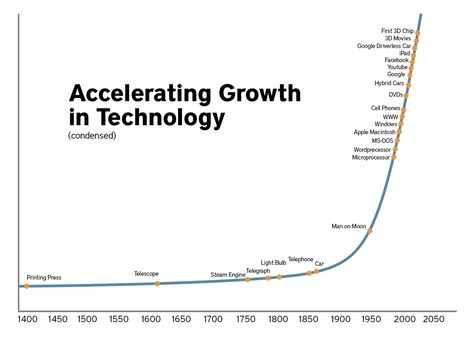
Compound interest is the eighth wonder of the world. He who understands it, earns it … he who doesn’t … pays it.” –Albert Einstein Often times when looking at the future, we use the projection of the past to predict the outcome of the future. This suggestion is generally not understood properly as due to the natural linearity of time, people are more likely to look at the next five years assuming the growth will march linearly like the past five years.
The truth is that even from the last five years to now, growth particularly technological growth is never linear and is always exponential.
The Apollo Guidance Computer, for example, was built of 4100 integrated circuits, each of which was a 3 input gate for a total of approximately 12,300 transistors – having its performance clocking in at 41.6 instructions per second.
An iPhone 6 has 3.36 billion instructions per second meaning an iPhone 6 is 80 million times faster than Apollo on just instructions per second and around 120 million times faster than the guidance computer that put Neil Armstrong and Buzz Aldrin on the moon. A single iPhone 6 could theoretically guide 120 million Apollo rockets at the same time (an iPhone 6S is 70% faster than an iPhone 6). This also doesn’t include the fact that a 64 bit processor can use less operations to process more complex computations - so 120 million times faster is definitely an understatement.
We humans are desperately linear when it comes to aiming at the future. It took our societies thousands of years to switch from Mircea Eliades "myth of eternal return" way of looking at the world (after all, nature is mostly cyclical in its immediate perception) and unfold towards the "time arrow" paradigm we are currently living in.
Except that for the past decades, something different has been emerging, that involves exponential thinking as per illustrated in Ray Kurzweil "second half of the chessboard" metaphor (echoing a legend that has its local version in almost chess playing culture).
This post explains very well what exponential thinking is about, and why we humans are so often wrong in the way we try to define the future on 10-15 years time frames. Must read especially if you feel uncomfortable with all this tech popping out and surprising us (and our governments) for the past few years. AirBnB and Uber were indeed unforeseeable and here is why...
To get content containing either thought or leadership enter:
To get content containing both thought and leadership enter:
To get content containing the expression thought leadership enter:
You can enter several keywords and you can refine them whenever you want. Our suggestion engine uses more signals but entering a few keywords here will rapidly give you great content to curate.


 Your new post is loading...