Your new post is loading...

|
Scooped by
Institut sur la gouvernance (IGOPP)
August 4, 2020 10:38 AM
|
[...] The tale is a cautionary one, given the high fashion for reverse listings these days. In the US, special purpose acquisition companies, or Spacs, last year accounted for a quarter of all IPOs. [...] Spac fans said it is a natural time for the sector to boom: many private companies are struggling following the coronavirus pandemic, and the lockdowns that accompanied it, and are seeking easy access to finance. Stock markets are booming, giving Spacs a straightforward route to market. But there is nervousness among investors towards more complicated corporate IPOs. Spacs, backed by big-name sponsors, provide investors with the comfort of a trusted intermediary. There are structural advantages too. In volatile times like these, it is attractive if a company can fix a price and execute a deal quickly, and avoid the delays and hassle inherent in filing an IPO prospectus and being scrutinised by regulators, before being able to list. Investment banks’ IPO fees, particularly hefty in the US, can also be mitigated. The downsides are obvious. In some jurisdictions at least, the level of information that investors get of a company that reverse-lists is scant, though US Spacs stress that the disclosures in their merger prospectuses are just as fulsome as a mainstream IPO would demand. Another negative is the dilution effect for company owners and investors, effected via complex warrant structures attached to the vehicles’ listed equity. And there is an inherent conflict of interest in the value of payback for sponsors being tied to the price paid for a merger. Deals also tend to be magnets for a “Spac mafia” of arbitrage hedge funds which buy up the warrants to exploit short-term pricing anomalies.
European Commission study finds shareholder pay-outs increased fourfold from 1992–2018, with a fall in the ratio of capex and R&D investment to revenues. If there is one theme that characterises debate about corporate governance over the past decade it is the conflict between short-term and long-term strategy and decision-making. The European Commission has now weighed in with a study that concludes that far too many company directors across the EU continue to think short term instead of acting in the long-term interests of their stakeholders. The commission concludes action is needed to shift decision-making. “An EU policy intervention is required to lengthen the time horizon in corporate decision-making and promote a corporate governance that is more conducive to sustainability,” the study says. Researchers worry that without new policies “shareholder primacy and short-term pressures from the finance markets will likely continue to influence corporate decision-making”. The conclusion comes despite evidence that a few high-profile fund managers have attempted to shift board and corporate thinking towards long-term aims and strategies—even during the Covid-19 crisis. In some quarters campaigners claim to have found evidence that the crisis has accelerated a shift to “stakeholderism”. [...] The study’s evidence seems to prove the point. Looking at data from 1992 to 2018, researchers found shareholder pay-outs increased fourfold from less than 1% of revenues to almost 4%. They also say the ratio of capex and R&D investment to revenues has been declining.
Over the last few years, misbehavior of corporate executives like Harvey Weinstein, Steve Wynn, Leslie Moonves, and Elon Musk has outraged many people around the world. The misconduct has ranged from the inadvisable to the unethical to the criminal. Almost all of it – when made public – has damaged the executives’ public reputations, diminished the value of their companies’ stock, and raised some serious legal and policy issues. My recent article, Executive Private Misconduct, in The George Washington Law Review examines this convergence of private lives and public consequences of executive misbehavior. The article puts the legal issues arising from this convergence into the context of greater intolerance for executive private misconduct, as prompted by the unfolding #MeToo movement, shifting social understandings of public and private, and changing corporate social expectations. It also analyzes the core legal tensions in corporate and securities law that have made these issues so difficult to resolve and offers pragmatic proposals for policymakers and executives.
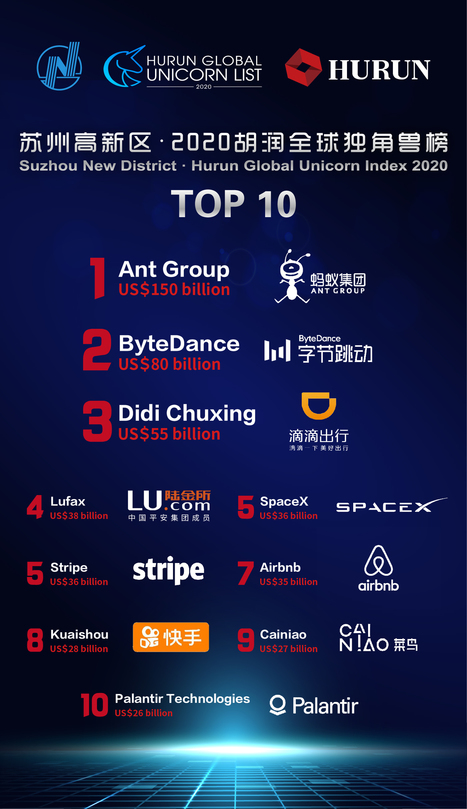
The Hurun Research Institute, in association with Suzhou New District from East China, today released the Hurun Global Unicorn Index 2020, a ranking of the world’s start-ups founded in the 2000s, worth at least a billion dollars and not yet listed on a public exchange. This is the second year of the list and follows on from six quarterly Hurun China Unicorn Indices. This report includes the Hurun Best Unicorn Investors in the World 2020, a ranking of the 100 most successful unicorn investors. Valuations are a snapshot of 31 March 2020. Hurun Research found 586 unicorns in the world, based in 29 countries and 145 cities. On average, they were set up nine years ago, with 80% selling software and services and 60% consumer-facing. 5% were in traditional sectors, with the majority disrupting financial services, retail, entertainment, business management solutions, healthcare, logistics and automobile. The total value of all known unicorns in the world is US$1.9tn, equivalent to the GDP of Italy. 89 unicorns saw their valuations rise, 23 saw their valuations drop. There were 142 ‘new faces’ and 50 drop-offs. Of the drop-offs, 30 were because they went public or were acquired and 20 saw their valuation drop below US$1bn. Hurun Report Chairman and Chief Researcher Rupert Hoogewerf said: “We have found 586 unicorns in the world. These young companies, only nine years old on average, are the world’s most exciting start-ups, leading new generation of disruptive technology and attracting the world’s top young talent. Just look at Elon Musk’s SpaceX – valued at US$36bn and fifth on the Hurun Global Unicorn Index 2020 – which caught the imagination of the world by delivering two astronauts to the International Space Station on 31 May. Others that have made headlines recently include Beijing-based ByteDance, which is seeing its massively popular short video app TikTok come under threat from both the US and Indian governments, as well as China fintech Ant Financial, which is reportedly looking at a whopping US$200bn IPO in Shanghai and HK.”
Days before, Slyngstad had announced his decision to resign as chief executive of the oil fund — the largest sovereign wealth fund in the world — after an impressive 12 years, during which the fund had topped $1 trillion in assets and sparked headlines for announcing its intention to divest from shares in the very asset from which it derives its wealth: oil. [...] Tangen is a celebrated stock picker. But the oil fund is de facto an index tracker fund, which is forbidden from investing outside of listed stocks and bonds, except in unlisted property. NBIM, whose investment management arm Tangen will soon lead, must keep to benchmarks set by the Finance Ministry, with a tracking error of just 1.25 percent. “The role of chief executive is not very influential on the way the fund is managed,” says Kapoor. He points out that though NBIM has a staff of more than 500 well-qualified and experienced managers, it is fewer than 20 bureaucrats in the Finance Ministry, “with little financial expertise and no experience,” who really call the shots. “The job is high-profile, yes, but the difference between a good job running NBIM and a bad job running NBIM is not really noticeable in terms of performance, because it only has a [small] tracking error from the benchmark set by the Finance Ministry. Room for maneuver is very limited.” This was a problem encountered by Slyngstad during his 12 years as head of the fund. He called repeatedly for the fund to enter into new asset classes such as private equity — calls that were rebuffed by the Norwegian government and the central bank. In 2018, a year before his departure, Slyngstad presided over a momentous inquiry into whether the oil fund should continue to be housed in the central bank, itself a highly unusual arrangement unlike those of other large sovereign wealth funds.
|
|
Scooped by
Institut sur la gouvernance (IGOPP)
August 3, 2020 11:36 AM
|
A strong year for the largest five US stocks despite the worst recession the country has faced in decades has further expanded their influence on equity markets. Apple, Microsoft, Amazon, Alphabet and Facebook now represent more than a fifth of the S&P 500. Not since the 1980s have the biggest five companies had such a large share of the index, according to S&P Dow Jones Indices. This concentration was further strengthened on Friday when Apple, Amazon and Alphabet, Google’s parent company, continued their steady march towards recent stock market highs, following bumper earnings on Thursday. The strong share price performance came in the same week that top executives from these and other tech giants were pressed by US lawmakers about the darker practices that have helped them to dominate their industries. One such critique has been their aggressive acquisition strategy of buying up smaller rivals. In a 2012 email, Facebook chief executive Mark Zuckerberg acknowledged that he planned to acquire the photo app Instagram in order to “neutralise” it. Elizabeth Warren, the US senator from Massachusetts and former Democratic presidential hopeful, said “Big Tech thinks they’re too big to be held accountable — and with gutless antitrust enforcement, they are”, in a Twitter post.
|
|
Scooped by
Institut sur la gouvernance (IGOPP)
August 3, 2020 11:19 AM
|
The United Arab Emirates announced Saturday the successful start-up of its Barakah nuclear energy plant, the first in the Arab world and a significant step towards the country’s goal of emissions-free electricity. With the announcement, the UAE becomes the newest member of an exclusive club of 31 countries running nuclear power operations. It’s also the first new country to launch a nuclear power plant in three decades, the last being China in 1990. The Barakah plant’s Unit 1 is the first of the country’s planned four reactors, which when complete are expected to meet 25% of the country’s electricity needs with zero carbon emissions. “Today is a truly historic moment for the UAE,” Mohamed Ibrahim Al Hammadi, CEO of Emirates Nuclear Energy Company (ENEC), said in a statement over the weekend. “We are now another step closer to achieving our goal of supplying up to a quarter of our Nation’s electricity needs and powering its future growth with safe, reliable, and emissions-free electricity.”
Interest on the part of investors and other corporate stakeholders in environmental, social and governance (“ESG”) matters has surged in recent years, and the current economic, public health and social justice crises have only intensified this focus. ESG, at its core, is a means by which companies can be evaluated with respect to a broad range of socially desirable ends. ESG describes a set of factors used to measure the non-financial impacts of particular investments and companies. At the same time, ESG also provides a range of business and investment opportunities. Net flows into ESG funds available to U.S. investors have skyrocketed, totalling $20.6 billion in 2019, nearly four times the previous annual record set in 2018, [1] while ESG funds in Europe also attracted record inflows of $132 billion in 2019. [2] More than 70% of funds focused on ESG investments outperformed their counterparts in the first four months of 2020, [3] and nearly 60% of ESG funds outperformed the wider market over the past decade. [4] Consumers and investors are placing a growing value on ESG, and industry leaders have responded in a number of ways, including issuing comprehensive sustainability reports and expanding ESG disclosures in their annual reports, providing information to ESG rating agencies and publicly communicating ESG commitments.
As the world begins its slow pivot from managing the COVID-19 crisis to recovery and the reopening of economies, it’s clear that the period of lockdown has had a profound impact on how people live. The period of contagion, self-isolation, and economic
uncertainty will change the way consumers behave, in some cases for years to come. The new consumer behaviors span all areas of life, from how we work to how we shop to how we entertain ourselves. These rapid shifts have important implications for retailers and ‘consumer-packaged-goods companies. Many of the longer-term changes in consumer behavior are still being formed, giving companies an opportunity to help shape the Next Normal.
Microsoft said on Sunday that it would continue discussions to acquire popular short-video app TikTok from Chinese internet giant ByteDance, and that it was aiming to conclude the negotiations by Sept. 15. The company made the statement following a conversation between its CEO Satya Nadella and U.S. President Donald Trump. It said it would ensure that all private data of TikTok's American users is transferred to and remains in the United States. Microsoft said there was no certainty a deal — which would also see the company own and operate the app in Canada, Australia, and New Zealand — would be reached. "Microsoft fully appreciates the importance of addressing the President's concerns. It is committed to acquiring TikTok subject to a complete security review and providing proper economic benefits to the United States, including the United States Treasury," Microsoft said in a statement. ByteDance and the White House did not immediately respond to requests for comment. The announcement came after Trump had said on Friday that he would soon ban TikTok in the United States.
To get a good look at Google, climb a barren hill in front of the online giant’s Silicon Valley headquarters—or rather, both of them. To the right lies the old hq, a clump of low-slung office buildings ringed by dozens of similar boxes. To the left a brand-new corporate centre is rising. From outside it resembles an oversized circus tent, but the inside is still undetermined: pillars, wooden panelling and hardly any walls. The bare-bones structure is meant to provide architectural flexibility. This will come in handy in a post-pandemic world in which offices will look quite different. “We’ll get a chance to reimagine it,” says Sundar Pichai, the boss of both Google and its parent company, Alphabet. And just as the bricks-and-mortar structure is changing, the organisation is in transition, too. When Mr Pichai took over as chief executive of Google in August 2015, after it became the core of the newly formed Alphabet, the online-search-and-advertising business had annual revenues of $66bn and net income of $14bn. By the time Sergey Brin and Larry Page, Google’s founders, handed him the reins of Google’s parent company last December his division was raking in profits of $34bn on sales of $161bn—and Alphabet was worth almost twice as much as four years earlier.
SoftBank Group Corp. said it plans to buy back as much as 12.3% of its shares for 1 trillion yen ($9.6 billion), adding to a repurchase program that has helped lift its shares this year. The Tokyo-based company said the latest buyback program would run through July 2021. The company has said it plans to sell 4.5 trillion yen in assets to fund repurchases and other activities. SoftBank founder Masayoshi Son turned to asset sales and repurchases after his shares tumbled with the coronavirus pandemic and business missteps earlier this year. The strategy has helped lift his company’s stock more than 150% from its low in March. SoftBank said that due to the uncertainty in market trends, repurchases under the 4.5 trillion yen asset program may not be completed until April 2021 or later. SoftBank Group shares have climbed about 45% this year before today.
Corporate America is finding it hard to kick the share buyback habit, even after the US slipped into its worst recession in decades. Total buybacks are expected to drop this year as the downturn caused by coronavirus saps corporate profits, prompting many US blue-chips to suspend or cut back share repurchases. Yet companies in the S&P 500 that have reported second-quarter earnings so far have reduced the number of their outstanding shares by an average of 0.3 per cent from the previous quarter, according to calculations from Credit Suisse. Updates showed that some of the largest US multinationals continued to buy back their own stock or even accelerated stock repurchases. [...] David Lebovitz, global market strategist for JPMorgan Asset Management, noted that the buybacks were “not happening everywhere”, but were “driven by specific sectors and stocks”. He added that financial and materials companies were potentially more willing to engage in buybacks through the downturn, because their stocks have not advanced as much as companies in other sectors since the lows in March.
|
Corporate Social Responsibility and Environmental, Social & Governance (ESG) issues have become increasingly important over the past few years, and evaluating a company’s ESG disclosures has become a key tool used by many investors in making investment and engagement decisions. Many companies are, with increasing frequency, publishing ESG reports on their websites and incorporating ESG disclosure into mandatory filings with the U.S. Securities and Exchange Commission. According to a National Association of Corporate Directors Report, in 2019, 66% of companies in the Russell 3000 Index discussed and incorporated some ESG risk disclosure into their financial filings. [1] The increase in disclosure has been accompanied by an increase in shareholder litigation on ESG issues. This post is divided into three parts: Part 1 provides a brief summary of the rise in investor pressure for increased ESG disclosures; Part 2 describes the SEC response to these trends and disclosure regimes, with a particular focus on the World Economic Forum’s 2020 frameworks; and Part 3 discusses litigation related to ESG voluntary disclosures and what companies can do to limit the risk of associated litigation.
There have been many positive stories during the pandemic of people and organisations supporting the cause, from frontline health and key workers to Captain Sir Tom Moore’s fundraising heroics, to firms pivoting their business to producing ventilator machines, alcohol sanitiser and personal protective equipment. Unfortunately, the economic reality of the pandemic is starting to show its ugly face, with businesses starting to fail and people being made redundant at an alarming rate. Sadly, this is only the start of the economic difficulties as the UK’s furlough scheme draws to a close at the end of October. As the school and summer holidays start, many people will take a much-needed break, although spare a thought for those key workers who continue to provide us with core services and those working in certain sectors such as tourism and hospitality where they will be working at breakneck speed to catch up on lost revenue. [...] While there is the temptation to explain professional misconduct as a function of a bad apple or a rogue employee, this is too simplistic an explanation. Our research suggests that professional misconduct could occur to any of us, particularly when there is a toxic combination of the following three factors:
(1) At the individual level, often people make decisions that are too far removed from the people who are affected by their behaviours, leading to them sleepwalking into professional misconduct.
(2) At the organisational level, cultures that are excessively target focused breed perverse behaviours where ethical decisions are subsumed under business transactions.
(3) At the regulatory level, paradoxically while increased regulation aims to reduce malpractice, excessive regulation within tight timeframes can lead to people and organisations increasing their efforts to circumvent rules.
Google has struck an exclusive $750m partnership with ADT to sell and develop its Nest smart home products, sending shares in the US security provider soaring to levels not seen since it was relisted by its private equity owners two years ago. The deal entails Google taking a 7 per cent stake in ADT for $450m. In return, ADT will go from selling a range of cameras and other devices to only selling Nest products to consumers and small businesses. The two companies will each put in another $150m in three tranches over the coming years, if certain conditions are met, towards marketing, training and product development. “This is transformational for us,” said Jim DeVries, chief executive of ADT, as its shares leapt by more than two-thirds in early trading on Monday. “This partnership with Google gives us an opportunity to absolutely accelerate our ability to compete in the smart-home space.” The alliance comes at a time when Silicon Valley’s dealmaking has come under extra scrutiny by antitrust regulators in the US and Europe. ADT’s 20,000-person sales and installation team will help distribute Nest’s internet-connected cameras, thermostats and smart speakers to residential and small business customers. [...] Under the terms of the two companies’ agreement, Google’s share ownership is limited to 9.9 per cent of ADT and it cannot sell down its stake until three years after the deal closes, unless the security provider fails to meet certain obligations. Any future acquirer of ADT’s consumer business would have to gain Google’s approval, or strike a similar partnership with Nest.
Bank of Montreal has signed a deal with Google to offer digital chequing accounts in the U.S. through Google Pay, the technology giant’s mobile payment app, as banks increasingly cozy up to Silicon Valley to head off the threat of digital disruption. Toronto-based BMO is one of six banks and two credit unions to join an initiative that Google, a subsidiary of Alphabet Inc., launched last November, when it offered accounts with Citigroup Inc. and Stanford Federal Credit Union. The digital chequing accounts, designed to be managed from a smartphone, will rely on BMO’s banking infrastructure and qualify for deposit insurance. BMO has already launched its own digital chequing accounts across the U.S., which helped it boost its U.S. deposits by 9 per cent last year. But the bank is turning to Google, with its massive reach, to improve its rate of growth. [...] The user interface for the accounts will be made by Google, and a BMO news release suggests it intends to offer customers financial insights and budgeting tools through Google Pay. The partnership allows Google to lean on banks’ reputation for stability and reliability and could give the technology giant greater access to a trove of financial data generated by bank customers.
|
|
Scooped by
Institut sur la gouvernance (IGOPP)
August 3, 2020 11:38 AM
|
Companies that rank highly on corporate social responsibility measures are more likely to be the target of hedge fund activism, academic research has found. This is because some activist investors view CSR as a sign that a company is wasting money rather than focusing on shareholder returns, according to research conducted by Pennsylvania State University’s Mark DesJardine, Erasmus University’s Emilio Marti and HEC Paris business school’s Rodolphe Durand. That is particularly the case if such hedge funds activists, which tend to target and call for a shake-up at inefficient companies, view a company’s efforts to do good as little more than superficial greenwashing. The research looked at 506 US-based activist campaigns between 2000 and 2016 and found that companies whose CSR ratings were above the industry average had a 5 per cent chance of being subject to hedge fund activism. That compares with a 3 per cent likelihood for the industry average.
|
|
Scooped by
Institut sur la gouvernance (IGOPP)
August 3, 2020 11:32 AM
|
State Street Global Advisors, the world’s third-largest asset manager, has lambasted a proposed US rule on the use of environmental, social and governance investing across pension portfolios, arguing it could jeopardise the retirement incomes of millions of people. In June, the Department of Labor set out plans for a rule that would require private pension administrators to prove that they were not sacrificing financial returns by putting money in ESG-focused investments. But the $3tn asset manager said it did not support the change, joining a growing chorus of organisations and investors calling for the DoL to roll back its proposals. “Addressing material ESG issues is good business practice and essential to a company’s long-term financial performance — a matter of value, not values,” wrote SSGA’s Lori Heinel, deputy global chief investment officer, and general counsel Katherine McKinley in a letter to the DoL. “We seek to capture these drivers of long-term shareholder value for our clients.”
|
|
Scooped by
Institut sur la gouvernance (IGOPP)
August 3, 2020 10:01 AM
|
Recently, there have been significant developments towards a more stakeholder-oriented governance model, as evidenced by, among other things, the statements from the Business Roundtable and the World Economic Forum, as well as statements from institutional shareholders like BlackRock. Simultaneously, there has been increasing interest in re-evaluating the purpose of the corporation, for example in the UK and France. The Dutch stakeholder model has evolved over time into a truly workable model in a successful market-based economy. This model has proven to be attractive to US and other foreign investors in Dutch listed companies. The Dutch experience has some important lessons for those seeking to adopt a more stakeholder-oriented governance model. We have learned that there are three key requirements to make such a model work. These are: (i) embed a clear stakeholder mission in the fiduciary duties of the board, (ii) give teeth to that stakeholder mission, while creating appropriate checks and balances, and (iii) foster a stakeholder-oriented mindset and environment. Below, I offer some further insights into these lessons learned.
There has been a surge in activist interventions at companies around the world, and there has also been a broadening of focus—activism is no longer the sole province of hedge funds and other specialized investors; activism is now not just seeking to unlock value, but also to intervene in governance and performance areas. [...] It is apt to say that the hunger for value creation and accretion has not died down. We have seen that the numbers of campaigns so far in half year 2020 is 89% of all campaigns recorded in 2019 and, as mentioned earlier, this is largely driven by factors such as corporate governance, M&A and strategy. We have seen that majority of the boards within the sample companies have members that will age within the next five years thus will be calling for board refreshment to diversify their age brackets. In terms of expertise brought to the boards we also saw that majority of the boards lack sufficient numbers of directors with technology and governance expertise.
Climate change, economic insecurity and inequality, and worries that some companies and industries have grown too large, concentrated, and powerful have heightened concern about whether business entities conduct themselves in society’s best interests. The profound human and economic harm of COVID-19 will only deepen concern about whether our corporate governance system is working well for the many or instead subordinating the interests of employees and society to please the stock market. As a result, we are witnessing an increased demand that corporations, and the institutional investors who control the bulk of their stock, respect the best interests of society and all corporate stakeholders, not solely stockholders. The buzz abbreviation for this is ”environmental, social, and governance” (ESG), or, as one of us has called it, “EESG” (the extra “E” is for employee — a crucial but often missing component in the ESG discussion).
CBC has obtained the full 273-page report prepared by an independent consultant looking into harassment claims by the former head of the English Montreal School Board, Angela Mancini. The report highlights shouting matches, swearing, flinging of papers, and perhaps most bizarrely, allegations of passive-aggressive humming of a song from The Lion King. The report, prepared by independent consultant Steven Droz, reveals the two subjects of Mancini's harassment claims were the vice-chair of the EMSB, Joe Ortona, and the board's director-general, Anne-Marie Matheson. Those two weren't named in a seven-page executive summary of the report CBC obtained last month, in which Droz concluded that Mancini herself was largely to blame. Mancini resigned as board chair earlier this month.
(Reuters) - Eastman Kodak Co (KODK.N) CEO Jim Continenza added $79 million to his net worth on Wednesday when his options in the imaging company turned from worthless to lucrative thanks to a U.S. government loan for a pharmaceutical ingredients supply deal that super-charged the value of his shares. Kodak’s stock increased 1,167% in value in two days, after the administration of President Donald Trump agreed to provide a $765 million loan for the company to produce pharmaceutical ingredients to help fight the coronavirus pandemic. Trump announced the deal at a news conference on Tuesday evening. Continenza’s stock options, granted to him when he became Kodak’s CEO and executive chairman in 2019, had no value on Monday, but were worth $59 million on Wednesday following the rally in the stock, according to an analysis by compensation consultant Farient Advisors. Continenza also owned 650,000 Kodak shares as of June 23, which went up in value on the news by $20 million.
La société est appelée à relever de nombreux problèmes liés aux technologies, notamment les a priori concernant les logiciels de reconnaissance faciale, les algorithmes pour détecter le contenu haineux et les fausses informations, ainsi que les préoccupations croissantes en matière de protection de la vie privée et des données. Dans ce contexte, la nouvelle Chaire de recherche du Département de philosophie de McGill cherchera à combler le fossé entre les technologies et les questions urgentes de nature éthique, sociale et politique. La Chaire recevra un soutien financier de deux millions de dollars de la Fondation Jarislowsky pour entreprendre des recherches et des études novatrices sur les technologies et leur impact auprès des individus et des sociétés. La Chaire de recherche sur les technologies et la nature humaine Stephen Jarislowsky permettra d’acquérir une compréhension approfondie des nouvelles technologies ainsi qu’une perspective philosophique aiguë sur les nombreuses questions inhérentes au développement de l’intelligence artificielle (IA) et des autres technologies qui changent rapidement le monde actuel. Ce don, qui tombe à point nommé, sera doublé par McGill afin de doter la Chaire d’un montant total de quatre millions de dollars.
|