Your new post is loading...
On July 31, the IRS and Treasury proposed regulations (the “Carried Interest Regulations”) on the taxation of carried interest under Section 1061 of the tax code. Section 1061 was added to the tax code as part of the 2017 tax reform legislation and generally provides that capital gain allocated under certain carried interest arrangements is eligible for the favorable 20% U.S. federal income tax rate only if the underlying asset was held for more than three years at the time of sale. [...] While the Carried Interest Regulations will generally be effective for taxable years beginning after the final regulations are published, taxpayers are permitted to rely on the Carried Interest Regulations before that time so long as they follow them in their entirety and in a consistent manner.
The New York Times Co. for the first time Wednesday reported higher revenues from its digital business than its print operations, a “watershed moment” in the newspaper’s nearly 170-year history, according to CEO Mark Thompson. “And we don’t think it’s likely we’re going to go back from this moment,” Thompson said on CNBC’s “Power Lunch.” The Times reported $185.5 million in revenues from digital subscriptions and advertisements, compared with $175.4 million in revenues from print subscriptions and advertisements. In the year-ago quarter, the company reported $220.56 million in print subscription and ad revenues and $170.66 million in digital subscription and ad revenues. [...] The Times, and the media industry in general, has needed to overcome declining print newspaper circulation in recent years by harnessing the expanded reach of the internet into a formidable business operation. “The Times’ physical paper ... remains very strong, which is why it’s taken a while to see this crossover point. But digital has grown enormously over the last eight years when I’ve been chief executive,” said Thompson, who is leaving the job in September. “We had something like 650,000 digital subscribers back in 2012 when I arrived, and we’re getting pretty close to 10 times that.”

|
Scooped by
Institut sur la gouvernance (IGOPP)
August 5, 2020 12:12 PM
|
Alibaba, the NYSE-traded Chinese ecommerce giant, is currently valued at over $500 billion. But Alibaba’s governance is opaque, obscuring who controls the firm. We show that Jack Ma, who now owns only about 5%, can effectively control Alibaba by controlling an entirely different firm: Ant Group. We demonstrate how control of Ant Group enables Ma to dominate Alibaba’s board.We also explain how this control gives Ma the indirect ability to disable (and perhaps seize) VIEheld licenses critical to Alibaba, providing him with substantial additional leverage. Alibaba is a case study of how corporate control can be created synthetically with little or no equity ownership via a web of employment and contractual arrangements.
|
|
Scooped by
Institut sur la gouvernance (IGOPP)
August 4, 2020 10:49 PM
|
OAKLAND, Calif. (Reuters) - Self-driving truck entrepreneur Anthony Levandowski on Tuesday received an 18-month prison sentence in the highest-profile trade secrets theft case in Silicon Valley in recent years. What was Levandowski convicted of? Prosecutors said Levandowski deliberately moved over 14,000 sensitive files to his personal computer while working at Google with a goal of eventually benefiting his future employer, Uber Technologies Inc. Levandowski was indicted for stealing 33 documents deemed trade secrets, but pleaded guilty to taking just one document. He agreed that the document, a weekly project-tracking spreadsheet, was a trade secret. What is a trade secret? Companies have sought to protect increasing amounts of private information such as formulas and processes from leaving their walls by deeming them trade secrets. Disputes over whether something is a trade secret often hinge on whether others in the field know about it and whether it is independently valuable. “The line is often drawn by the company you’re leaving, and they often declare things to be trade secrets that aren’t trade secrets,” said Ed Swanson, a San Francisco criminal defense attorney. Is it safe to take anything before leaving a company? Attorneys on both sides of these battles said the safest route is to ask permission to take any desired files.
|
|
Scooped by
Institut sur la gouvernance (IGOPP)
August 4, 2020 10:35 PM
|
As discussed in further detail below, based on the results of the 2020 proxy season, there are several key takeaways to consider for the coming year:
(1) Shareholder proposal submissions continue to decline. The number of proposals submitted decreased by 9% from the prior year to 720, which was 11% lower than the five-year average of 809.
(2) The number of social and environmental proposals significantly decreased, leading to governance proposals being the most common. [...] The five most popular proposal topics, representing 36% of all shareholder proposal submissions, were (i) written consent, (ii) climate change, (iii) anti-discrimination and diversity (although board diversity proposals were down more than 51% from 2019 levels), (iv) independent chair, and (v) lobbying spending.
(3) Overall no-action request success rates held steady, but Staff response letters declined significantly. The overall success rate for no-action requests held steady at 70%, driven primarily by substantial implementation, procedural, and ordinary business arguments. [...]
Institutional Shareholder Services (ISS) has launched its Annual Benchmark Policy Survey signaling potential changes to ISS’s proxy voting policies for 2021. Below we discuss the Global and North American Survey, which highlight the many key corporate governance issues that are top of mind for boards of directors and management today. The Global Survey covers questions relating to maintaining ISS’s COVID-19 guidance, racial and ethnic diversity on boards, executive compensation adjustments in light of the pandemic, oversight of climate change risk, sustainability frameworks, auditor independence and oversight and audit committees, and the annual meeting format. The North America Survey focuses on independent board chairs. Institutional investors, companies, corporate directors and other market constituents participate in the survey. The survey will close on August 21, 2020, at 5pm ET. ISS will then review the results along with input obtained from investors, company executives, directors and others through its various regional, topic-specific roundtables and conference calls to advise and assist ISS with updating its policies ahead of 2021 annual shareholder meetings. The survey is available here.
Proposed rule treats ‘do-good’ investing differently, critics say. Supporters say proposal resolves conflicting ESG guidance. A proposed record-keeping rule for socially conscious retirement investments must go unless plan sponsors want to spend more time in court, benefits advisers told the Labor Department. The regulation would require plan fiduciaries to fully document their reasoning for investing in environmental, social, and corporate governance (ESG)-focused funds. That change would create a separate standard for evaluating ESG-related funds than other investments, something plan participants could latch onto in cases challenging the financial management of work-sponsored retirement accounts. “The documentation of ESG considerations creates a possible litigation roadmap,” Aliya Robinson, an ERISA Industry Committee retirement policy adviser, said in a comment letter. Challenges “could be brought for any alternative that is not considered by the fiduciary,” she said. The Employee Benefits Security Administration maintains the scrutiny on retirement investing is warranted to preserve the financial security of plan participants, as mandated by the Employee Retirement Income Security Act of 1974. But critics questioned the need to single out ESG funds.
Whereas governments are increasingly considering affirmative action programs to increase corporate board diversity, the effect of such programs can be superficial as they do not address the underlying problem, which is women’s access to and inclusion in relevant corporate networks. To address this issue, we study the relationship among affirmative action programs (binding gender quotas and non-binding gender targets), director networks, and the number of board positions individual directors hold given their gender. We use personal, professional, and network characteristics of 25,127 unique directors from 2,435 public firms in 32 European countries over the period of 2000 through 2017. We find that in the absence of affirmative action programs, women directors benefit less from their networks than men directors suggesting the existence of a gender gap in network benefits. After the passage of binding gender quotas, this gender gap in network benefits narrows between women and men directors. Overall, this research suggests that binding gender quotas make director networks a more salient tool for hiring women and may help in leveling the playing field in the way these networks are used for achieving top management positions.
Employees at Blizzard Entertainment, a division of Activision Blizzard Inc., began circulating a spreadsheet on Friday to anonymously share salaries and recent pay increases, the latest example of rising tension in the video game industry over wage disparities and executive compensation. Blizzard, based in Irvine, California, makes popular games including Diablo and World of Warcraft. In 2019, after an internal survey revealed that more than half of Blizzard workers were unhappy with their compensation, the company told staff it would perform a study to ensure fair pay, according to people familiar with the situation. Blizzard implemented the results of that study last month, which led to an outcry on the company’s internal Slack messaging boards. One employee then created a spreadsheet and encouraged staff to share their compensation information. The anonymous document, reviewed by Bloomberg News, contains dozens of purported Blizzard salaries and pay bumps. Most of the raises are below 10%, significantly less than Blizzard employees said they expected following the study. [...] In internal messages reviewed by Bloomberg News, Blizzard employees said they were struggling to make ends meet while watching Activision Blizzard revenue grow year after year. Some producers and engineers at Blizzard can make well over $100,000 a year, but others, such as video game testers and customer-service representatives, are often paid minimum wage or close to it.
The Delaware courts have not been shy about warning of the dangers that can arise when merger negotiations are handed over to conflicted directors who fail to keep their boards fully informed about their divided loyalties. Over the last two years, the Delaware Supreme Court has faulted a director for lining up a buyer without disclosing that he had negotiated a lucrative equity roll-over deal on the side, and the Court of Chancery chastised a director (and his hedge fund sponsor) for engineering a quick sale of a company without disclosing to the rest of the board that he had been tipped off to the price the buyer had in mind. Directors have an “‘unremitting obligation’ to deal candidly with their fellow directors,” the Delaware courts have stressed, and that is no more true than when they are entrusted to lead merger negotiations.
|
|
Scooped by
Institut sur la gouvernance (IGOPP)
August 4, 2020 11:44 AM
|
This is a guide for people who aspire to become chair of the board or are becoming a chair for the first time. We describe the steps to becoming a chair in the UK, what the role involves, and the personal characteristics needed to chair a board effectively. We focus on non-executive chairs of quoted company boards, although we briefly consider other types of board. This is a great time for anyone thinking of becoming a board chair for two reasons: the opportunities are becoming more numerous and the role more interesting. For those who have had a successful executive career, it is a hard transition to make and yet it can be a deeply satisfying one. Topics include:
Why become a chair ?
Am I suitable to be a chair ?
Have you the time to take on this responsibility ?
How long can you serve ?
How does the appointment process work ?
|
|
Scooped by
Institut sur la gouvernance (IGOPP)
August 4, 2020 11:27 AM
|
Alphabet Inc borrowed $10 billion in the investment-grade corporate debt market on Monday, the Google parent’s largest ever bond issue, which it secured at its lowest-ever cost of financing. Of the $10 billion on offer, the $1 billion five-year tranche was issued at a coupon of 0.45%, the lowest coupon seen at that maturity since Apple Inc (AAPL.O) issued a $1.5 billion five-year note at 0.45% in 2013. Investor appetite was fierce for the tech giant’s six-part bond, as low interest rates and corporate bond buying from the Federal Reserve continues to support issuance. The deal garnered more than $31 billion in demand, according to Refinitiv IFR. Previously, Alphabet’s lowest coupon was 1.25% on a $1 billion May 2014 note. “We’re at a stage where these extremely high-quality issuers - of which Alphabet is one - are going to price very very tight. That’s because there are a lot of buyers who need short-term, don’t-need-to-think-about-it money. You’re getting two times the yield on the five-year Treasury,” said Tom Graff, head of fixed income at Brown Advisory. Last week Alphabet reported its first quarterly sales drop in its 16 years as a public company. Its share price was largely unmoved however, as the loss in sales was offset by a recovery in Google’s ads business. “There is a very narrow set of companies that were already super high quality, that are not impacted by this recession we’re going through right now. And Google is one of them,” said Graff.
|
|
Scooped by
Institut sur la gouvernance (IGOPP)
August 4, 2020 10:39 AM
|
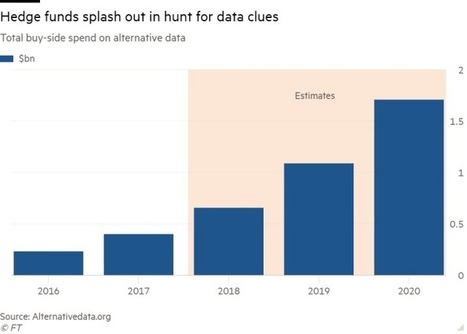
A multibillion-dollar industry offering unusual data such as satellite imagery and measurements of social media sentiment is enjoying a boom in demand as hedge funds and companies hunt for clues on how to tackle the coronavirus crisis. Many investors have turned to so-called alternative data — niche information beyond standard financial market indicators or statistical releases — after finding official numbers too slow in reflecting the collapse in economic activity due to Covid, and the recovery. Providers argue it can provide precious, real-time glimpses into how a company or economy is faring. [...] Alternative data is not a new concept. Merchants in ancient Babylon measured the depth and flow of the Euphrates river to try to get an edge in their trading, after discovering a correlation with the supply of commodities, according to Andrew Lo and Jasmina Hasanhodzic’s The Evolution of Technical Analysis. However, the sector came to widespread attention several years ago during an investor craze for computer-driven trading funds. Even before coronavirus struck, total annual spending on such information by fund managers alone was predicted to reach more than $1.7bn this year, up from $400m three years ago, according to Alternativedata.org. There are nearly 1,500 providers of alternative data, according to Neudata, another seller of such information, which says it has been around four times busier than normal handling client queries in March, April and May.
|
A group of creditors holding about one-quarter of the junior-ranked debt of Cirque du Soleil is challenging in a U.S. bankruptcy court the way the sales process for the entertainment company is playing out, saying its interests are being trampled by larger lenders. A small ad hoc group of second-lien lenders holding about US$40-million in debt filed an objection in the United States Bankruptcy Court for the district of Delaware late Tuesday, protesting the way Cirque’s restructuring under creditor protection in Canada is progressing and arguing the U.S. court should not recognize certain decisions made here without a fair hearing. They’re being represented by U.S.-based law firms White & Case LLP and Farnan LLP, and by Montreal-based Langlois Lawyers LLP. Lawyers for the group, which calls itself the Ad Hoc Committee of Independent Second Lien Holders, argue the Delaware court should not automatically rubber-stamp the rulings made by the Superior Court of Quebec, the main jurisdiction in which the case is being heard. They say that under U.S. bankruptcy law, they are being short-changed by terms of the stalking horse bid for Cirque approved by a Quebec judge last month. “Second-lien lenders will get nearly nothing” for their contribution of approximately US$154-million to the US$1.2-billion credit bid, the group says in its objection to the stalking horse offer. “This makes no economic sense.”
|
|
Scooped by
Institut sur la gouvernance (IGOPP)
August 5, 2020 12:15 PM
|
In an important recent contribution to the short-termism debate, Professors Michal Barzuza and Eric Talley what they call an “emerging consensus in certain legal, business, and scholarly communities … that corporate managers are pressured unduly into chasing short-term gains at the expense of superior long-term prospects. See Michal Barzuza & Eric L. Talley, Long-Term Bias (February 20, 2019), forthcoming in the Columbia Business Law Review, available at SSRN: https://ssrn.com/abstract=3338631. Instead, Barzuza and Talley contend that that “corporate managers often fall prey to long-term bias—excessive optimism about their own long-term projects.” This article is an invited comment on Barzuza and Talley’s article. Subject to various quibbles raised herein, I broadly concur with Barzuza and Talley’s argument that corporate directors and officers can be biased towards long-term projects and, accordingly, may reject short-term projects offering higher returns. But what law reforms follow logically from their conclusion, if any? With respect to judicial review, I want to differ with Barzuza and Talley on three points. First, I believe Barzuza and Talley overstate the risk of judicial intervention. Second, they fail adequately to distinguish between directors and managers, even though that distinction is central to the application of Delaware law. Third, I believe their analysis implies that judges should retain the deference to director decision making inherent in doctrines such as the business judgment rule and intermediate review. With respect to encouraging shareholder activism, I argue that the responsibility for policing managerial hyperopia (or myopia, for that matter) should be assigned to the board of directors, not the shareholders. Heterogenous shareholders lack the proper incentives and knowledge to properly police management.
|
|
Scooped by
Institut sur la gouvernance (IGOPP)
August 5, 2020 12:09 PM
|
In a new paper, we ask whether social media could have a role in corporate governance. Prior to the advent of social media, a small shareholder faced prohibitive costs to reach other investors. For example, she would have had to obtain the shareholder lists, which the firm might have only reluctantly made available, and to pay for printing, postage and more, if a proxy solicitation firm were hired. These costs and the prospect that others would simply free ride on these efforts effectively discouraged small shareholders from playing any meaningful role in corporate governance. The rise of social media, in particular, the internet stock message board, makes it possible for tens of thousands of investors who are interested in the same stock to voice their opinions and exchange information at almost zero marginal cost. Importantly, stock message board users come from diverse backgrounds, allowing them to tap into the wisdom of crowds, and include many non-experts with opinions that professionals may not have. The non-experts may also have valuable perspectives as employees of the company whose stock is being followed or as friends or neighbors of its employees, suppliers, customers, competitors, or advisers, or, if the company is the target of an acquisition, of the acquiring company.
|
|
Scooped by
Institut sur la gouvernance (IGOPP)
August 4, 2020 10:46 PM
|
A growing number of younger Canadians are buying life insurance coverage online as the novel coronavirus pandemic spurs worries about economic uncertainty and puts a spotlight on potential health risks. Since the onset of COVID-19 in early March, Sun Life Financial has seen its online life insurance sales grow by more than 40 per cent compared to the same period last year. The increase in demand for its online product – called Sun Life Go – has largely been driven by clients under age 40, with sales climbing by more than 50 per cent among this younger demographic. TD Insurance has seen similar spikes in interest among 30- to 40-year-old clients who purchase policies digitally, with sales up by more than 50 per cent year over year. Sales have also jumped by 30 per cent for clients under age 30 – a group traditionally less likely to buy life insurance. “With more time at home – people have now begun to pay closer attention to their monthly costs, which includes insurance premiums,” said TD Insurance chief executive officer Raymond Chun in an interview. “At the same time, they are able to see if they have gaps in coverage – especially when it comes to their health and protecting their family.” A life insurance policy provides a lump-sum payment upon the death of an individual. Term life insurance pays a death benefit if the insured person dies within a specific period – usually within 10 to 20 years of the issue of the policy. Permanent life insurance is set up for the lifetime of an individual. Premiums are typically higher for permanent life, but it appeals to some buyers because there is a set price tag for the duration of the contract that does not increase with age.
|
|
Scooped by
Institut sur la gouvernance (IGOPP)
August 4, 2020 10:19 PM
|
Hedge funds with artificial intelligence capabilities showed a huge competitive edge over investors that didn’t use AI, new research indicates. AI-led hedge funds produced cumulative returns of 34 percent in the three years through May, a report Tuesday from consulting and research firm Cerulli shows. That compares with a 12 percent gain for the global hedge fund industry over the same period. “There has long been suspicion of the ability of AI to react to unexpected events, such as the coronavirus pandemic,” said Justina Deveikyte, associate director of European institutional research at Cerulli, in a statement Tuesday. “But there is now a sense that the technology has advanced to the point where it is better able to adapt to unforeseen scenarios via the ever-growing amount of market data available.” Machine-learning algorithms in finance tend to recognize patterns in historical data, making it tough to adapt to economic lockdowns caused by a one-in-a-century pandemic, according to the report. Still, factors used in machine learning draw from sources such as newspaper stories to collect information daily, spotting trends for investors amid the Covid-19 turmoil, according to Cerulli.
The public pension funds of New York and Colorado are best positioned to lead a consolidated shareholder lawsuit blaming Boeing Co.'s board and management for the fallout from two catastrophic 737 Max 8 crashes, a Delaware judge ruled Tuesday. The states’ complaint “more cogently focuses on, and contains more factual allegations relevant to, board knowledge,” Chancellor Andre G. Bouchard wrote for the Chancery Court in a brief order, citing “the massive disparity in stock ownership and the unique internal resources” the pension funds could marshal. Moreover, the states’ earlier records suit, though filed later than those brought by other investors, “obtained meaningful additional documents regarding” the firing of ex-CEO Denis A. Muilenburg in December, the judge said. The suits accuse Boeing’s board and senior leadership of engaging in virtually no oversight as it developed and rolled out the Max 8. That “epochal corporate governance failure” makes them responsible for commercial crashes in Ethiopia and Indonesia that killed 346 people in total and led to the jet model’s worldwide grounding, the suits claim.
A parliamentary committee is examining recent changes to the administration of the Investment Canada Act, the federal regime for reviewing foreign acquisitions of Canadian businesses. [...] We believe enhanced reviews will work better for Canada if three goals are met:
(1) First, speedy decisions on acquisitions of distressed assets. Most enhanced scrutiny reviews will use a national security test that is opaque and can take 200 days or longer. And if these really are distressed assets, and if there are lots of them, we will need more timely decisions to save firms and the jobs associated with them.
(2) Second, transparency around the definition of “critical sector” and about issues raised in the review process. Australia openly declared all sectors critical, while France listed such areas as food safety, defence, energy, AI, quantum computing and cyber security, among others. In Canada, we have left “critical sectors” undefined beyond health.
(3) Third, keeping economic security at the forefront. The legal basis for enhanced reviews will fall almost exclusively under the national security provisions of the act, not the economic-based “net benefit” rules. Are takeovers of distressed firms national security or economic issues? We think economic security is mainly at play, even when Chinese firms target technology businesses or specific elements of the energy sector.
The Securities and Exchange Commission is investigating how Eastman Kodak handled the announcement of a $765 million deal with the U.S. government to produce COVID-19 drug ingredients, the Wall Street Journal reported Tuesday, increasing scrutiny of a blockbuster deal beset by allegations of insider trading and suspicious transactions. [...] The SEC is early in its investigation and it’s unclear if the probe will result in allegations of wrongdoing, according to the WSJ. The SEC declined to comment while Kodak shares fell 9% following news of the investigation. In a statement to Forbes, an external spokesperson said Kodak’s internal communications team never intended for the announcement to be published ahead of time, and the WSJ reported that journalists were told to delete the information after it went public. As for Continenza’s stock options, a spokesperson said the grant was intended to prevent his shares from being diluted in the future and was given to him the day before the official announcement because it was the first time the compensation committee met after the grant was approved by shareholders in May 2020. Kodak’s move into pharmaceuticals is a dramatic pivot for the company, which dominated photography for over a century after its founding in 1888. But after failing to capitalize on the rise of digital photo sharing and cell phone cameras, Kodak filed for Chapter 11 bankruptcy in 2012 and briefly flirted with the idea of pivoting to cryptocurrency in 2018.
In the paper The Origins and Real Effects of the Gender Gap: Evidence from CEOs’ Formative Years (forthcoming in the Review of Financial Studies), we provide the first systematic evidence on the socioeconomic backgrounds of U.S. CEOs. Using individual census records for the families where the CEOs grew up, we study how CEOs’ formative experiences affect their capital allocation decisions. Our main finding is that CEOs raised in male-dominated families—those where the father was the only income earner and had more education than the mother—hire fewer women and allocate smaller capital budgets to female managers. We argue that gender effects in financial policies originate in CEO beliefs developed during formative years.
Early hopes of a rapid, V-shaped recovery—a deep drop but swift pickup of growth in Q3—have been dashed world-wide. Most CEOs around the globe believe the economic recovery will be slow, and it could take considerable time before output recovers to prepandemic levels. In China, Europe, and the US, between 42 and 55 percent of CEOs envision a U-shaped pattern: partial shutdown measures control localized outbreaks with countries gradually succeeding in managing the pandemic. Growth would be sluggish and wouldn’t reach prepandemic levels until the final quarter of 2020. Other CEOs, especially those in Japan and the US, envision a W-shaped scenario: the continued risk of new outbreaks and a second resurgence of the virus lead to more stringent containment measures and a new contraction of output during the second half of the year. Output would see another drop in the second half of 2020, and any further recovery will be put off until well into 2021.
|
|
Scooped by
Institut sur la gouvernance (IGOPP)
August 4, 2020 11:41 AM
|
Any shareholder who's ever endured hours of travel to attend a company's annual meeting is in for good news in the wake of the COVID-19 pandemic. Experts say the success of AGMs taken virtual this year will likely translate into more options for online and teleconference participation at future events — provided that some technical bugs can be ironed out and with the caveat that full shareholder participation is necessary. Most corporations are required to meet once a year with their shareholders to deal with routine matters such as electing the board of directors, choosing an auditor and approving the minutes of the last meeting. [...] "The challenge is that participation at some of these (virtual) meetings has been limited — the ability to ask questions has been limited by the company to either written questions in advance or sometimes no questions," he said. "In some cases, the ability to log in has been quite complicated." [...] As of July 28, 583 AGMs had been held by companies listed on the Toronto Stock Exchange, according to figures compiled by Hansell LLP of Toronto, a corporate advisory law firm. That's down almost 22 per cent from the same time last year, as some companies took advantage of pandemic-related deadline extensions offered by regulators. [...] In Canada, Hansell found 54 per cent of the meetings were virtual only, which means that shareholders could attend remotely by phone or computer but couldn't vote or ask questions in real time. Votes were collected ahead of the meeting. About a quarter — 26 per cent — were traditional physical AGMs, where shareholders could vote ahead of time or attend in person to vote or ask a question.
|
|
Scooped by
Institut sur la gouvernance (IGOPP)
August 4, 2020 10:48 AM
|
Au cours des 18 derniers mois, 73 patrons de 500 groupes cotés ont quitté leurs fonctions. La plupart du temps, formellement, ils ont démissionné. Mais la réalité est parfois différente, surtout quand un actionnaire activiste est au capital. En 1988, Warren Buffet, le légendaire investisseur à la tête de Berkshire Hathaway, disait qu'« un PDG qui n'est pas performant est souvent renouvelé indéfiniment, parce que personne ne dispose d'outils pour mesurer sa performance ». Trente ans après, ces critiques sont-elles toujours valables ?
|