Trying to define something, even from the inside-out as I am attempting to do with my definition of Connectivism, introduces the sticky issue of essentialism.
A well presented video on Social Learning Theories – Constructivism and Connectivism. I have compared the similarities and differences of Constructivism and Connectivism here. Here George dis...
Stephen's Web, the home page of Stephen Downes, with news and information on e-learning, new media, instructional technology, educational design, and related subjects. Connectivism and Connective Knowledge, Essays on meaning and learning...
Stephen's Web, the home page of Stephen Downes, with news and information on e-learning, new media, instructional technology, educational design, and related subjects...
"Learning theories are concerned with the actual process of learning, not with the value of what is being learned. In a networked world, the very manner of information that we acquire is worth exploring.
One thing that I find discomforting about connectivism and communities of practice is the apparent avoidance of controversy. They are all about positive connections, at least this is most emphasised, although I believe that the proponents do consider the fact that opposite knowledge values exist and conflict with each other.
Some of you who were born in the 60s or before might have watched this, but this would be remembered forever. What is happening now with a similar motto, though different nature is the Education Re...
In case the quotes didn’t clue you in, this post doesn’t argue against massive open online courses (MOOCs) such as the ones offered by Udacity, Coursera, and edX. I think they are very worthy ventures and will serve to progress our system of higher education. I do however agree with some criticisms of these courses, and that there is room for much more progress. I propose an alternative model for such massive open online learning experiences, or MOOLEs, that focuses on solving “problems,” but first, here’s a sampling of some of the criticisms of MOOCs..
Amazon.com: Connectivism for EFL Teachers: A Theory of Learning For A Digital Age eBook: Thomas Baker: Kindle Store (Connectivism for EFL Teachers: A Theory of Learning For A Digital Age: Connectivism for EFL Teachers is the resu...)...
George Siemens, a MOOC pioneer ominously said, “But if I were president of a mid-tier university, I would be looking over my shoulder very nervously right now, because if a leading university offers a free circuits course, it becomes a real question whether other universities need to develop a circuits course.” Get it? This is the end of universities as we know them.
This is my farewell post. May I start with a story? “What is your problem?” asked the Doctor Wise. “I have headaches, some sneezing, and pains in the joints, don’t know why,...
Connectivism, introduced in the mid 2000′s, is an idea based on the premise that knowledge exits within systems and is acquired by individuals who interact collaboratively within activities r...
I read with interest this morning an article by Thomas Frey called The Rise of the SuperProfessor, in which Mr. Frey forecasts the emergence of a class of elite professors who "consistently demonstrate excellence, passion, and clarity, throughout their academic careers" and who brand themselves and market their teaching excellence to the world, unencumbered and unsupported by the towers of academia.
George Siemens, a main proponent of connectivism and a social media strategist with the Technology Enhanced Knowledge Research Institute (TEKRI) at Athabasca...
I'm going to try and summarise my experiences and reflections on the recent LAK12 conference in the five areas that seemed to resonate with me over the 4 days of the conference (including the pre conference workshop day) which are: research, vendors, assessment, ethics and students.
MOOC – Udacity and Coursera Sounds really exciting this time with the MOOC, as reported by Audrey Watters 18 April 2012. Both Udacity and MITx – as well as those 3 Stanford classes last te...
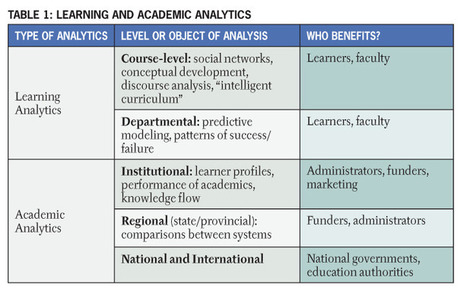
George Siemens (gsiemens@gmail.com) is with the Technology Enhanced Knowledge Research Institute at Athabasca University. Phil Long (longpd@uq.edu.au) is a Professor in the Schools of ITEE and Psychology and is Director of the Centre for Educational Innovation & Technology at the University of Queensland.
In this talk I discuss what will be coming 'After Moodle' by means of a discussion of open learning, connectivism, and personal learning environments, including...
To get content containing either thought or leadership enter:
To get content containing both thought and leadership enter:
To get content containing the expression thought leadership enter:
You can enter several keywords and you can refine them whenever you want. Our suggestion engine uses more signals but entering a few keywords here will rapidly give you great content to curate.


 Your new post is loading...
 Scoop.it!